…isn’t such a big deal in France. Or maybe now it is. Either way, seems like the French attitude (the Italians do pretty much the same) is much healthier than our own American attitude toward alcohol.
Month: April 2011
-

Union Power (II)
Two unions I support, simply because they have kick-ass logos (on par with my local International Association of Heat and Frost Insulators and Allied Workers)! I particularly admire the telephone operators union logo and the fact that there was a vendor outside the building selling t-shirts and coffee mugs withtheir logo. I bought one of each.


-
Mexico City and Five Other Safe Places in Mexico
Just FYI, since I’m down in Mexico City right now: Despite all the drug chaos in the north of Mexico–the state of Chihuahua has a homicide rate of 300 per 100,000 (compared to 36 in Baltimore City and 6.5 in New York City)–most of Mexico is much safer than most of America. Here’s an article about the five safest places in Mexico to travel.
Even I was a little apprehensive to travel to Mexico City for vacation (mind you, just a little, as we did want to come here). It’s strange, because where else in the world will you be told by various sources to 1) not take cabs, 2) not take the metro, 3) not walk, and 4) not drive? We’ve done the first three and have felt safer than, say, taking the subway at night in Philly or the Light Rail in Baltimore.
I can’t tell just how normal and functioning this city is. You walk around, take the metro, get things to eat, look at pretty buildings, go to markets and museums, walk around random neighborhoods, eat street food… it’s all very normal. Now don’t get me wrong, there are stories of crime. And though we don’t stick to the “safe” parts of town, we haven’t walked around the supposedly bad parts of town at night while flashing dollars and taking pictures. But then why should we?
Maybe crime is more of an issue in Mexico because they have higher standards of a crime-free society. In America, it’s as if we’ve written off huge segments of society and cities and think that it’s normal to do so. What guide book would even mention East Baltimore or West Chicago or East New York, much less warn you not to go there?
The only thing here in Mexico City that isn’t normal is the lack of horrible traffic and air pollution. But this week is a big holiday week (Santa Semana) and things are a bit quieter than normal as a lot of people go back to their home towns and villages to celebrate.
-

Meet me at the corner…
My wife and I were strolling through a deserted (and safe) Mexico City late last night when we stumbled across this doozy of an intersection.

-
William Schaefer (1921-2011)
He was as through-back to another time, a less politically correct time. I liked his moxie, even if I have mixed feelings about his urban vision. He was a one-man political institution, and certainly Baltimore would have been worse off without him.
His obit in the Baltimore Sun and the New York Times.
-
In Defense of Flogging, the Website
Just what you’ve been waiting for, I’m sure! But seriously, the good people at Basic Books were kind enough to make me a website. Here it is, live and online.
I’m sitting in Newark Airport, heading to Mexico City for a week’s vacation. Don’t expect much here till I’m back.
-
It ain’t easy…
“Freeway Rick” talks about the trials and tribulations of being a big-time crack dealer.
Specifically, this podcast from NPR: Planet Money tests various economic theories about crack dealing. But it’s a shame the economists have to “discover” this when better sociological and ethnographic work said this a long time ago. The drug stuff starts a minute into the podcast.
And lest how we forget, “Freeway Rick” Ross–along with being a violent drug dealer destroying lives and communities–also contributed to a patriotic cause. He was buying drugs from the CIA, and what could be more patriotic than that? And his money was then used to buy guns for the Contras. And the Contras, as Ronald Reagan told us, were great freedom fighters!
Also, to my surprise, I didn’t realize that crack might have been invented as early as 1974, and in San Francisco. See page 33 of this book and the research of Ronald Siegel.
[Though I’m still curious about an obscure 1908 reference to cocaine with a “small crystal ‘rock-candy’ form” (Cop in the Hood, p. 270, note 71)]
[thanks to Alan I.]
-
My head hurts
Talk about culture wars cognitive dissonance. No matter your political leanings, there’s something in this story to make your head explode.
A man born a woman was fired for not being man from his $10/hour job at a drug treatment center watching people pee into cups for drug tests. He’s suing his former employer on the grounds of “gender-identity discrimination,” which is illegal in New Jersey.
-
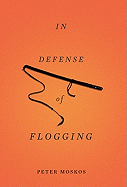
Liking a Defense of Flogging
The first review of In Defense of Flogging is out today. It’s always a bit nerve racking when you click on that first review. But it’s favorable. Phew! Though I view descriptive/neutral-plus as favorable for a book like this. It’s hard to gush over a book called In Defense of Flogging, lest others start wondering if you got “something you want tell me?” (Hell, I’m just happy it wasn’t panned… but maybe I should set my sights a bit higher.)
From Publishers Weekly:
 Moskos, an assistant professor at John Jay College of Criminal Justice who specializes in police and criminal science, debates with the utmost seriousness the merits of flogging as an alternative to incarceration. Whether it’s called caning or lashing, he concludes flogging, which penetrates the flesh but is over quickly, is less cruel than depriving people of a chunk of their lives in “a barbaric, inhuman” institution where a record number of 2.3 million Americans endure insult and humiliation, with a high incidence of sexual aggression, rape, and a great risk of contracting a communicable disease. Moskos lists the long history of prison reforms in the U.S., but concludes that our penal system remains “an insidious marriage of entombment and torture.” Presenting the Singapore and Malaysian models of flogging, the author draws on interviews and recommendations to boost his “thought experiment.” Indeed, when Moskos mentions the possibility of electric shock as another option , readers will begin to wonder if the writer is poking outlandish fun and crafting a notion similar to Swift’s 1729 classic “A Modest Proposal,” using satire to call attention to the “shame” of our inhumane prison system.
Just for the record, I intend no satire. But any comparison to Swift’s A Modest Proposal has got to be good.
The book will be out June 1. And it’s up to #24 on the Vulture’s Anticipation Index.
-
Hating the Lovers
Speaking of issues I thought we had long since decided (like slavery, segregation, suffrage, medicinal bleeding, etc.), a poll found a plurality of Mississippi Republicans believe interracial marriage should be illegal. Forty-six percent oppose, 40 percent support, and 14% are “undecided” (as if they’ve weighed the pros and cons of this timely issue, but still need a few more days to decide). Wow.
It’s not just the shockingly retro racism of this (and I do wonder how Democrats would fair), it’s the fact that the question asked whether inter-racial marriage should be legal or illegal. I mean, you might be a Small-Government racist who personally disapproves of kids these days who go about miscegenatin’. Okaaaay. Whatever, dude. To find racists Republicans (or in any political party) is about as noteworthy as finding out that NPR might have a liberal bias (not that “the tape” showed this).
But to want interracial marriage to be illegal, to want your supposedly small-government non-racist Tea-Party Republicans to tell Americans who they can and cannot marry is not just unpalatable and racist…. It just doesn’t make sense.
Wouldn’t it be nice if one of the Republican candidates for President did something as radical as come out unequivocally in favor of the legality of interracial marriage? I mean, even Clinton had his Sister Souljah moment. But who is daring enough to piss off the base? Of course the candidates could release a collective statement, if they didn’t want to take the risk of, gasp, coming out individually for the right of interracial marriage.
You know, the Tea Party and Republicans spend a fair amount of time saying they aren’t racist. And it’s nice that they care. And maybe most of them aren’t. But when your Republican party is 98 percent non-black and the majority of your voters in at least one state areracist… you’ve got to wonder.