That seemed to be the recipe. The story by Patrice O’Shaughnessy in the NY Daily News.
Author: Moskos
-
Prison for Old People
Should an 87-year-old go to prison?
John Eligon and Benjamin Weiser write about this in the New York Times.
I don’t think so. What good does it serve? Punishment, of course. But aren’t there better and cheaper ways to punish?
I certainly don’t want to pay to keep people who are no threat to me behind bars. Can’t we fine them for every cent they’re worth and sentence them to home confinement? I don’t want to pay one cent of taxpayer money to incarcerate rich people. Why is prison the only answer?
-
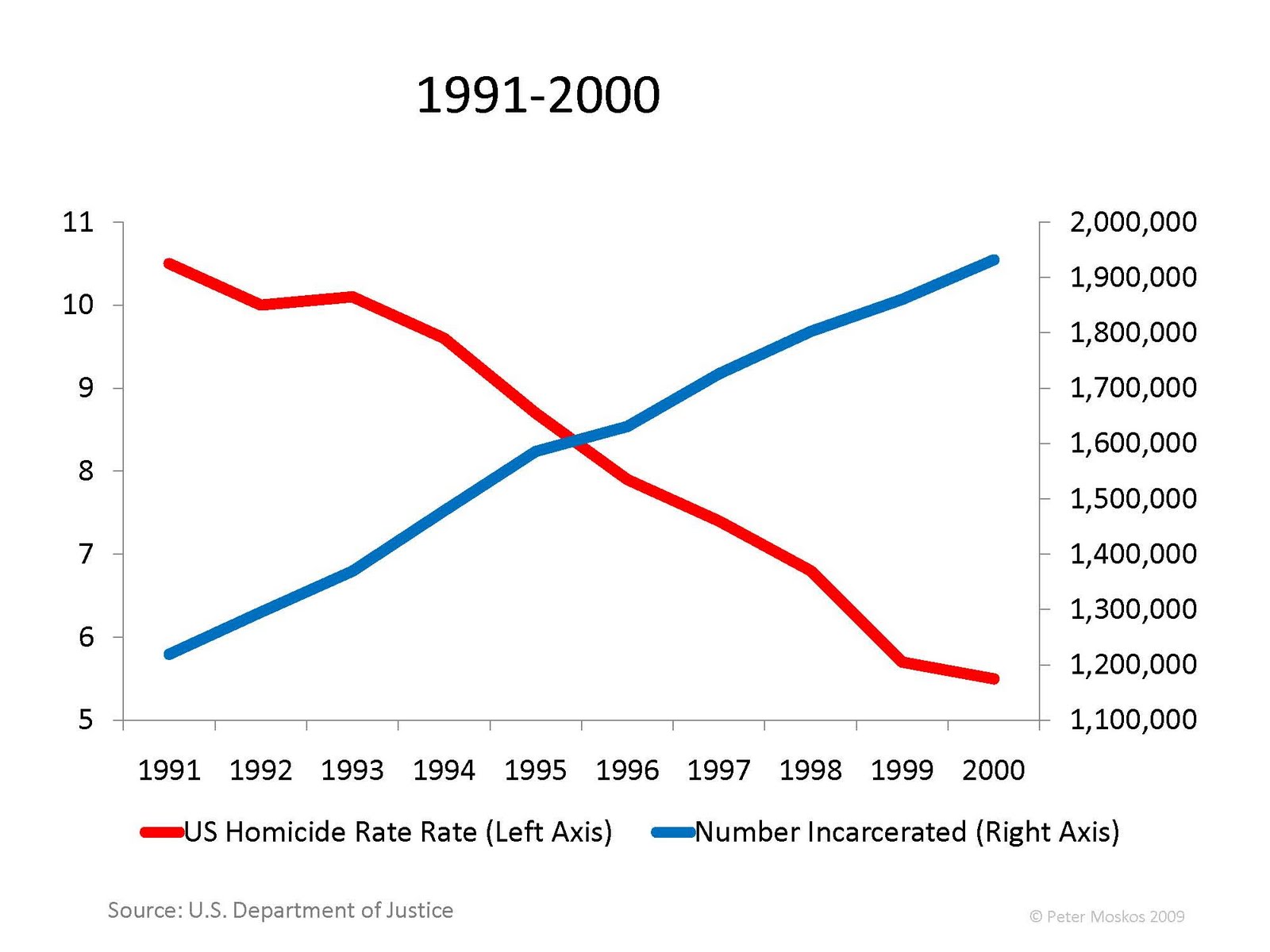
More Prison, Less Crime?
If you look at this chart, it’s not hard to think that the great crime drop was caused by locking up all the criminals. A student brought this up in class. In the 1990s, it looks pretty convincing:
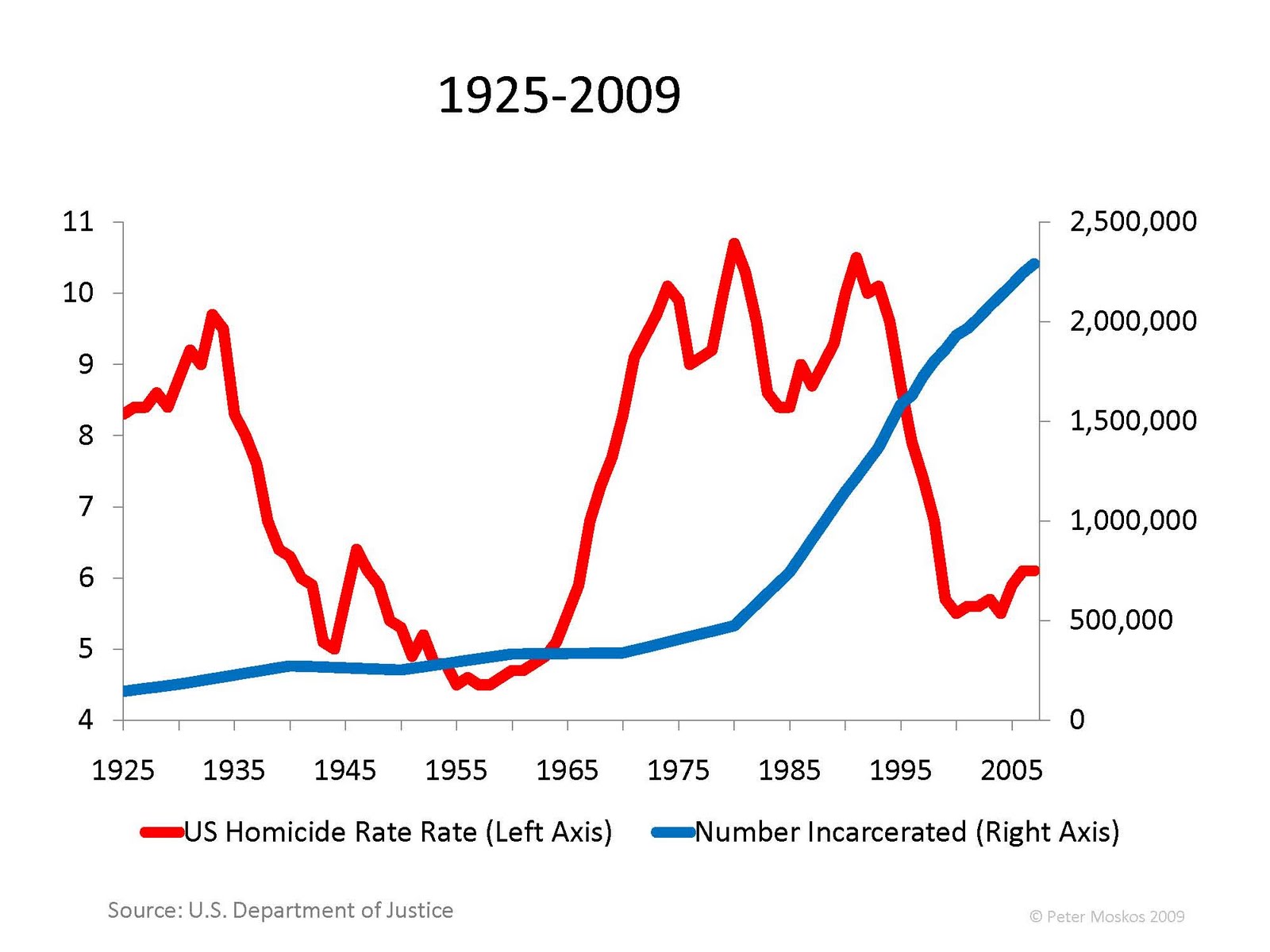
 But just looking at the 1990s misses the big picture. Here’s the same data going back to 1925. Crime went up and down and up and down, but the prison rate stayed more or less the same, and then skyrocketed after 1970.
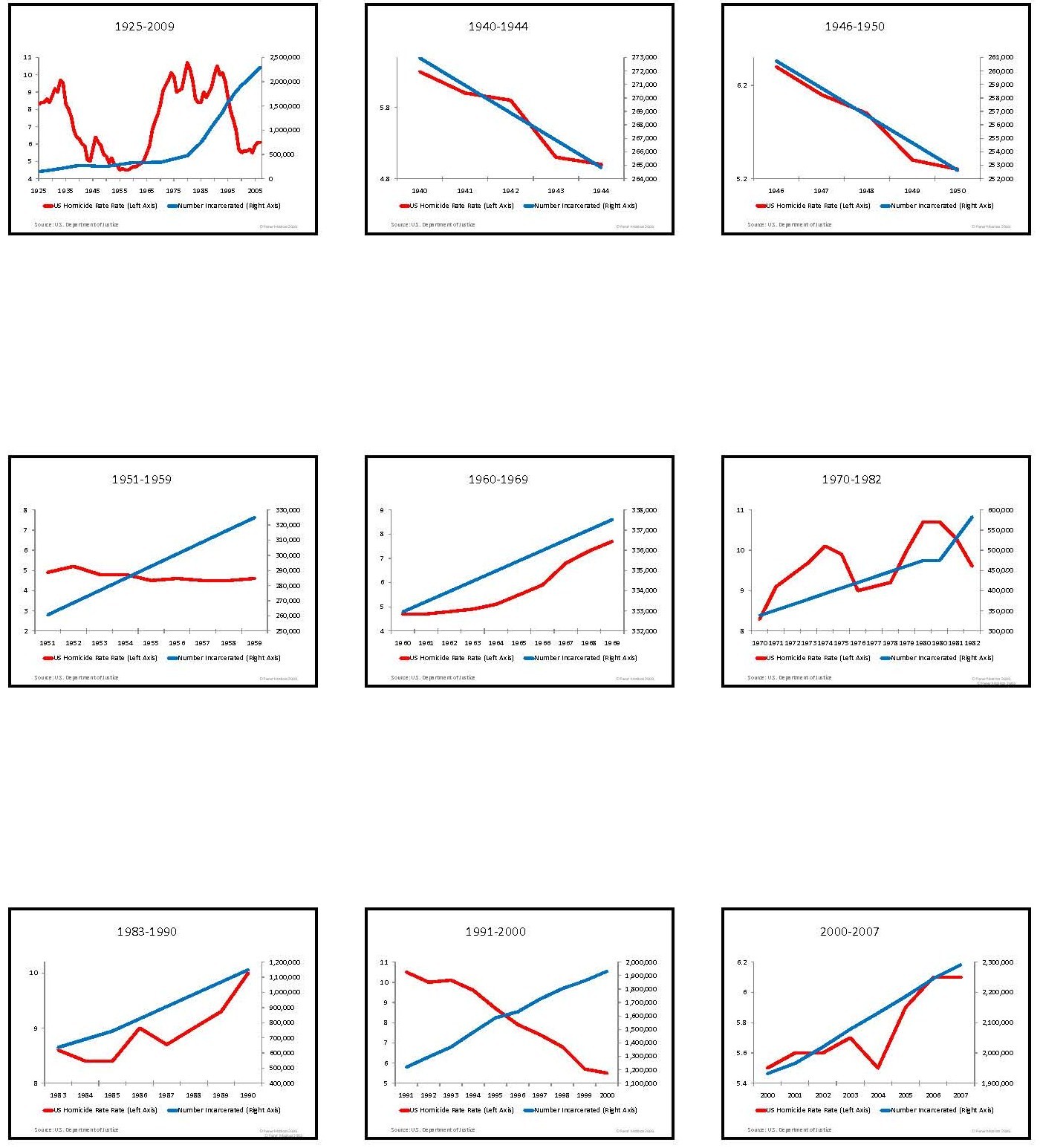
  And here’s what happens it you look at each decade separately:
 What it comes down to is this:
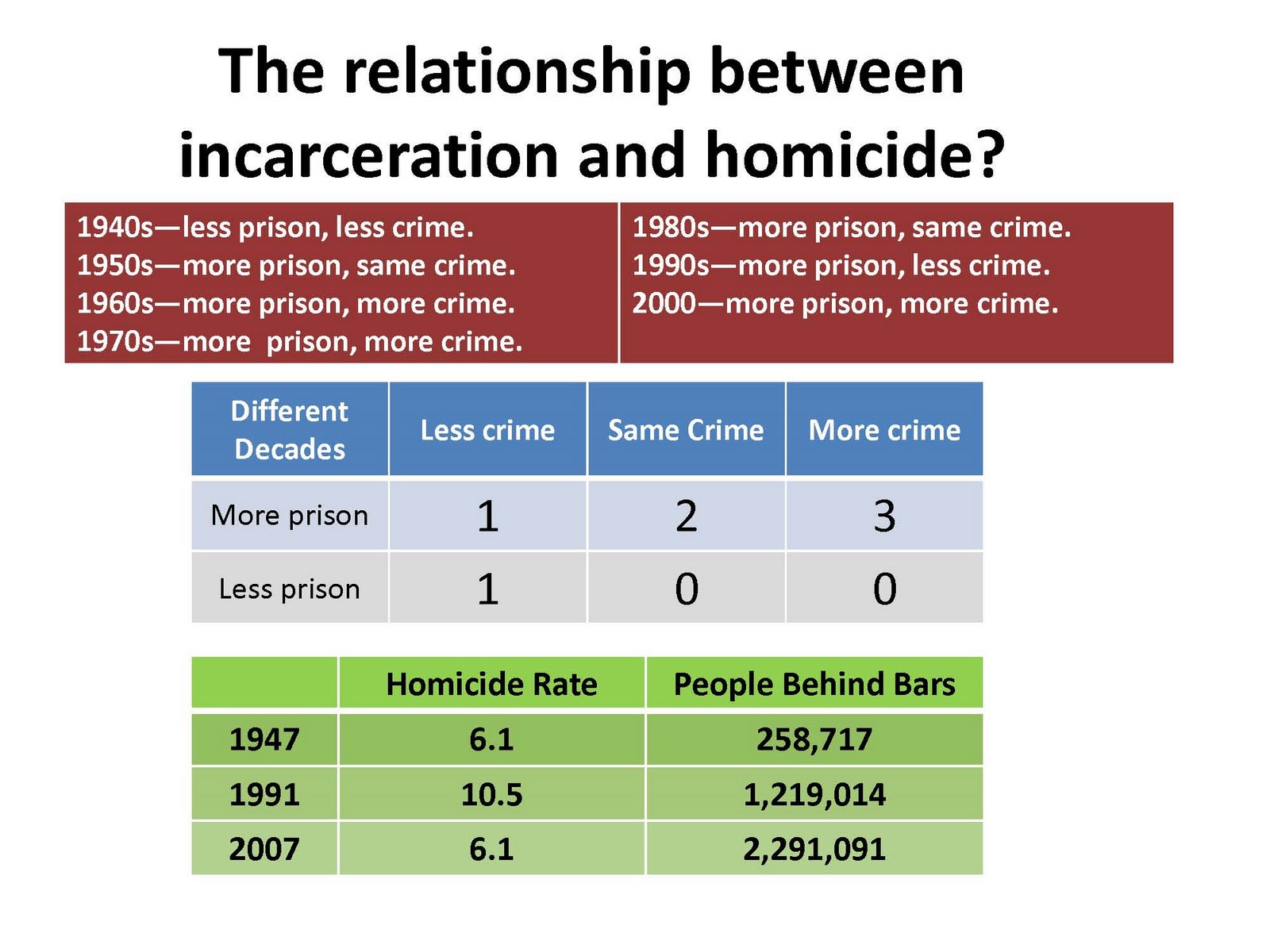 In three decades we’ve had moreprison and moremurders. In two decades we’ve had more prison and murders were basically unchanged. In one decade we had lessprison and lessmurder. And in just one decade, the 1990s, we’ve had more prison and less murder.
 Between 1947 and 1991, the prison population increased almost 500 percent. Meanwhile the homicide rate went up by more than a third. Did locking up more people increase the homicide rate? Probably not.
So what makes the 1990s the decade of choice that proves incarceration is the solution to crime? Was there some magic tipping point? Was there something special about the second million we incarcerated that didn’t apply to the first million? Probably not.
I’ll put it another way, in 1947, the homicide rate was 6.1 per 100,000 and we had 259,000 people behind bars. In 2007, we had the same murder rate of 6.1 and yet 2.3 million people are behind bars. What good have we gotten from locking up an extra two million people, spending something like $50 billion per year for the privilege?
You think there might be a better way?
-
Why Police Officers Hate the Department
People often fail to understand just how dysfunctional a big-city police department can be (and some have told me small town PDs are worse).
Justin “H.L.” Fenton reports in the Sun:
Sgt. Carrie Everett… spoke to a reporter after she was administratively charged in connection with an incident in which a murder suspect committed suicide by jumping from a top-floor window while under police supervision at Mercy Medical Center. Everett said the department’s policies governing patients in medical custody were flawed and put officers and the suspects at risk.
The department charged her internally with “conduct unbecoming a member of the Baltimore Police Department and speaking with the media without permission.”
Nothing like blaming the messenger.
Police officers below the rank of commander are prohibited from speaking to members of the media. A spokesman said officers are trained to be police officers, not to talk to reporters, and said officers only have a “ground level” view of the department.
I was never “trained” to talk to reporters. And yet I seem to manage OK. Plus, I don’t buy the the department can constitutionally limit free speech in such a manner. And sometimes, dare I say so myself, a “ground-level” view of the department can be most instructive. But let’s get back to this incident.
When I had hospital detail (one of the least favorite details for police and all too frequent if you happened to have 324 post), I made sure a prisoner was chained to his or her bed. Then I sat outside the room. And you sit there. If you’re lucky someone will come by and bring you coffee or food. Luckily, unlike a lot of police, I like reading.
Now let’s say I’m sitting there reading the the paper or my book and a murder suspect quietly gets out of his cuffs and jumps out the window, killing himself. That’s not good. But my second thought would probably be joy that he went out the window rather than out the door.
Did I do my job? No. Should I get in trouble? Yes. But does it say in the General Orders that I need to be in the room at all time? I don’t think so. But I was responsible. So blame me, not my sergeant.
There’s something strange about holding a supervisor responsible for officers working alone without direct supervision. Especially when the rules aren’t clear. If you want to blame the sergeant, why not go higher and blame the command staff? Oh. yeah. It’s never theirfault.
Meanwhile the department will continue its practice of making “supervisors ‘fall guys’ for failures of procedure.”
And the best part? This sergeant, for being right, gets rewarded with reassignment to… guess where. Yes, the lovely Eastern District. Officers in the jackpot often get reassigned to the Eastern or Western, depending on which would make a longer commute. Such is the nature of the jackpot (and one of the silver linings of already working in the Eastern or Western). So now, through no fault of their own, all the officers of the Eastern get punished with a disgruntled sergeant working over them. When shit does indeed roll downhill, why does it always seems to end up in the Eastern?
-
Shut yer mouth, dude!
Why is it so hard for some people to just shut up?
Some people are using this video as anti-cop propaganda. I see an officer acting in an incredibly professional and even patient manner. He’s doing his job. He follows the rules. He tells his name and badge number when asked.
A little skateboarder calls him a dick. To his face. Twice. He gets locked up. Legally. Good. The kid could have done two things to not get locked up (and I’m purposefully ignoring the skateboarding is a crime issue): 1) carry ID, 2) don’t call a police officer doing his job a dick.
If the San Francisco Chronicle is to be believed, the officer has been assigned station duty while the matter is being investigated?! That’s a crime. The officer did nothing wrong. Now thatcould have been me.
-
Best Cookbook Ever
Seriously. My wife’s cookbook is officially out today. Co-authored with Tamara Reynolds. Forking F-ing Fantastic!Go buy it. Seriously. Come on… I don’t ask much of you.
-
“Running only leads to more running”
A Chicago Tribunepiece on why the Fenger High School students fight. It doesn’t really answer the question. But then again it’s not like there is a good answer. What it comes down to seems to be the belief that kids from the projects are “invading” another neighborhood (with seemingly very similar socioeconomic characteristics) where the high school is.
“As far as I know, they don’t like us,” said Young, who dreams of playing professional football even though he’s not on the school team, “and the way I feel, we don’t like them.”
The reporter can’t actually determine any real difference between the groups (though I love dig “even though he’s not on the school team”). Perhaps the only thing that might be considered profound is this line: “I’m not gonna run from it…. Why should I have to run from where I live? If I have to run from where I live, where else do I go?”
I guess no different than East Side versus West Side (Baltimore), Bloods versus Crips (LA), Jets versus Sharks (Broadway), or East Platform versus West Platform (L-going Cubs fans).
-
Prohibition Deaths vs. Prohibition Deaths
Pete Guither at Drug WarRant has an interesting post, here stolen in its entirety:
Robert Almonte, executive director, Texas Narcotic Officers Association and El Paso police deputy chief (retired), had a different view of the war on drugs than most of the learned participants in the recent conference in El Paso (surprise, surprise): ‘War on Drugs’ conference got the issue wrong.
It’s a pretty bad piece of dreck, full of standard stale prohibitionist misdirection, strawmen, and cherry-picked statistics. I particularly noted the ending:
Our children deserve better; El Paso deserves better. O’Rourke, in calling for the public to exert pressure on our elected officials to legalize marijuana, has stated: “As evidence, I point to the 3,200 people who have been killed in Juárez.”
I say to you, Mr. O’Rourke, as evidence against legalizing marijuana and other dangerous drugs, I point to the countless Americans and their families whose lives have been destroyed by drugs and the over 38,000 Americans who die from drug overdoses each year.
Let me get this straight. As a defense of prohibition, we should ignore the 3200 killed in Juárez under prohibition, and instead focus on the 38,000 Americans killed by overdoses under prohibition.
Right.
-
Personally Dissed by the Drug Czar
And by the President of the International Association of Chiefs of Police! Mr. Kerlinkowske, Mr Laine, nice to meet you.
At an October 3rd address at the 2009 International Association of Chiefs of Police Annual Conference, Czar Kerlikowske said (via stop the drug war):
But I must underscore how important your help on this issue is – on the streets, within the criminal justice system, and in the court of public opinion. Recently, Peter Moskos and Stanford Franklin, members of a group called “Law Enforcement Against Prohibition,” published an op-ed in the Washington Post calling for the legalization of drugs. They claimed that legalization would increase officer safety.
Chief Laine, as President of IACP, responded with a letter to the editor. The Washington Post did not print it. This letter, which I am holding in my hand, should have been printed. As Russ appropriately put it, “The simple truth is that legalizing narcotics will not make life better for our citizens, ease the level of crime and violence in our communities or reduce the threat faced by law enforcement officers. To suggest otherwise ignores reality.”
From the Crime Report:
Kerlikowske criticized the Washington Post for not publishing a letter from IACP President Russell Laine in rebuttal to an op-ed article the newspaper had run asserting that drug legalization would make police officers safer. … “We have to be smarter about drugs, which doesn’t mean softer or weaker.”
Smarter? Is that the answer? Because the people that have been fighting the war on drugs for the past century have been… er, stupid? In the letter, Mr. Laine says we ignore reality and calls us “repulsive” for linking the war on drugs to officers’ safety. No time to “retreat,” he says. “It is not time to legalize drugs; it is time to get them off our streets.”
I’d love to hear his plan to get drugs off our streets.
I bet it won’t work.
Nor does Mr. Laine explain how regulating and controlling drug distribution would increase availability and use.
Mr. Laine is police chief of Algonquin, Illinois, a little rich white boom exurb outside of Chicago. Between 1999 and 2007 there was one homicide in Algonquin. One. In nine years. I’m just sayin’…. Mr. Laine and the 50 officers under his command must be doing a very good job.
You can read our op-ed in the Washington Post, the one that started this whole kerfuffle, here.
-

Got Milk
A unique form of assaulting a police officer. From the New York Times.

That’s in Brussels … Belgium … between France and the Netherlands.