Civil forfeiture is still a problem. A man in Chicago has been trying for 13 years to get $101,000 is cash back from the those who stole it.
Last year, the U.S. attorney’s office in Chicago collected more than $19 million in asset forfeitures. The Justice and Treasury departments raked in more than $4.5 billion nationally in 2014.
Is this case there were no drugs, and, as often happens, the man whose money was taken was never charged with a crime. Take it from Yakov Smirnoff: “What a country!”
Will the anti-cop Left please figure out what it wants? For more than a decade, activists have demanded the end of proactive policing, claiming that it was racist.
…
Equally vilified was Broken Windows policing, which responds to low-level offenses such as graffiti, disorderly conduct, and turnstile jumping. Black Lives Matter activist Shaun King launched a petition after the 2014 shooting of Michael Brown in Ferguson, Missouri, demanding that Attorney General Eric Holder “meet with local black and brown youth across the country who are dealing with ‘Zero Tolerance’ and ‘Broken Windows’ policing.”
Well, the police got the message. In response to the incessant accusations of racism and the heightened hostility in the streets that has followed the Michael Brown shooting, officers have pulled back from making investigatory stops and enforcing low-level offenses in many urban areas. As a result, violent crime in cities with large black populations has shot up — homicides in the largest 50 cities rose nearly 17 percent in 2015. And the Left is once again denouncing the police — this time for not doing enough policing.
…
King scoffs at the suggestion that a new 70-question street-stop form imposed on the CPD by the ACLU is partly responsible for the drop-off in engagement. If American police “refuse to do their jobs [i.e., make stops] when more paperwork is required,” he retorts, “it’s symptomatic of an entirely broken system in need of an overhaul.” This is the same King who as recently as October fumed that “nothing happening in this country appears to be slowing [the police] down.”
…
The activists’ standard charge against cops in the post-Ferguson era is that they are peevishly refusing to do their jobs in childish protest against mere “public scrutiny.” This anodyne formulation whitewashes what has been going on in the streets as a result of the sometimes-violent agitation against them.
…
That officers would reduce their engagement under such a tsunami of hatred is both understandable and inevitable. Policing is political. If the press, the political elites, and media-amplified advocates are relentlessly sending the message that proactive policing is bigoted, the cops will eventually do less of it. This is not unprofessional conduct; it is how policing legitimacy is calibrated. The only puzzle is why the activists are so surprised and angered that officers are backing off; such a retreat is precisely what they have been demanding.
The guilty pleas, which drew prison terms from three to 12 years, were the latest development in a wrenching 10-year saga that began when police officers responding to a distress call on the Danziger Bridge on Sept. 4, 2005, opened fire on unarmed residents, killing two and injuring four.
…
Under the terms of Wednesday’s deal, the four officers involved in the shooting received sentences ranging from seven to 12 years, with credit for time served. The fifth man, Mr. Kaufman, who was accused in the cover-up, got three years.
…
The victims, in a city still without order and drowning in floodwaters, were crossing the bridge in search of food or relatives when police officers rushed to the scene in a rental truck. The officers opened fire with shotguns and AK-47s, leaving four people severely injured and two dead: 17-year-old James Brisette, and Mr. Madison, a 40-year-old developmentally disabled man who took a shotgun blast in the back.
…
But other officers who had pleaded guilty testified that defendants had fired without warning, stomped on the dying and immediately afterward began to construct what would become an extensive cover-up.
What I saw of the police during the storm were heroic officers operating with no leadership or resources whatsoever. The cops I was with were protecting and serving under incredibly trying conditions, and doing so with professionalism and compassion. That they were cut adrift from any command or support was obvious; Eddie Compass (and Ray Nagin) were … criminally incompetent.
…
Everyplace I was, people were taking care of each other with unbelievable tenderness…. I never once saw a black man with a gun who was not in uniform.
…
I say all this because for the NOPD to say, “we had to do what we did because the city was in chaos” is patent bullshit and disgraces the majority of officers, who did their jobs without any support at all. There was no chaos. The structure of government disappeared, and the people behaved themselves admirably.
…
We now are learning about some of the things bad cops did. And it’s certainly true that a small number of civilians did bad things during Katrina. But the vast majority, cop and civilian alike, behaved exactly as we would hope they would.
On April 15th, an off-duty Baltimore cop shot and killed a man. “Witnesses” said, according to WBAL:
The officer was having an argument with the man outside the store and the man ran away toward the store.
“As he was running in the store the police shot him, boom. When he got in the store, the police (officer) got over top of him, but once he seen us run up there, he tried to pause and say, ‘Stay right there, don’t move,’ and then he called for the ambulance,” a witness said.
It’s a pretty detailed account. Yes, says this good citizen, who of course prefers to remain anonymous. A cop chased and shot another black man in the back. But luckily these good Samaritans — and at great personal risk — followed the cop in the store to make sure the cop didn’t deliver the coup de grâce. Is hero too strong a word?
This is how false narratives gain traction “Hands up, don’t shoot!” (Which was also a lie.) After all, all cops wake up every morning thinking, “who can I shoot today?” and Baltimore cops in particular love killing innocent people.
This WBAL story does note, really an afterthought:
Police said witnesses inside the store, including clerks, told them that the suspect announced a robbery in the store.
Police are reviewing surveillance video.
But really, who you gonna believe? I mean, this wreaks of a police cover up, store owners cowering in the face of police pressure, and the bad word of police against the good word of criminals.
Luckily, in this case there was video. Good video.
Reporters, in their defense, can’t verify that a witness was there. But they could try a bit harder. In places like Baltimore “witnesses” appear after every police-involved shooting. And the story is always that the cops killed a surrendering man. Hands-up-and-shot. It’s nothing new. I’ve been keeping an eye on this for the past 17 years. And in Baltimore it’s never happened. Not once. Sure, it could happen. But it hasn’t. And you’d think that might matter. (When I was in the academy a housing cop was accused of this but luckily shot this criminal through the criminal’s pants’ pocket and the criminal’s hand. But what if he hadn’t been so luckily in missing center mass?) And during that time there have been 4,422 murders.
Eight times out of ten, the “witness” didn’t see it; and nine times out of ten, they’re lying. (And the 10th time? Well, I’m glad there’s video.)
In this case it’s not just the “witness” was wrong. Sometimes reasonable people can disagree on what they see. It’s that the witness’s story was 100 percent anti-police fiction and still reported as very possibly true.
A cop is in the store and a guy comes in a pulls a (turns out to be fake) gun and a knife. He tells the cop to kick it out (or whatever the kids are saying these days when robbing people). Presumably, after rubbing the customers, he would rob the store.
And yes, if you try and rob a cop, you get shot. Nothing wrong with that. And cops in Baltimore (unlike many cities) are required to carry a gun off duty while in the city (and permitted to in the rest of the state). When I took out my trash, I was packing.
And, as usual, the video showed exactly what police said happened. Of course you generally only hear about the exceptions. And you should hear about the exception. But you don’t have to base your worldview on them.
Again, Commissioner Davis had the cop’s back, as he should. From the Sun:
“He did the absolute right thing,” Davis said of the officer.
Davis said the officer acted appropriately and courageously. He said a witness in the shop told him he felt his life would have been in danger if the officer had not acted.
…
Davis on Saturday also criticized some media outlets who quoted people at the scene who identified themselves as witnesses and gave what he said was false information.
Davis read an excerpt from a Baltimore Sun story in which a man said Howard “ran in the store for safety.” A second man said the officer started “fussing” with the Howard, who cursed at the officer before the officer drew his weapon.
Davis said several other outlets spoke to the men, but that their accounts were false. He called the reports “absolutely erroneous and irresponsible,” and said the two men “lied about what occurred.”
The department released surveillance video outside the store that shows the officer walking into the shop, and Howard crossing the street just behind him, contradicting the witness accounts.
In their later story, after the video was released, WBAL dropped the “witness.” Given everything that has happened in the past year in Baltimore, maybe the lying “witness” should have been mentioned.
It’s kind of hilarious that Chicago Mayor Rahm Emanuel is trying to present his cover-up-and-dictate style of management as concern for police misconduct. But leaving that aside, a task-force he appointed has released its report.
Some of what it says needs to be said: “From 2011-2015, 40% of complaints filed were not investigated by IPRA.” And: “These events and others mark a long, sad history of death, false imprisonment, physical and verbal abuse and general discontent about police actions in neighborhoods of color.”
And let’s not forget the false (and consistently false) police reports and (mayoral?) cover-up related to the killing of Laquan McDonald:
Not until thirteen months later — after a pitched legal battle doggedly pursued by local investigative journalists resulted in the court-ordered release of the dash-cam video of the shooting — did the public learn the truth: McDonald made no movements toward any officers at the time Van Dyke fired the first shot, and McDonald certainly did not lunge or otherwise make any threatening movements. The truth is that at the time Van Dyke fired the first of 16 shots, Laquan McDonald posed no immediate threat to anyone.
They really should have added that McDonald didn’t pose any threat when the last shots were fired.
There are the ignored red flags:
The enduring issue of CPD officers acquiring a large number of Complaint Registers (“CRs”) remains a problem that must be addressed immediately. From 2007-2015, over 1,500 CPD officers acquired 10 or more CRs, 65 of whom accumulated 30 or more CRs. It is important to note that these numbers do not reflect the entire disciplinary history (e.g., pre-2007) of these officers.
The inability to act on red flags:
Sadly, CPD collects a significant amount of data that it could readily use to address these very troubling trends. Unfortunately, there is no systemic approach to addressing these issues, data collection is siloed and individual stakeholders do virtually nothing with the data they possess.
And the perennial problem with “community policing”:
Historically, CPD has relied on the Community Alternative Policing Strategy (“CAPS”) to fulfill its community-policing function. The CAPS brand is significantly damaged after years of neglect. Ultimately, community policing cannot be relegated to a small, underfunded program; it must be treated as a core philosophy infused
But here’s where ideology begins to trump common sense. It’s claptrap to advocate for “community policing” without defining community policing or offering any evidence to its effectiveness. Yes, police right now need better relations with the non-criminal public in minority neighborhoods. But the main job of police, lest we forget, is to deal with the criminal public.
And then there’s the absurdity — the dangerous and even racist absurdity — of promoting racial balance in police activity and use of force.
Police Officers Shoot African-Americans At Alarming Rates: Of the 404 shootings between 2008-2015:
• 74% or 299 African Americans were hit or killed by police officers, as compared with
• 14% or 55 Hispanics;
• 8% or 33 Whites; and
• 0.25% Asians.
For perspective, citywide, Chicago is almost evenly split by race among whites (31.7%), blacks (32.9%) and Hispanics (28.9%).
The idea that police should stop, arrest, and even shoot and Tase people in proportion to population demographics is nutty. For real perspective, consider that of 3,021 Chicagoans shot last year, just 25 were shot by police. 79 percent of murder victims were black; 4 percent were white. For known assailants (which is known just a shamefully low 26 percent of the time) the figures are comparable.
With this perspective, the use-of-force stats seem quite reasonable. To say this is not to deny a historically troubling legacy or even current problems. But if the benchmark for success in policing is racial parity in use of force, then Chicago and Chicagoans are in for more bloody years.
Chicago is 5.5 percent Asian. As a benchmark of success, will we not rest till more than 5 percent of those shot by police are Asian?
Overall, use of lethal force by the Chicago Police Department is on par with the national average (0.33 per 100,000 for the CPD, compared with 0.31 for the nation). Chicago is below LA, Houston, Atlanta, San Francisco, and most cities. The Chicago Police Department may have 99 problems, but an excessive use of lethal force and a racial disparity in that use of force doesn’t seem to be one of them.
Still, there is a room for improvement. The NYPD kills people at an outlyingly-low rate of 0.08. Maybe, instead of suing police departments into institutional paralysis, folks could determine what the NYPD is doing right and advocate better — rather than less – policing based on best practices. (But who on the Left wants to talk about what the NYPD is doing right?)
But I’ll finish on a positive note:
The findings and recommendations in this report are not meant to disregard or undervalue the efforts of the many dedicated CPD officers who show up to work every day to serve and protect the community. The challenge is creating a partnership between the police and the community that is premised upon respect and recognizes that our collective fates are very much intertwined.
Wouldn’t it be great if I could show that video games decrease violence because young men, rather than hanging out and starting fights and shootings on the corner, stay inside and play “Call of Duty”?
I don’t think people over 40 understand just how big video games are. Compare games to movies. “Star Wars: The Force Awakens” has grossed $935,500,000 to date. Grand Theft Auto V grossed more than that in three days.
Overall I still suspect that video games had something to do with the crime drop in the late 1990s. That was when video games got good enough that even cool kids stayed inside to play them. And if you’re home, you’re not on the street getting into trouble. More recently video game sales have leveled off. And social media has grown, which may contribute to a rise in crime. Who knows? And how would you prove it?
As preliminary research I thought I’d look some big games and try and link their release to a drop in nationwide homicide.
But — and not for the first time — I was stymied by the UCR. They don’t break crimes down by days. Only months. And that’s not good enough. Damn them!
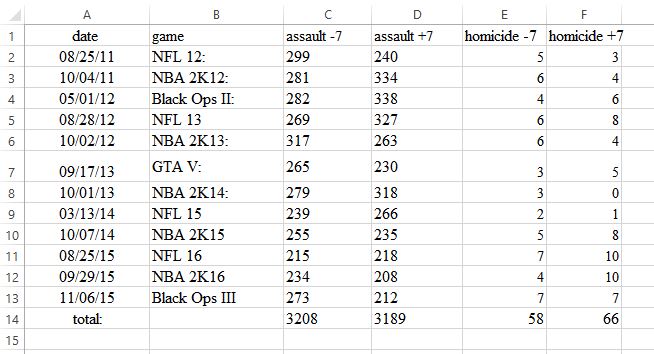
But at least for starters I could go to Opendata Baltimore to see if anything was going on in Baltimore. I looked at all assaults and also homicides in the 7 days both before and after release day (excluding the day of release because of hassles with the early morning hours).
It looks like nothing is up. The data look random. Anyway, overall there’s certainly no decrease. Homicides are up, but the n is low and it’s probably just random fluctuation (and assaults are down).
Along with connections to Da Mayor, the white elephant in the room is the “special consideration” given to the Hasidic community. It’s an open secret in the NYPD that Hasids and some of the Orthodox community are treated very kindly. Why? Because they got, as they say in Chicago, clout.
In 2013 DeBlasio won the Democratic primary (and hence the general election) by 101,503 votes. He avoided a runoff by 5,623 votes. Fewer than 700,000 votes were cast. Yes, in a city of 8.5 million, local elections are decided in an off-year with less than 10 percent of total residents voting. Meanwhile, there are 15,000 Satmars whose leaders offer their votes as a block. Most voted for deBlasio.
Unlike some the other guy who lied about being a Baltimore cop, this guy has a few thoughts worth hearing. From Humans Of New York:
I got an Ivy League education and then became a street cop for six years. I’d always been a knee jerk liberal. I was one of those kids screaming ‘off the pigs’ at protest marches. And then I ended up joining the force. I think it should be mandatory for everyone…. I think everyone should have to be a cop. It’s the ultimate social work. It’s the cop who has to step in when everything else has broken down. It’s where the rubber meets the road. It’s where conflict bubbles to the point of needing resolution, and somebody has to step in and protect the group welfare.
…
Everyone should have to make an arrest. Everyone should have to feel the fear of trying to apprehend someone who doesn’t want to go to jail. It breaks my heart to see all the hate toward cops. Are there hateful, racist cops? Sure. And they should be punished. But I’ve worked in just about every industry. And I didn’t find any more racism in the police department than I’ve found in boardrooms and retail stores.
I’m finally getting around to watching The Seven Five, a documentary about the 75 Precinct in the 1980s and criminal cop Michael Dowd. Good stuff… the documentary, that is, not the cop.
I like how the movie is told through three perspectives: the dirty cops, the cops who caught them, and the criminal the cops worked for. And of course they’re all really charismatic.
But what amazes me is the reputation for NYC being so crazy back then. I mean it was. Sort of. In 1990, the height of the crack epidemic (the Bronx was already burnt) New York City’s homicide rate peaked at 30 per 100,000.
And the 75 Precinct was the highest homicide precinct in the city, with 126 murdersin 1993. That’s a rate of about 80 per 100,000.
Last year in New York City? The homicide rate was 4.
You know what Baltimore’s homicide rate was last year? 55.
When I worked the Eastern District the homicide rate was 100.
Last year in the Western District, the homicide rate was 140.
Think of what that means, to residents and cops alike.
[Fun fact: The most ever homicides in any one Baltimore district? The Western in 1972. 87homicides. (Though last year’s rate was probably higher, given the population flight from the area.)]
Another vacant crumbling amid high winds – Mosher St at Vincent St. Fell into alley cut-through pic.twitter.com/s1T5s3qnUO