My book review of Bernard Harcourt’s, Against Prediction,was just published in the American Journal of Sociology. You can read it here.
Author: Moskos
-
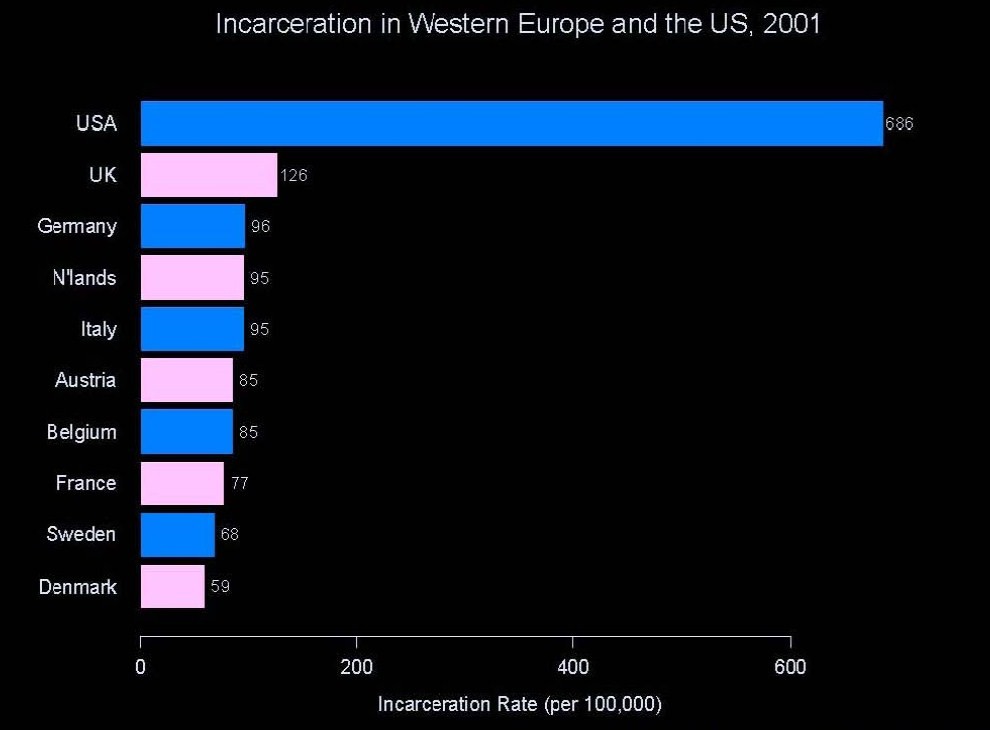
What’s wrong with this picture?
I heard Harvard Professor Bruce Western speak tonight at New York University. A short while back I heard him speak at John Jay College and he was nice enough to give me his powerpoint presentation. I use some of it in my class.
This is one of those slides:

We now lock up 730 people per 100,000. And this rate is still going up. That’s more than any country in the world. More than North Korea. More than China. More than Russia. And remember that “rate” takes population into account. Hell, in pure numbers we lock up more people than China. And there are more than a billion of them.This massive incarceration only started in the mid-1970s with the war on drugs. Mostly affected are young black male high-school drop outs. Among this cohort, the majoritywill be incarcerated at some point in their lives. Now I know this stuff and even I find it hard to believe. I asked Prof. Western if his data on incarceration included prison andjail andarrests? Nope. Just prison.
Doesn’t anybody care?
-
In the Big City
The trial of the officers involved in the Sean Bell Shooting continues with lots of interesting testimony.
The justice department declares that New York City’s auxiliary police aren’t really police. At least when it comes to paying benefits to the family of two officers killed while patrolling in uniform.
And Governor Paterson, who I seem to like more and more, first admitted he slept around a bit. Now he says he smoked some weed and snorted some blow… you know, back in the 1970s, when it seems like everyone was doing it. This was the man to party with! Too bad I was only 8.
The governor said, “Most Americans during that period of time tried a whole lot more than that, and then gone on and led responsible lives.”
Does this mean he thinks people shouldn’t be locked up for drug use? Probably not. Politicians never have problems being hypocrites when it comes to the war on drugs. But maybe Paterson is different. Here’s hoping.
-
33,541 Drug Overdose Deaths in 2005
The Drug War Rant and Stop the Drug War turned me on to a report by the Center for Disease Control. The just released “Deaths: Final Report for 2005” (hey, it takes a while to count all the dead folk) may not be the most uplifting title, but they do breakdown the two-and-a-half million deaths in America (bet you couldn’t have guessed thatnumber).
Here’s the shocker: 33,541 people died of drug overdoses (see Tables 21 and 22 of the report for details). The report doesn’t breakdown drug overdoses and legal and illegal drugs. But the vast majority of overdose deaths are from illegal drugs (opiates like heroin in particular) and entirely preventable.
Nobody wantsto overdose on heroin. You take illegal drugs because you want to get high. Overdoses happen because the drug is stronger than you think. Or you get clean and relapse and forget your tolerance is down. People don’t have to die. They would live if only we regulated and labeled this very dangerous drug. Somehow our drug-policy makers have decided that maintaining drug prohibition is worth tens of thousands of death per year. Shame, drug warriors. Shame.
-
Missing. . . . not!
New Jersey Governor Corzine signed “Patricia’s Law” mandating that police must accept—without delay—any report of a missing person. I would assert that no law named after a person has ever been good. This one sure isn’t.
The Recordreports:
Under Patricia’s Law, police cannot refuse to take on the case of a missing person — whether child or adult — on any basis, including if circumstances do not indicate foul play or if it appears the person disappeared voluntarily.
Police must then take down more than two dozen pieces of information, from the person’s name to the address of his or her dentist. If the person remains missing after 30 days, police must attempt to gather DNA samples as well.
People worry about their loved ones. But the last thing you want is police hunting down dental records because a bus is late and a cell phone is out of juice.
The vast majority of “missing” persons aren’t missing. Missing persons come home. Traffic was a bitch. Or they had to work late. Or they’re having an affair. This is not police work. Mandating police to waste hours on useless cases is no way to help find real missing persons. And the strain on resources will hurt us all. Any law that assumes that police have unlimited resources is a bad law.
One probable outcome is that police response time to a call for missing person will increase in to the hours. That’s what I would do. Because 99 times out of 100, that person will appear before then. And for the 1 time out of 100, it’s not like broadcasting a report one hour faster will help anyway.
-
Around when you need one?
The Timesreports that the NYPD is to shrink to its smallest size in 15 years. That’s a little misleading because the department in never at its budgeted size. The “size” of the department would “drop” to 36,838. But the actual number of officers today is 35,800. So the department could still grow despite this “drop.” The horrible irony is that the department has been shrinking ever since 2000. You know, right before the country set on a new path of safety and security. You might think the federal government would want more New York City police to help prevent the next large-scale terrorist attack. You might think that.
This does point to a larger issue of why there are so many unfilled positions. Word on the street is that standards in the academy have already dropped substantially. The answer, for once, is shocking simple: Starting salary: $25,100. Top pay after 5 or 6 years: $59,585. That’s not a lot to live in New York. And it’s less than most other surrounding police departments pay. You get what you pay for.
The idea the more cops equals more safety is actually surprisingly new. For decades, at least until the mid 1990s, “experts” in the criminal justice field used a lot of trees to disprove any link between police numbers and crime. What matters isn’t so much how many police there are, but what those police officers do. But if police are doing the right thing—and that’s a big if—more police officers help. And since the early 1990s, police officers in New York have been doing the right thing more often than not.
Nobody knows the “right” number of police to have. Ideally we’d always have more. But when you take the zero-sum world of municipal budgets into account, I think New York City has about the right numbers today. Raising the pay of police officers is an issue of fairness and an issue of getting and retaining better officers.
It only takes one big lawsuit tomorrow—paid out of the pockets of New York City taxpayers such as myself—to negate any financial savings from cheap pay today. Saving a buck or two (or million) now will cost us more later.
-
Marginal Revolution
Alex Tabarrok and Tyler Cowen, the people behind Marginal Revolution, a respected and well read blog, have been very kind to me (or at least very kind to my book).
Tyler Cowen posted about my book and the Amazon pre-sales rank got a big boost (not that I check these things, of course).
-
Wild gun fight. Police shoot bad guy. Officers shot.
This one, if the Sunis to be believed, sounds wild. Though if the Sunis to be believed, this happened in East Baltimore (you know, where bad things happen). Best I can tell it started in the Central and ended in the Northern.
Officer Anthony Jobst, 47, was in his patrol car in the first block of E. Lafayette Ave. about 2:30 a.m. when he heard gunshots and saw a white Audi speeding away. Jobst, who was joined by four other uniformed officers, drove after the Audi and followed it for about a mile to an alley in the 400 block of E. Lorraine Ave. in the Harwood neighborhood.
The Audi crashed in the alley, and the driver ran out and hid behind a brick wall. When officers approached him, the man opened fire, shooting Jobst in the foot and grazing the left leg of 27-year-old Officer Hadyn Gross, Bealefeld said.
Officers returned fire, striking the man several times in the upper torso, but the gunfight was “protracted” because he was wearing body armor enhanced with steel inserts.
…
Back at Lafayette Avenue, where shots were first fired, police found Rico Alston, 27, with two bullet wounds to the chest. Alston was taken to an area hospital.He was in serious but stable condition yesterday, police said.
[March 19 update: 88 rounds were fired. The bad guy died Monday night. The Sunreports, “At one point, the man signaled to police that he was surrendering – but police said he used the lull in gunfire to reload the Smith & Wesson.”]
-
Always the narcs getting into trouble
Too often, almost predictably, undercover vice units are involved in scandal. Even the Sean Bell shooting has a strong narc connection.
The Night Club Task Force involved in the Sean Bell shooting was formed in reaction to the Chelsea abduction and murder of 18-year-old Jennifer Moore. These undercover vice and narcotics officers worked to establish patterns of wrongdoings in clubs, such as alcohol sales to minors, to force closure with civil proceedings and nuisance abatement laws. Evidently they did a good job. Perhaps the unit should have been disbanded with accolades. Instead, after three months in Chelsea, commanders sent the 20 or so police officers to Queens. In the killing of Sean Bell, this unit’s undercover vice and narcotics mentality is very evident.
In a drug arrest, it is important to find drugs on a person. Otherwise there is no case. Vice and narcotics officers are ingrained to work in ways that build strong court cases. But guns aren’t drugs. If the officers believed that Bell and his friends were going to get a gun, they should have stopped the suspects before they got to their car. But they wanted an arrest. If the men weren’t in the car with the gun, no court case would have had a change. But still, any illegal gun would be confiscated and them men would spend a night in jail
Undercover units should be limited to operations that uniformed officers can’t handle. Because plainclothes police know and feel they are police to the bone, when performing police duties they can too easily forget or fail to convince citizens that they are, in fact, police. Badges can be bought on eBay. The flash of a shield isn’t enough, especially when a gun is involved.
Uniformed foot patrol can work with bars and nightclubs to alleviate problems rather than sting them out of business. There is nothing about a rowdy bar that a good cop or two can’t handle. Local beat cops know the area. Officers on foot are rarely involved in controversial shootings because they are more familiar with the surrounding and less likely to be afraid. The good old-fashioned beat cop… Nobody is better at keeping the peace. Instead of drug cops trying to make a good arrest, beat cops focused on public safety would have saved the life of Sean Bell and the careers of three police officers.
-
Balancing Security and Liberty
Occasionally I will repost op-eds of mine to give them fresh life and allow people to comment. The following was published in theWashington Post, August 2, 2004. You can read all my op-eds here.
When you board a plane, both you and your carry-on bags are searched. A civilian employee of the Transportation Security Administration may open and search your checked luggage as well. Although primarily looking for security threats, workers report any illegal or suspicious objects to a supervisor or law enforcement agent, even if the object represents no danger to the flight.
Two legal concepts allow both you and your bags to be searched despite the Constitution’s protection against unreasonable search and seizure. By being in an airport and trying to board a plane, the Supreme Court says, you have given “implied consent” to being searched. The “plain view” principle, according to the court, states that whatever law enforcement legally finds, feels or sees — even if unrelated to the original investigation or search — is fair game for arrest and prosecution.
Using security and terrorism as justification, the government is beginning to extend airport-like implied consent zones to more and more of the public sphere, including the entire Boston subway system. Before the Democratic convention, daily commuters, anybody approaching a national political convention, and drivers on vital bridges and tunnels were told to expect random searches without a warrant. Fourth Amendment protection against unreasonable search and seizure does not apply.
When police are granted greater rights to search without probable cause, they will use these rights. Therefore it’s essential to consider the implications of implied consent and plain view searches in the public sphere. Fear of increased government repression is shared by both ends of the political spectrum. But many others understand that a necessary element of freedom is security. Airline passengers should be screened. The Democratic and Republican national conventions need to be bomb-free.
Few people object to bomb searches on airplanes. And many would be willing to waive their constitutional rights (if such rights were negotiable) to guarantee their security. But what starts as a necessary security measure will quickly become standard law enforcement procedure even for crimes that are nonviolent and not related to terror. These expanding implied consent zones have staggering implications for American life and freedom far beyond al Qaeda.
Police officers are experts at bending rules, particularly in the “war on drugs.” As a police officer, I was taught to push the rules of the “Terry search,” which meant that if I articulated fear that a suspect might harm me, I could legally frisk suspects for weapons without probable cause. I know officers who towed cars, again legally, simply so they could “inventory” the contents (technically for safekeeping). In both cases, the real goal was to find illegal drugs and make an arrest.
One must expect law enforcement to use all its available tools. As a law enforcement officer, why deal with the tedious process of probable cause, judicial approval and paperwork?
In order to stop and search any suspect, not just a terrorism suspect, law enforcement need only wait for a person to enter an implied consent area such as a subway or a shopping mall. Their action justified by the “war on terror,” police may then conduct a full search. The true object of the search — most likely drug possession, but any contraband will do — is unrelated to terrorism.
Of course people shouldn’t break the law or carry illegal objects. But the difference between civilian employees searching for bombs in airports and government agents conducting random searches for suspicious objects is the difference between preserving a free society and creating a police state.
In airport security today, items deemed suspicious are not necessarily dangerous: Large amounts of cash, pirated CDs, pornography and, of course, drugs — not just illegal drugs but even prescription drugs in certain circumstances. In fact, controversial books can be grounds for further investigation and arrest. Such a standard, even if established in airports, is unacceptable and must not be allowed to spread to our streets and subways.
The solution — the balancing of public safety with constitutional liberties — is surprisingly simple. The only way to prevent creeping use of implied consent is to limit the doctrine of plain view. Before searching a person, the government must choose either plain view or implied consent. If the government must search without probable cause, let it search, but only for illegal weapons or bombs. If security outweighs the Fourth Amendment, the scope of such searches must be limited to objects representing a clear and present danger to public safety. Any unrelated suspicious or illegal objects found must be ignored.
It is the job of our courts and legislature to strike the balance between security and liberty. By limiting the plain view doctrine, lawmakers or Supreme Court justices have the rare opportunity to be tough on terrorism while guaranteeing the rights and freedom of citizens.