Author: Moskos

  • No more “Moving Day”

    There are many day-to-day things in the ghetto that start to seem normal, or at least routine, when you’re in too deep. These are things that would shock most outsiders.

    Take evictions. Every day you’d turn your police car into a street and see the insides of an entire home neatly piled up in the street. This structure often looked like a trash dumpster, but there was no dumpster. Just a whole lotta shit, piled high. Somebody would often be sitting by sadly, trying desperately to guard or sell the more valuable stuff while arranging for transport and a place to stay.

    And while I know it’s not nice to make fun of people’s misfortune, cops love morbid humor. Luckily, evictions were not the job of city police. So the sad sight of people lives on the street might be greeting with a Groundhog-Day like exclamation of “Moving Day!” Hey, at least nobody died.

    Well it turns out that having all your shit piled on the street actually is a Baltimore thing, hon. And now, happily, it’s a thing of the past. The city recently started prohibiting landlords from tossing evicted tenants’ belongings into the right of way. And guess what? Evictions have fallen 25 percent. Better yet, the number of tenants present for eviction day (the city sheriff keeps track of these things) dropped almost 40 percent.

    Why is this? Because, as the Baltimore Sun reports:

    Previously, after a landlord got approval from a judge to remove a tenant, the landlord would call the sheriff’s office to schedule the eviction. Although the court would notify tenants that an eviction was imminent, they were not told the date when the sheriff would arrive.

    No wonder people had their belongs thrown out: they didn’t know whenthe eviction would happen.

    The number of times Department of Public Works crews have been called to pick up personal property has fallen from about 580 a month to three in January and none in February.

    The new ordinance requires landlords to inform tenants of the date and to send that notice three times, by two different forms of mail, 14 days before an eviction and, a week before, with a posting on the property. City officials said that providing a firm deadline gives tenants time to plan whether to move their belongings or pay their rent.

    That seems like a no-brainer.

    But what dothey do with all the stuff?
  • Man pays for sex

    New York Governor Eliot Spitzer slept with a whore. She was an expensive whore, as is befitting a man of his station. I believe once the price is more than $1,000 an hour, the word is “high class.” So there you have it: Man Pays for Sex. There really isn’t much else to say.

    I don’t care. I don’t think more highly of this man. There’s irony galore. I feel for sorry for his wife to have to go through this. But really, I don’t care. That’s his and her (…and her) business.

    [And there’s the fact that the “liberal rag” New York Timesonce again shows its true colors in excellent, trustworthy, and independent reporting.]

    Perhaps the only thing more silly than the war on drugs is the skirmish against prostitution. I don’t want street walkers on my block anymore than I want public drug dealers. But if you can run a prostitution ring as a legal, regulated, taxpaying, and complaint-free business, more power to you!

    What doesbother me is that federal law enforcement officials waste any time and money cracking down on rich men paying upwardly mobile young women for sex.

    Aren’t we at war? Aren’t we supposed to be worried about terrorism?! And we’re squandering precious resources on paid sex between consensual adults?!! Oh, Lord. Why is this a crime? At least Spitzer had the common courtesy not to do it in a public bathroom.

  • The fire-bombing of 324 car

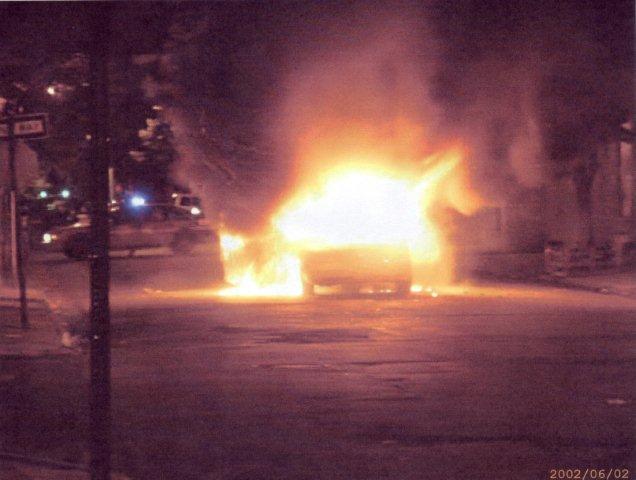
    The fire-bombing of 324 car

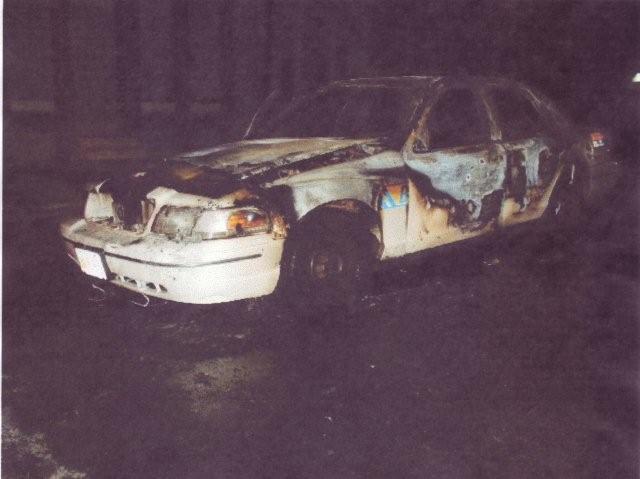
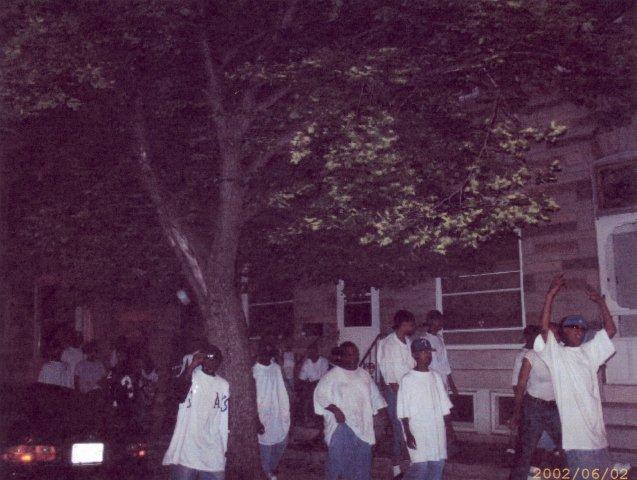
    About a year after I left the B.P.D., this happened. 324 car got firebombed. Some locals didn’t like the officer driving it because he could outrun and catch anybody in the district who tried to run from him. Somebody led him on a foot chase while his friends torched the car. It was our best car, too. The only one with a computer.

    It got torched.

    And burnt-out shell.

    The yo-boys celebrating their victory. What can you say about a group of mostly kids, all in white T-shirt and jeans, celebrating their victory? It’s 1AM, do you know where your child is?
    [originally posted 9/07]

  • Officer shot

    Something strange is going on here. There are important details not reported.

    No matter, I’m glad the officer is alive. The rah-rah part of these stories bothers me. If the bullet was anything but a graze, odds are this officer will never patrol again.

    City officer shot by gunman who was hiding in bushes
    By Ruma Kumar

    12:06 PM EST, March 8, 2008

    A rookie Baltimore police officer is recovering and in good condition at Maryland Shock Trauma Center this morning after he was shot in the leg around 1 a.m. in Southwest Baltimore, police said.

    Officer Pedro Perez, 24, who graduated from the police academy in July, was injured during a patrol stop in the 100 block of Palormo Ave., Police Commissioner Frederick H. Bealefeld III said at a press conference today. Perez and his partner had stopped to talk to two men loitering in an area where criminal activity is rampant when a gunman jumped from behind some bushes and shot at the officers.

    At least three shots were fired, Bealefeld said, and one hit Perez above his right knee. Bealefeld said police are following a number of “good leads” and do not believe there is a link between the unidentified gunman and the two men the officers were talking to at the time of the shooting. The two have been held for questioning, but are considered “more witnesses than suspects at this point,” Bealefeld said.

    “This definitely reinforces the dangerous nature of the work these police officers do, and (shows) that more work needs to be done,” Bealefeld said today.

    Saying Perez is with his family, Bealefeld added, “this man is in excellent spirits…he’s eager to get back.”

    Police did not release a description of the gunman.

    Copyright © 2008, The Baltimore Sun

  • Humanizing the Corner

    I just stumbled across “Murder I Wrote” (from a link related to Bradford Pulmer’s blog).

    In 1997, David Simon, producer of The Wire (the best TV show ever), wrote in The New Republic how corner boys were recruited for a day to be slinging extras for the TV show Homicide(not the best show ever). The boys complained about how unrealistic it was.

    “Damn,” said Manny Man, walking back to his position. “This ain’t gonna look right. People in other cities gonna see this show and think the crews in Baltimore don’t know how to carry it.”

    Most of the boys are now dead.

    Simon understands that yo-boys may not but model citizens, but they’re living breathing people. I was strangely moved by Simon’s article.

  • 911 is still a joke

    In his blog, Bradford Plumer writes a thoughtful analysis of one chapter of Cop in the Hood (scroll down to “Call a Cab Cause a Cab Will Come Quicker,” and the comments in particular).

    I learned of a 911 operator in Detroit criminally convicted of negligence for failing to take a call from a 5-year-old boy seriously. The boy’s mom died. But I listened to the call. She shouldn’t have taken the call seriously. She was right (even if in this case she was dead wrong)!

    No city has tried to “unsell” the public on 911. It is way too tough, politically.

    People think that 911 saves lives (and it does for fire and ambo). I think the first job is to educate the public about the “bullshit” nature of the majority of 911 calls.

    It’s too easy to say police need to respond to every call without understanding how this response isn’t feasible. Responding to thousands of needless 911 calls prevents the police from getting out of their cars and doing the kind of real police work that would really save lives.

    In a year in the Eastern District, police have to respond to over 6,300 “911 hang-ups.” That’s over 5 percent of all calls. Police have better things to do. Here’s how probably 6,299 of them went:

    [Cop knocks on door]

    “Did you call 911?”

    [indignantly] “No!”

    “Well somebody did.”

    “I didn’t!”

    “Do you have kids”

    “Yeah.”

    “Well tell them to stop playing with the phone.”

    “My baby wasn’t playing the phone!”

    “Ok. Whatever. Good bye.”

    [door slams]

    For that, we don’t have officers walking the beat.

  • The Trial in the Killing of Sean Bell

    Sean Bell, an unarmed black man, should not have died. But the officers on trial won’t be convicted of anything major. The police certainly make mistakes. We all do. Like it or not, mistakes aren’t usually crimes, especially for police.

    After any high-profile police shooting, there is the hope that time will reveal the truth and truth will lead to justice. This trial won’t bring truth or justice because there is no single truth.

    In the Sean Bell shooting, there are as many truths as there were bad choices. On many different levels the events leading up to Sean Bell’s death were not exactly ideal police work. Yet everybody behaved rationally in their own way.

    Sean Bell left a club and thought a black man with a gun was a robber. Bell drove away, hitting the gunman in self-defense. An undercover officer fired in self-defense when a drunk man he thought was armed hit him with his vehicle. The officer’s partners fired when they thought they were being fired on from the vehicle.

    It only takes one bullet to kill. While the number of shots fired makes the headline, what matters is why police shot at all. The first shot, combined with adrenaline and danger, often causes other officers to shoot. This is the so-called “contagion effect.”

    Police aren’t supposed to shoot at or from moving vehicles. But police are trained to shoot when they think their life is in danger. If that threat exists for 10 seconds, they will fire for 10 seconds. When I was a police officer, my gun held 17 rounds, two more than allowed in New York City. I could fire 50 rounds in 15 seconds. I was trained to reload quickly and “get back in the game.” If you don’t like that, change the training or change the gun. But don’t blame police officers.

    This trial has become a symbol for race and policing in New York City. Are police too quick to see young African-American men as threats? Would so many shots be fired if Bell and his friends were white? Perhaps not, but police kill white people too. You just don’t hear about it because there is no white version of Al Sharpton.

    It’s unfair to unload three centuries of American racial discrimination and police mistreatment onto the backs of these three police officers, especially when two happen to be black. The shame is that short of vigils and riots, our society has no ritualized way to atone for collective sins.

    Sean Bell isn’t on trial. Society isn’t on trial. The New York Police Department isn’t on trial. Three men are. Conviction would mean the loss of their jobs and freedom. But a guilty verdict won’t bring Sean Bell back to life. And acquittals won’t return the police officers’ lives to normal.

    Despite the police cliché, “better to be judged by twelve than carried by six,” police don’t want to be judged by twelve. Police, often for good reason, don’t trust city juries. The officers want a bench trial so their fate is in the hands of a Queens judge rather than a Queens jury.

    Judges are better at deciding cases on facts rather than prejudice and personal experience. Of course judges, especially senior white judges, have fewer reasons to have prejudice against police officers. This senior judge, Justice Cooperman, is certainly no cop hater, but he’s also no pushover. Cooperman actually tried, convicted, and imprisoned two police officers in 1986.

    Still, beyond a reasonable doubt is a tough legal standard to prove. Was there a need to shoot in the first place? Was a threat still present when the last shot was fired? If the answer is yes or even maybe—anything but a strong no means no conviction.

    My gut knows the police did something wrong because Sean Bell is dead. But what should a reasonable police officer have done? I don’t know. I never had to shoot my gun on duty. My gun was never the only thing between me and an SUV trying to kill me. I have doubts. As long as Justice Cooperman has some of the same doubts, the officers will and should walk free.

  • The Wire, the War on Drugs, and Jury Nullifcation

    There’s a great article in Timeby Ed Burns, Dennis Lehane, George Pelecanos, Richard Price, and David Simon. They’re the writers for the best show ever, The Wire.

    It’s a powerful piece and you should read the whole thing. Needless to say, they write well.

    Interestingly, they argue that for jury nullification, a concept I have long loved.

    “If asked to serve on a jury deliberating a violation of state or federal drug laws, we will vote to acquit, regardless of the evidence presented.”

    As long as one member of a jury votes to acquit, conviction is impossible. It happened during Prohibition and there are some examples in our current War on Drugs. Vote your conscience. Refuse to convict regardless of the law, the evidence, or the suspect’s guilt. It’s a statement with impact. And it’s a very powerful right we the people have against unjust laws.

    “Jury nullification is American dissent, as old and as heralded as the 1735 trial of John Peter Zenger, who was acquitted of seditious libel against the royal governor of New York, and absent a government capable of repairing injustices, it is legitimate protest.”

    It’s a clever idea and I support it.
    “It will not solve the drug problem, nor will it heal all civic wounds. It does not yet address questions of how the resources spent warring with our poor over drug use might be better spent on treatment or education or job training, or anything else that might begin to restore those places in America where the only economic engine remaining is the illegal drug economy. It doesn’t resolve the myriad complexities that a retreat from war to sanity will require. All it does is open a range of intricate, paradoxical issues. But this is what we can do — and what we will do.”

  • An “adrenaline-accelerating night ride”!

    Another good review. From Publishers Weekly, a trade magazine:

    Cop in the Hood: My Year Policing Baltimore’s Eastern District
    Peter Moskos. Princeton Univ., $24.95 (304p) ISBN 978-0-691-12655-5

    A Harvard-trained sociologist, Moskos set out to do a one-year study of police behavior. Challenged by Baltimore’s acting police commissioner “to become a cop for real,” he accepted. During his six months in the police academy and 14 months on the street, he “happily worked midnights, generally the least desirable shift” in one of the city’s least desirable precincts: the Eastern District (where HBO’s The Wire is filmed). Moskos frankly records his experiences with poverty, violence, drugs and despair in the gritty ghetto. During “field training,” he first encountered “drug dealers, families broken apart, urban blight, rats, and trash-filled alleys. Inside homes, things are often worse.” Moskos’s overview of policing problems covers everything from arrest quotas, corrupt cops and excess paperwork to the reliance on patrolling in cars, responding to a barrage of 911 calls, rather than patrolling on foot to prevent crimes. Moskos blends narrative and analysis, adding an authoritative tone to this adrenaline-accelerating night ride that reveals the stark realities of law enforcement while illuminating little-known aspects of police procedures.

  • You see this cat is a baad mother–

    What would you do when you get shot? Get a Slurpy? Shut your mouth!

    From today’s Baltimore Sun.

    Can you dig it?

    Man gets shot, takes cab to convenience store
    He hailed taxi, went to S. Baltimore 7-Eleven

    By Gus G. Sentementes

    Sun reporter

    8:33 AM EST, March 5, 2008

    A man who was shot several times in South Baltimore last night didn’t call an ambulance, but instead hailed a cab whose driver took him several blocks to a 7-Eleven store, authorities said.

    The shooting occurred shortly before 8 p.m. when police said a 32-year-old man was wounded on the first block of E. Heath St.

    Suffering from injuries to his neck, arm and body, police said the man jumped into a nearby taxi and rode a half mile to the convenience store on South Hanover and Hamburg streets.

    Police said the man went inside the 7-Eleven and that someone inside called for an ambulance. The victim was taken to Maryland Shock Trauma Center and treated for non-life-threatening injuries, according to police.

    Police said they had made no arrests and did not know whether the man had paid his cab fare. The name of the taxi company was not immediately available.

    Undoubtedly, he’s a complicated man.

    [Basic crime stories are usually so dry. I love that fact that Gus Sentementes, a well-seasons crime reporter (who has never called me, by the way), asked the tough question, “did he pay his fare?!”]