My third book, Greek Americans: Struggle and Success (3rd edition), is probably the one you don’t care about. But it’s not often you come across a 12-page book review. Hell, for all I know, maybe you do care.
Author: Moskos
-
Former LA Sheriff Baca Pleads Guilty
I don’t know much about LA county. The LA Sheriff’s Department has 18,000 employees and 9,100 sworn officers. And running a huge jail system ain’t easy. But Sheriff Baca and his cronies have been in trouble for a long while. His people tried to strong-arm an FBI agent investigating his department. Not cool. Perhaps we shouldn’t be electing top law enforcement officials. From the NYT:
The plea agreement with the United States attorney’s office caps a stunning fall for Mr. Baca, who was among the most powerful men in Southern California during the 15 years that he led the sheriff’s department. Seventeen sheriff’s department employees have been convicted as part of the federal investigation into corruption and civil rights violations in the Los Angeles County jails during his tenure. Inmates were routinely sexually humiliated and severely beaten by sheriff’s deputies at the jails, according to the Department of Justice.
The LA Times has more of the salacious details.
-
RIP Derek Geer and Jason Goodding
Does all the talk about cops being too quick to shoot people “for no reason” have an effect? (A “Ferguson Effect”?) I don’t know. But it might have been in the back of the mind of 14-year police veteran Deputy Derek Geer. Just two days ago Geer tried to tase an armed 17-year-old boy. For his less-lethal efforts, Geer was killed. He leaves behind a wife and two children, ages 13 and 11.
Geer was the second cop this week to be shot and killed in a situation where police brought a taser to a gunfight. The first officer killed after using using leth-lethal force was Sergeant Jason Goodding. He and his partner recognized a man with an outstanding warrant. The wanted man resisted arrest, was tasered, and then shot Goodding three times. The other officer then shot and killed the subject. If only the cops had shot the wanted man a few seconds earlier…. Then people would be calling for “justice” for the criminal.
Update: While writing a post about two killed officers, two other officers were killed. Both were shot and killed by a 67-year-old wanted man. Together these Harford County Sheriff’s deputies had 46 years experience.
-
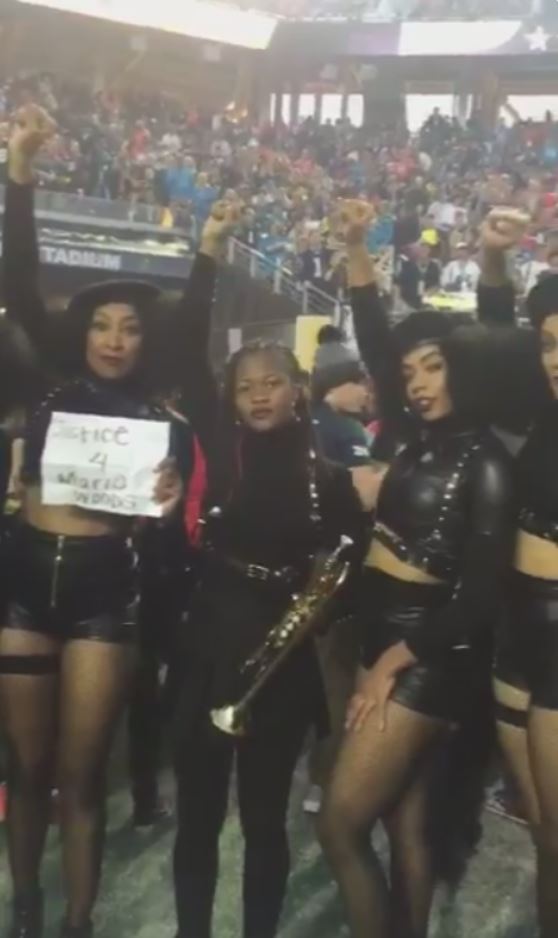
“Justice 4 Whom”?!
Generally I couldn’t care less what Beyonce’s dancers think. But “Justice 4 Mario Woods” and a black power salute? Are you effing kidding me? Mario Woods was shot and killed by San Francisco police back in December. It was a good shooting.
Christ almighty there are plenty of bad police shootings. Not this one. Woods doesn’t need justice. “Justice 4 Mario Woods” means there was an injustice done by police. But right there and then, Mario Woods was armed and dangerous and needed to be stopped.
Crazy Mario Woods had already stabbed a stranger. And now he’s just walking down the street holding the bloody knife. Police tell him to drop the knife. He won’t. Police knew Woods had knife, had just used it, and may have wanted to use it again. Police use less lethal force… one, two, three, four, and five times. Woods won’t drop the knife even after being beanbagged and tased. It’s like he’s on a mission. (Based on what Woods said, I suspect this was suicide by cop.) If he gets closer to others and starts cutting, police might not be able to shoot. It’s a crowded street. Woods needed to be stopped.
The Guardian, which since Coldbath Fields Riot of 1833 has published exactly one unbiased story about police, says, “Mario Woods was allegedly armed with a kitchen knife.” No. He had just tried to kill somebody. He was armed with a kitchen knife.
One thing that bothers me about press accounts of this incident are journalists who still talk about the knife being “alleged” or the victim being “allegedly” stabbed. For legal reasons, I understand why you might throw in “alleged” when describing the suspect. But when the suspect is dead, you can drop the “alleged” crap. Dead men can’t sue any more than than they can be convicted of crime.
The very first reporter who called me, the one who brought this shooting to my attention, mentioned almost in passing that Woods “allegedly stabbed somebody.”
“What?” I said, “Well, that would really matters to police. He had just cut somebody? That would change everything.”
“Allegedly,” she insisted.
“Well, did he just cut somebody or not?!” To police, this detail would matter tremendously.
To the best of my memory, I swear the reporter said: “Yes, but he hadn’t been convicted yet.”
I felt like I was entering the Bizarro world of liberal media make-believe I’ve heard conservatives foam about. Did she really expect police to wait until conviction before deciding the victim was real and knife sharp? Go tell the stabbed dude he was only “allegedly” stabbed. Here’s what the actual victim did say:
“I’m trying to get my life together. My life has been a shambles since this happened.”… “I got stabbed by someone I don’t even know and I don’t have a beef with or anything like that.”… Jacob says he is the forgotten victim, the one who was attacked and the victim protesters and city officials have ignored.
Woods, who according to his mom and lawyer was a gentle man (of course) who was turning his life around (“He was really kind and easy to deal with and really appreciative. Terrific. Never aggressive”) had an extensive violent criminal history. He had spent nearly all his adult life in prison. Now Woods’s record doesn’t mean cops get to kill him for no reason, but it might shed some light on why Woods would do some crazy shit.
-
“They pursue not the truth”
In case you missed it (I did), here’s some good deep legal analysisfrom Page Croyder regarding the trial of the six Baltimore cops:
They pursue not the truth, but in the words of Mosby, “justice for Freddie Gray.” And they will trample over the law, the evidence, their ethical responsibilities and real justice to get there.
Croyder doesn’t like Mosby, in case you can’t tell. And for good reason.
If the published commentsfrom one of the jurors in the first Freddie Gray trial are accurate, then I was right, wrong, and right again.
Right that the jurors were close to acquitting Officer William Porter on the most serious count, involuntary manslaughter.
Wrong that they were close to acquitting him on the other charges as well. In fact, they were very close to convicting him for misconduct in office, and leaned towards conviction for reckless endangerment.
And right that this trial should have been moved. This hung trial makes it all so clear that the six officers cannot get a fair trial in Baltimore city.
According to the Sun, Judge Barry Williams instructed the jury that to find Porter guilty of misconduct in office, he had to have acted with “evil motive and bad faith,” that he could not have made a “mere error in judgment,” and that he “corruptly failed to do an a act required by his duties.”
There was zero evidence of evil motive, bad faith or corruption in performing his duties. Porter acted completely consistently with other police officers. Acting in conflict with a general order does not equate to misconduct, either. If one thinks the police, as a department, act unreasonably in how they transport prisoners, that’s what civil suits are for. But not criminal charges.
-
Your Personal Ferguson Effect
There’s an interesting comment in a previous postwhere an officer describes what he calls “my personal Ferguson Effect.” Two similar cases. One cop shot and killed a non-compliant unarmed person. The other cop did not shoot a non compliant person and is now dead.
The knowledge after the fact of whether the suspect had a gun or not is certainly emotionally powerful in forming our judgements of these officers, but it is irrelevant legally to the officer on the scene attempting to effect an arrest of a non-compliant suspect.
…
The fact that the media and the masses apply this rule of hindsight to police use of force and are pressuring police agencies to do the same for internal investigations makes me fearful that the courts will soon start pushing to adopt this same rule of hindsight. That is my personal Ferguson Effect.
Leaving aside these specific cases, I’m curious if other officers have had specific moments in the past couple years — their own Ferguson Effect — that changed the way you do their job. Was there some discussions, protests, riots, news report, prosecutions, politician, Benghazi (I’m kidding about the last one, I hope) that changed the way you do your job?
-
Swamy Pete says…
Swamy Pete, the gypsy scryer, looks into his crystal ball.
With eerie music in the background and an echoey voice, Swamie Pete makes a bold prediction:
In the future, in fact tomorrow at exactly 19:00 hours eastern time, crime will not happen. The crystal ball says that for maybe three hours, somehow people will manage to have fewer problems. The root causes will remain constant, and yet fewer people will dial 911. Yes, I can see it now… for a few hours Sunday night, triggers on guns will be harder to pull and knives will be so dull they will not cut human skin….
But… at around 10:30pm everything will be back to normal.
I never liked that Swamie Pete and his voodoo nonsense, even if back in October he was right about the homicide increase of 2015. How did he know that? Witchcraft, I say!
But by the way, if we accept that blizzards reduce homicide. And the Super Bowl reduces homicide. Why is it so controversial that aggressive police presence focusing on maintaining order in high-crime communities can reduce homicide? I don’t know. I’ll ask Swamie Pete if I ever see him again.
Update (Feb 10): Surprisingly, call volume was only down a little during the Super Bowl. Not the huge dropoff I expected. Crime data isn’t out yet.
-
Defining the Ferguson Effect
Denying the Ferguson Effect and any link between policing and crime has become almost a cottage industry in some circles. It’s sort of the liberal equivalent of conservatives denying climate change and, er, on the small chance it is changing, any link between global warming and human activity. Sure, the world may be warmer. But God works in mysterious ways. Same with crime, if you listen to many of the Left.
Here’s a new study :
There is no evidence to support a systematic Ferguson Effect on overall, violent, and property crime trends in large U.S. cities.
OK. But the author do admit:
The disaggregated analyses revealed that robbery rates, declining before Ferguson, increased in the months after Ferguson. Also, there was much greater variation in crime trends in the post-Ferguson era, and select cities did experience increases in homicide.
OK…. So doesn’t that mean there is a Ferguson Effect? Apparently not:
Overall, any Ferguson Effect is constrained largely to cities with historically high levels of violence, a large composition of black residents, and socioeconomic disadvantages.
“Constrained to”? Isn’t “constrained to” synonymous with “present in”? Aren’t cities with “historically high levels of violence, a large composition of black residents, and socioeconomic disadvantage” exactly where you’d expect to find a Ferguson Effect!? I mean, I wouldn’t expect to find a Ferguson Effect in Winnetka, for crying out loud! (Winnetka, Illinois: median income $211,000; 0.3 percent black.)
Liberals, myself excluded, have long tried to discount the efficacy of policing vis-à-vis crime prevention. And now academics seem to want to deny any “Ferguson Effect” because… I don’t know. Just guessing, but maybe it goes against a Progressive narrative that police are racist enforcers of bourgeois heteronormative values?
There’s no reason the Ferguson Effect needs to be universal or even linked specifically to one event in August, 2014. The question shouldn’t be if all cities haven’t seen an increase in all crime but rather why why some cities — most cities, in fact — have.
What if, hypothetically to be sure, a laser-like focus on police-violence reduced police-involved killings but simultaneously allowed hundreds and even thousands of more murders to happen? If that were true, then what?
What if “hands up don’t shoot” were built on a false narrative? What then? What if, just for the sake of debate, we assumed that most police-involved killings were actually justified (since most are) and even life saving? What if the goal of eliminating police-involved killings was, in part, counterproductive? Then what?
Different cities have had different “Ferguson Moments.” It wasn’t like something magically changed everywhere when Michael Brown was (justifiable) killed. All policing is local.
In New York City the Ferguson moment may have been protests after the death of Eric Garner. Cops were verbally attacked, physically attacked, and two were killed and another bludgeoned with a hatchet. If you think none of that matters… well then you haven’t talked to any New York City cop.
In Baltimore, just thinking out loud here, perhaps it was the protests and riots after the death of Freddie Gray. And the misguided criminal prosecution of innocent cops. In Cleveland, not that I know much about Cleveland, I would assume policing changed related to the killing of Tamir Rice. In Nashville? Beats me. But maybe it was giving hot chocolate and coffee to protesters. I applauded that move. Liberals like me love that shit. But I bet it pissed off a lot of the rank-and-file.
So no, it’s not Ferguson per se. Call it whatever you effing want. (I’ve never been a fan of the actual term “Ferguson Effect.”) I’m talking about the real-world effect of an anti-police narrative, the fear cops have of getting in trouble for doing their job, and perhaps the first-hand experience of policing anti-police protests.
Meanwhile, in Chicago:
Cops say they have avoided making many of the stops they would have routinely done last year. They fear getting in trouble for stops later deemed to be illegal and say the new cards take too much time to complete.
Their reluctance to make stops was borne out by a police statistic released Sunday: Officers completed 79 percent fewer contact cards in January 2016 than over the same period last year.
January 2016 was the deadliest first month of the year since 2001
Just coincidence, of course. There’s no way to prove any of this. But I sure haven’t heard any good alternative explanation. (At some point, I am partial to Occam’s Razor.)
The ACLU rejects any correlation between declining street stops and rising violence…. Other cities have scaled back their street stops without an explosion of shootings. The reduction of “invasive” street stops is actually a good thing.
Really? Well, yes, the NYPD scaled back its stops and crime did not increase. (Not only did crime not increase, between 2011 and 2013 homicides in New York City plummeted 35 percent!)But that doesn’t mean that all police stops are bad and to be prevented.
The ACLU released a report in March that found blacks accounted for 72 percent of [Chicago] stops between May and August of 2014, but just 32 percent of the city’s population.
Again?! Once again we have a denominator problem. Eighty percent of Chicago homicide victims are black. And presumably murderers, too, since most homicides are intra-racial. Should only 32 percent of those arrested for homicide be black? I don’t think so. Are only 32 percent of public drug dealers black? No. So why would one expect only 32 percent of those stopped by police to be black?
Look, cops aren’t always right. And cops will always complain. But if homicide is going up and cops are saying, “Uh, here’s the problem: I can’t do my job. And this is why….” Perhaps we should listen. What worries me is the goal to eliminate virtually all discretionary police activity couched in the language of social and racial justice. But if you want police to do less, there’s no better way than mandating a two-page form for every stop.
We will see what happens. But crime already is up in many cities. And that — not reducing the number of police stops — should be our first concern.
[see also this]
-
The 1 percent
Out of 12,000 Chicago Cops, 124 are responsible for a third of misconduct lawsuits settled by the city since 2009, costing $34 million. The Tribune(behind a paywall unless you good for the article) reports that 82 percent of the department’s officers were not named in any settlements. (Keep in mind that a good chunk of that 82 percent haven’t interacted on-duty with a member of the public since Richard J. Daley. The proper denominator here would be the number of cops on the street.):
Of the more than 1,100 cases the city settled since 2009, just 5 percent were for more than $1 million…. [The rest still] cost the city millions of dollars…. A vast majority, 85 percent, were settled for $100,000 or less, which meant the deals did not require City Council approval. And Chicago officers accused of misconduct are rarely disciplined.
Of course there are many unfounded complaints. Just as there are many BS lawsuits filed for a quick monetary settlement. I know that. But just like a criminal arrest 20 times — God only knows how many crimes he committed without getting caught — a cop with 57 complaints? God only knows how much shit you really did. Not every mope complains.
While many officers as well as police union officials attribute claims of misconduct to the rough and tumble of working in crime-ridden neighborhoods, complaints against Campbell, Sautkus and their colleagues have often occurred while the group patrolled relatively low-crime areas, focused on quality-of-life issues.
…
The three officers have earned hundreds of awards and commendations from the department for their work. They’ve also racked up 16 lawsuit settlements since 2009 among them and two other officers who also live in the neighborhood… The city paid $1.5 million to settle those cases.
How the hell does one officer get sued (with payout) seven times in seven years and average about 6 complaints a year? Good God. Hundreds of awards. As long as he kept finding the drugs, he gets awards. Doesn’t anybody look for red flags?
I can’t help but think of my friend and squadmate who retired as a noble patrol officer after 33(!) years on the mean streets of Baltimore. He once confided in me, half gleefully and half sheepishly, that he hadn’t received a single serious complaint in his entire career. Now mind you, in his 30th year, he wasn’t exactly setting the curve in number of arrests. But he did his job and did it well. His secret? He was a good cop. He didn’t take shit, but he also treated everybody with respect, even those who didn’t deserve it.
-
The Denominator Problem: Throwing stones from glass houses
There’s something bordering on the absurd when newspapers write stories about police racism based on claims like, “90 percent of those arrested are African-American while African Americans make up only 65 percent of the population.” The assertion, sometimes explicit and sometimes implied, is that cops are racists hunting black men. Same thing with papers that assume that any arrest not prosecuted is a bad arrests. [That link is particularly great because it features a video from 3 days after the riot explaining, in a progressive wet dream, how “Gangs work together to restore peace in Baltimore.” Aw, how sweet. How did that work out?]
The absurdity comes from the lack of consideration for the denominator. If you want to talk about race and arrest or traffic stops or use-of-force or anything, you need a relevant denominator. What percent of those with whom cops interact are black? What percent of those who commit violent crimes are black? Answering any one of these won’t answer the question, but it does help complete the picture.
I mean, what if I told you that 40 percent of the people arrested for murder were black in a country that is 13 percent black. Knowing nothing else, it’s a meaningless statement. Does that imply cops are disproportionately arresting black men for murder? Well, actually… yes. But whether that disproportion is a problem is something else. The arrest and incarceration rates should reflect the crime rate more than the population demographics, I would think. Without looking at the racial disparity in homicide, the racial disparity in the arrest rate for homicide (or incarceration rate or those killed by police) means almost nothing.
Police use of lethal force, I would posit, should reflect the demographics of armed violent criminals more than the US Census count of population.
And yet time and time again you see police blamed for racial disparities in society. I honestly don’t know if reporters make these errors out of statistical ignorance or ideological conviction. But either way, college educated journalists should know better. In a similar manner, let me call outsome of the same papers that make these claims. The American Society of News Editors calculates minority representation at newspapers. The Washington Post is 31 percent “minority” (and 14 percent black) in a city that is 60 percent minority! (And 51 percent black.) The New York Times is 19 percent “minority” (and 8 percent black) in a city that is 65 percent minority! (And 25 percent black.)
[I put minority in “quotes” because minority percentage is often used as a cover for just how few actual blacks are involved. As if, given America’s legacy of slavery and racism, hiring a Chinese immigrant, a “person of color,” is the same as hiring a born-in-Baltimore African American. (Fun fact: did you know that Italian-Americans are an officially recognized minority group at my school when it comes to hiring and promotion?)]
So should the workforce at a newspaper represent the demographics or the city? I don’t know. Maybe. Or should it reflect the demographics of its readers? Or maybe the demographics of America (36 percent minority). Or maybe just the demographics of those who graduate from journalism school? I don’t know. Sure, it’s a good debate to have. Just like the debate about minority representation in police departments is good to have. But it seems odd for a newspaper that is 46(!) “percent points more white than the residents” to fault police departmentsthat actually does a much better job and reflecting the diversity of the community it serves.