Author: Moskos

  • When fear of being a victim hits home

    I saw some tweets from a certain kind of professorial class saying: “COVID fatality rate is now about 125/100K in NYC. So why do people over-react to small rises in the murder rate, which is just 5/100K.” 

    In high-crime neighborhoods, such as Baltimore’s Eastern and Western Districts, the murder rate is 125 per 100,000 EVERY DAMN year. What I don’t hear from academics right now about a Coronavirus death rate of 125 per 100,000 — the same ones who are dismissive of rising crime and murder in high-crime neighborhood — here’s what I don’t hear: “It’s just a blip. Don’t over-react. Besides, virus deaths are actually way down, compared to 1918.”

    There’s a certain irony because the Coronavirus really is a blip! And it really isn’t as bad as it was in 1918. And yet that doesn’t mean we shouldn’t react. Hell, even error on the side of over-reaction. Maybe understand there actually is a balance between civil liberties and public safety. After all, lives are at stake! Or maybe I should say our lives are at stake.


    Public-health professionals like to emphasize the virus-like transmission of violence. Violence isn’t a virus. Still, look how people will change their lives when they’re the ones at risk. But when other people, black people I need to point out, are victimized or murdered at similar rates, by criminals? Meh. A see a lot of white people at anti-police rallies shouting: “Depolice! Decolonize!” 


    But that fear you have of being a victim of the Coronavirus? The feeling of helplessness and despair and even death? What keeps you from leaving your house? For those who live in fear of crime, who those who live on the same block as violent criminals, that’s what life is like all the time.  

    Of course I need to point out that deaths from the virus are still happening, so the rate of death this year, at least in places hard hit, like where I live, will be very high. 


    We actually know so much more about violence than the virus. Violence, just
    from policing alone, is actually not that hard to reduce when there are resources and political will. 

    The
    virus will, presumably, at some point, be history. And violence will
    still be with us. But not all of us. Just some of us. And too many
    people, educated people, not only won’t care, but will advocate for policies and policing
    that make violence worse.

  • Murdered in the Park

    Murdered in the Park

    Just last month, I swear I told my class, “People won’t talk about crime until a cute white girl gets murdered.” Tessa Majors, unfortunately, is that woman. Would her murder be getting as much press if she had been black? I doubt it. But who knows? Turns out not a lot college students of any race get robbed and killed. But that’s not what I’m going to write about.

    Nor am I going to write about that the murder weapon seems to have been a 4-inch folding knife. Why do I point this out? Because this is the exact kind of knife that was made legal just last year, against the advice of law enforcement, and heralded by some as a “heroic” and “a massive victory for justice in New York.” Bravo.

    Nor will I go into what Majors might have been doing in the park. Nor the shameful conduct of the SBA (union) President, Ed Mullins, in publicly releasing details of an in-progress investigation to make political hay.

    Nor will I touch on the fact that the apparent robbers and murders are but kids, aged 13 and 14. “What can you do?” cops say, “Our hands our tied. They’re kids and weed isn’t enforceable anymore.” That’s bullshit, of course. They seem to have been causing trouble for quite a while. Cops could at least ask, “What are doing and where the hell is your guardian?” and take it from there. That’s where the attention and proactive help needs to be focused. The problem is coming from inside the house. I guarantee it. But if nobody else dares go there, why should I?

    Cops, at least in theory, might have prevented this murder with proactive policing. But in doing so they might have become a media sensation. And not in a good way. If you were a police officer and you suspected these kids of previous crimes, would you risk
    stopping them on reasonable suspicion? In a park? God forbid the kid is uncooperative and runs. Or puts up a fight. With indignant Columbia students pulling out their phones and calling you racist?

    For police, at least in terms of public relations — and this is a current and real problem — it’s probably better to have a poor woman murdered that risk the public indignant public and political pushback from stopping a 13-year-old black kid on suspicion of criminal activity.

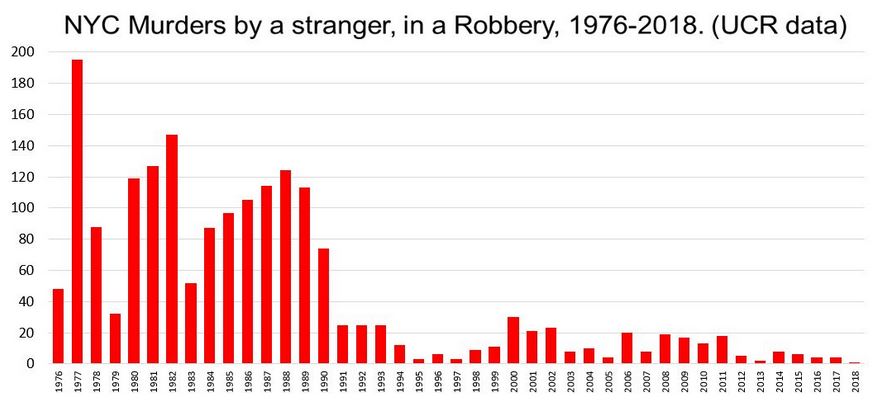
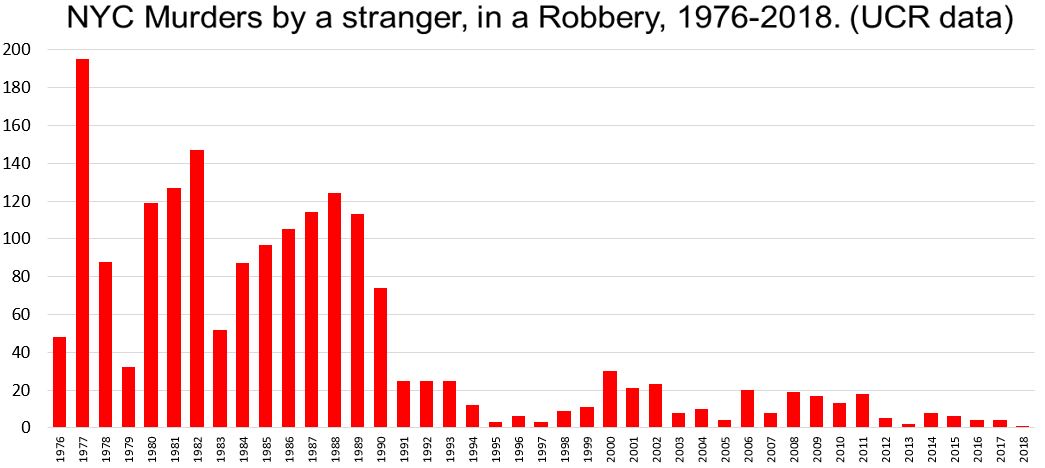
    I’m not going to talk about any of that. Here’s where I do want to go: the numbers. I like data. And when I looked at them in New York City, I see these kinds of robbery/murders are rare. Really rare. Particularly for women. And then for white women? It basically doesn’t happen. But it did. and I guess that’s the definition of news.

    I took the UCR murder numbers [FBI Uniform Crime Reports] for New York City. I excluded “unknowns” for all the variables I’m looking at. That is not a moderate cut, particularly with regards to “offender 1 circumstance” and “victim 1 relation to offender 1.” How much it matters? I don’t know. But it does matter. But perhaps not so much to my main point, which is that this type of crime really is rare.

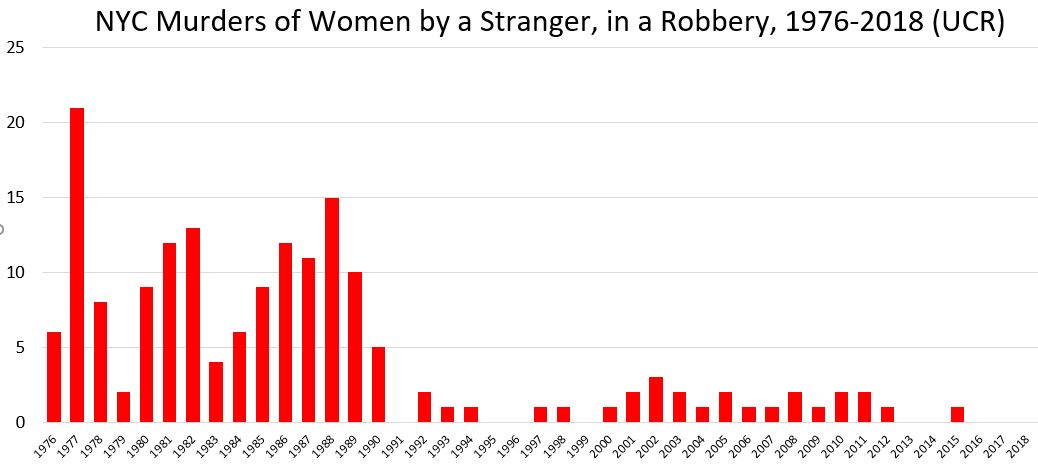
    In the past 20 years — since 2000 — only 2(!) women under 20 have been murdered by strangers in a robbery. It’s the not young who are at risk, but the old. Most women victims are over 50. Five of the 20 women victims were over 80 years old, which seems particularly bad. The last time a white woman of any age was killed by a stranger in robbery was 2015. Before that was 2011 and 2009. All three of the victims were senior citizens. The robber/killers were all in the 30s. One was white, one was black, one was hispanic.

    Since 2012, there have been but 30 people murdered by strangers in robberies in New York City. Total. Last year just one person in New York was murdered in a robbery by a stranger. One. A 66-year-old Asian man. In 2017? Four. All men. Same in 2016. There haven’t been more than 10 such murders a year in nearly a decade and not more than 20 such murders in a year since 2002. But in 1988, there there were 124 such victims! It really was a different city.

    Since 1992 — arguably when New York City started becoming safe — there have been 28 murders of women (and 287 of men) by strangers in robberies. Yes. Total. Since 1992. In 8 different years since 1990, the number of women killed in robbery has been zero.

    As to race, it seems that Asians are disproportionately targeted and victimized. But with that notable exception, victims or robbery/murders seem to reflect the demographics of New York City, at least generally. Offenders are disproportionately (but not exclusively) black men. For the women victims since 1992, 17 were white, 8 black, 2 Asian (1 unknown). Of their robber/killers, 17 were black, 10 white (1 unknown). Two women were murdered by women.

    Note the scale of the y-axis is much more magnified on the second picture.

    My point is that this type of crime — a woman being killed by stranger in a robbery — is rare in New York City. No, not just for white women. And not just for women. So when something like this does happen, it should be news. No, not cause for alarm and the ever-feared (at least in criminal justice circles) “over reaction.” But no, this shouldn’t be swept under the rug. Because we don’t want to go back to the days when the public lived in fear and people were literally being murdered by strangers in robberies gone wrong on a near daily basis.

    Rest in peace, Tessa Majors.

  • Violent, mentally ill, on the street: We need to do better than this

    My op-ed in the Daily News:

    Police officer Lesly Lafontant emerged form a coma yesterday after a bystander, Kwesi Ashun, somehow deemed it appropriate to beat Lafontant with a metal chair while Lafontant was trying to arrest Dewayne Hawkes, wanted on a warrant, after Hawkes had urinated on the floor on a nail salon.

    Ashun was shot and killed by police. His death, not the beating a police officer, received the attention of a City councilwoman, who tweeted, ”My condolences to the victim and their family.” She wasn’t talking about the cop. Later, she talked of working “to bridge the divides.” As if when a man beats a cop nearly to death, the police are partly to blame.

    Ashun had a record, including violent dealings with police. He was arrested for slashing a cop in 2004. Recently his family tried to get him help. “My brother was having a mental episode. He was very angry. He was spiraling [out of control]. They said he wasn’t a danger.” Eleven days before the recent attack, a city Health Department “mobile crisis team” concluded Ashun wasn’t a threat to himself or others. His sister was told to call 911 but refused: “I wasn’t comfortable with dialing 911 on an ill black man. It was too dangerous. So I didn’t call.”

    The man who relieved himself in the salon, Dewayne Hawkes? Despite starting this mess, being wanted on a warrant, resisting arrest, and instigating a series of events that led to a cop in a coma and Ashun being killed, he was released on “supervised probation” without bail. What message does that give to police? Or to the people in the nail salon?

    All serious mentally ill people need help; only a few are at risk of committing serious violence. The problem is New York City has hundreds of thousands of mentally ill and no way to treat them, particularly against their will. They bounce between hospitals, jails and homeless shelters. Some, like Ashun, end up dead. Others, like Randy Santos, will be in prison for the rest of their lives.

    Santos had a long history of violence and strange behavior before being bailed out of Rikers by a bail-reform advocacy group; he now stands accused of having murdered four homeless people, a crime to which he has confessed. Santos’s mother tried to get her son help, but he chose to decline treatment. Perhaps that’s a choice that he shouldn’t have been allowed to make.

    It’s actually not that hard to identify some of the people who need help. If your family tries to get you committed, perhaps you need be committed. Sure, we’d want an independent medical or psychiatric determination to make sure it’s not your family that is crazy, but it should be possible.

    This part isn’t about bail reform; it’s not about police use of force; it’s not about affordable housing for the homeless. This is about people being hurt because families are unable to get help for their loved ones.

    But there is a link to bail and criminal justice reform. And it’s not just a right-wing overreaction. Basically a few hundred people — a few hundred repeat offenders we can red-flag — are going to destroy the worthy gains of reform because we have no system to deal with them.

    The plan to close Rikers Island calls for a 60% reduction from current low levels, and some of those 60% will be violent and mentally ill. They need help, and they’re not going to get it.

    It behooves reformers and legislators to solve problems that are both inevitable and, if unaddressed, will doom reform efforts. The MTA is currently prohibited from banning repeat criminal offenders from the subway, even the few who push people onto subway tracks. New York judges are legally prohibited from considering a person’s “danger to the public” when setting bail. Public peace of mind requires it.

    Current reform will further limit judges’ ability to hold people and, by design, restrict police officers’ authority to arrest. On Jan. 1, almost all misdemeanors and some felonies, including some robberies and burglaries, will become not-detainable offenses. Offenders are to be given an “appearance ticket” that requires pre-trial release.

    We know that most of those are detained on low level crimes aren’t mentally ill or violent. But some of them are. If we won’t or can’t detain criminals and treat the violent mentally ill before they do harm, what is Plan B?

    The severely mentally ill do not belong in jail. But they also don’t belong on the street. They need help for their sake and for ours.

    Moskos, author of “Cop in the Hood,” is a professor at John Jay College of Criminal Justice.

  • FOP Report: “Mismanagement of the BPD and its Impact on Public Safety”

    I’ve read this so you don’t have to. But you should. This is
    put out by Baltimore City FOP #3. So sure, take it with a grain of salt. But FOP #3
    isn’t like some other unions that tweet ill-advised statements that hurt the
    image of policing and their members. [cough NYPD’s PBA SBA!]

    In 2012 FOP #3 released “Blueprint for Improving
    Policing.” It was far more right than wrong. It was ignored. Had it been
    followed, perhaps the 2015 riots wouldn’t have happened. Then Baltimore would
    still be seeing declining crime and an influx of people.

    In 2015 FOP #3 released an “After Action
    Review” of the riots that, again, was basically correct. As the Baltimore
    Sun put it: “If what the FOP reported is wrong, the Mayor and Commissioner
    need to prove it.” Needless to say, they didn‘t. 

    So in the context that this is not an ideological screeds
    but a union perspective put together by a consulting team (that’s OK, even
    encouraged) consider some of the points in the FOP #3 report about the
    Mismanagement of the Baltimore City Police Department.

    This is not a crime plan. (But it least it doesn’t pretend
    to be.) The consent decree isn’t a crime plan nor are reformers’ proposals to
    reduce police violence crime plans. We need a crime plan. But this is about
    fixing the organization. The first step.

    There is still a leadership problem: Officers fear proactive
    policing because of unjustified criminal prosecution by the state’s attorney. This isn’t just “we don’t want to be held accountable” griping. See, eg, this.

    As to the consent decree, “police have not been informed or
    training in following the consent decree.” But the major issue right now is
    probably staffing, and that results in overtime which costs money and, when
    mandatory, low morale.

    Hire people to fill vacancies instead of paying overtime. As
    to recruitment: train recruiters in how to recruit, conduct exit interviews,
    recognize exemplary employees, and pay past due recruitment bonus. Seems like
    common decency, much less common sense.

    There is currently budgeted funding for 470 more police
    officer positions, plus 100 civilians. Standards should be higher. And pay and
    benefits at a level to attract good candidates.

    There are currently only 634 officers assigned to patrol.
    That is just 70 officers for each of 9 districts! (And may include sergeants,
    light duty, medical, etc.) This is probably less than half of what it used to
    be. I read this and said, “can it be?” It can.

    Back in 2001, just one district (of nine total)–my
    district, the Eastern District–had 265 total assigned sworn police officers.
    We had 130(!) working patrol officers for 3 shifts. And I’m just talking
    officers (not sgt’s and LTs or light duty or medical). Violence went down.

    Officer numbers are down because BPD has replaced only 80%
    of losses since 2001, for a decline of 850 police officers (to 2,480). This is
    25%(!) reduction in numbers. And the trend has worsened since 2014.

    And when numbers are down, you can’t take officers from HQ
    or consent decree compliance or specialized units or the mayor’s detail or the
    academy. So you pillage patrol, the so-called “backbone” of any
    police department. And that is what has happened. BPD needs a
    backbone.

  • Murder down for whites but not blacks

    The 2018 murder rate is down from the previous two years, but higher than we’ve seen in 6 of the past 10 years. Last year’s murder rate is the same as 2015. And 2009! And yet I keep hearing every year that violence is down. So what’s this trend? And sort of related, why do some people insist on the “violence is down” message year after year, even when it’s not true?

    Yes, violence is lower than it was in 1991. Violence will hopefully always be lower than 1991. But that doesn’t mean violence is trending down year after year. If we keep starting the graph around 1991, violence will always look downward trending.

    The murder rate in the US actually peaked in 1980 at 10.2 (per 100K). And then there was the lesser but better-known crack-trade-related murder peak of 1991 (9.8 per 100K). So we’re down from there, no doubt.

    Violence plummeted in America between 1994 and 1999. It might be worth pointing out that is right after the Biden-supported and now maligned crime bill. I don’t actually think that’s why crime went down, but it does correlate. And it didn’t hurt. It might have helped.

    Whatever the causes — and I do think better policing (along with changes in drug dealing) was a huge part of the solution — many lives were saved between 1994 and 1999. Of course, as always, there were racial disparities. Blacks benefited most from the decline in violence. From 1994 to 1999 the number of black murder victims dropped from about 12,000 to 7,000 per year! White murder victims declined, too (but less so, from 11,000 to 8,000). This brings us to 1999.

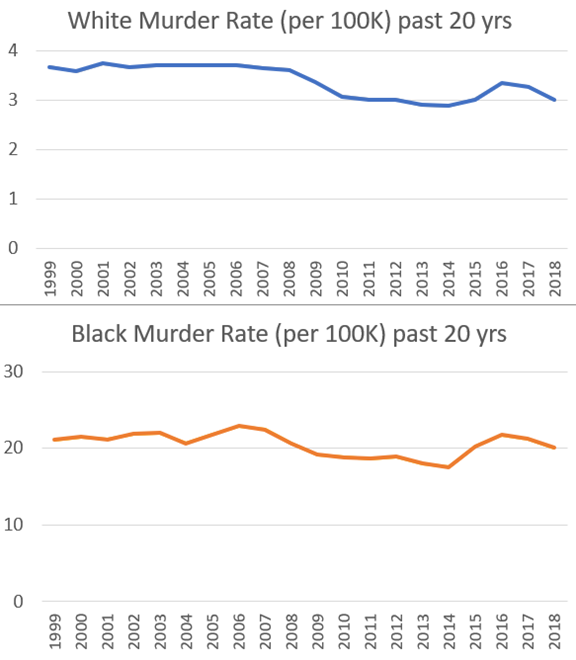
    Since 1999, the murder rate for whites has dropped even more, another 20%. Great news! But not for blacks. In absolute numbers, more blacks were murdered in 2018 than in 17 of the past 20 years. That’s not a good trend.For African Americans, murder has been up and down over the past 20 years. But the murder rate is no better in 2018 than it was in 1999.

    Image


    What bother me is some of my friends who insist “violence is down” are well intentioned white people who live in safe neighborhoods, hashtag#BLM, and believe those who advocate less policing in other people’s neighborhoods. (Neighborhoods they won’t set foot in, mind you.)


    Yes, violence is down compared to 1991. But is it a sustained “trend”? Not really. Not if you start the clock in 2000. And not for non-whites. Not for young black men in particular. So when people say violent crime is down, ask “For whom?”


  • Rest in Peace, NYPD Detective Brian Mulkeen

    Brian Mulkeen was a Fordham grad and worked at Merrill Lynch till he quit his job and joined the NYPD. Apparently Mulkeen was killed by “friendly fire” while wrestling with an armed suspect.

    There’s a nice 1 minute video on twitter. I was mostly just sad and dry eyed till “Country Roads” kicked in. Because he’s not just a cop; he’s a person. RIP, Brian Mulkeen.

  • “Stop the car or I’ll step in front of it”

    “Stop the car or I’ll step in front of it”

    This was not a good shooting. And cringe-worthy from an officer’s perspective. From the suspect’s perspective, well, he’s dead.

    I’m quoted in this article.

    The background is the car popped up on a stolen car list (I think from an automated license plate reader). The officer is told to investigate. The car is in a parking lot. There is no car stop. There was no fleeing that preceded this.

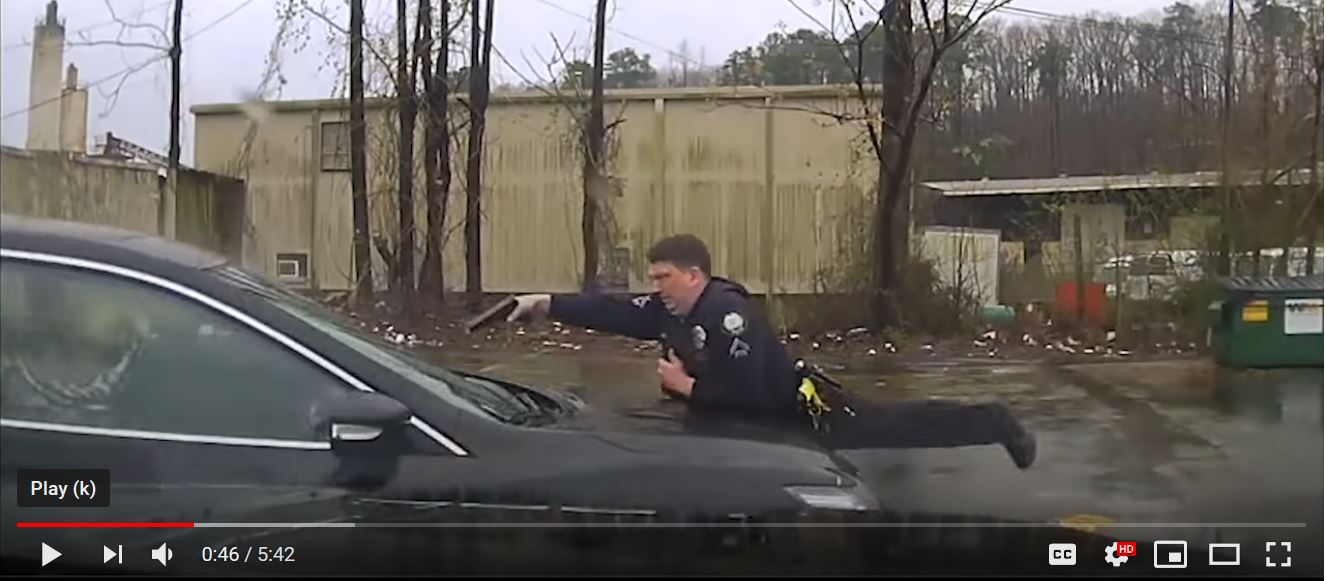
    The first problem is Officer Starks stops his car in front of the stolen car. That in itself isn’t bad, if you don’t care about your police car. But he does so in such a way that he has to get out of the police car in front of the suspect’s car. You don’t do that by choice.

    The second problem is the officer doesn’t wait for backup and the third problem is he exits the car with his gun drawn (or immediately does so after exiting the car). If you feel the need to approach the car with your gun drawn (which is fine but not required for a car that comes back stolen), shouldn’t you also feel the need to wait for backup? Either there’s a potential threat or there isn’t. And if there isn’t, he shouldn’t have had his gun out. And if there is, he should have waited for backup.

    There was no good reason to think the driver of the car, later identified as Bradley Blackshire, was armed. Though indeed he might have been. But he wasn’t. (Though in an odd but irrelevant twist the passenger later tells cops on the scene that Blackshire “has a gun,” even though he doesn’t; no gun is found. Turns out she got of jail that day. She asks to get her jacket back, because, you know, it’s cold. She’s bizarrely calm and compliant after all this.)

    But the fourth problem is the biggie. The driver, Blackshire, starts to slowly drive away after not getting out of the car, and the officer shoots and kills. When the car starts moving, Officer Starks is on the driver’s side of the car. The car is brushing against him, but it is not going to hit him. There is no threat. Just a dude slowly driving away at gunpoint. Yes, the driver could have complied. Should have, even. But non-compliance is not the issue. Non-compliance is pretty common. More to this point, non-compliance is not a lethal threat. The officer shot four times and killed Blackshire over being in a car reported stolen (it’s not clear it ever was) and “failure to obey a lawful order.” That’s unacceptable. Also likely a convictable criminal offense.

    And then, to make matters worse — who knows, perhaps Blackshire would still be alive if Starks had left well enough alone, but no — Officer Starks chooses to nominate himself for a Darwin Award. He steps in front of a moving vehicle.

    Sure, sometimes police officers end up in a chaotic situation where they find themselves in front of a moving vehicle. Shit does happen. But you don’t choose to put yourself in front of a moving vehicle. Especially not if you just shot and incapacitated the driver.

    As I say in the newspaper article: “It’s just shocking to see. Not getting in front of a car is the rare case where general orders, common sense and officer safety coincide.”

    It looks like the driver does indeed hit the brakes when Starks steps in front of the car. But then, if I had to guess — which I don’t, but I will — Blackshire can’t keep his foot on the brake, perhaps because, you know, he’s been shot and is dying. So the car, as cars do, idles forward. At this point Starks goes up on the hood of the car and fires another 11 rounds.

    The car hits and stops against dumpster or something, and then there’s the predictable period of curse-filled verbal commands being shouted at a dead or dying man. Blackshire seems to have enough life left in him to raise his hands, until he doesn’t.

    What makes this situation unusual is that the officer was actually in control of setting the stage for this interaction. Officer Starks chose how to approach, and he chose wrong. And then Officer Starks shot when there was no imminent threat, and then he placed himself in danger and shot again. There never even was a split-second decision that had to be made.

    I’d bet this isn’t the first time Officer Starks made unwise aggressive decisions in his career. And if I have to bet — and I don’t, but I will — this time will be his last.

    [Update: In January 2020, A judge ruled that firing the officer was unjust.] 

  • Quality Policing Episode 25

    There’s a new episode of quality policing. And with a new cohost. Click through and listen here. https://qualitypolicing.com/episode-25-peter-moskos-and-introducing-leon-taylor/

    Download the mp3 file here:

    https://api.spreaker.com/v2/episodes/17113983/download.mp3

  • To call 911 or not to call 911?

    To call 911 or not to call 911?

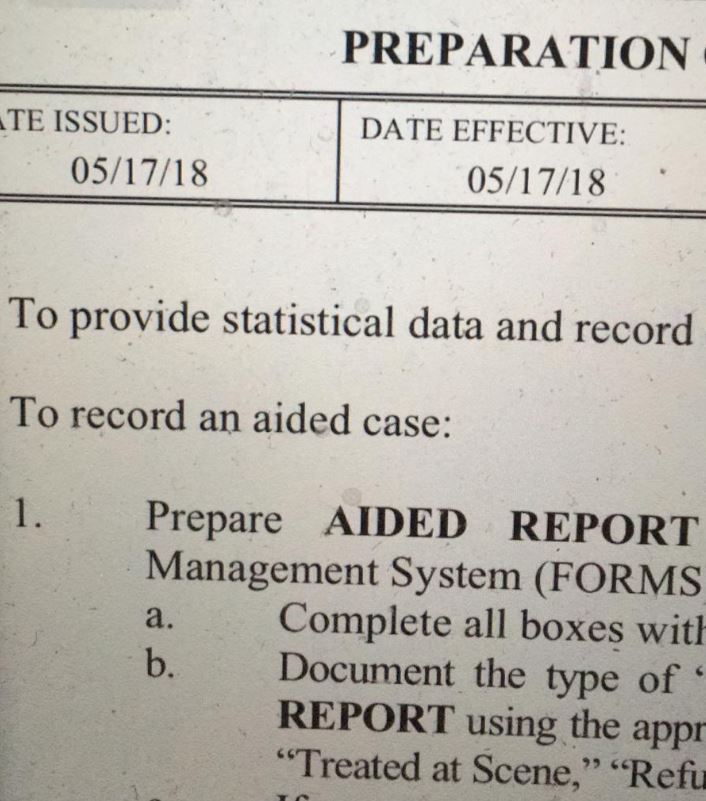
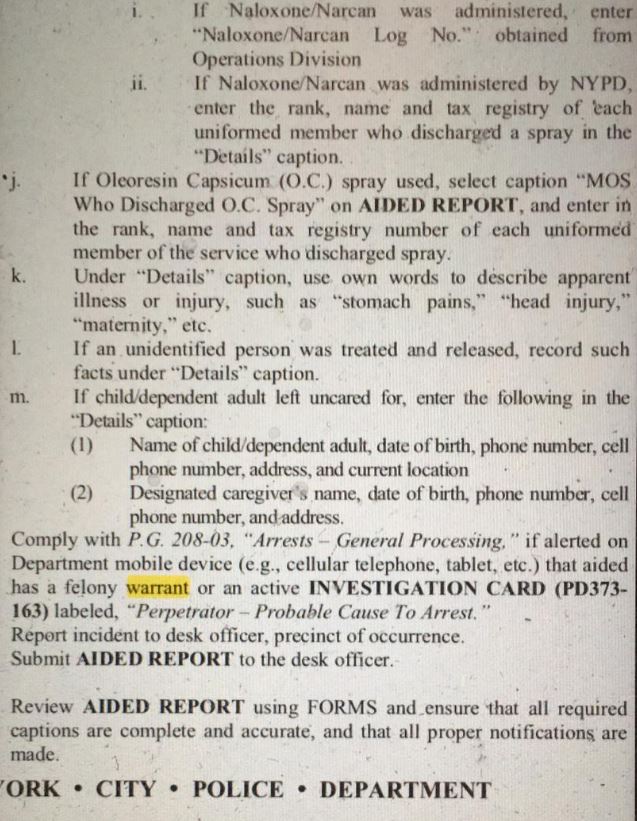
    May 17 of last year the NYPD issued an obscure order concerning “aided reports” — that’s when a cop responds to a 911 call for a sick person waiting for an ambulance (a “bus,” as they say here) — requiring the officer to enter the person’s information into their phone. This looks all technical and boring.


    When you put the “aided card” into the phone, it automatically goes
    and queries the warrant system. This means that if Uncle Pedro has a
    heart attack and he or you is wanted, cops will take you away
    (after medical treatment, but still). Thanks, technology! That’ll teach
    you to call 911!

    Say your Uncle Pedro has chest pains. Or is ODing. Should you call 911? Of course! Right? But what if you don’t know if he’s wanted? What if you don’t know if you’re wanted? Should you still call 911? You know cops might also respond because, well, why not? Maybe cops can do some good
    before the ambulance arrives. (Though generally, as a former cop, when it comes to medical care, are you serious?)
    Or keep the peace. But should you be debating all this before deciding to call 911? While you’re discussing the pros and cons, Uncle Pedro just stopped breathing. 

    The NYPD has spent time and dollars trying to build relations with all communities. We want people to call for help. The goal has always been to bring people into the system, not make them afraid of it. The Neighborhood Coordination Officer (NCO) philosophy is just the latest serious effort. All this will be for naught if people are afraid to call 911 or 311 even for non-police matters.

    We don’t need people thinking EMS are the bad guys. And we for sure don’t need people fighting unarmed EMTs because they’re worried that they the EMTs and paramedics are going to call the police and get them arrested. That’s not good public policy.

    Cops do not have discretion when somebody comes back wanted. A
    warrant is a warrant. And arguably for good reason. A judge hath spoken.
    But there are wanted people out there, and an entire undocumented
    population, for instance, whom we still want to call 911 when A) there’s
    a fire, B) they witness a crime C) they victims of a crime, and D) when
    they need medical care. Needless to say, this is not an inclusive list.

    Perhaps for minor violations, when you know the person’s name and addresses, just give the guy something like a “must appear notice,” like the one he never got because it was mailed to his address from three years ago. Then bounce it to a detective for follow up. A surprisingly large percentage of people who have warrants simply do not know they are wanted. Give them 60 days or something. Why is the only part of the criminal justice system that moves quickly the one in which somebody wanted is taken in?

    It’s in everybody’s best interests to have people turn themselves in at a more convenient time. This can be the difference between staying employed or being fired. Most warrants are not over urgent matters. And often staying employed can make all the difference in the world.

    Could it become common in NYC hospitals (and not the hospitals serving rich white people) for police to run the names of visitors and patients while they are waiting around? For some, their injury or presence might constitute grounds for a probation or parole violation. This is exactly what Alice Goffman said was happening in Philadelphia. (It’s not clear it actually was happening, but people thought it was, and that’s bad enough.)

    New York City has an estimated undocumented population (aka illegal immigrant) population of 560,000. Even in a sanctuary city, people — more than half a million New Yorkers — are afraid. Currently NYPD doesn’t share this information with ICE. But that could change overnight. Recently I had an immigrant student whose boyfriend was hit by a car. He was hurt. The driver stopped, but the boyfriend didn’t want to exchange information. A guy hit by a car through no fault of his own was afraid to get the driver’s information or go to the hospital. This is not good.

    What problem is this solution supposed to fix? “We want the cops to put an aided card into the phone on the scene and it to automatically query the warrant system.” It is bad policy to routinely run warrant checks on people seeking medical care.

    I know it’s not in the public’s interest to have wanted people running around. It’s one thing for police to run somebody because they have suspicion. It’s another to do so because they called for help. It’s not in the public’s interest to have people afraid to seek medical care or see EMTs and paramedics and the FDNY as part of law enforcement. Let’s base a policy decision based on evidence rather than, “hey, cops now have smart phones linked to the warrant system!”

    One interesting (at least to me) thing I learned in talking to somebody about this, cops in New York did not routinely run (check for warrants) every time they 250d (stopped) somebody. In Baltimore, we ran basically everybody we stopped. This is a big difference in police behavior, and I’ve never heard anybody discuss or even be aware of this. But even in Baltimore we didn’t routinely run people on medical calls. In part we didn’t want to know. Because if the person is wanted and going to the hospital, guess who gets to babysit the patient until they’re released? Not a good use of patrol resources. And the next shift will really hate you, too.

    Maybe we ran more people in Baltimore than they did in NYC because more people were wanted. But it probably had more to do with an unrelated technological issue. One radio channel in Baltimore covers one district (aka precinct) with 1 dispatcher for 15 (often fewer) patrol units. One radio channel in New York covers multiple precincts and has perhaps 10(?) times as many officers. It takes precious air time to run a 10-29 (Balto code for, check warrants). And air time in New York is more precious. Many stops, even car stops, weren’t called in. That’s not safe or good policy. Something as simple as how many units are on one radio channel, can change police culture more than any formal debate or informed policy. Maybe it shouldn’t be that way.

    And if it is good policy to check people in medical crisis for warrants, and I don’t think it is, they hey, why not go all-out and front-end it to the 911 and 311 operators. Let them be part of the system, too. At least it would be honest. “Thank for calling 911. This call is being recorded and you are being checked for any felony warrants. Now, what is your emergency?”

  • What’s Up With Crime Being Down in Camden?

    What’s Up With Crime Being Down in Camden?

    Let me start by saying I don’t know much about Camden, New Jersey. So if you know more, help me figure things out.

    The city of Camden is just across the river from Philadelphia. It’s part of Camden County. The city has a declining population of about 75,000. Camden is about half black and half hispanic. It is, by any quantifiable measure, a “struggling” place. I wrote a post about violence in Camden back in 2015.

    In 2011 the city and police department were in crisis and announced plans to abolish the police department and start fresh, with a new police department. In May 2013, the city police department was abolished (in part to break the police union, which has since re-formed). Anybody that wanted to stay on had to re-apply for the job. Since then, the new Camden County Police Department covers Camden City (and only Camden City) while in Camden County, I guess some other agencies (I presume local agencies and/or the sheriff) do the work.

    This all makes data gathering a bit confusing. But I (painstakingly) went through the UCR’s arrest numbers for Camden City from 2009 to 2016 (the last available year).
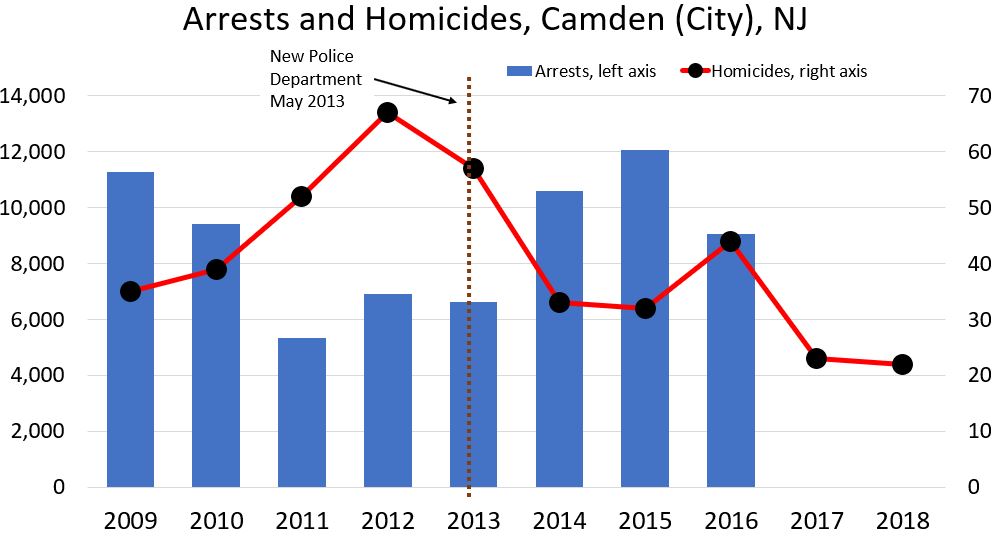
    Nice chart, if I do say so myself.

    If history is a guide, and they say it is, when people blame an institution for human problems and tear it down and start new, after a few years you end up with pretty much the same situation and problems. Police are as much a product of their environment as anybody else. There are still occasional problems of corruption and brutality in Camden. Cops still get attacked. And Camden is still mired in poverty (a 37% poverty rate). But poverty is declining and money is being invested.”

    Meanwhile, across the river in Philadelphia, murders are up 25 percent (2016-2018). I do presume “underlying social conditions” haven’t gone that drastically in opposite directions in these neighboring cities just since 2016. So what if — crazy idea — police (and prosecution) actually matter. Maybe a lot. And even more than the so-called “root causes.”

    I mention this because the new Camden County Police, policing Camden City, have become the progressive reformers’ dream team (despite being founded, in part, in a fit of Republican union busting). Since 2013 there have been a lot of positive press, but here is one example that presses all the feel-good buttons like “strategic shift toward community policing” and “rebuilding trust between the community and their officers” and “being mentors in the community” and “a showroom for community policing techniques” and “nothing stops a bullet like a job.” OK, but all that sets off my BS alarm.

    In terms of crime, the proof is in the pudding. Give credit where credit is due. And here’s the thing: violence really is down. A lot!

    Last year there 22 murders and the year before 23, down from 67(!) in 2012. Shootings also been cut in half. Maybe police culture really did change for the better. Or training. Or technology. Or strategies. Or maybe police are now simply funded at the proper level they had not been. Or maybe we’re getting more for less. I don’t know.

    But I do know, despite what is often reported, it hasn’t been just kumbaya with carnivals and free ice cream. Those gimmicks can be part of building trust, but they’re not crime prevention strategies. Non-criminals need more positive casual interactions with police. Criminals need more interactions, too Perhaps not all so positive, but still professional and respectful. (The person you arrest today can be your source or even save your ass tomorrow.) As Chief Thomson says), “Nothing builds trust like human contact.”

    And speaking of human contact, reported use-of-force — usually something reformers want to reduce — increased dramatically with the new police department. That could mean cops are now more brutal, but more likely cops are policing more, and some of that leads to justified use of force. Camden is being lauded by reformers for bringing down crime with exactly the form of pro-active policing loathed by the same reformers!
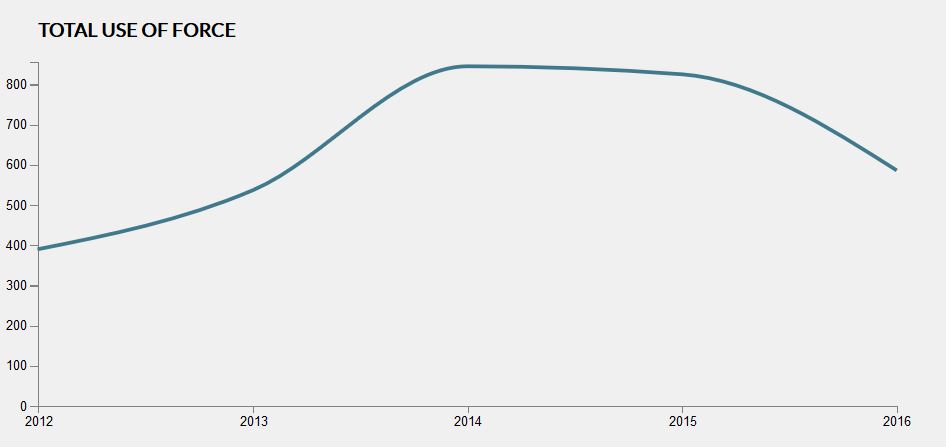
    http://force.nj.com/database/pd-dept/camden-camden

    Force went up. Arrests went up. Crime went down. But what about the idea, very popular among reformers who don’t live in high-crime neighborhoods, that arrests are bad, and people in dangerous neighborhoods hate police because police are arresting (or shooting) people of color for no good reason.

    If you decriminalize minor offenses, goes the hope, police “legitimacy” will increase, which along with leading to less incarceration means more solved crimes and many other wonderful things. It sounds good, especially if you think police are the problem and your neighbors aren’t.

    Based on UCR arrest numbers, arrests went up with the new police department. Camden cops are arresting more people, and crime is down. There may have also been better policing, but there was also just more policing. And the kind of arrests that increased — low-level discretionary arrests — would indicate that police focused on quality-of-life issues and Broken Windows. This is not the reformers’ party line.

    Caveat: I really hate using arrests as a metric for anything, much less good policing. But arrest data is available. And huge changes in arrest numbers tell you something is going on. Arrests can be a proxy for pro-active policing: cops stopping suspicious people, chasing and catching the bad guys, cops less afraid of making an honest mistake. My inquiry into Camden was inspired by thisarticle from March 2017 (that I just read) saying drug arrests were way down. Except that seems not to be true.

    In 2011, Camden cops may have lost a little of whatever go-getter spirit they still had. This was Camden’s Ferguson Effect (pre-Ferguson). Cops were told they were no good and their job was on the line. Arrested dropped 50 percent, from 11,000 in 2009 to 5,348 in 2011. Along with Camden, Baltimore and Chicago also saw similarly quick and drastic decreases in quantifiable policing. And in all three violence shot way up. Yes, correlation that is also causation [thunder clap]. At the start of 2012 Camden laid off 45 percent of the police force. Murders went up to 67 (which is a shocking number for a city of 75,000).

    Let’s compare 2012 and 2014 Camden, when murders went down from 67 to 33:

    • Drug arrests up 79% to 3,052.
    • Marijuana possession arrests in particular up 467% to 488.
    • Curfew and loitering violations up 34% to 1,128.
    • “All other offenses (not traffic)” up 50% to 3,352 (This most minor category is probably something catch-all like disorderly conduct, trespassing, loitering).
    • DUI arrests up 483% to 175 (an indicator of more policing).
    • Non-felony (ie: discretionary) assaults up 57% (to 754).
    • And murder arrests — because there were fewer or them — down 23% (to 20).

    Policing get “better,” but what does that mean? Maybe police officers have better manners. That matters. But what brings down crime is focusing on repeated violent offenders, usually young men, who commit the vast majority of violence crime.

    There’s irony here in that this little department so loved by progressives, has achieved success, in part, by arresting more minorities. And you know what kind of arrests increased the most? All the little ones that reformers want to stop in the name of social justice But those progressive reformers don’t live in Camden. If you do live in Camden, you probably support anything that works.

    For a small city, 9,000 arrests is a very large number. Scaled up to the population of New York City, for instance, this would be over one  million arrests a year (compared with the 240,000 arrests in NYC last year). One arrest for every 8 people is similar to the arrest rate that Baltimore had in the early 2000s (when I was there and violence was going down). This is the same arrest rate people (stupid people, mind you) blamed for Baltimore’s riots a decade later (arrests and crime in Baltimore dropped drastically from 2003 up until the riot of 2015).

    Now keep in mind arrests are not good on their own. It’s very important what the data do not reveal. How many times did cops change behavior without resorting to arrest? My guess is a lot. More good policing does often lead to more arrests, but it’s really important to put the horse before the cart. Policing is the goal. Not arrests. “More arrests” is never a good strategy.

    I’d like to know how many people were arrested in Camden in 2017 and 2018 when murder really dropped. In the ideal world, violence and arrests (and incarceration) all go down in sync. That’s the win-win(-win). But residents will always choose more arrests and less violence rather than the standard police reform package of less policing and more violence.

    One moral, and you see it time and again, is you don’t have to fix society’s problems to fix violence. Violence is not inevitable. But equally important is the corollary that you can’t fix society when violence is out of control. Most residents want more police. They want visible police who maintain order and treat people with respect. It’s not too much to ask for.

    Maybe what is going on in Camden is just slapping lipstick on a pig. But hey, it’s hard to argue with success. Don’t underestimate good PR and a progressive-sounding chief who both controls the narrative and won’t give in to anti-policing naysayers. And it’s likely that what the arrest numbers do not show — better hiring, training, culture, attitude, accountability, and leadership — is what makes effective aggressive policing possible, or at least palatable.

    Camden homicide numbers

    2018: 22

    2017: 23

    2016: 44

    2015: 32

    2014: 33

    2013: 57

    2012: 67

    2011: 52

    2010: 39

    2009: 35

    2008: 53

    2007: 45

    2006: 33

    2005: 35

    2004: 49

    2003: 41

    Non-fatal shootings

    2017: 95

    2016: 92

    2015: 109

    2014: 90

    2013: 143

    2012: 172

    Arrests

    2009: 11,280

    2010: 9,414

    2011: 5,348

    2012: 6,903

    2013: 6,613

    2014: 10,582

    2015: 12,049

    2016: 9,052

    Notes: In the data (for 2016, ISPSR 37056 and 37057) variable “offense” the value 18 is the total for drugs. Subtotals follow. Values 180 and 185 are again subtotals of what follow. This makes drug arrest numbers very easy to triple count, as I did at first.

    For 2009-2012, I’m assuming Camden City is the agency with the listed population of 77,665. I ignore the other Camden, which presumably is the rest of the county. After 2013 (unless I’m wrong) Camden City is the agency “Camden County Police Dpt” with a listed population of about 75,000.

    As always comments and corrections are welcome. Replications welcome; data available on request.

    Some sources: https://www.nj.com/camden/index.ssf/2018/01/camdens_2017_murder_rate_was_the_lowest_in_decades.html

    http://www.camconnect.org/resources/CrimeMaps.html

    https://camdencountypros.org/unit-list/homicide/#tabpanel22

    https://www.icpsr.umich.edu/icpsrweb/ICPSR/series/57