Author: Moskos

  • Videotaping police isn’t quite as legal as you thought

    Honestly, my eyes glazed over a little bit reading (most) of this. But you should still read it. In much of the country, it’s still kind of a legal gray area about whether or not you can record police.

    I did an L.A. radio show a while back and a cop called in with a very insightful comment: older cops are still bothered by people filming them or taking their picture. Younger cops think it’s pretty normal for people to be holding up their phone when something interesting in happening.

    Regardless, the advice I would give to police officers is that it will undoubtedly be legal and protected in the future. So stop fighting it and get used to it.

  • Killed by Police (2 of 3): Race

    Killed by Police (2 of 3): Race

    [See parts 1 and 3 and NYC]

    Using the data from killedbypolice.net, I looked at the race of those killed by police. Though before I give you these numbers, ask yourself this question: what percent of those whom cops kill do you think are white, black, and hispanic. Forgive the callousness, but we’re talking numbers. And this figure will get to the core of the notion that cops are “gunning for” or “hunting” black men.

    [Update: These are based on the best data from April, 2015. As of November, 2015, we have more data, but I don’t believe the conclusions have changed substantively. See also the Guardian and also, slightly better for what they exclude, the Washington Post for more up-to-date numbers on those killed by police. All three data sources are more or less in sync.]

    Given that blacks are 13 percent of the population and whites about 65 percent, what percentage would expect to see among those killed by police? Presumably police are more likely to shoot a murderer than an average Joe. So I wouldn’t think it’s reasonable to expect to find that blacks would be just 13 percent of those killed by police. What percentage would you expect to see. What percentage would mean there isn’t a problem of police shooting African Americans in particular (as opposed to police just shooting too much in general)?

    Presumably police are (and should be) more likely to kill those who are willing or trying to kill other people. [Update: others have used arrest rates as the denominator, which seems like a good way to analyze racial disparities vis-a-vis police interactions.] Nationwide, blacks are also about 50 percent of murder victims (and thus presumably murder perpetrators, since most homicides are intra-racial). Over the past 10 years, according to FBI data that looks at those who have feloniously killed a police officer, whites are 53 percent and blacks are 44 percent.
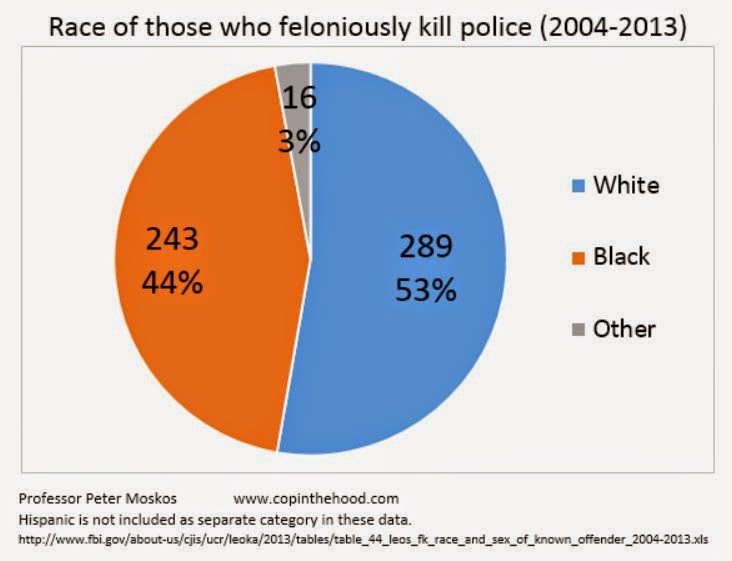
    [For various reasons, none particularly good, FBI data seems to lumps all hispanics into the white category. The data at killedbypolice.net counts hispanics as separate. But it means that hispanics are invisible in the FBI data but counted in killedbypolice data. And I’m using both. So consider this a fair warning about comparing numbers and figures from different data sets.]

    One would hope that the racial breakdown of police-involved homicides would be not out-of-wack with the racial breakdown of those who kill police. This indeed seems to be the case: 48 percent if those killed by police are white, 30 percent are black, and 18 percent hispanic (the doesn’t-add-up-to-100-percent bit consists of Asian, Indian, Pacific Islander, and other.)
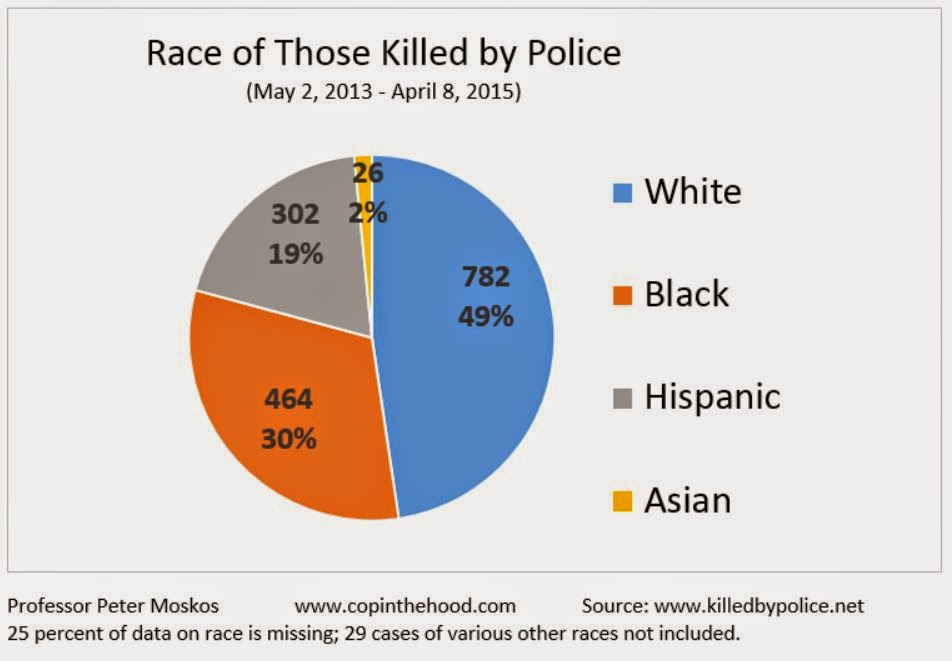
    Though if you’re so inclined, and I see so reason not to, you could spin the same data this way:
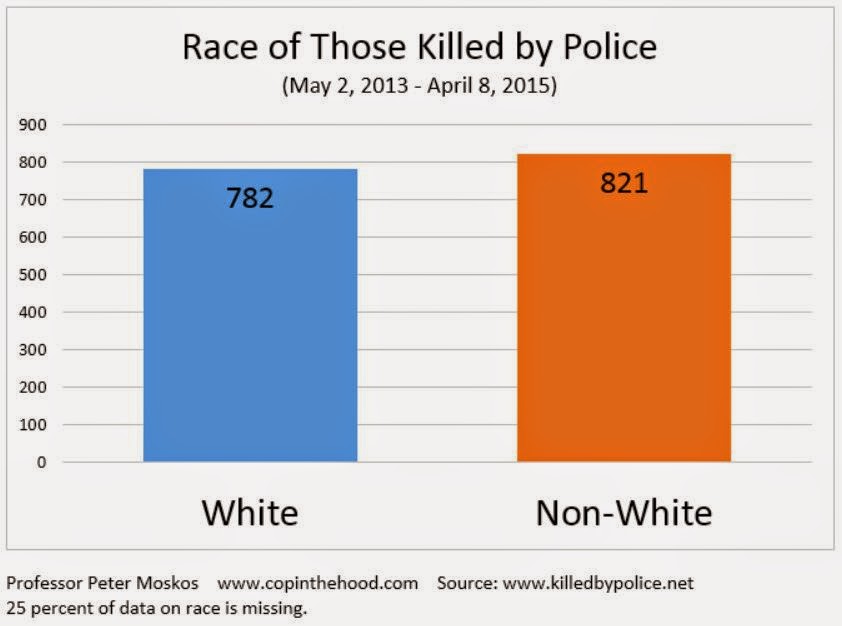
    Now the data doesn’t indicate which shootings are justified (the vast majority) and which are cold-blooded murder (not many, but some). And maybe that would vary by race. I don’t know, but I doubt it.

    Still, per capita, blacks are 3.5 times more likely than white men to die at the hands of police. This is now adjusted for population, and only includes men.
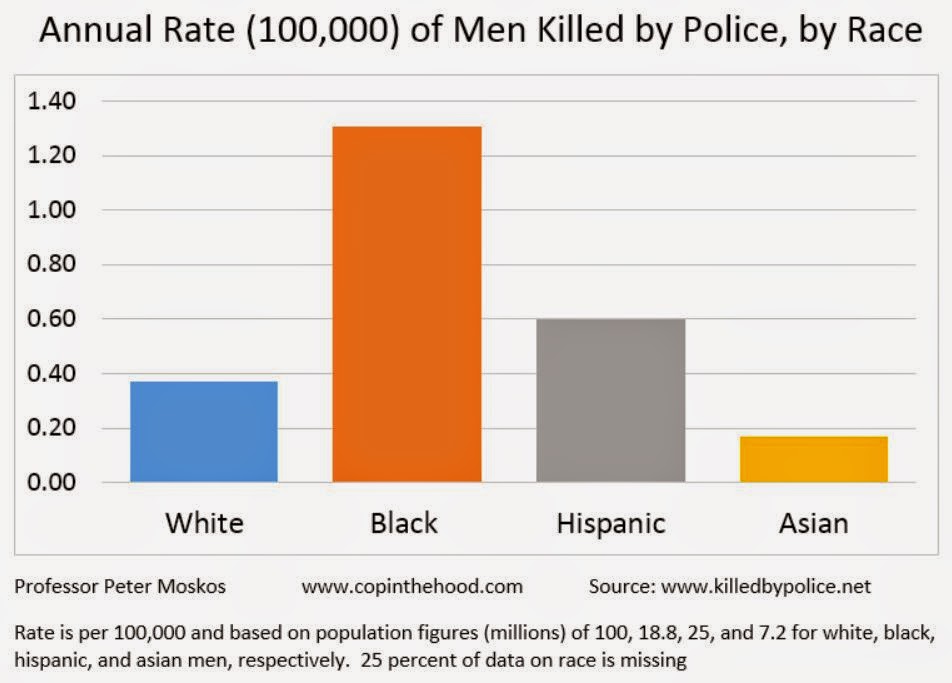
    Keep in mind the homicide rate for the entire country of Canada is 1.6. So a homicide rate of 1.3 for black men just killed by police (!) is very high.

    While it is a very damning figure for our country, it’s not necessarily damning for police. There is a 6:1 (per capita) black-to-white homicide rate disparity and a 4:1 black-to-white disparity (per capita) among those who felonious kill police officers. Given disparate rates of violence, it would be naive to expect equal rates among those killed by police.

    Adjusted for the homicide rate, should one choose to do that, whites are 1.7 times more likely than blacks die at the hands of police. Adjusted for the racial disparity at which police are feloniously killed, whites are 1.3 times more likely than blacks to die at the hands of police.

    Another statistic: A black man is 16 more likely to be killed by a cop than kill a cop. A white man is 20 times more likely.

    Though it goes against the all-cops-are-racist narrative, it’s not inconceivable, given an equal threat level, that a white person is actually more likely to be shot by police. I’ve gone into these reasons before, and it’s just speculation, but two I want to highlight are 1) cops in more minority cities face more political fallout when they shoot, and thus receive better training and are less inclined to shoot, and 2) since cops in more dangerous neighborhoods are more used to danger; so other things being equal (though they rarely are), police in high-crime minority areas are less afraid and thus less likely to shoot. Based on experience, I suspect that police in high-crime areas deserve more credit than they get for not shooting. Some of the bad shootings I’ve seen recently… I can’t imagine a cop in Baltimore being so damn scared for no good reason.

    So I am saying that a guy with a gun in the ghetto might actually be less likely to be shot by a cop who is more used to danger and guns. But a guy with a gun who makes a sudden movement in a neighborhood with a cop who has never faced danger in the face? Boom. [Update: it’s not like unarmed white people don’t also get killed by police.]

    All this said, one should keep all this morbidity in perspective. The odds that any given black man will shoot and kill a police officer in any given year is slim to none, about one in a million. The odds for any given white man? One in four million. The odds that a black man will be shot and killed by a police officer is about 1 in 60,000. For a white man those odds are 1 in 200,000.

    But the odds that any given police officer will have to shoot and kill somebody this year? 1 in 1,000. That is not negligible. Add when one adds in the times a cop was afraid for life and didn’t shoot? Or an officer did shoot and missed? Or shot and wounded? And then you multiply that by 20 years? Those are odds most people would not accept in a job description.

    [Go back to Part 1 or forward to Part 3.]

    #

    [My critique of ProPublica’s misleading claims. More analysis from St. Louis NPR.]

    [Corrections welcome. Please double check my work.]

    Those last figures are based very roughly on 1 million cops, 1,000 killed by police, 20 million black men, 333 killed by police, 100 million white men, 500 killed by police. For everything else, feel free to check my math and excel formulas, if you can make sense of this:
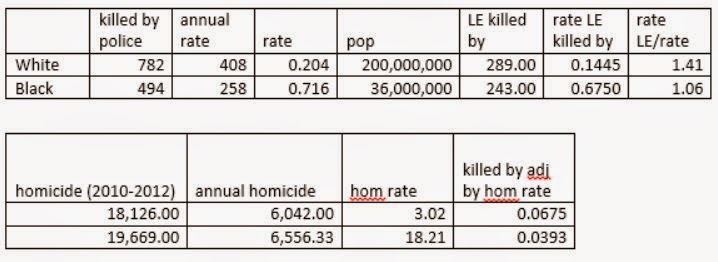
    For reference, the top-left cell is Row 13, column A. Annual rate =SUM((B14/2)*(24/23)). Rate: =SUM(C14/(E14/100000)). Rate LE killed by= =SUM(F14/(E14/100000)). Final rate: =SUM(D14/G14). Hom rate: =SUM(J14/(E14/100000)). Killed by adj by hom rate: =SUM(D14/K14).

  • “‘Hands up, don’t shoot’ was built on a lie”

    I thought we all knew this by now, but apparently some people missed the memo. Responding to my Washington Postop-ed, a few people see rather upset that I wrote:

    In Ferguson, as the Justice Department made very clear, all credible evidence supported officer Darren Wilson’s account of a justified, legal and necessary shooting. Brown robbed a store, fought for the police officer’s gun and then physically charged the cop.

    People, this isn’t debatable any more.

    If you still don’t want to believe this and won’t read the DOJ report, read my summary or a very brave piece by The Post’s Jonathan Capehart:

    “Hands up, don’t shoot” became the mantra of a movement. But it was wrong, built on a lie.

    It is imperative that we continue marching for and giving voice to those killed in racially charged incidents at the hands of police and others. But we must never allow ourselves to march under the banner of a false narrative on behalf of someone who would otherwise offend our sense of right and wrong. And when we discover that we have, we must acknowledge it, admit our error and keep on marching. That’s what I’ve done here.

    Or John Maynard Keynes or Paul Samuelson may or may not have said: “When the facts change, I change my mind. What do you do?”

  • Killed by Police (1 of 3): New Data!

    Two years ago a somewhat shadowy person or group began compiling all media accounts of people killed by police. It’s at killedbypolice.net. Best I can tell, he/she/it/they do a pretty good job.

    According to the site: “Corporate news reports of people killed by nonmilitary law enforcement officers, whether in the line of duty or not, and regardless of reason or method. Inclusion implies neither wrongdoing nor justification on the part of the person killed or the officer involved. The post merely documents the occurrence of a death.”

    Not that this list is perfect. Certainly there might be some police-involved homicides that don’t make the local paper or TV news broadcast. But there can’t be too many. From May 2, 2013 to April 8, 2015, there have been 2,177 documented cases of people dying or being killed by police. (The vast majority are shot… but see died after being tased). And one cop killed his own family. Personally I wouldn’t include off-duty and not job related, but that’s a minor quibble, statistically.

    The compiled data is impressive both in its thoroughness and documented nature. And compared to only other data we have, such as the crappy UCR data on justifiable police-involved homicides, this killed-by-police list is gold. It’s the first time — ever — we can start looking at who police are shooting.

    So I played with the data. I refined it and shined it real nice and turned it into a proper SPSS file (and removed the few who weren’t killed in the 50 states plus DC). I have everything from when the list started (May 2, 2013) to April 8, 2015. So it’s just under two years of data. N = 2,177

    So the first thing we learn, which we knew, is that the UCR is a vast undercount. But now we have some idea about how much: a bit more than 50 percent. [For the more statistically inclined, the missing UCR data, at least with regards to race, does seem to be mostly random (which is good), which means the UCR data might be OK for some analysis.]

    So we learn that police in America kill about three people a day. Three police-involved deaths a day may seem like a lot. But is it? America is a big country. It doesn’t seem like an epidemic. In a typical day, 38 Americans will be murdered, 90 will die in car crashes, 110 Americans will commit suicide, and 120 will overdose on drugs. Maybe we have to begrudgingly accept three police-involved killings a day as par for a violent nation. But maybe not.

    I think we could rather easily cut the number of people killed by police in half. That would save the lives of around 500 people a year. But I’ll get to that in the third and final post.

    [Part 2]

  • “This one is different”

    An op-ed of mine to appear in Sunday’s Washington Post:

    This one is different.

    Walter Scott was killed — shot multiple times in the back — by North Charleston, S.C., police officer Michael Slager last weekend. Scott, already running away, was no threat to the officer when the first shot was fired. He was even less of a threat when Slager paused and fired the eighth and final round.

    To non-police, Scott’s death may look familiar: Not even a year after Eric Garner died during an arrest in Staten Island, N.Y., and Michael Brown died in a police shooting in Ferguson, Mo., here was another black man killed by police.

    But to law enforcement officers observing the North Charleston tragedy, the case is nothing like “another Ferguson” — and that’s where the police perspective and the civilian perspective on these events diverge.

    Click through to keep reading.

  • “Suspect is down,” says the dispatcher

    Here’s video of the initial Walter Scott car stop. (Yes, his brake light was out.)

    But what I love, which I suppose is kind minor in the grand scheme of thing, is how fucking amazing this drawling dispatcher is. She is bad-ass and calm.

    “Shots fired. He grabbed your taser. Suspect is down,” she drawls, almost yawning, like it happens ever day. But it doesn’t. And that’s how you want dispatchers to act. The last thing you want, and sometimes it happens, is a dispatcher losing control. She (sometimes he) holds the entire police department in her voice.

    Somebody still needs to write the great book or make the great movie about dispatchers. They really are unsung underpaid heroes. So many lives depend on them.

  • “U.S. police shootings not simple as black and white”

    Good article by Tom Blackwell in Canada’s National Post:

    “If we point to the officer and say, ‘You did something wrong,’ we all feel a lot better, and it’s concrete,” said Marcia McCormick, a criminal-law professor at St. Louis University. “But when the problem is the system — you have racism without racists…. It doesn’t seem as harmful, and [is] so abstract that we have a hard timing figuring out how to fix it.”

    Factor in the differences in demographics — blacks make up just 13 per cent of the U.S. population — and that means African Americans were four times as likely to be killed by police.

    Still, Moskos is not convinced that means black people are being disproportionately targeted, arguing that blacks are five times as likely as whites [per capita] to kill police officers, and that much of the policing in America focuses on black street crime.

    “The narrative that cops are out gunning for unarmed black people is just not supported by the data,” he said. “Cops tend to shoot a lot of white people too, it just tends not to make the news.”

    Moskos is worried that the focus on race is distracting attention from what he considers the real issues. Those include the “criminalization of poverty ” and the aggressive police enforcement of relatively minor offences, such as traffic violations and failure to make support payments, the transgression that relatives say made Scott run from police.

    But the incident in South Carolina points to a concerning mentality, [Eugene O’Donnell] said. The officer appears to have taken steps to make his actions seem legal, until the video blew the story apart.

    “It raises the question of whether there is not a culture in some parts of the country of, ‘We can do anything we want and get away with it,’ ” he said. “I worry that at least some of the many police forces in the country work in a culture like that.”

    Even if blacks are not lopsided victims of police force, a larger issue emerged in Ferguson, and again at protests in North Charleston Wednesday: the widespread sense among law-abiding African Americans that they are in a sense harassed by officers.

  • “We got a dead guest”

    It was an odd feeling to be made-up and mic’d and then walk off the set of a TV show.

    I had just rushed (on a Citibike, no less) from AP’s studios on 33rd and 10th (for Dutch TV) to midtown. It’s a studio I’m very familiar with (though not the show). I was rushed on and given a seat before it became clear that the subject was not the S.C. police-involved shooting I signed up for, but the Boston Bomber verdict. I’m no lawyer. I wasn’t there. I got nothing to say. Hell, I don’t even care if the guy is given life or death.

    You gotta know when to say no. So I wished them well, and they wished me well, and that was that. We weren’t live yet (thank God).

    Leaving, I heard a tech guy said into his mic, “we got a dead guest.” That’s a new phrase for me. He then looked at me sheepishly and say, “uh, not literally.”

  • Meanwhile, in the Land of the Free…

    A bad police-involved shooting is a bad shooting. Now admittedly police, being armed representatives of the state, have a higher degree of responsibility than an average Joe. But my problem with the dozen or so media requests I get after something like this is perspective and selective outrage. Perhaps 500 or 600 people are killed by police America each year (it’s a shame we don’t know for sure). The vast majority are justified.

    Just today in my newsfeed there are stories about these other issues. And I’m happy they’re in the news. But these are mostly one-off issues. Bad shootings by police are such a small part of greater nationwide problems. And nobody is calling me about any of these other issues. They don’t galvanize the public. Why not?

    1) People out of jail can’t get jobs. This is a problem that affects 66 million Americans. 66 million! Oh, well.

    2) A prisoner who was going to be released this month dies because of bad health care. A dialysis technician didn’t show up for work. You know, sometimes people can’t get to work. But is our system so screwed up that there’s no backup plan? Somebody died. Others were hospitalized. Hope it doesn’t happen again. But it will.

    3) Something like 90 rounds were fired at a Sweet 16 party in Cincinnati. Just another day in the city. People be crazy. Oh, well. (Also in Cincinnati papers today parents were charged in killing their 2-year-old child. And officials identified a man, a white man with a knife, who was killed by Cincinnati police on Monday.)

    4) A professional basketball player was cut in some stupid club argument.

    5) In Ferguson, you know, that Ferguson, all of 30 percent of registered voters voted in a local election. And that was considered high voter turnout. I mean, if you’re not voting in Ferguson in this election this year… Jeeze, what can I say?

    Meanwhile, and not just today:

    5) More than two-million Americans woke up today behind bars. No other country in the history of the world has locked up so many people, by rate or numbers. I mean Rwanda is the only country that comes close, by rate. And they, it should be pointed out, had a friggin’ genocide.

    6) Best I know, villages in St. Louis County and elsewhere are still funding 30 percent of their budget through taxes, fines, and civil penalties, in effect criminalizing having no money. Similar to the guy in South Carolina who was wanted for failure to pay child support, and then killed. Oh, well.

    And this is just the news from today. And the only way we seem to be able to broach any of these issues is in relation to a questionable police-involved shooting. Here’s the problem: Even if there were no bad police-involved shootings, a few dozen people each year wouldn’t be be dead. But shouldn’t we also care that 38 Americans who are going to be murdered today. 120 Americans will die today from drug overdoses (about half prescription and half illegal drugs). 110 Americans will kill themselves today. Oh, well.

  • Well this look bad.

    Very bad. For a lot of reasons. A man is wanted for arrest for unpaid child support. A cop shoots the man while the man is running away and clearly, at that moment, is not a threat. The officer then apparently picks up and moves and drops his Taser closer to the dead body? Oh, it’s all bad.

    The North Charleston, South Carolina, police officer is being charged with murder.

    The NYT has the video.

    As if the first seven shots weren’t bad enough… the pause and the eighth shot? That last shot, as so often happens, will doom the cop. Though in this case it’s not like the first seven were justified. But even if they were, cops have to justify all their shots. And a pause indicates a reassessment of threat. And then he shot again?