Those who have not been following the trial assume there was some justification to the state’s charges. This assumption may be too generous. The prosecution not only failed to prove its case beyond a reasonable doubt, but as presented, the facts failed to show even evidence of a crime.
Category: Police
-
“Who’s really to blame in the Freddie Gray case”
-
“The people ride in a hole in the ground”: Subway Broken Windows
One point of Broken Windows policing is that it requires police discretion and intelligence. Yes, rules are important so police act without the bounds of the law, but just because something is against the rules doesn’t mean it’s a Broken Window worthy of police attention.
Similarly, just because something is a Broken Window wouldn’t necessary mean it’s against the law. (Though I can’t think of a single example… Actually maybe topless women in Times Square? Not that I personally mind or think breasts are a Broken Window, but apparently others do).
When Bill Bratton was on the cover of Time Magazine in 1996 (for which he was later fired), he was called, correctly, “A leading advocate of community policing.” When dealing with quality-of-life issues as a police officer, it’s not just about blind rule enforcement. It’s about selective rule enforcement based order maintenance and public fear. The law focuses only on the criminal individual. Broken Windows policing gives consideration to the reasonable community standards.
Thankfully (over significant objections from the ACLU and others who wanted to let the live and beg in the subway system), the courts ruled in 1990that begging on the subways is not constitutionally protected free. (Nor should it be, damnit, because it’s a closed and confined space, and people have a right to be left alone, especially when they can’t get away.) In 1997 the court upheld a ban on the unauthorized sale of goods, even political materials.
Yesterday on the subway, in very short order, I saw three illustrative examples. In ascending order of disorder:
1) Is this guy a Broken Window?
Not in my mind. I have a soft spot for Mexican singers on the train. I really do.
I’m a strong believer that people riding the train have a right to be left alone. The subway is for commuting. It is not a free and open public space. And though this guy was violating the rules, I don’t think he’s a Broken Window. Reasonable people can differ. But as a cop, I’m using my discretion and not citing him.
But it is illegalto play any instrument or “sound production device” on the subway. [I can’t believe phonographs are expressly prohibited! (Or that I once violated the phonograph rule….]
[Here’s the unedited two-minute version. He gets added props for playing the whole song rather than hustling through a verse to move to a new car every stop. And another nice thing about musicians like this is they keep away the straight-up obnoxious beggars. I’ve never seen them on the same train. Bad for business. Who would give something to Joe-Junkie demanding our attention when this guy is singing, telling us not to cry?]
2) Are these musicians on the platform a Broken Window?
At first I was thinking that was an officially issued (and auditioned for) spot for subway musicians. Yes, if it’s MTA approved(and quality controlled) it’s legit. But it’s not:
Notwithstanding any other provision of this section, the use on subway platforms of amplification devices of any kind, electronic or otherwise, is prohibited.
That makes sense. A good rule of thumb is that it’s OK if you can walk away from it. It’s not that they’re bad musicians, but what if I don’t want to hear them? Broken Window? Probably not. But I could go either way.
3) What about these guys?
The “showtime” style dancers bother me and a lot of people. Not that these two seem like bad kids (unlike other whom I have seen start fights for people unwilling to move). I call Broken Window. But why? What’s the difference? It’s not just that they’re young and more “urban” (I love using that code word in a completely urban environment). But as a police officer (and believer in Broken Windows) you have to articulate the differences. For starters:
A) Amplified sound.
B) Dancers move. Musicians don’t.
C) There are two people rather than one. These two were not particularly threatening, there is something potentially dangerous about swinging around in small confined spaces. The law generally only recognizes individual action, but the public and police are and should be sensitive to group behavior.
D) I don’t want anybody’s ass in my face.
E) I have to pay attention else so I don’t receive an errant (or intentional) kick.
F) This is known and generally(not universally) disliked behavior in New York City.
Maybe there are a few others you can come up with.
And as a practical matter I’d be willing to give up Mexican singers to get rid of showtime dancers. And the city has tried some creative non-puntative methods. But part of the point of Broken Windows is you do selectively enforce rules based on non-discriminatory community standards. But you have to be able to articulate differences between acceptable and unacceptable behavior.
And keep in mind all three of those examples were from just one subway ride yesterday.
4) And then there’s this guy. This tweet and this videois actually what started this whole post. This is a Broken Window that needs immediate action.
Insane dangerous man on F train at 2:30. Was 100x worse before video roll. Told motorman. Sorry 4 vertical. @MTA pic.twitter.com/RPmfz6rx0C
— Todd Schnitt (@toddschnitt) June 21, 2016
This doesn’t happen often in New York, but it does happen.
[This guy is clearly having some mental episode. And I suspect drugs are involved — both drugs he shouldn’t be taking but is along with drugs he should be taking but isn’t. He needs help. But along with his long-term needs, there is the short-term matter of everybody else on that subway. People should not be expected to tolerate this behavior as just a normal part of a commute in which you ride in a hole in the ground. And the passivity you see is less acceptance than self-preservation.]
Yes, of course it would be great if there were a mental health crisis team at the ready. But in the short term, if there were a cop on this train, he or she better not walk away saying, “Broken Windows is racist and quality-of-life enforcement is not my business.”
That said, I actually had a tough time figuring out what crime this guy was actually committing. There’s no begging or “sound production device.” But that is why you need police discretion and a catch-all like disorderly conduct: “in any manner which may cause or tend to cause annoyance, alarm or inconvenience to a reasonable person or create a breach of the peace.”
This man needs to be taken off the train at the next stop and committed, hopefully through deescalation and voluntary compliance, but by force if necessary. (And no, I’m not willing to stop the whole transit system to wait for a response team. Tens of thousands of commuters have rights, too.) But I could imagine people criticizing a cop for having to use force on this poor unarmed man…. But if you’re the cop? What do you do. It’s not so easy.
-
Attacking Broken Windows Again
There’s a report out by the newfangled NYC Department of Investigation Office of the Inspector General for the NYPD (you know, OIG-NYPD, for short): “An Analysis of Quality of Life Summonses, Quality of Life Misdemeanor Arrests, and Felony Crime in New York City, 2010-2015.”
The report is surprisingly good, in terms of data analysis and presentation. (I love, for instance, how somebody cared and took the time to explain how the data in the charts should be read.) Though it seems strangely political that one of the first things the office does is produce a report to be spun as “Broken Windows Doesn’t Work” (Despite evidenceto the contrary). From the OIG report:
Issuing summonses and making misdemeanor arrests are not cost free. The cost is paid in police time, in an increase in the number of people brought into the criminal justice system and, at times, in a fraying of the relationship between the police and the communities they serve.
The report limits itself (sort of) to:
what, if any, data-driven evidence links quality-of-life enforcement–defined narrowly for purposes of this Report as quality-of-life criminal summonses and quality-of-life misdemeanor arrests–to a reduction in felony crimes.
From 2010 to 2015, it doesn’t find any. Both misdemeanor enforcement and crime went down. Ergo, Broken Windows must be broken.
But no Broken Windows advocate thinks there’s a one-to-one correlation between misdemeanor summonses and lower crime! Both can go up. Or (in the ideal Broken Windows world) both can go down.
In the six years before 2010 (the starting year for the report) misdemeanor arrest in NYC went up substantially (190,346 to 245,400) and murders went down (570 to 471). Of course when arrests are up and crime is down, the anti-Broken Windows klatch says correlation doesn’t mean causation (even though sometimes it actually does). But of course when the data works for them, correlation “proves” Broken Windows doesn’t work.
But perhaps, to give police a bit too much benefit of the doubt, the NYPD simply reassessed what needed to be done. Some would call this problem-solving policing. And the NYPD actually has a pretty good track record of this over the past 25 years. Tactics change. Times change. Reassessment is a key to problem solving. As old problems go away and new problem appear, police don’t need to keep making the same quality-of-life arrests.
But I mentioned “too much benefit of the doubt” because police were and are wedded to the idea that all arrests are good, and more arrests are better. This is wrong. And the recent reduction in small-scale enforcement happened not because police under Bloomberg and Kelly wanted to reassess their strategies but because the department was dragged kicking-and-screaming by lawsuits into the political reality of a lower-crime New York City.
This OIG report does a great job in linking police enforcement to violent crime.
Higher quality-of-life enforcement rates in precincts with higher proportions of residents who are Hispanic or living in [public housing] may be related to violent crime rates in those precincts. (p. 44)
You think? We need minor arrests and citations, especially when they’re given to major criminals.
What’s interesting is that when one takes violent crime into account:
White residents receive higher[!] rates of quality-of-life enforcement, and precincts with higher proportions of residents who are black or males aged 15-20 receive lower[!] rates of quality-of-life enforcement than would be anticipated given these precincts’ violent crime rates.
Whoa.
This goes against type. It could mean (à la Ghettoside), that given the crime rate, communities with high-crime are actually under-policed. Or it could mean there is no connection at all between violence and police enforcement, and police just happen to be harassing blacks in high-crime areas. (And these position are not necessarily mutually exclusive.)
Anyway, I applaud the report for at least considering violent crime as a relevant factor. Because it is. Such politically-incorrect honesty is shockingly rare. But more importantly — though I think there is a link between good Broken Windows policing and a reduction in serious crime — quality-of-life issues deserve police attention for their own sake. Even if the Broken Windows theory (unattended disorder leads to more disorders and serious crime) can’t be proved, we still need Broken Windows policing because order maintenance and quality-of-life issues matter for their own sake.
The major problem with this report is that it doesn’t take 911 and 311 calls for service into account. This is a serious omission. Police get called to deal with “minor” issue because neighbors don’t think they’re so minor. Police have little control over whom they interact with. As Bratton put it in 2014:
“The idea that we can engage in policing that’s racially proportionate is absurd,” he told reporters after a panel discussion in Manhattan about Broken Windows.
Quality-of-life enforcement, he said, is driven primarily by complaints made to the city’s 311 hotline, meaning police action is in response to citizen complaints.
“We go where the calls come from, we go where the help is needed, we go where the victims are, and that’s the reality,” Bratton said. “If those numbers are racially disparate, or disproportionate, well, that’s the reality.”
Assuming calls for service are concentrated in high-crime minority areas (because they are), what are police supposed to do? Wait for some white people to walk by engaging the public?
The other half of the story, the bad half, is that quality-of-life crackdowns come from nervous and insecure precinct commanders. Very few people call 911 to ask cops to stop and arrest people for nickel-bags of weed. But it happened 83,000 times in 2010. That’s non-intelligence-driven policing. Too often commanders face Compstat pressure and need to “do something” to keep the brass off their back. Quality-of-life policing can and must be part of real policing, and not just a way to generate numbers or revenue.
The 71 in Crown Heights, for instance, went crazy giving tickets to bicyclists. People were not complaining about bikes without bells. But a commander wanted “numbers,” and “numbers” he got. This wasn’t real policing, much less quality-of-life enforcement or Broken Windows policing. But the data in the report can’t distinguish between good misdemeanor enforcement (Broken Windows) and bullshit misdemeanor enforcement (Zero Tolerance).
Or take this example I wrote about in 2009:
Police know the difference between “good” and “bullshit” stats. One ranking NYPD officer told me he neither asks for nor approves of bullshit citations from those under him. He gave an example of a public park closed at night: “If the park were used by people to party—smoking and drinking–we would encourage citations. But if people were just using the park as a shortcut coming home from work, I wouldn’t want officers citing those people. That’s an excellent use of discretion.” He’s right, and an officer under him acknowledged his superior’s ideals. But he added, “I’d love it if I always had enough good C’s [criminal citations], but I need numbers. And if I don’t have enough stats and CompStat is coming up, I don’t care if they’re bullshit. I’ll take whatever the f*ck I can get!” In a world where “better stats” and “more stats” are synonymous, the tail has long since started to wag the dog.
Broken Windows is not Zero-Tolerance enforcement. Key to Broken Windows is proactive order-maintenance policing that targets quality-of-life issues and public fear. Neighborhoods with more violence fear should be targeted more heavily for selective misdemeanor enforcement.
With less policing, crime and violence rise. (The former especially in neighborhoods with more criminals and the latter especially in neighborhoods with public drug dealing.) Shamefully, many in the police-are-the-problem camp refuse to accept any cause and effect between less policing and more crime, particularly in cities such as Baltimore and Chicago beset with passionate but unfocused calls for “police reform.”
Hopefully we’ll see police as part of the solution and demand proactive, smart, quality-of-life policing responding to citizens’ fear in high-crime areas. But then police will focus disproportionately on blacks and hispanics in high-crime neighborhoods.
Or we can continue down the wrong roadand see police as part of the problem. As murders increase nationally, we shouldn’t be debating the crime rise and quibbling semantics over the “Ferguson Effect” and “Broken Windows.”
If we restrict policing and police discretion in order to return to the failed call-and-response police model of the 1980s and early 1990s, police will still focus disproportionately on blacks and hispanics in high-crime neighborhoods. But less with the citation book and more with the crime-scene tape.
-
Utah v. Strieff: The not so poisonous tree
The branches of the poisonous tree got pruned a bit. The Supreme Court says that if a cop makes a kinda illegal stop — “mistaken” is the word the Court uses — and then arrests the person after a warrant check, and then finds drugs in a post-arrest search, the drugs are admissible in court.
This might seem to go against the “fruit of the poisonous tree” doctrine. Because it does. It would have been so easy for the Court to say the stop wasn’t based on reasonable suspicion — even my intro students understand the “fruit of the poisoned tree” doctrine — and just leave it at that. This decision muddies a simple rule for cops: don’t stop people without reasonable suspicion.
Before the decision, and after Scalia’s death, some on the Left gleefully predicted :
The era of conservatives merrily hacking away at Fourth Amendment safeguards appears to be over. And Sotomayor’s aggressiveness on Monday suggests that, in the long run, she believes her side has the winning hand.
Nope. Not yet. Sotomayor was on the losing side of 5-3 decision. Scalia would have made the vote 6-3.
The facts are this:
Based on an anonymous complaint, Officer Fackrell was surveilling a suspected drug house on-and-off for a few hours over a week. He sees different people going in and out quickly, signs of repeated drug transactions. Something is fishy, but he’s seen worse. He stops one guy who leaves the house a block away to “find out what was going on [in] the house” and “what [Strieff] was doing there.” This could have been good legit police work. Except Fackrell did not articulate “reasonable suspicion,” the required (albeit somewhat vague) legal standard needed for stop. Nor did Fackrell ask Streiff. He “stopped” Strieff; Streiff was not free to leave. And for that you need “reasonable suspicion.”
Reasonable suspicion (Terry v. Ohio) is not a high standard — just more than a hunch — but for whatever reason the court assumed (without deciding, because the state conceded the point) that there was no reasonable suspicion.
The court found the illegality of the stop borderline. A “mistake” but not any “flagrantly unlawful police misconduct.” Reasonable people can disagree, and I think the Court is wrong here. But I’m thrilled any time the Court acknowledges the gray in policing.
Maybe there was reasonable suspicion. I strongly suspect I could have articulated reasonable suspicion for this stop. What do I mean? Reasonable suspicion isn’t something that just is or isn’t. It’s a concept police have to articulate in writing. And some cops write better than others.
Maybe Strieff looked like a tweeker. (Because he was.) Describe why. What did he do that was suspicious. Frackrell didn’t note when Strieff went into the house. So maybe Streiff spend the night as an airbnb guest or something. I doubt it. And Frackrell doubted it. And Officer Frackrell was right, of course. But being right doesn’t make it legal. You have to articulate this and more to build reasonable suspicion. Or maybe there was another legal reason to stop Strieff. Maybe jaywalking. You can make a pretextual pedestrian stop. Apparently Frackrell didn’t. So even if it could have been a legal stop, turns out it wasn’t.
The Court has been having second thoughts about the “fruit of the poisonous tree” doctrine — evidence obtained illegal can’t be used — for a while now:
The significant costs of this rule have led us to deem it “applicable only…where its deterrence benefits outweigh its substantial social costs.”
[I don’t buy the “substantial social costs” argument. Guilty people get away with murder all the time. A few more junkies not pleading guilty to minor drug charges? I can live with that.]
Here are the legal issues:
There are four exceptions to the fruit of the poisonous tree doctrine: independent source, inevitable discovery, good faith for search warrants, and the attenuation doctrine. Of course the latter one, the hardest to understand, is the one that matters here.
The attenuation doctrine. Honestly, I don’t have an opinion on the attenuation doctrine. How could I? I didn’t know it existed until a few hours ago.
It means:
Evidence is admissible when the connection between unconstitutional police conduct and the evidence is remote or has been interrupted by some intervening circumstance, so that “the interest protected by the constitutional guarantee that has been violated would not be served by suppression of the evidence obtained.”
I’d paraphrase that, if I could.
The court accepts there was no attenuation in space or time (standards from the 1975 Brown v. Illinois). Point to Strieff. But — and I think this is a bit of a stretch — but pay attention because this is the key:
The outstanding arrest warrantfor Strieff’s arrest is a critical intervening circumstance that is wholly independent of the illegal stop.
They combine that with the fact that “Officer’s Frackrell’s illegal stop [wasn’t] flagrantly unlawful police misconduct.”
This is not like if a cop had made an illegal search and then found drugs in that search. That would be no attenuation and thus unconstitutional. This was an almost legal stop, says the Court, and a warrant is a warrant and there’s nothing wrong about search incident to arrest. It may be the wrong conclusion, but it’s not crazy.
Justice Sotomayor is getting the headlinesfor her passionate dissent. In her over-reaching writing, she seems to be picking up where Scalia left off. But what I fear is that Sotomayor’s passionate dissent — you might say a bit off the deep-end — will actually serve to expand the impact of the decision she doesn’t like. Sotomayor’s interpretation may become a self-fulling prophecy. If this case is remembered, it will probably be for her dissent:
Do not be soothed by the opinion’s technical language: This case allows the police to stop you on the street, demand your identification, and check it for outstanding traffic warrants — even if you are doing nothing wrong.
That is certainly not what the decision says. That is certainly not what happened in the case in question. But Supreme Court cases are usually remembered in very brief summaries. The details of the case get lost to time. Terry v. Ohio? Reasonable suspicion, stops, & frisks for officers’ safety. Lost over time are the circumstances so well articulated by Detective McFadden.
Sotomayor’s issues go far beyond this stop and this reasonable suspicion to the very heart of proactive investigatory policing. Yes, people stopped by police get checked for outstanding warrants. Is that bad? Sotomayor thinks so. She continues:
We must not pretend that the countless people who are routinely targeted by police are “isolated.” They are the canaries in the coal mine whose deaths, civil and literal, warn us that no one can breathe in this atmosphere.
Whoa.
What bothers me about Sotomayor’s dissent is her implication that people with arrest warrants shouldn’t be stopped and arrested by police because so many people are wanted on warrants. Warrants are issued to quickly for bullshit like unpaid fines. But take that up in a separate case. If a judge issues a warrant, the cop’s job is to get that person to the judge. End of story. Probable cause of a crime has already been established by a judge. You’re supposed to arrest people with warrants. That’s why we call them arrest warrants!
The majority decision, written by Thomas, tries to keep thing narrow:
Officer Fackrell’s purpose was not to conduct a suspicionless fishing expedition but was to gather information about activity inside a house whose occupants were legitimately suspected of dealing drugs…. This was not a suspicionless fishing expedition ‘in the hope that something would turn up.’
Sotomayor will have none of this:
The warrant check, in other words, was not an “intervening circumstance” separating the stop from the search for drugs. It was part and parcel of the officer’s illegal “expedition for evidence in the hope that something might turn up.”
In this case Sotomayor is wrong. But in general, at least from my experience, she is right. Terry frisks may be needed to find weapons, but they’re used much of the time to find drugs.
In Strieff, the Court says that drugs are admissible if found incident to arrest, after a warrant check, after a stop (that may have sort of been justified, but…) for which there was not reasonable suspicion. It might be the wrong decision, but it’s not as far reaching as Sotomayor would have you believe. It least I hope not.
I don’t think the exclusionary rule should be chipped away. But this wasn’t a crazy stop. This wasn’t a malicious stop. This wasn’t an illegal arrest. This probably could have been a legal stop. But, as argued by the state, it wasn’t. That is was the Court should have ruled on. I’d have signed off with the other dissent, written by Kagan and Ginsburg.
Nobody will remember Streiff as a stretch of the “attenuation doctrine.” Hopefully, Sotomayor’s dissent not withstanding, nobody will remember this case at all.
[For a more legally knowledgeable (but still very readable) interpretation, see Orin Kerr’s poston Scotusblog.]
-
Politics, Police, and Prosecution
One thing that may be worth considering is the position of former commissioner Anthony Batts and current Commissioner Kevin Davis as to whether or not the officers should have been criminally charged in the first place.
Perhaps Batts thought of Gray’s death as more of civil issue (which was the correct position) and Batts pushed back against the mayor and state’s attorney. It’s entirely possible that before the cops were indicted on May 1, 2015, there were some meetings between Davis and city leaders in which Davis agreed with the elected officials. Batts was fired on July 8th, and Davis took over. Presumably this eased some pressure on Mayor Stephanie Rawlings-Blake and State’s Attorney Mosby.
It would be a shame if somebody got the top job by being willing to throw six officers under the bus in a mistaken criminal prosecution. Or is such backroom drama just business as usual?
On the plus side, Davis has done a better job at actually being commissioner.
-
10-32. They’re all going to be acquitted.
I’m calling this trial for the defense. Now I’m only following on twitter, so take this with a grain of salt, but the trial of Goodson — the most culpable of the officers on trial for the death of Freddie Gray — is not going well for the prosecution. Judge Williams told the defensethat they may “truncate their case.” The defense filed a written motion for judgment of acquittal. (Doing so in writing is unusual.) Such a motion is rarely granted, and this case is probably no exception, but think about it: how can you tell the defense to “keep it short” if there’s a chance you’ll decide for other side?
The prosecution called Neill Franklin, my old police academy commander, co-author, and co-believer in ending the drug war. The prosecution paid Neill to testify as an expert witness regarding “rough rides.” He didn’t know much about them. What cop would?
Franklin did get busted for not knowing his 10-codes, which I find kind of funny. Now 10-codes are city specific and Franklin, in his defense, was never a street cop in Baltimore and has competing 10-codes to account for. But he was responsible for the department (Education and Training) that taught 10-codes. Franklin was brought in as an expert witness in “general orders, policies and procedures.” Well, in that case you should know your local 10-codes. I still know my 10 codes (admittedly, I’m a bit rusty on ones I probably never knew, like “request animal shelter.”)
What are 10 codes? Think 10-4. You know what that means. Well there are a few others. Along with the “signal and oral codes,” Baltimore City has 10-6 (wait), 10-9 (repeat), 10-11 (meet me at… which, if used on a call, is a non-emergency call for more officers), 10-14 (wagon), 10-15 (emergency wagon), 10-16 (backup, but means emergency backup, and is less than a balls-to-the-wall “Signal 13”), 10-18 (shift is over!), 10-20 (location), 10-23 (arrived on scene), 10-29 (records check), 10-30 (wanted, but I hope some cops still use “thirty-dash-one” without knowing what it refers to), 10-31 (in progress), 10-32 (enough units on scene, ie: stop contributing to the clusterfuck), 10-33 emergency. And maybe since last year codes like 10-34 (civil disturbance) and 10-90 (looting) entered the Baltimore 10-code lingua franca.
Now keep in mind these 10-codes are Baltimore City specific. And the fact that there isn’t a standard list of 10-codes (except 10-4, and 10-20 always means location) makes them not only useless but potentially dangeriou, especially when disaster strikes and you need inter-agency communication. There’s a justified movement to move away from 10-codes and go to plain English.
That said, there is something efficient and clear about 10 codes. That is worth something. Also, they’re kind of fun.
So Franklin didn’t know 10-15. That doesn’t look good for an expert on Baltimore arrest procedure. But the former major in charge of the police academy would have basically zero dealings with prisoners or prisoner transport; Maryland state police don’t use wagons. He did testify that seatbelting does not ensure an individualis secure and that it’s possible for prisoners to unseatbeltthemselves.
Now Franklin’s job (yes, expert witnesses are paid) is not to do what the prosecution says or help any side. His job was to come to court, be put on the stand under oath, and answer questions honestly to the best of his abilities. He did that. That he didn’t help the prosecution is not his concern. But it is a problem for the prosecution. A big problem.
There’s this:
Fraling: In your expert opinion, did Goodson give Gray a rough ride?
Franklin: “I can’t say for sure.”
— Kevin Rector (@RectorSun) June 15, 2016
If Franklin really is the best witness prosecution can call in the least weak case the prosecution has? Well, that’s why I say it’s over.
-
Gun Control? “Your Side Won”
First published many years ago. I’ll just keep doing so.
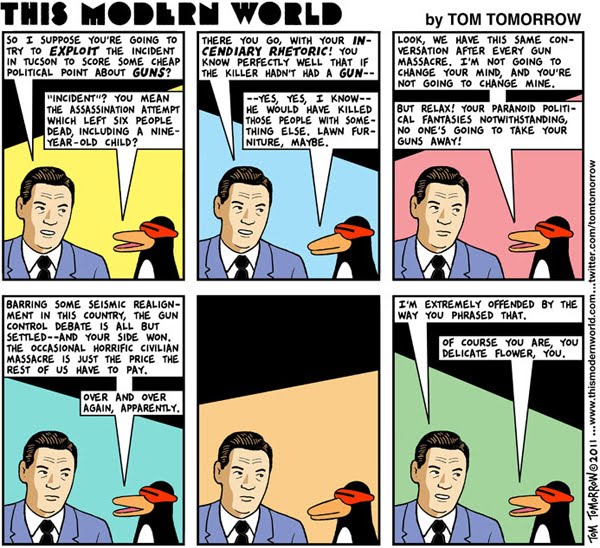
Tom Tomorrow, one of my favorite cartoonists, summarizes gun control and killings quite well. Click through to read.
“Barring some seismic realignment in this country, the gun control debate is all but settled–and your side won. The occasional horrific civilian massacre is just the price the rest of us have to pay.”
“But relax,” as the penguin says, “Your paranoid political fantasies notwithstanding, no one’s going to take your guns away!”
Here’s a more recent one. Tom Tomorrow hasn’t lost it.
-
All in the Family (II): Another Nexus of Baltimore Violence
Forgive me for speaking ill of the dead, as I did a few days ago. But today the Baltimore Sun has a feature about a man who has had two sons murdered. Tragic. It really is. Nobody should have to deal with one child murdered, much less two.
But being cynical and a former Baltimore cop, I’m thinking maybe this is a case of, “you play the game, you take your chances.” Zeus does not throw random thunderbolts. Lightning doesn’t strike twice in the same place. You get the idea? Did they “have it coming?”
But read Colin Campbell’s sob story. These kids are presented as nothing but lost angels:
“He was my best friend,” said [father] Nedrick Johnson, 38.
The Johnson brothers played pickup sports and rode dirt bikes since they were 5 or 6 years old, their father said. “They used to sneak them out of the house and everything,” he said.
Both were athletic: Darrian played quarterback, and Darrius power lifted competitively, he said. Darrius shot pool, could do a flip off a wall with a running start, and would sometimes ride his dirt bike with one hand — or none.
…
Nedrick Johnson scrolled through photos of his sons on his cellphone: standing in front of the Christmas tree, sitting together at a family get-together, diving into a pool in tandem, popping wheelies on their dirt bikes.
…
Darrian was caring, helpful, loyal, supportive and fiercely protective, his friends said.
…
“He was the type to call you out of the blue,” she said. “‘You good?’ ‘I’m just checking on you.’ ‘You need anything?’”
…
Homes said Darrian was a great cook and a lifelong friend.
“He lived his life,” he said. “No matter if he died young, he lived his life to the fullest.”
All that and a “great cook”? My God! Norman Rockwell couldn’t present such a dreamy All-American Family.
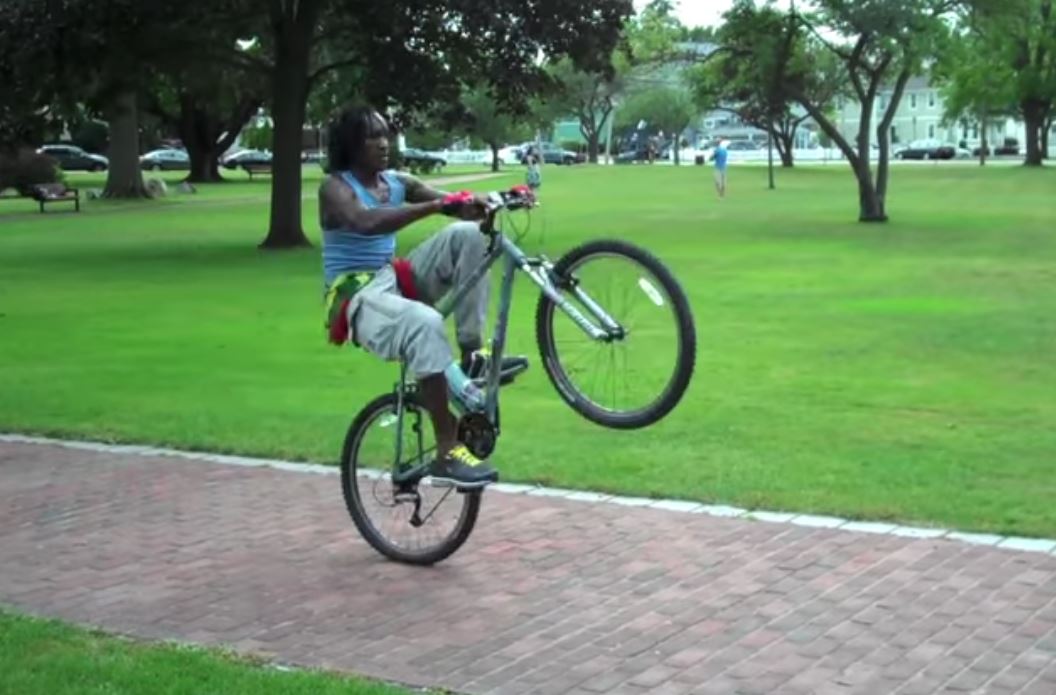
But it made my Spidey-Sense tingle. Maybe you shouldn’t be “living life to the fullest” when you’re 19 years old. When I was 19 I was studying in college and waiting tables. But my first warning sign was “popping wheelies on their bikes.” Might seem wholesome to you. I love bicycles! Do you picture something like this?

(This guy is not a Johnson brother)
But in Baltimore we know what “dirt bike” means. (In a tweet, Colin confirmed “motor”.) “Dirt bikes” are horrible for quality-of-life. And they kill people (eight between 1997 and 2000, as I have in my notes, but more since. Update: this (dirt bike seriously hurts pedestrian, runs) and this (car hits dirtbike, driven get beaten), and even this. But by some bleeding-heart narrative I don’t understand, riding illegally and dangerously is just kids expressing themselves, even part of an uprising against racist cops.
I respectfully beg to differ.
First of all, good parents don’t let their under-10 kids “sneak out” with any bike, much less a motor bike. “Oh, that Junior. You turn your head for a second and next you know he’s doing wheelies on North Avenue!” Imagine the flack you’d get if you simply let your kid ride a bicycle without a helmet! You somehow it’s OK for other children — poor black kids in Baltimore — to do no-hand tricks on motorbikes while going the wrong way in traffic?!
And, get this — pay attention because this is important — Baltimore police officers have gotten in trouble for trying to stop 7-year-olds from riding motorized ATVs in the streets. Why? I don’t know, but I suspect because when people read, “police removed a 7-year-old from his bike and detained his mom,” they’re thinking the kind of bike with cards in the spokes, so the cops must be assholes. It lead to media and public outrage against the police. And also a multi-year lawsuit from the boy’s mother (really from a lawyer who thought he could get a cut of the city payout.) The city actually fought the case and won.
[Update: That kid on a bike story got mentioned in the DOJ’s 2016 report on the Baltimore Police Department as an example of how systemic problems are. No, not in Baltimore. But in the BPD. It makes no sense.]
Here’s what I found from a brief search of Maryland’s online criminal records.
Darrius Johnson — the brother killed in a double-shooting in 2015 — was born in October 1995 and had a moderate criminal record: assault, trespass, escape, burglary, assault, and trespass on school grounds. But keep in mind this record only covers the last two years of his life. Victims may beg to differ, but crimes don’t officially count until you’re an adult. (And there’s even a movement to raise the age.)
Darrius’s brother, the one just killed, Darrian “Doddy” Johnson, seems to have stayed on the good side of the law with no criminal record. [Update: I originally posted incorrect information here that listed a Darrian Johnson with a different DOB and address. This was kindly corrected by a commenter. Corrections are always welcome.]
But the real criminal seems to be their father. He’s no father of the year. For starters there’s the murder charge he faced when he was 15! (The disposition of the murder charge isn’t clear — hey, maybe he didn’t do it — but I suspect that when the case was booted up to circuit court, he got charged as a juvenile and the records were sealed.) There’s a first-degree rape charge at 18 (got null prossed, as ineffective prosecution could be seen as form of ghetto criminal entitlement). (There’s also the issue of some fraud case with the State Employees Credit Union that he lost for $34,000 plus court fees.)
And then there’s the usual mélange of battery, assault, drugs possession with intent, more assault, drug dealing, more drugs, handgun violations, more drug dealings, assault, more handguns and drugs (not marijuana), armed robbery, and another handgun violation.
The three sons mentions in the article may just be the kids he willingly took responsibility for. Paternity suits indicate at least two other sons (including a Nedrick Jr. already been convicted of a handgun violation). In fact, best I can tell (I may be wrong) Senior had three sons in two years! [Update: originally I had the time frame wrong.]
Reading a fluff pieces like this in the papers, you might begin understand why cops hate “the media.” Neighbors call 911 and complain about shitty and violent public drug dealing neighbors over the years and over the generations. Police respond day after day after day to the crimes of this family. We pay and expect police to deal with the Johnsons.
Let me say the taboo: Nedrick is a bad father and perhaps even a bad person. There. I’ve said it so cops don’t have to.
Like the Antonios [sic] Addison and the Johnsons, some individual families are personally responsible for a disproportionate amount of violence and pain in Baltimore. Individual people on individual blocks actually are the problem. This isn’t some abstract theory of crime. This really is about “these people” not in the abstract offensive sense but in the literal sense of these people with these names who live in this house and commit these crimes.
Police have to deal with the micro problems, the individuals, the Addisons and the Johnsons. Police don’t deal with the macro issues of social justice. And since nobody else (government, church, school, welfare, prosecutors) seems to be able to deal with these problems, we pay and pray that police do. And then if and when something goes wrong, we put the police on trial? I doesn’t make sense.
Does this matter? I think it does. Because when you read about a poor father with two murdered sons, you may think think he deserves your sympathy. Hell, maybe he does. Like, despite all the father’s efforts, the mean streets of Baltimore done reached out and grabbed his children. But keep in mind it’s this very man that make the streets of Baltimore so mean.
Who do you think shoots and kills and assaults people every year? The same criminals who sue police departments. Freddie Gray’s death was tragic; it may even be criminal, but that doesn’t mean he’s a role model on par with Martin Luther King, Jr. Keith Davis Jr. is an armed criminal who shot at and was shot by police. Even the out-to-prosecute-cops State’s Attorney agreed. That should be the end of the story. But it’s not.
False narratives matter because we’re not being honest. When we portray criminals as innocent victims and give violent criminals the moral high ground, we perpetuate the violence.
-
Who speaks for the rapist?
Apparently, in the Stanford rapist case, the judge. If you’re still in denial that our justice system can be mean and even racist, would you at least consider that it often benefits the rich and privileged? And then can you see that these two statements are essentially one and the same?
Here’s very interesting take from Ken White, a defense attorney concerning privileged justice, from Mimesis Law:
Empathy is a blessing. But empathy’s not even-handed. It’s idiosyncratic. Judges empathize with defendants who share their life experiences – and only a narrow and privileged slice of America shares the life experiences of a judge.
That’s one reason that justice in America looks the way it does.
…
Despite what Hollywood would lead you to believe, we criminal defense attorneys do not advocate lenient sentences for all wrongdoers as a matter of policy. Many of our clients are frequently victims of crime themselves, and their lives are circumscribed by criminal environments. We don’t believe, in the abstract, that people who tear the clothes off of young women and violate them in the dirt next to a dumpster should go free. Our role is to stand beside our clients, no matter who they are or what they did, and be their advocates, the one person required to plead their case and argue their interests.
…
But most people fed into the criminal justice system aren’t champion athletes with Stanford scholarships. Most aren’t even high school graduates. Most are people who have lived lives that are alien and inscrutable to someone successful enough to become a judge. Judges might be able to empathize with having to quit their beloved college, but how many can empathize with a defendant who lost a minimum-wage job because they couldn’t make bail?
…
This means that the system is generally friendly to defendants who look like Brock Allen Turner and generally indifferent or cruel to people who don’t look like him. No high school dropout who rapes an unconscious girl behind a dumpster is getting six months in jail and a solicitous speech from the likes of Judge Persky.
…
So you won’t find defense lawyers like me cheering Brock Turner’s escape from appropriate consequences. We see it as a grim reminder of the brokenness of the system. We recognize it as what makes the system impossible for many of our clients to trust or respect. And we know that when there’s a backlash against mercy and lenient sentences – when cases like this or the “affluenza” kid inspire public appetite for longer sentences – it’s not the rich who pay the price. It’s the ones who never saw much mercy to begin with.
…
There are two ways to see good fortune and bad fortune. You can say “someone who has enjoyed good fortune should be held to a higher standard, and someone who has suffered bad fortune should be treated with more compassion.” But America’s courts are more likely to say “someone who has enjoyed good fortune has more to lose, and someone who has suffered bad fortune can’t expect any better.”
Judge Persky and his ilk can’t stop being human. But they are bound by oath to try to be fair. When a judge says you are very fortunate and therefore it would be too cruel to interrupt that good fortune just because you committed a crime, they are not being fair. For shame.
Let me throw one other contraversial idea out there: six months behind bars for rape is just about right. It’s the “normal” sentences that are way too long! Incarceration is supposed to punish, not destroy lives. If only that standard applied to everybody.
[Hat tip to Radly Balko’s tweet]