In the Kansas City Star by Tony Rizzo.
Category: Police
-
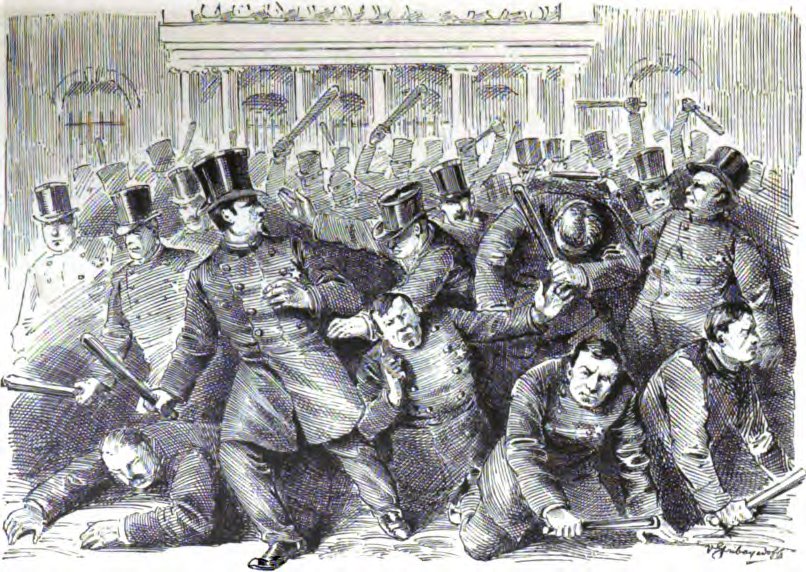
The Good Old Days
It turns out you can fight City Hall. In 1857 they did. And won. It turns out that if you’re City Hall, you can’t fight the State House.
The winner of this brawl at City Hall between two competing police departments got to be New York’s Finest!
 The mayor was arrested and New York State took over the police (before giving them back a few years later).
I just got the image from wikipediato use in class and thought I’d share.
-
Give that man a medal!
Too bad a story about an honest Liberian customs officer is news.
But hell, if I made $15 a month… I would probably take the $20,000 bribe.
So I guess he’s a better man than me.
And they did give him a medal. And $1,000.
-
Bang bang, they hit the ground
Baltimore Crime turned me on to this:
Spotcrime maps every shooting in Baltimore (City and County) for 2008. Hit ‘start’ at the top left. Whether you want Turning of the sound to hear the bang bangs is up to you. At the time of this writing, I’m still only in October.I can’t tell if this is sick or genius. If I’m in doubt, I usually go for the latter.
-
The Epidemic That Wasn’t
The New York Times reports on crack babies… not!
You know, for what it’s worth, one of my favorite students confided in me that he was crack baby. He was all right.
-
Lol Cop
Pepper Spray Me led me this story in the Chicago Tribune about, Vincent Richardson, a 14-year-old who, apparently successfully, impersonated being a police officer for five hours. And not for the first time. And not just the normal pulling-over-cars-with-police-lights kind of thing. I mean this guy patrolled with a real live Chicago police officers and fooled him, too(!?). You would think the no gun or badge thing would raise eyebrows.
To paraphrase Chris Rock: Vincent Richardson is the Darius McCollum of Crime.
-
The Company of Others
 When I was a cop in Baltimore, I kind of assumed I was the only active police officer going for a PhD at one fo them fancy graduate schools. I wasn’t.
I’ve also assumed I’m the only former Baltimore police officer to write a book based on time in the Eastern District. I’m not.
I’m not certain why I only heard about Daniel Shanahan’s Badges, Bullets, & Bars recently. Professor Edith Linn (retired NYPD) told me about it at the ASC conference in St. Louis. She’s written a great book herself, Arrest Decisions. In it, she quantifies many of the points about arrest discretion I make in my book.
I’ve ordered Badges, Bullets, and Bars and look forward to reading it. You can read the 1st chapter here. It seems pretty hard core.
The book is dedicated to:
“All the excellent Law Enforcement officers who shortened their careers by crossing the thin blue line and venturing into the wrong territory; sometimes into criminal territory. Therefore permanently tarnishing their badge, reputation, family, and all the good that badge stands for. This book is for the police officers that could not find their way back, wanted to make a difference, and unfortunately, could have.”
Yikes! I imagine most police stayed far away from Shanahan. The stories of mentally unstable cops are legendary and usually great for a laugh… until somebody gets hurt.
But I’ll withhold further judgment till I read his book. He certainly does not seem like a man you would want to cross.
You know, if you like police books, there’s a great web site: Police-writers.com. If I checked it more often, I would have know allthe books written by Baltimore police officers.
-
Embrace the Right
At the closing of Obama’s inauguration, Joseph Lowery said these controversial words:
“We ask you to help us work for that day when black will not be asked to get in back, when brown can stick around, when yellow will be mellow, when the red man can get ahead, man, and when white will embrace what is right.”
Often, I suppose for the sake of politically correctness, the quote is replayed without the last “white” phrase (uh, as if “yellow” and “red man” are politically correct?). But it’s the last phrase that pissed off a lot of people (admittedly, when I first heard Lowery I was too busy laughing to even hear the last phrase).
Why are some so upset? What it all comes down to is the belief that Lowery “got away” with saying something that he could only “get away” with because he’s black.
Personally, Lowery’s comments were my favorite part of the whole day (at least of the parts that involved speeches)! It was great to end everything on a lighter note, and the retro 1960’s cadence was charming (I was born in the 1970s).
But I’m not surprised that so many take umbrage to what I see as a little humor with historical significance.
To those who were surprised that there’s such passion, I offer this:
Many people… and I’m thinking white working-class Republican police officers like those I worked with in Baltimore—but it could be anybody, I suppose.
Many people are just trying to get by and provide for their families. Unlike wealthier folk, these working men and women can’t always afford to live out in “nice” suburban neighborhoods with safe streets and good schools and where Section-8 housing fears to tread.
Say drug dealers move in down the block (be them redneck or ghetto) and things get worse. But say the drug dealers are black. Hell, they might be. Whenever working folk open their mouths, “liberals” (who of course don’t live on the block) call them racist. But they’re not. Really. They don’t hate drug dealers for the color of their skin; they hate drug dealers for the content of their character.
Working folk too often don’t know the politically correct way to phrase things. Working class blacks can say all kinds of things about blacks that white folk can’t say. But the poor white guy, he feels he can’t even join the conversation.
Here’s the rub: for people who so often feel trapped in a linguistic and socioeconomic bind—those who always feel they have to watch what they say so they don’t get called racist—it’s just not fair that Lowery gets applauded for these racially charged words.
Take it when Sarah Palin was referred to as “pig in lipstick.” No supporter of Palin was seriously offended. Hell, McCain used the same line. But that wasn’t the point. The point was a rare moment of victory for them in the linguistic gotcha game: “Ha, see, you’re not being politically correct!”
The thinking goes that if a black person can say something (take, for instance, a comment based on an honest observation like, “that nigga’s lazy!”), why can’t a white person say the same thing? Especially if the black and white man are working together and thinking the same thing about the same lazy person?
What if Rick Warren, the white preacher said this: “We ask you to help us work for that day when white will not be asked to get back, and when black will embrace what is right. Amen.” Ignore the fact that it doesn’t make sense historically or rhyming sense. A white guy could not have said this to the nation. He’s be called racist. So if I white can’t say it, goes the thinking, why should Lowery get away with it?
People don’t want to be held responsible for what others of similar skin color have done (now or in the past). For a lot of whites, being white isn’t seen as a privilege. Hell, they haven’t benefited from the system. The Man ain’t given them shit! They can barely pay the bills.
I do understand the idea that people simple want a level playing field. There are people who want real racial equality. No affirmative action. No things that black coworkers can say that whites can’t. No nothing. No excuses.
Personally, I believe that such an attitude lack a historical perspective and too generously presumes we’re in some post-racial Utopian world (though I do think we’re a bit closer to that world than we were a week ago).
To those who took offense, Lowery reinforced a racial world view and represents an arrogant and liberal form of reverse discrimination. To generalize by race is a form of racial profiling; to do it against whites is just as discriminatory as to do it against blacks.
For me, in my humble opinion, Lowery can say anything he damn well pleases. And we’d be all the wiser to listen.
-
Undercover danger
The Sunreportsthat the wounded officer arrested the same defendant in 2007.
That’s scary. It’s much harder for a police officer to remember everybody he’s arrested than it is for a criminal to remember the person who arrested him. It’s just a question of numbers, like it’s easier for students to remember their teacher’s name than vice versa.
It’s also why cops carry guns off duty. The last thing you want as a police officer out on a date is for somebody to come up to you and say, “You remember me?”
-
Murder Factory
Now here’s some good investigating journalism from Tony Rizzo and the Kansas City Star. Local zip code 64130 is featured in a series called “Murder Factory.” These eight square miles were home to 101 convicted murderers incarcerated in Missouri prisons.