Worth reading for many reasons: http://www.postandcourier.com/article/20160402/PC16/160409955
Category: Police
-
Bad Cop Good Movie: The Seven-Five
I’m finally getting around to watching The Seven Five, a documentary about the 75 Precinct in the 1980s and criminal cop Michael Dowd. Good stuff… the documentary, that is, not the cop.
I like how the movie is told through three perspectives: the dirty cops, the cops who caught them, and the criminal the cops worked for. And of course they’re all really charismatic.
But what amazes me is the reputation for NYC being so crazy back then. I mean it was. Sort of. In 1990, the height of the crack epidemic (the Bronx was already burnt) New York City’s homicide rate peaked at 30 per 100,000.
And the 75 Precinct was the highest homicide precinct in the city, with 126 murdersin 1993. That’s a rate of about 80 per 100,000.
Last year in New York City? The homicide rate was 4.
You know what Baltimore’s homicide rate was last year? 55.
When I worked the Eastern District the homicide rate was 100.
Last year in the Western District, the homicide rate was 140.
Think of what that means, to residents and cops alike.
[Fun fact: The most ever homicides in any one Baltimore district? The Western in 1972. 87homicides. (Though last year’s rate was probably higher, given the population flight from the area.)]
Another vacant crumbling amid high winds – Mosher St at Vincent St. Fell into alley cut-through pic.twitter.com/s1T5s3qnUO
— Justin Fenton (@justin_fenton) April 3, 2016
-
Problems with Tasers
I had no idea TASER was an acronym standing for anything, much less “Thomas A. Swift’s electric rifle“!
The LA Times reports:
LAPD officers fired Tasers just over 1,100 times last year…. The devices had the desired outcome — causing someone to submit to arrest — only 53% of the time.
Is half the time better than nothing or not nearly good enough? Anecdotally, it seems like a lot of bad police shootings are preceded by Tasers not doing what they’re supposed to do. You press the magic button… and nothing happens. And you’re not used to having to go hands-on, fighting, and physically dominating a suspect. So you’re scared and reach for your gun.
And that’s not the only problem with Tasers.
-
Special delivery
The hammer begins to fall on the officers who idiotically took offense and arrested a guy who had the nerve to criticize their reckless driving. Murray Weiss in DNAinfo:
The NYPD lieutenant involved in the questionable arrest of a Brooklyn mailman was stripped of his gun and badge Thursday and placed on desk duty.
…
The four are set to be harshly disciplined…. Machado, a former Marine who saw combat in Iraq, will take the heaviest hit because “the supervisor is the one who should dictate the situation,” a well-placed source explained.
“He is the boss and he is [the] one who controls what occurs,” the source said, predicting Machado, an 11-year veteran, could lose as much as a year’s vacation, but not his job, which was something even the mailman, Glenn Grays, said he did not want to occur.
You’d think, if the cops were in a legitimate rush rather than just driving like fools, they would have continued on to the emergency rather than having the time to stop and harass a mailman. I stand by my previous statement that this was “inexcusably shitty” police behavior.
-
56 Rounds: What it means to “have cops’ backs”
Yesterday I was asked by a journalist what it means for politicians and police brass to “have cops’ backs.” It’s a fair question. It doesn’t mean not being critical of police. It doesn’t mean defending cops when they make an unreasonable mistake. It does mean giving cops the benefit of the doubt and supporting officers when they do their job.
Take the recent police-involved killingof a father and son in Baltimore on the 400 block of E. Lanvale (314 Post, AKA Bodie’s Corner.)
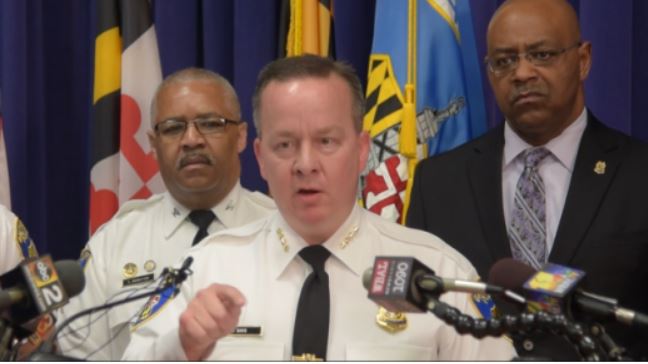
This is Baltimore City Police Commissioner Davis having the cops’ backs (I transcribed from the video in this story):
We had three police officers who were in the right place at the right time.
…
The police came and did their job and did what they had to do.
And I would add to that if not for the Baltimore police department yesterday, we could have had a mass shooting on our hands where several innocent lives could easily have been taken. I’m very proud of the work of our police officers yesterday. Their bravery. We can’t run from danger. We don’t run from bad guys with guns. We engage them.
We fired 56 rounds yesterday, until this threat was eliminated. I want to put that right out there right now: 56 rounds. And you can see, and you can perhaps imagine confronting, in a neighborhood street in broad daylight, a father and son duo, with an intent to kill, that’s what it took to eliminate that threat.
I’ll add to that, the son, one of the two men that we shot and killed yesterday, the son was out on bail for a handgun offense and the father was out on probation for a handgun offense. And that’s why I’ve personally spent so much time in Annapolis in this legislative session, in an effort to convince lawmakers, and we certainly have convinced the ones from Baltimore, about the necessity to do more with these laws and make these misdemeanors felonies. It’s about time. But that message still isn’t getting through.
But our police officers and our community knows [sic] that unfortunately there are violent repeat offenders among us, who live right here in our city, who think nothing about carrying two guns like that in broad daylight and popping out of a car. If it weren’t for the bravery of the Baltimore City Police Department, we could be having an entirely different press conference right now.
Kudos to Davis. You couldn’t ask for more. Now this is what one would expect from a good leader. But good leadership, especially in Baltimore, is not a given.
Davis didn’t have to say what he said. He didn’t have to say anything. Or he could have had a spokesperson say something neutral like “we’re investigating the incident.” Or he could have raised an eyebrow by mentioning the number of shots fired before emphasizing how the “officers guns were taken immediately after the shooting and they remain on modified duty, as is departmental policy.”
But Commissioner Davis didn’t do any of that. He went out of way to support his officers how bravely engaged with armed gunmen. This matters.
Contrast this with former commissioner Batts who, in the name of progress and reform, threatened cops and led the city into riots and violence.
But really contrast this with Baltimore City’s elected State’s Attorney, Marylyn Mosby, who pushes a cops-are-the-problem perspective. Her husband is running for mayor. She’s wasting her precious prosecutorial resources by prosecute good cops who may or may not have made an honest mistake.
After this shooting, Mosby treated the officers like criminals. For the first time in as long as anyone can remember, officers involved in a good shooting were read their Miranda Rights like common criminals. For shame. These cops aren’t criminals; they aren’t suspects in “custodial interrogation.”
Were it not for Davis and his strong and passionate words at the press conference (and also good journalism by the Baltimore Sun from which Davis quoted), it’s easy to imagine an anti-police narrative taking root. After all, this is Baltimore, where police are quick to gun down a father and son (with latter with junior-high-school graduation pictures at the ready) over a misdemeanor! (In Maryland and many states, illegal gun possession is just a misdemeanor).
I’m sure some non-present “witness” could be found saying, “The cops didn’t have to fire all those shots. They had already given up.” Academics would criticize Broken-Windows policing. Al Sharpton, able to get a few days off work, would appear to criticize racist policing. Protesters could chant “56 shots!” while the national media returned to Baltimore and ask if (ie: hope that) more violence would be forthcoming.
In that world, if Davis doesn’t have the cops’ backs, the next time a group of officers in an unmarked car see two guys getting out with guns? The cops could just keep on driving.
Eventually, after the shooting stops and bodies drop, somebody would call 911.
Would you engage armed gunmen? Why risk your life? Why face potential criminal prosecution? This is why having cops’ backs matters.
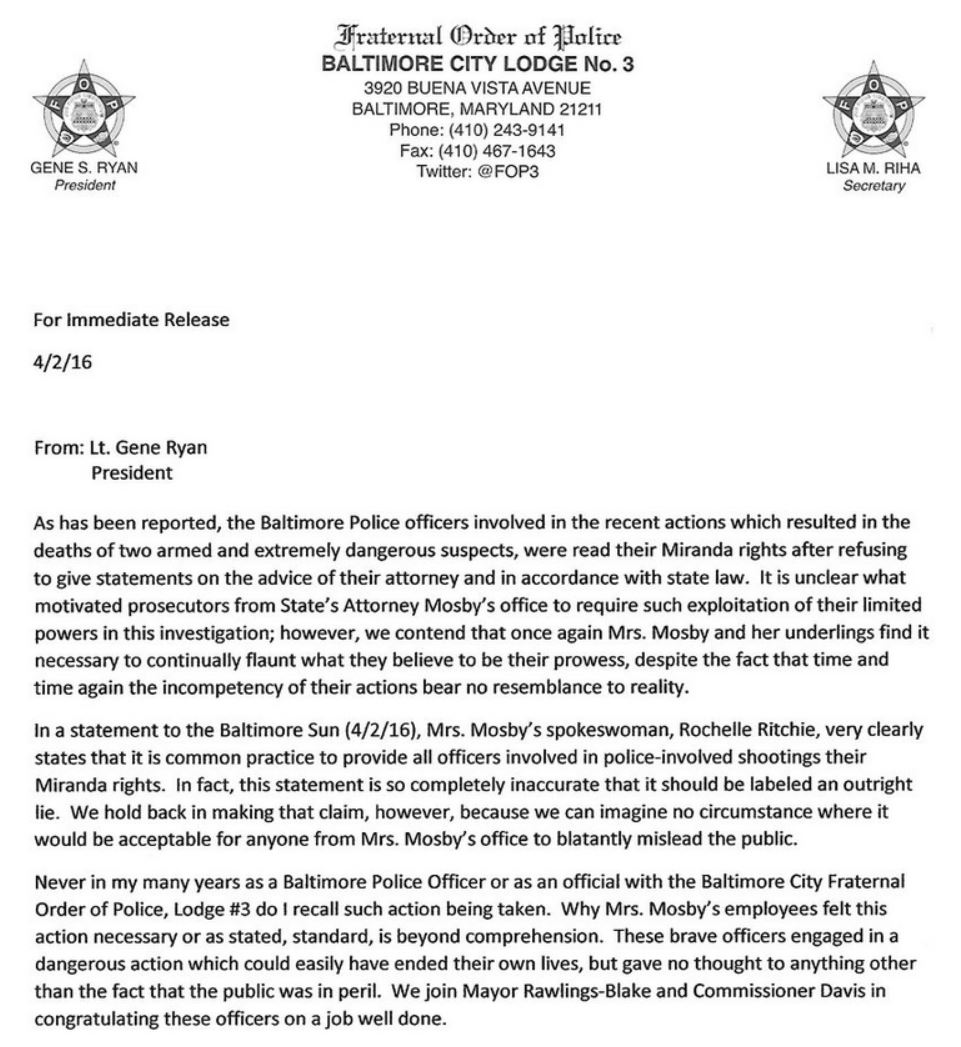
Update: Regarding Mosby reading the cops their rights, here’s the FOP’s statement:
2nd Update: Also, homicides year-to-date are up 25 percent this year compared to last. But given the post-riot near doubling in violence last year, being up only 25 percent from pre-riot figures is actually a massive improvement of sorts.
3rd Update: Mosby’s office denies it. (I wasn’t there. But I don’t believe her. It’s not like she has a track record of telling the truth.) And the BPD decides not to engage. But the union will play:
Lt. Gene Ryan, president of the Fraternal Order of Police, said Saturday that the statement from the state’s attorney’s office was “so completely inaccurate that it should be labeled an outright lie.”
-
How people get killed
Murders are usually thought of in the abstract. People “get killed.” Homicides “rates” go up or down. But to each killing, there’s a person who kills and a person killed. This isn’t really understood by those who don’t live or work in high crime areas. (Yes, while murder can happen anywhere… no, murder actually doesn’t happen everywhere).
Not to glorify snuff films — because, spoiler alert, this guy gets killed [update: or maybe just critically wounded] — but I think it’s important to understand the individual nature or homicides when talking about crime and police.
From the Daily News:
Police statistics said that as of Wednesday morning there had been 727 people shot and 135 homicides so far this year in the city of Chicago.
However, the Chicago Tribune reported at 9 p.m. that nine more people had been shot during the course of the day, including a 23-year-old man and a 43-year-old woman, who were both killed.
The incident is the latest in the city’s most violent start to a year since 1999.
Earlier this week a young woman named Camiella Williams, 28, told The Trace that she has lost 23 loved ones to shootings, and is now an anti-gun violence advocate.
As the story was being edited another one of her friends, 27-year-old Cordero Mosley, was shot six times and died.
-
Why fewer police-involved shootings in Chicago might be bad
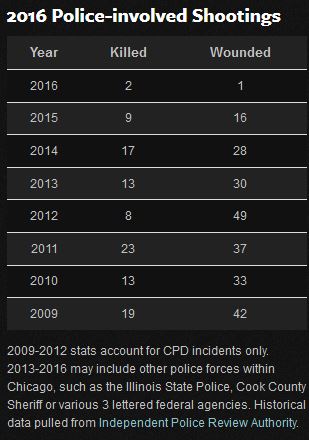
Police-involved shootings in Chicago are way down.

From heyjackass.com This is great news for advocates of police reform.
Chicago in 2016 will probably see police shoot just 15 or so people (based quite sketchily on January through March figures). This compares to 45 people shot in 2014. The decrease is without doubt due in part to those who keep a laser-like focus on police misconduct. The number of those shot by Chicago Police has plummeted for two consecutive years.
But it’s also very likely that Chicago will see close to 3,500 people shot this year. That would be 500 more than 2015. And that was 500 more than 2014. And that was 500 more than 2013. And for each 500-person increase in shootings, roughly 480 victims are black or hispanic.
What if — hypothetically of course and absent any corresponding decrease in violence in general — what if police-involved shootings served as a proxy (an indirect indicator) for police officers’ engagement and interaction with violent criminals and the criminal class? It’s not inconceivable. Another indicator is that police stops in Chicago have also plummeted.
In the police world we’d call these facts “clues.” Of course in the academic world I’m “just guessing.” But I’ll have a lot of time to guess before “hard social science” (that’s a joke, by the way) can prove what’s going on.
But hey, why focus on the negative? Why focus on criminals and dead young black and hispanic men when we can just keep the heat on police? Let’s assume heroic police behavior is criminal. Let’s criminally prosecute innocent cops and drive other cops who defend themselves into hiding. Let’s build a social movement on (what turns out to be) a lie and then pretend it doesn’t matter because, well, it could have been true. And then, when police do less and crime goes up, deny it. And then, when you can’t deny it any longer, say we don’t know why crime is up. Or better yet, blame the police.
But police-involved shootings are way down!

Update: here’s the same data but compiled on June 6:

-
“Prosecutors ordered officers in fatal shooting be read Miranda rights”
I’m surprised that I can still be surprised at Baltimore’s State’s Attorney Marilyn Mosby’s continued battle again Baltimore’s police. I don’t know, maybe she thinks all cops are bad because she grew up around so many bad cops. But Freudian analysis aside, imagine if the public prosecutor was out to get you and your colleagues. This concerns the latest police-involved shooting:
The Baltimore Police officers involved in Thursday’s fatal shooting of a father and son armed with weaponswere videotaped being read their Miranda rights at the direction of prosecutors after declining to give statements, a police union attorney said.
Michael Davey, the attorney, said it was the first time he could recall such a move by prosecutors in 16 years working with the police union.
“These guys should get a medal for what they did, instead of being treated like criminals by the State’s Attorney’s Office,” Davey said.
It’s almost charming, in that Baltimore criminal kind of way, that father and son were out doing something together. My dad used to take me to the beach.
Says retired deputy commissioner Anthony Barksdale:
If that guy could’ve let off with that rifle, all three of those cops would’ve been dead. That pink rifle might look silly, but it is highly lethal. You’re goddam right they fired 56 shots.
-
Ouch
Alameda Country deputies beat the crap out of this car thief in San Fransisco. Pesky security camera caught most of it (and with audio).
I haven’t seen a police beating like this since God knows when. And now the cops are going to go down. All because they thought somebody deserved a beat down.