Category: Police

  • Here’s to Officer Walter Fahey

    Here’s to Officer Walter Fahey

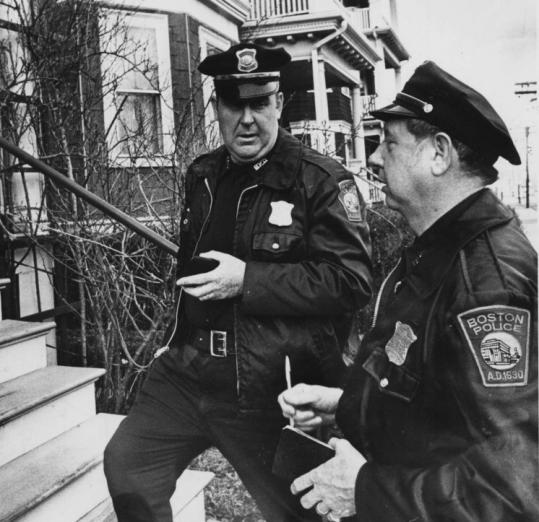
    The Boston Globehad a nice tribute to Boston Police Officer Walter Fahey, who died in October.

    [Update: I just received a very gracious email from Walter Fahey’s son. He mentions this piece in particular as capturing the spirit of his father. As my father wrote before he recently passed away: We shall never see their likes again.]

  • Guns and violence

    I’m too swamped with final papers right now to give this the justice it deserves (But I will give this link to other posts on gun control). I’m sure some of you might have some thoughts on this email I just received. Please comment and discuss.

    I live in VT which has very liberal (ha ha) gun laws. I’m not a gun owner and as a good liberal growing up in Brookline Mass, I was of course pro gun control. Now I have sort of come to the conclusion that the NRA argument, “Guns don’t kill people…”, is to some extent correct.

    One telling statistic I heard (probably wrong but it was on CSPAN) from an author who wrote a book about airline security after 9/11 was that in the first three months in 1973 after the FAA mandated full passenger screening there were 5,000 guns confiscated. Since I had never heard of gunfights on commercial airliners it made me curious about whether how we Americans, have changed. Also in Israel where lots of people carry guns, assault rifles at that (the Mumbai terrorists would have been dead in about 15 minutes if they had tried what they did in Israel), and yet they seem, other than the ongoing conflict, to have relatively low rates of gun violence?

  • Bicyclist-Assaulting Officer Indicted

    Bicyclist-Assaulting Officer Indicted

    I’m quick to give police the benefit of the doubt. I rarely feel good when an officer gets criminally charged. But an unprovokedassault on someone that could have been me? F**k ‘im.

    I’ve written about this incident before.


    The big offense, interestingly, isn’t for assaulting the guy. Early reports are that he’s just going to get a misdemeanor bang on that. Officer Pogan is going to get fired for creative writing in the felonious degree.

    According to theNew York Times:

    Officer Pogan arrested Mr. Long and charged him with attempted assault, resisting arrest and disorderly conduct. In his police report, Officer Pogan wrote that Mr. Long was obstructing vehicular traffic as he rode southbound on Seventh Avenue. After instructing Mr. Long to stop, Officer Pogan wrote, Mr. Long rammed him with his bicycle, causing the officer to fall to the ground and receive cuts on his forearms. Mr. Long then resisted arrest, Officer Pogan wrote.

    Who would have ever thought that there might be somebody with a camera? It’s not like it was Times Square…. Oh, wait.

  • Crack House

    I first published this a year ago when nobody read my blog. It’s worth a rehash.

    #1) 1900 Block of E Eager. 1906 E Eager is the third house (with awning) from Mr. George’s corner laundromat. Two short blocks North of Johns Hopkins Hospital, this corner (Wolfe and Eager) is one of the “hottest” (but hardly the only) drug corners in the neighborhood, heroin and crack are sold around the clock, rain or shine. Most of the customers are locals, but a conspicuous minority of whites drive in from the poor suburbs looking for the purer heroin found in the ghetto. This neighborhood, built around the turn of the century and featuring typical Baltimore rowhomes, formstone, and marble stoops, was all white until the 1950s, middle class until the 70s and 80s, now it is mostly vacant, all black, and very poor. Hopkins and city own most of the property. Hopkins has since torn down most of this area.
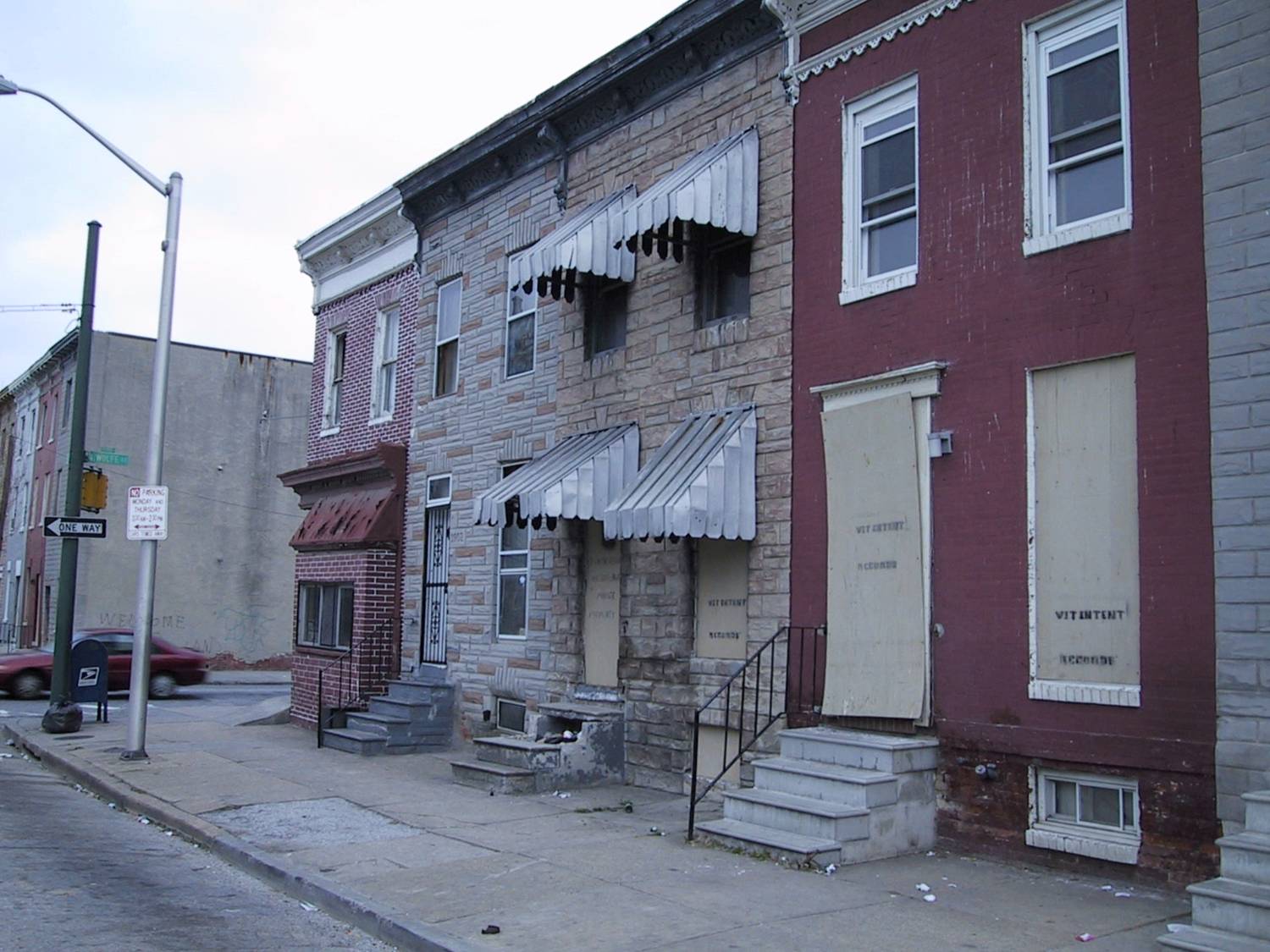
    #2) The corner looks deserted. It is just 7 in the morning. But a few moments earlier, there were dozens of people roaming about. But a funny thing happens when you part a police car in the middle of the intersection, turn off the motor (otherwise the picture is blurry), and take a picture. People scatter. Note how everybody is walking away. I didn’t take in personally.
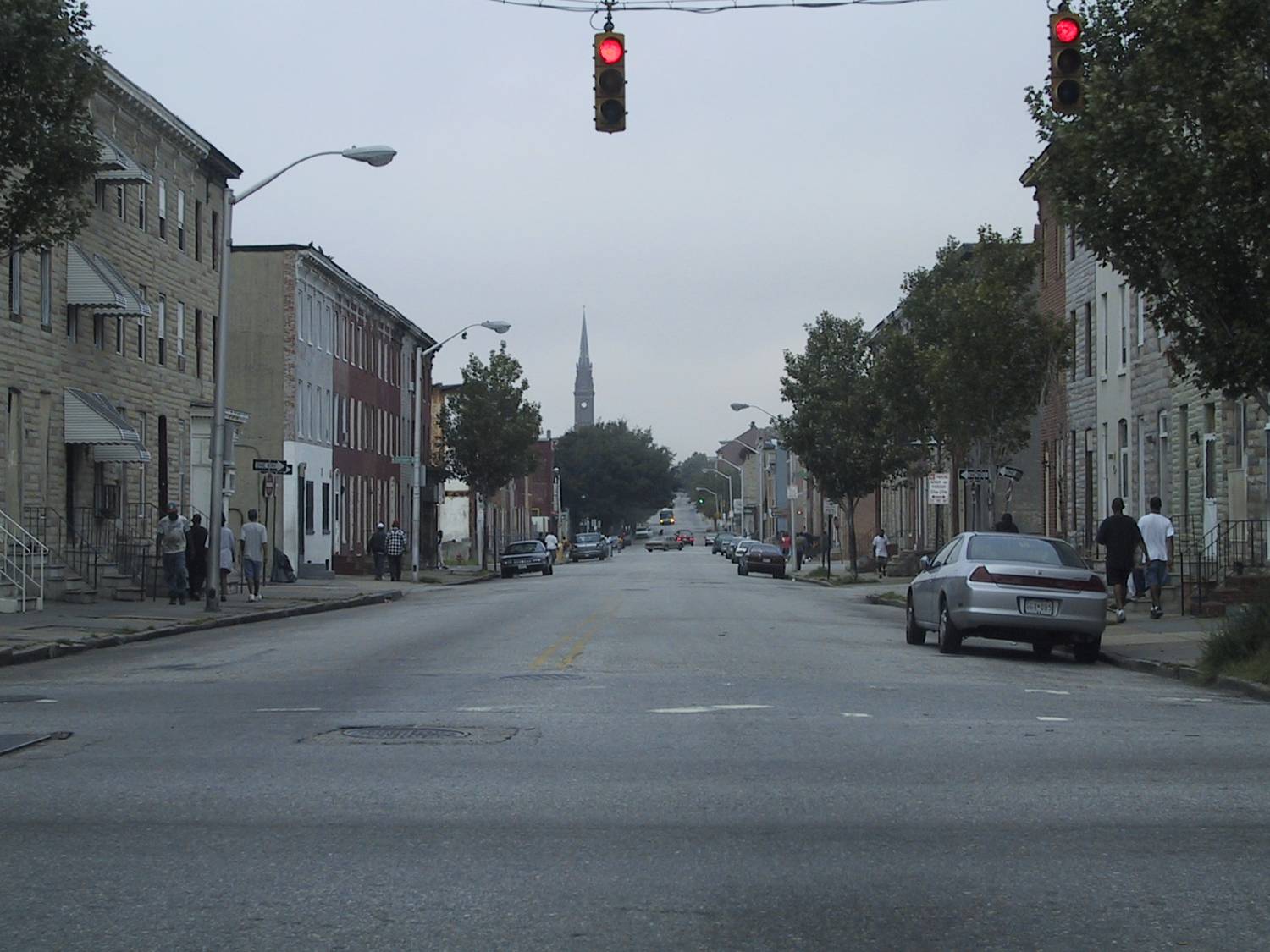
    #3) Approaching the rear of 1906 E Eager from N Chapel St. I was looking for a location to observe drug sailes on the corner and out of one house in particular.
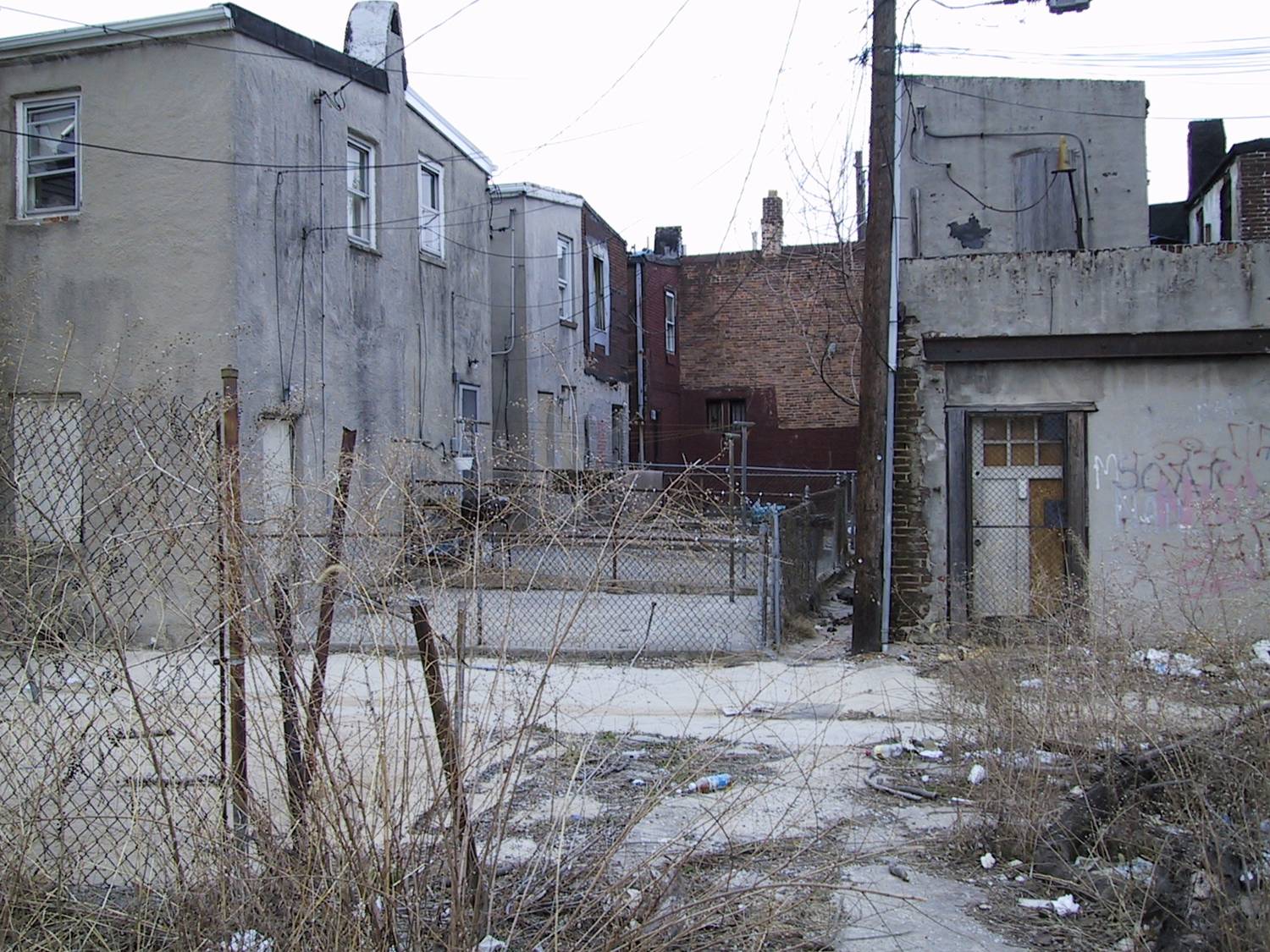
    #4) Most vacants are boarded up to prevent junkies from entering, or filled with too much trash and damage to let one safely enter. The Rear entrance of 1906 E Eager is wide open. The first, time, on official police business, I went in alone. The second time, to take pictures, I brought along a partner, just to be safe.
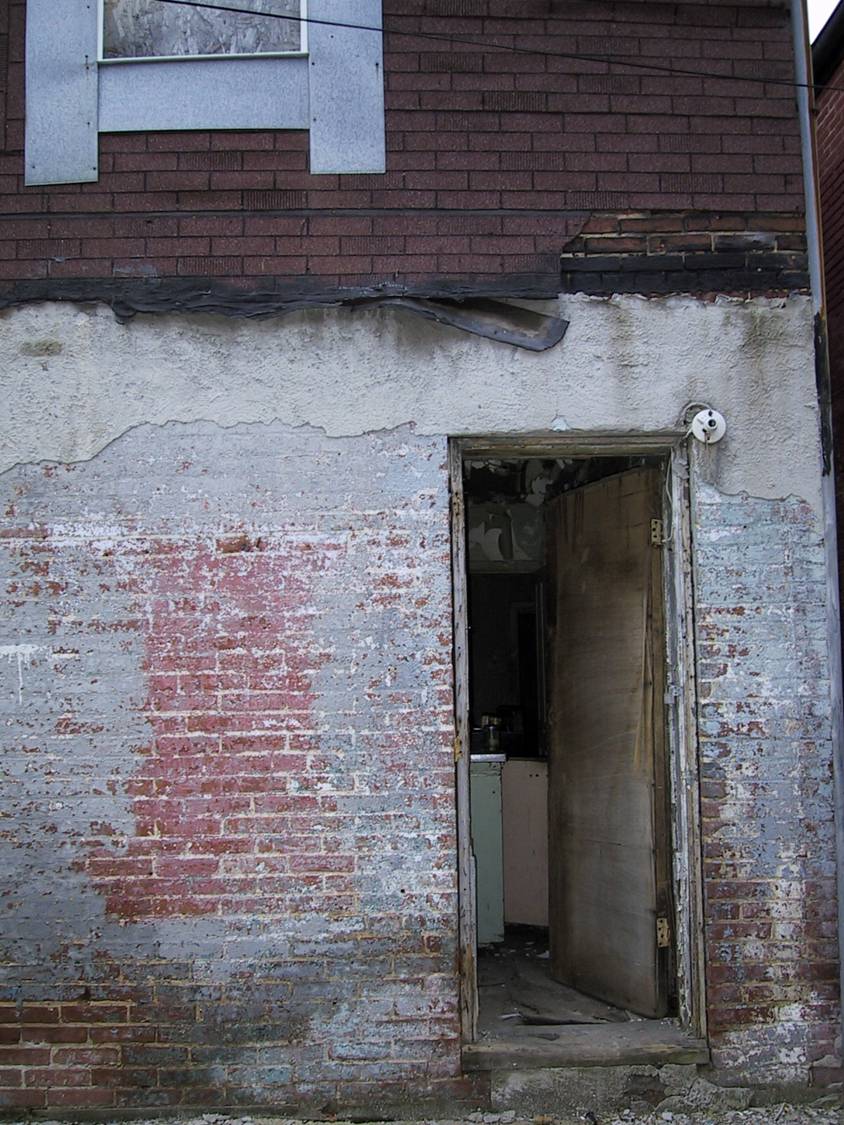
    #5) The rear room on the first floor is what used to be the kitchen. In the Northeast corner are old appliances, partially stripped and peeling lead paint, and remnants of alpine wallpaper.
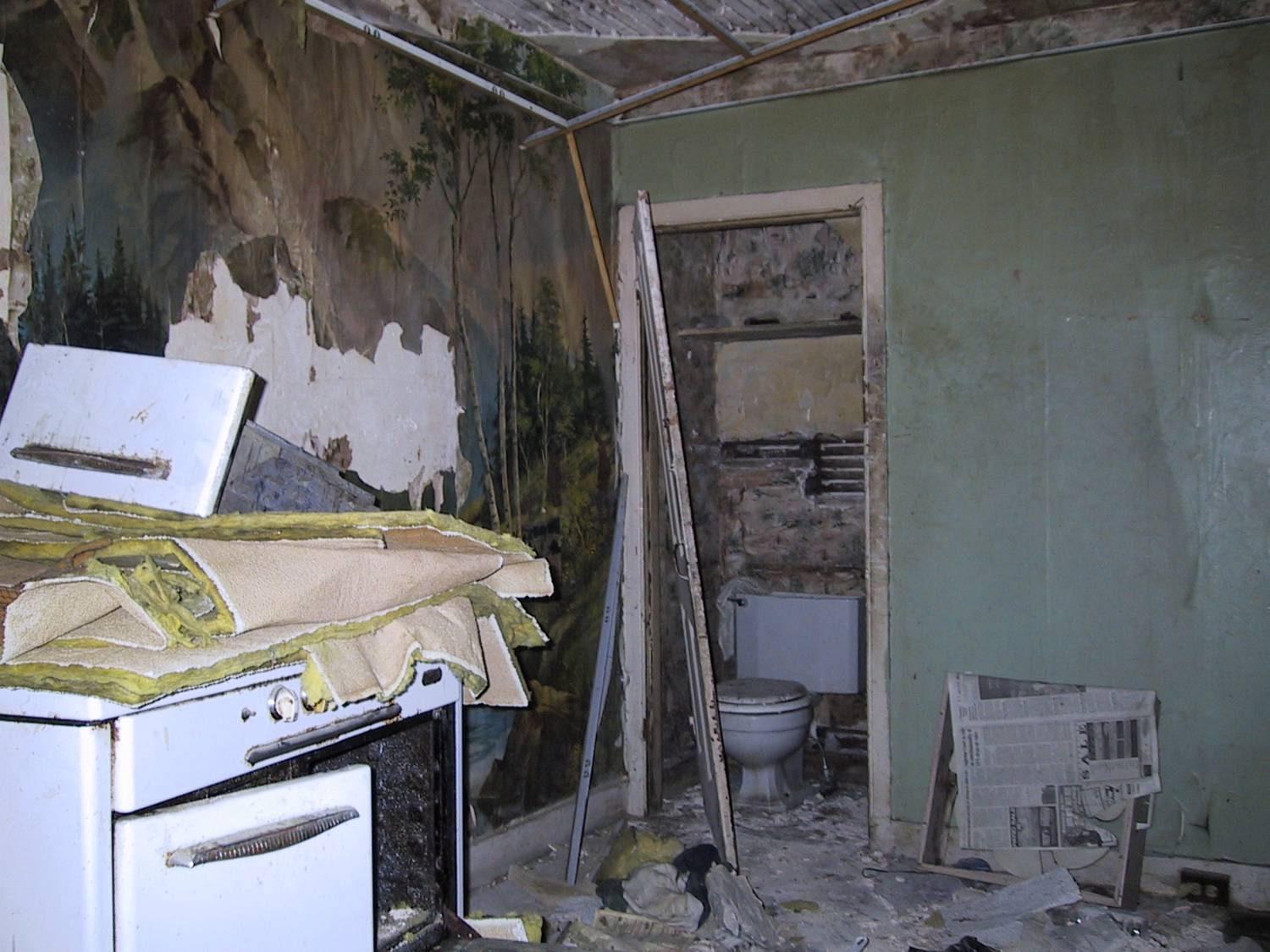
    #6) Another view of the alpine wallpaper
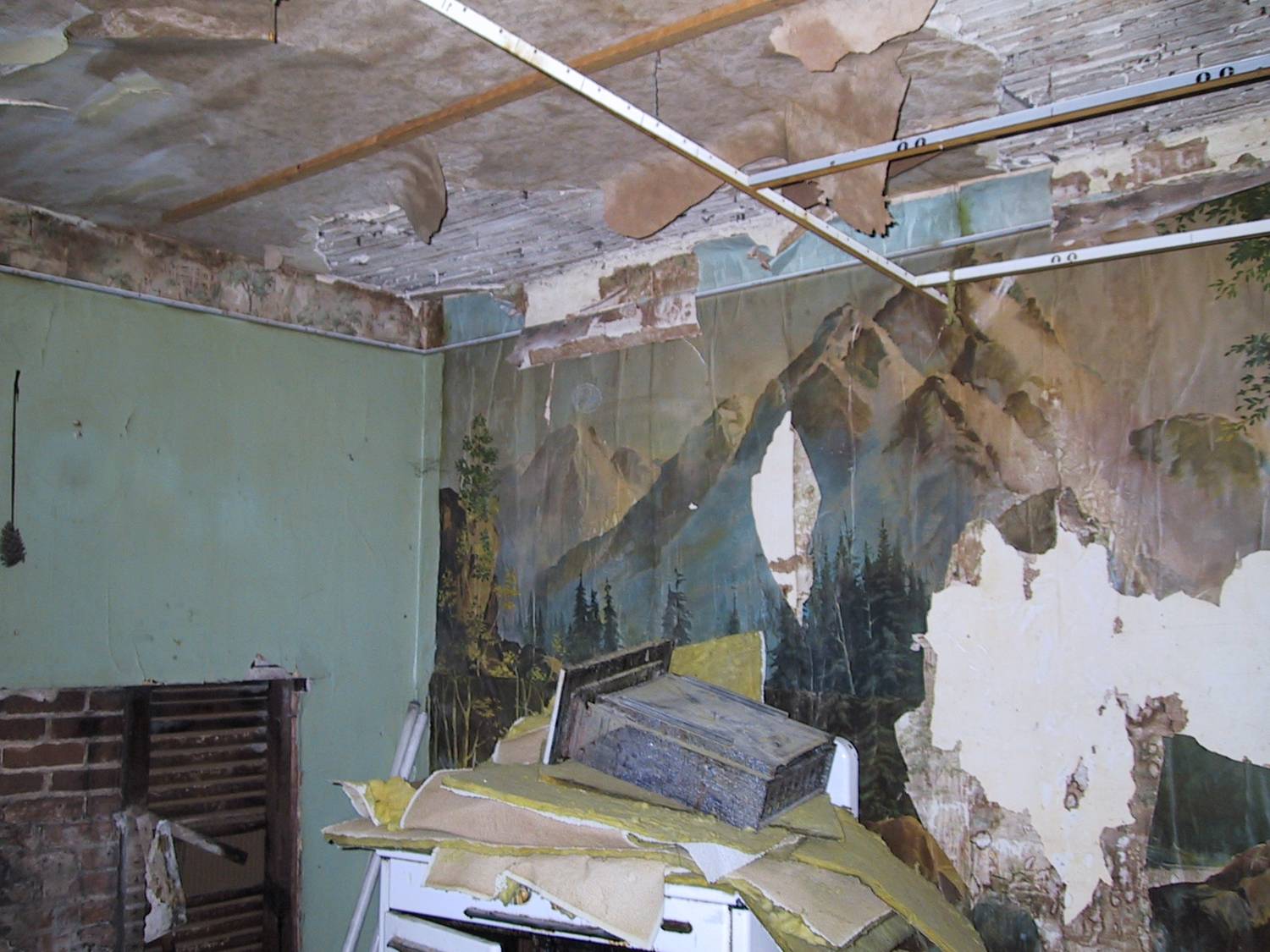
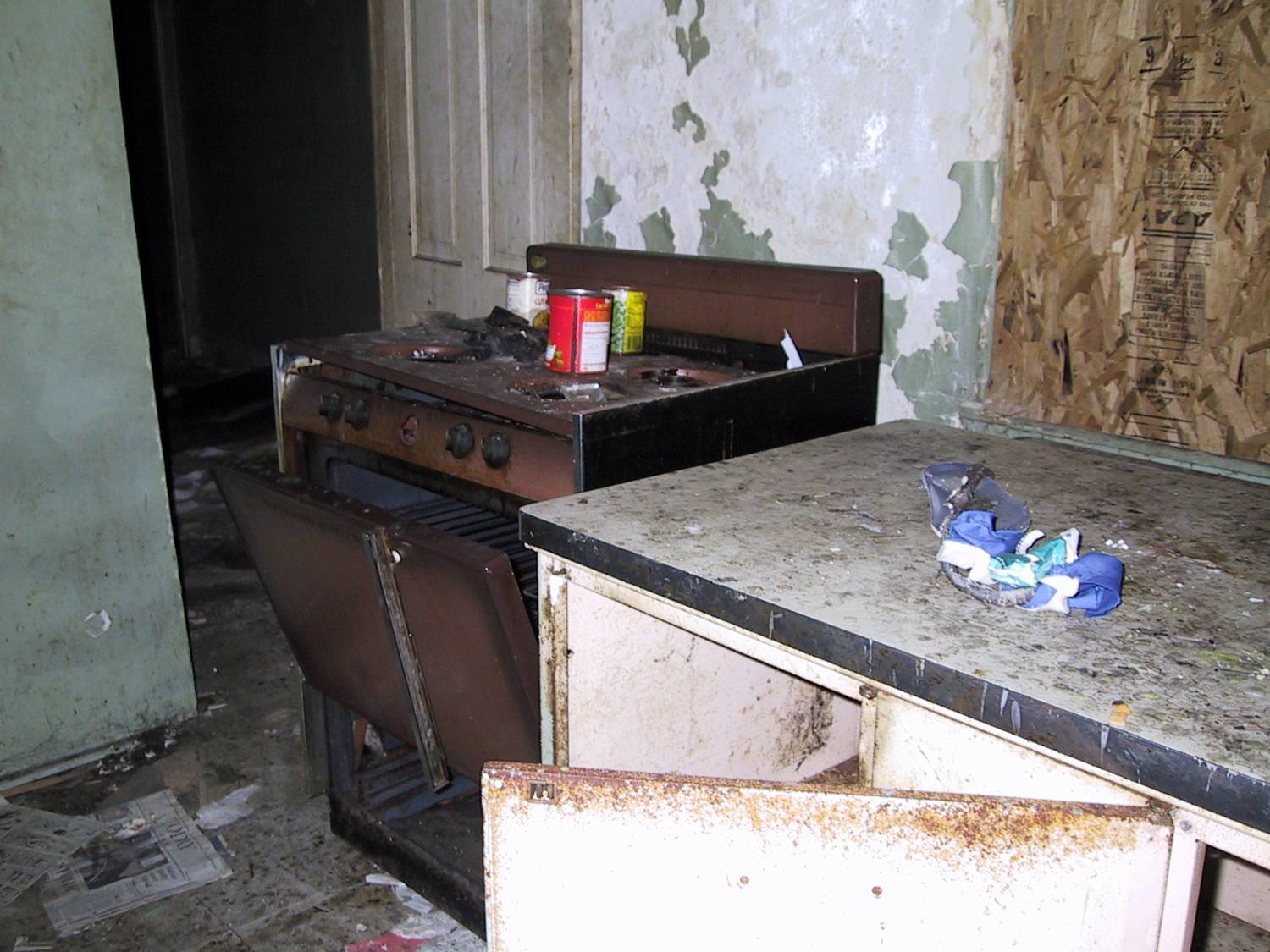
    #7) Looking Southwest in the kitchen, a few more appliances.
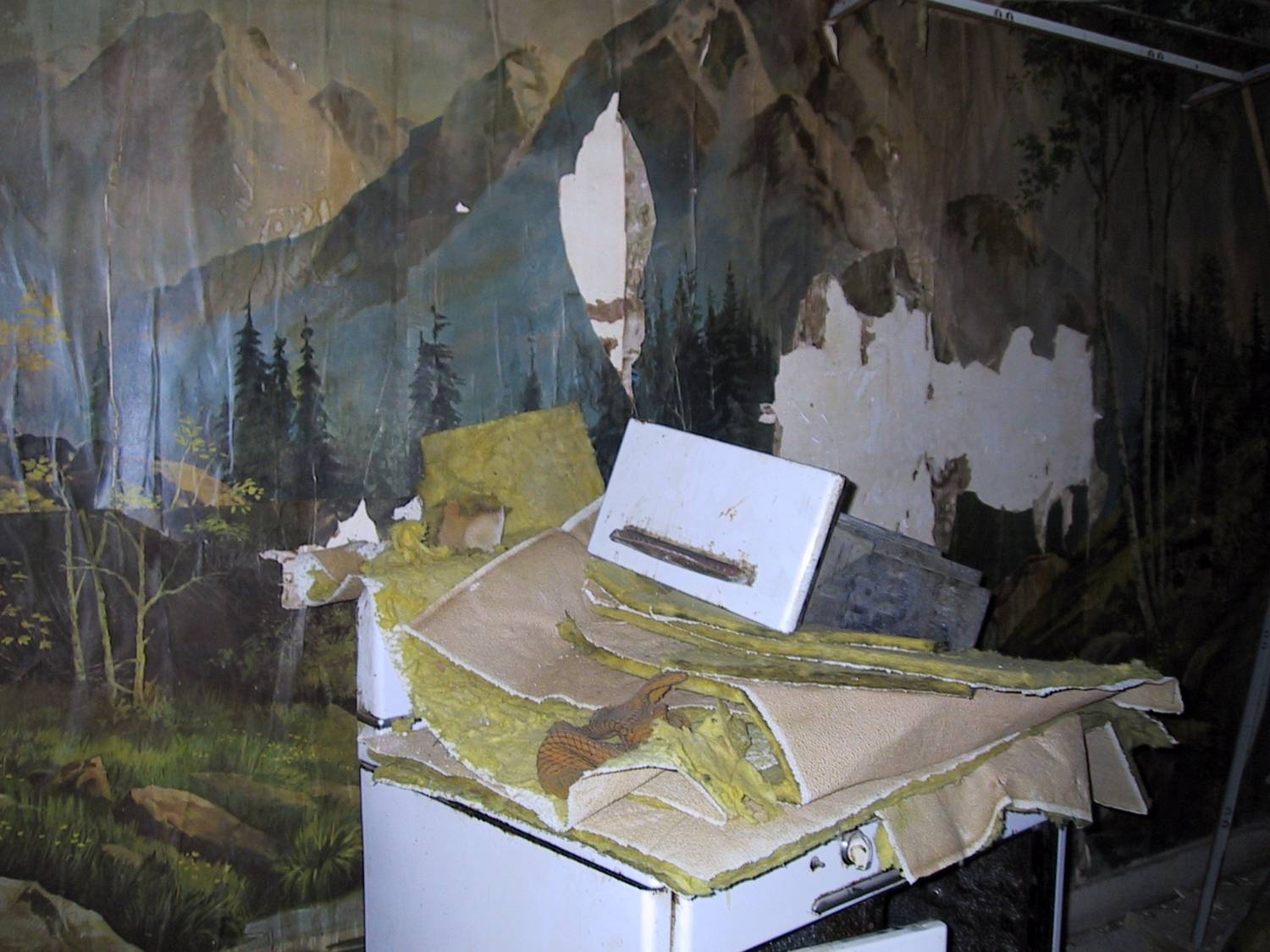
    #8) The Southeast corner of the kitchen. The iron stove top grates have long been sold for scrap. Almost all the metal has been.
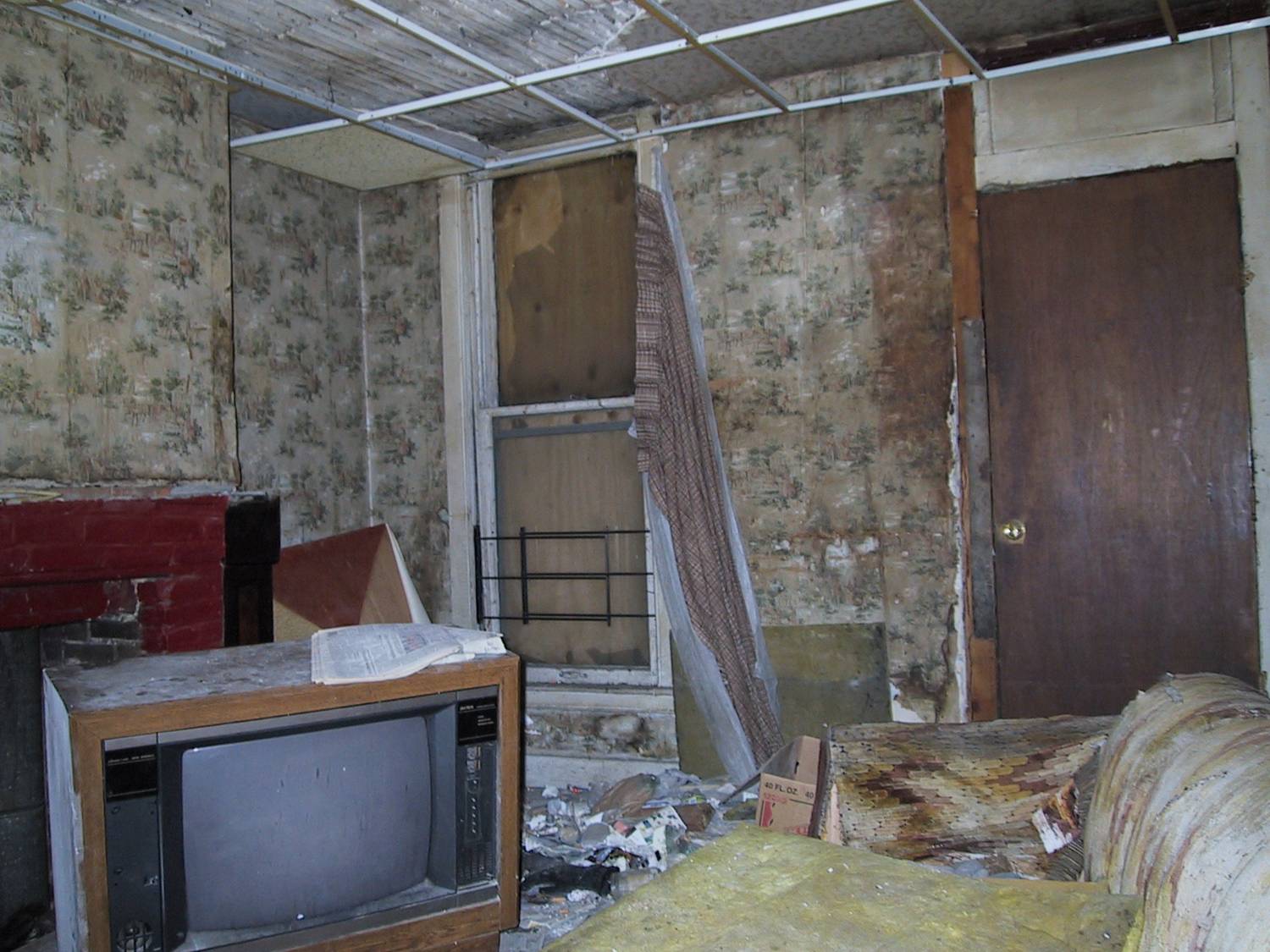
    #9) The front room is the living room. A TV and couch remain. Makes me think the home was occupied into the 1990s. The front door is on the right. It’s interesting to me that a big color TV, once somebody’s prized possession, is no longer worth anything.
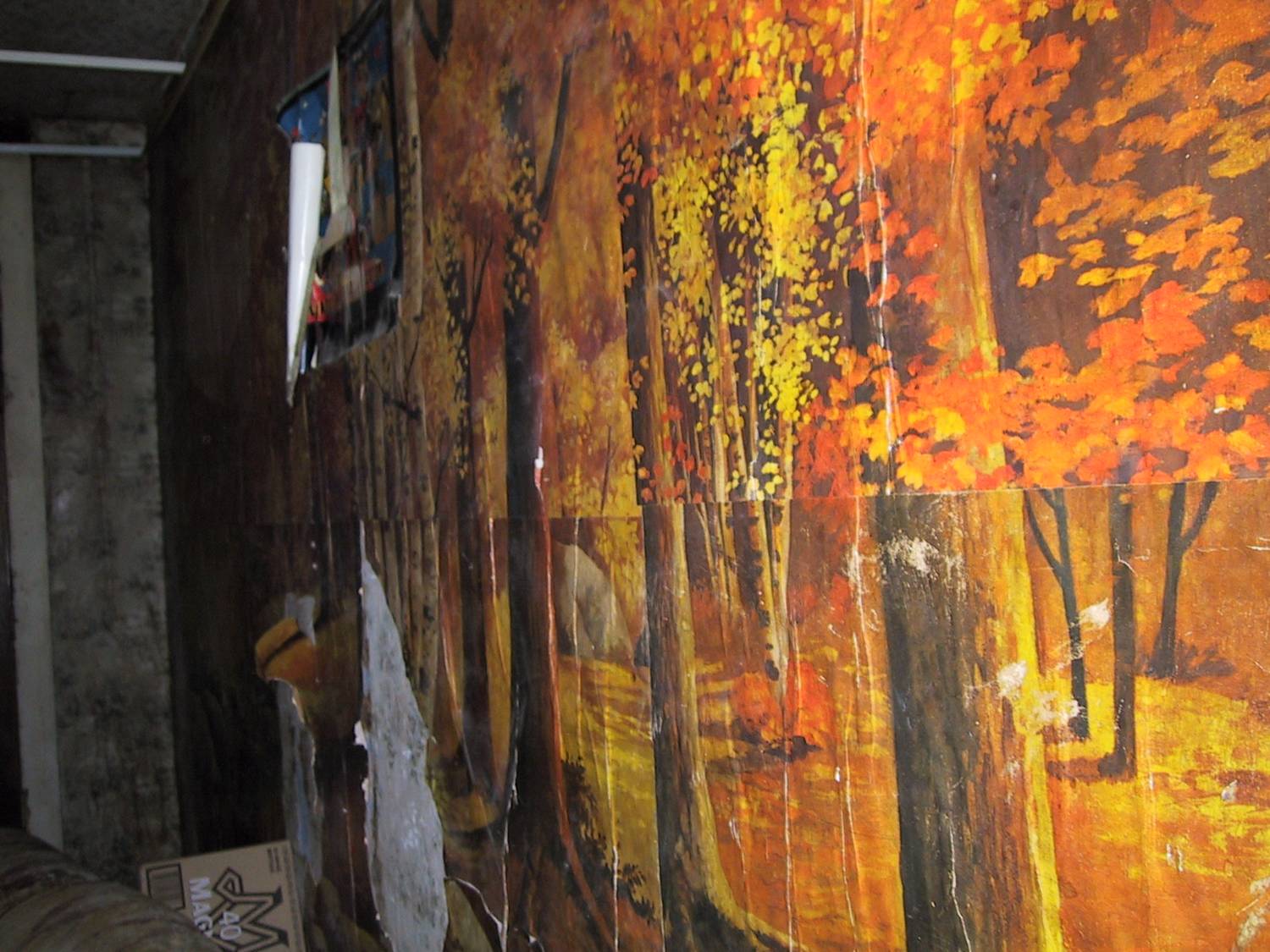
    #10) The front door is on the left. Vivid woodland wallpaper remains.
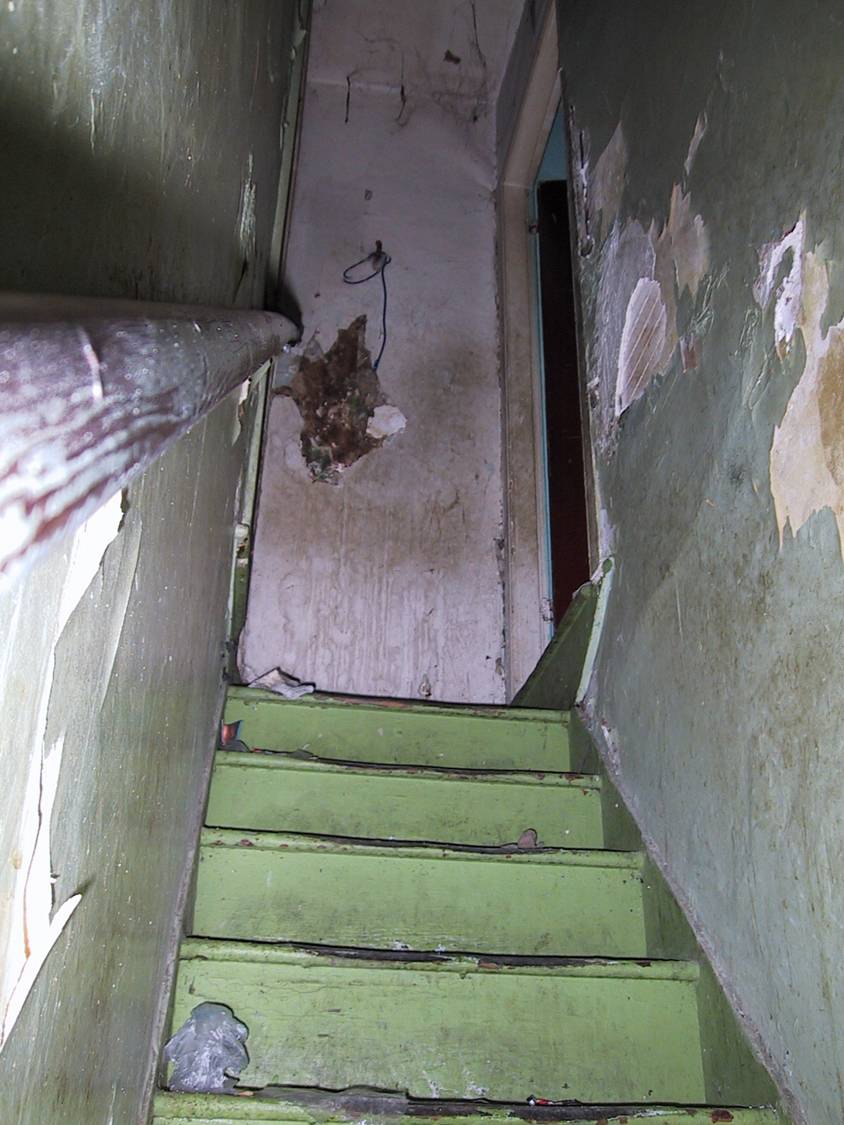
    #11) Looking up the staircase between the rooms. One of the stairs is rotted through, but the rest are in pretty good shape. This is a typical staircase for a rowhome. It’s horrible for police. Often there’s no handrail, and you can easily be pushed down. At the top, suspects could be in either or both directions. They don’t teach you about this in the police academy.
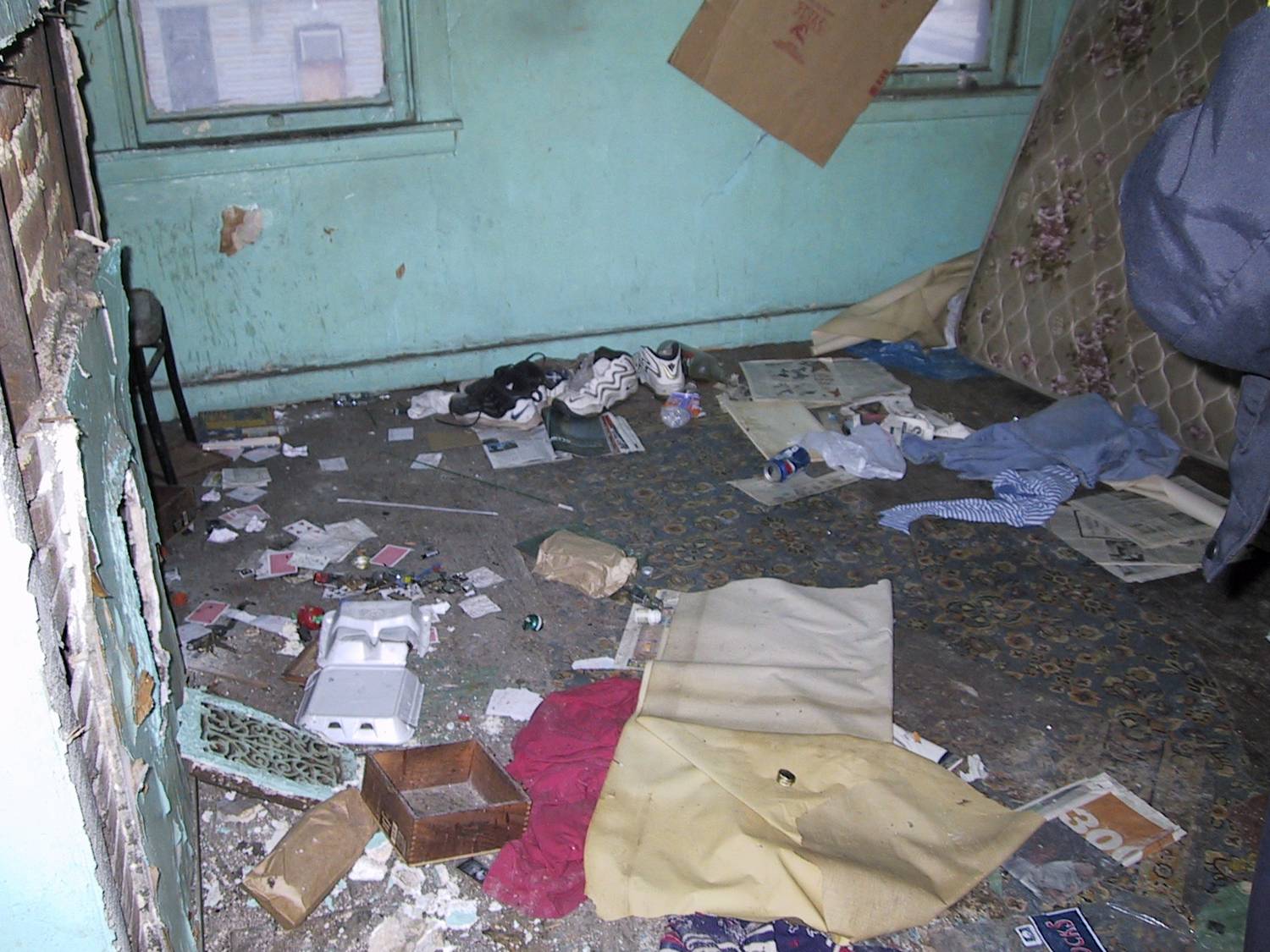
    #12) 2nd floor front room. Nice windows for surveillance of the dealers katty-corner across Wolfe St. Otherwise trash, some drug paraphernalia, a mattress against the wall, two pairs of shoes, and a nicely patterned linoleum floor remain.
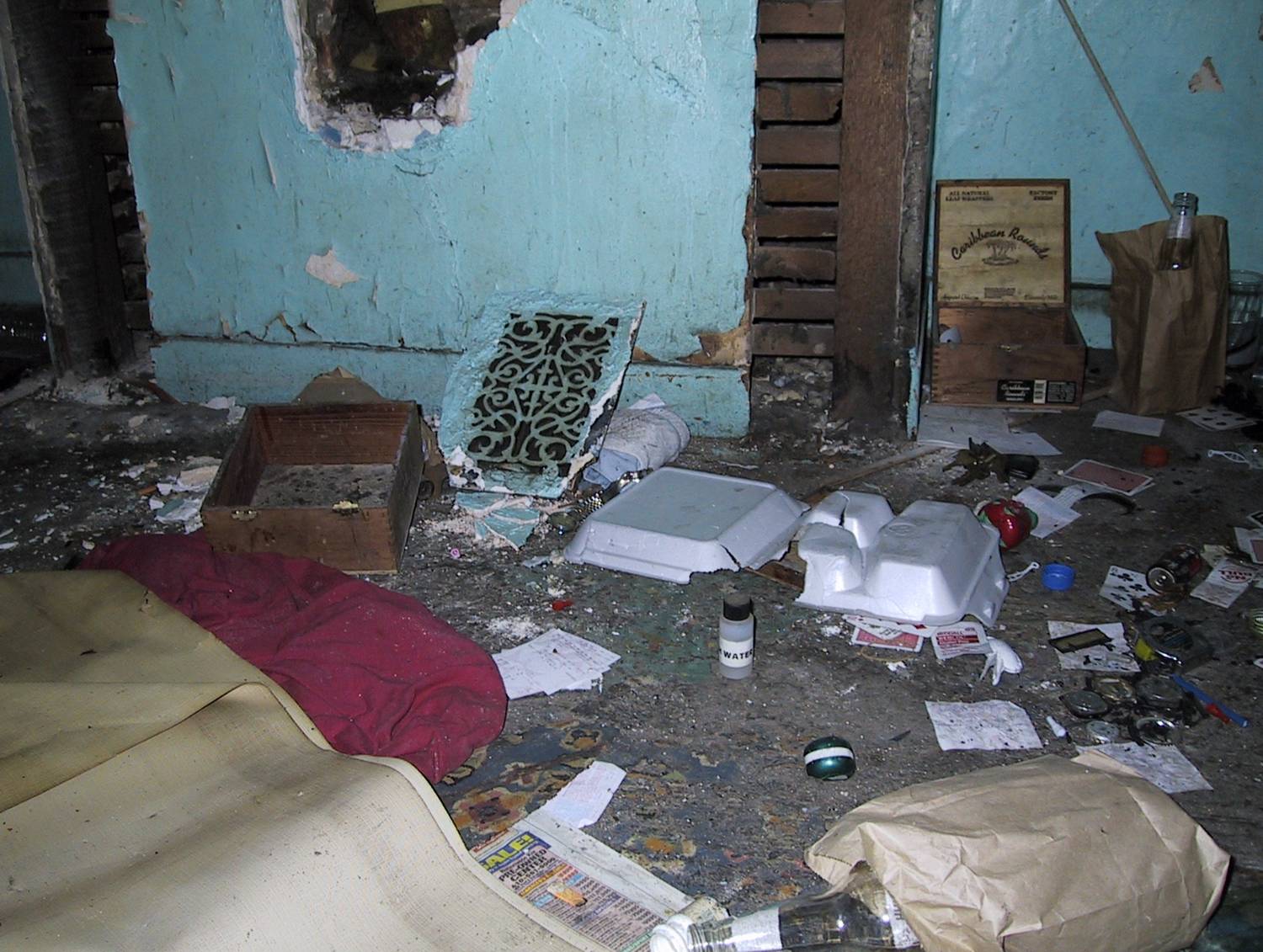
    #13) Looking East in the upstairs front room. A nice old heating grate, removed from the wall, hasn’t been taken to sell for scrap. A small water bottle (nicely labeled “water”) is on the floor. This water would be mixed with heroin and heated with lighter in a metal bottle cap from a 40oz bottle of malt liquor. The mixture is then injected. The only thing is these pictures I manipulated is the water bottle. I turned it so I could photograph the word, “water.” I love how it’s neatly labeled.
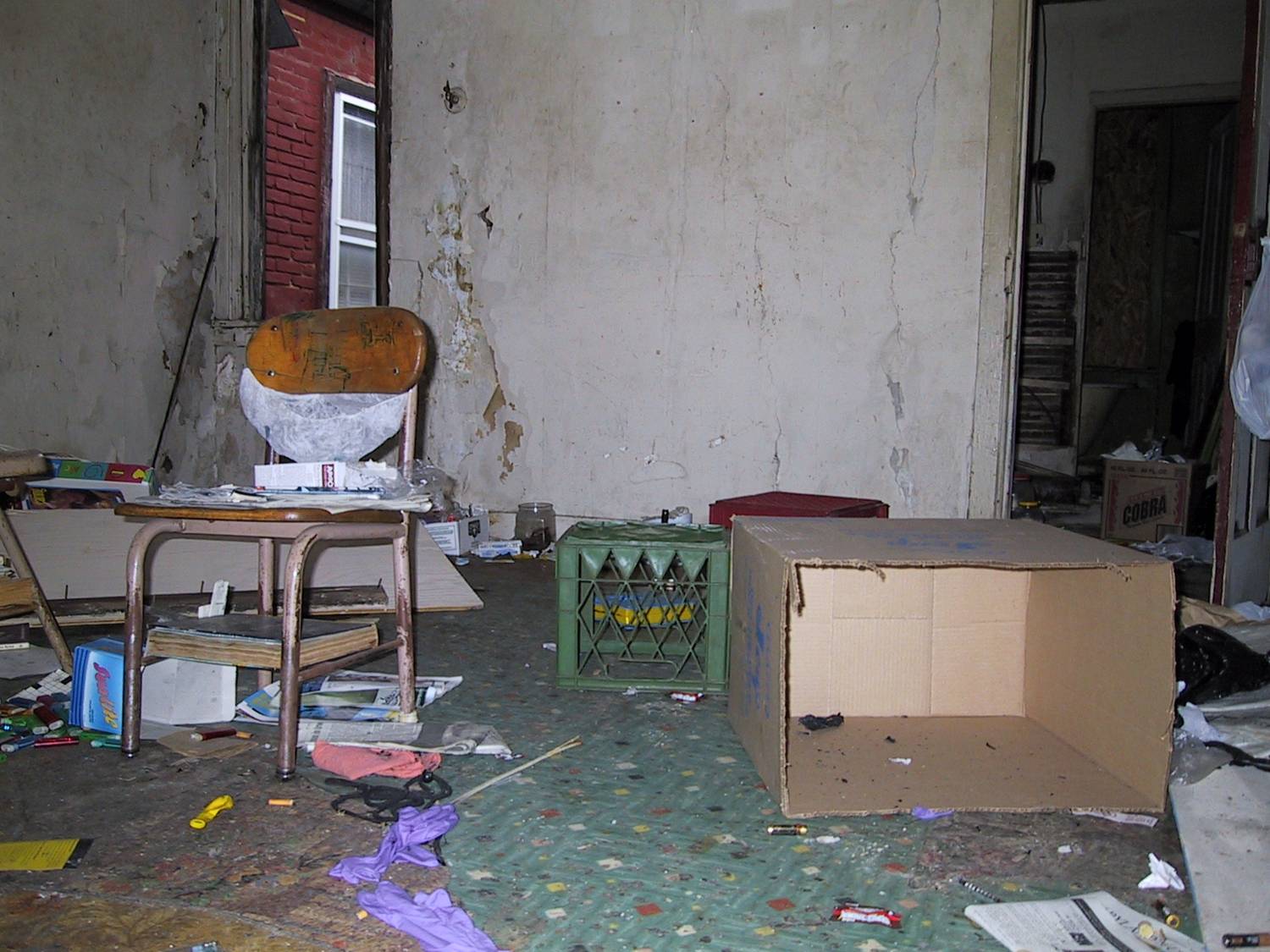
    #14) Rear room second floor. View looking rear from the stairs. Two layers of floor cover are visible, along with purple latex gloves, and a black tourniquet to make veins bulge for easier injection. An empty container of cornstarch is on the chair. Cornstarch can be put into empty crack vials and repackaged as “burn,” or fake drugs to sell for a quick buck, mostly to whites coming into the neighborhood. Some of these whites then call the police and tell us they were robbed (always of $10 or $20). They don’t get much sympathy. Locals would know not to buy from local junkies. But selling burn is not without risk as selling burn to the wrong person can get you beat up or killed.
    #15) Looking towards the front in the rear room. Mirrors and black pride posters increase the positivity and create a much nicer overall environment. Tupac, Goodie Mob, and Q-Tip. An almost empty bottle of Pepto Bismal lies on the ground, showing that indigestion can strike anyone.
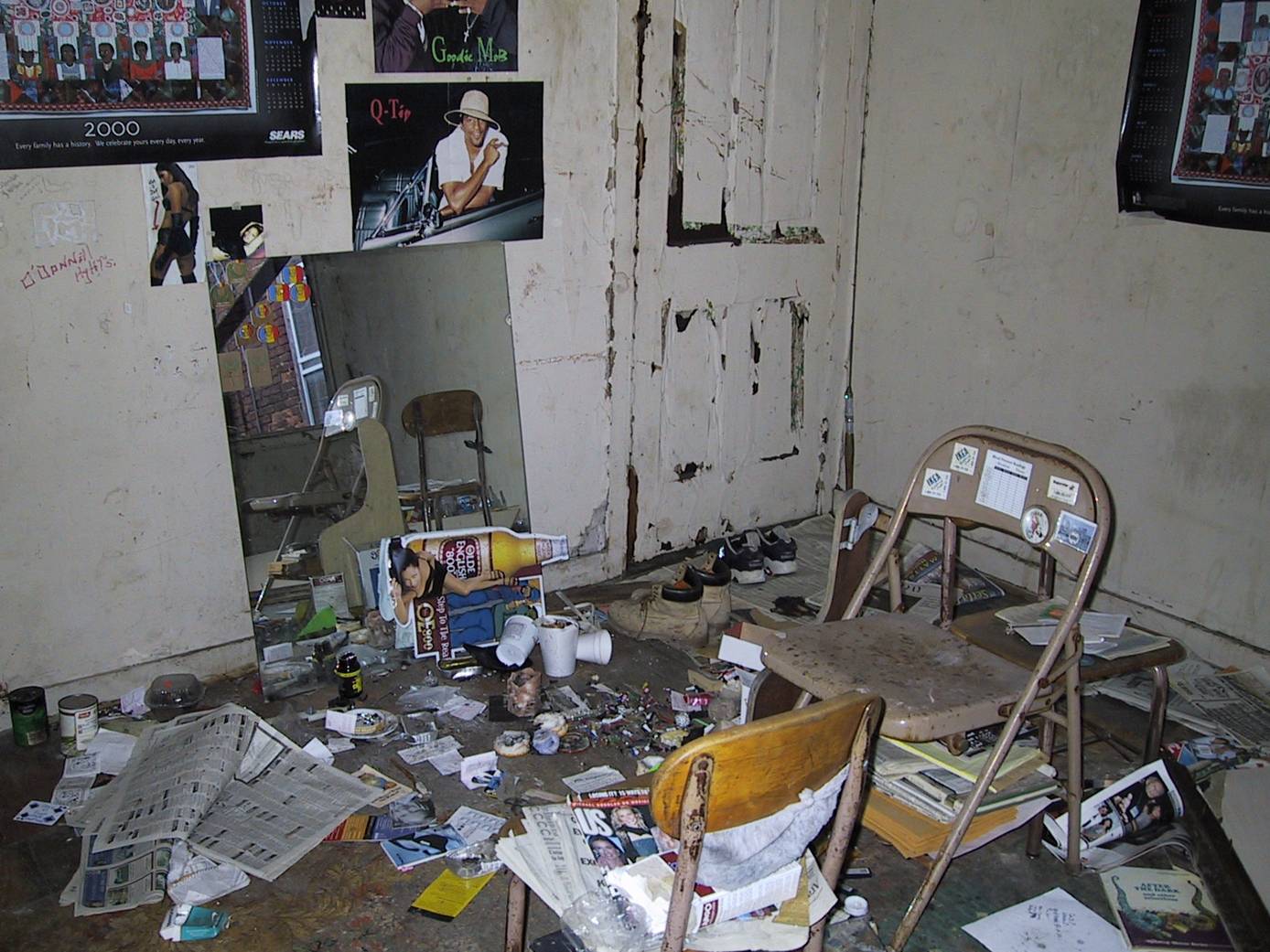
    #16) A poster and broken clock on one wall is just of above the bottles of piss and cans of shit neatly kept in the corner (unfortunately my partner knocked over that board you see on the lower right corner, tipping everything over. It smelled really rank after that.)
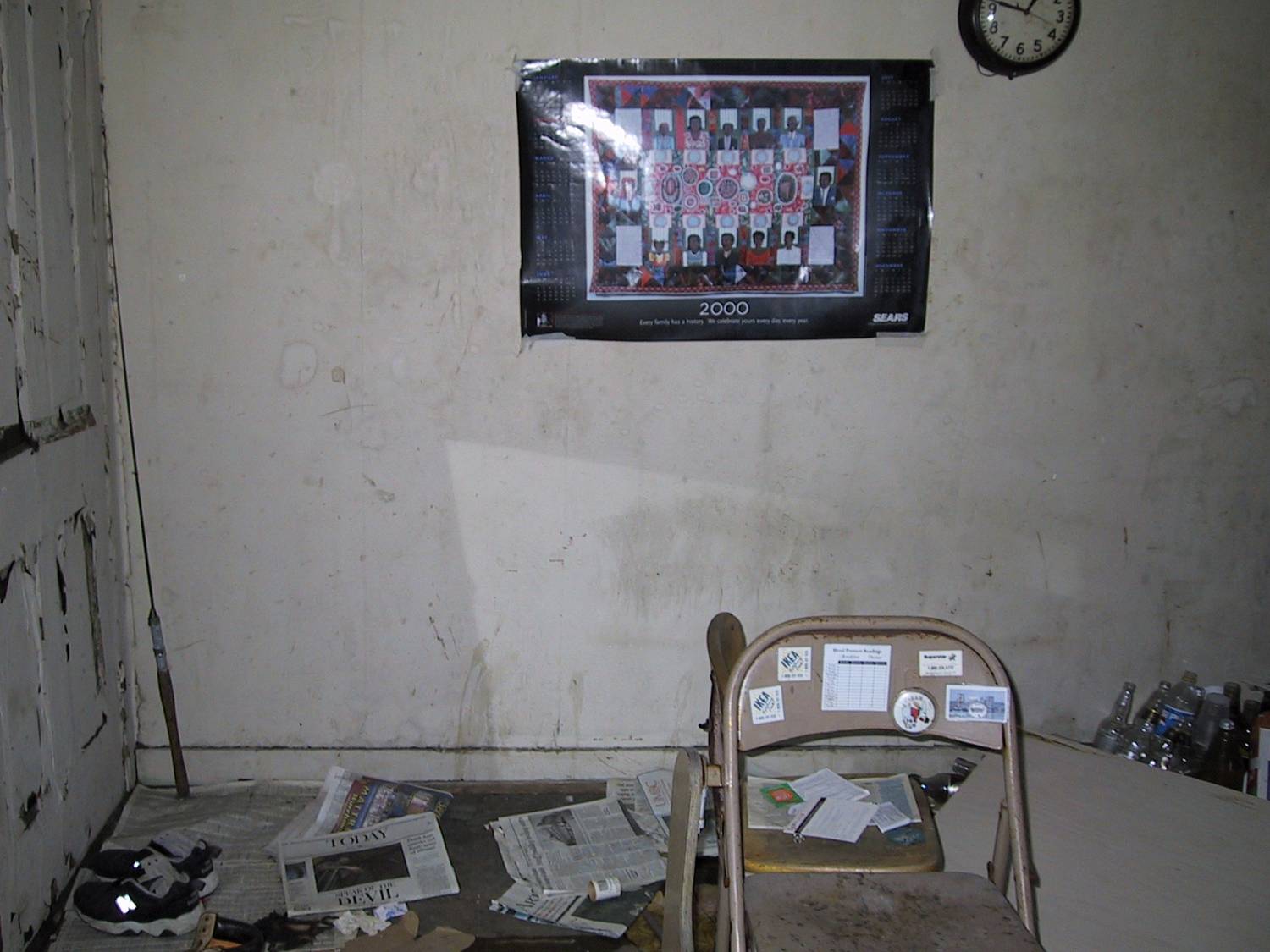
    #17) A 2000 Sears poster celebrating Black History claiming it’s not just for February anymore: “Every family has a history. We celebrate yours every day, every year.”
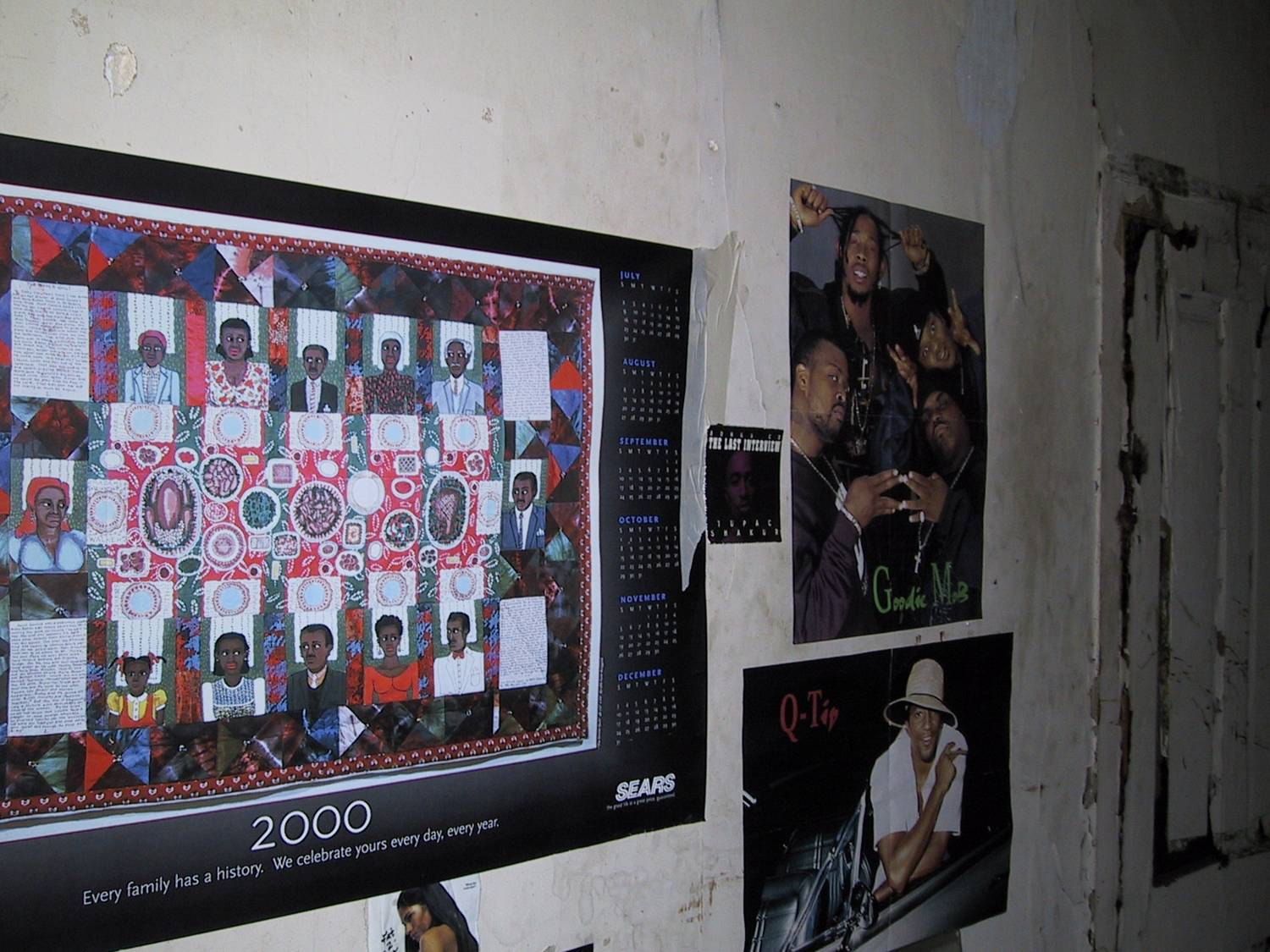
    #18) Bottles of piss sit in old malt liquor bottles. Next to it is a free parenting magazine and a toy box. My partner accidentally knocked the loose door on to the bottles of human waste. This spilled a lot of piss. We left the place worse than we found it. This wasn’t low-impact policing. Sorry.
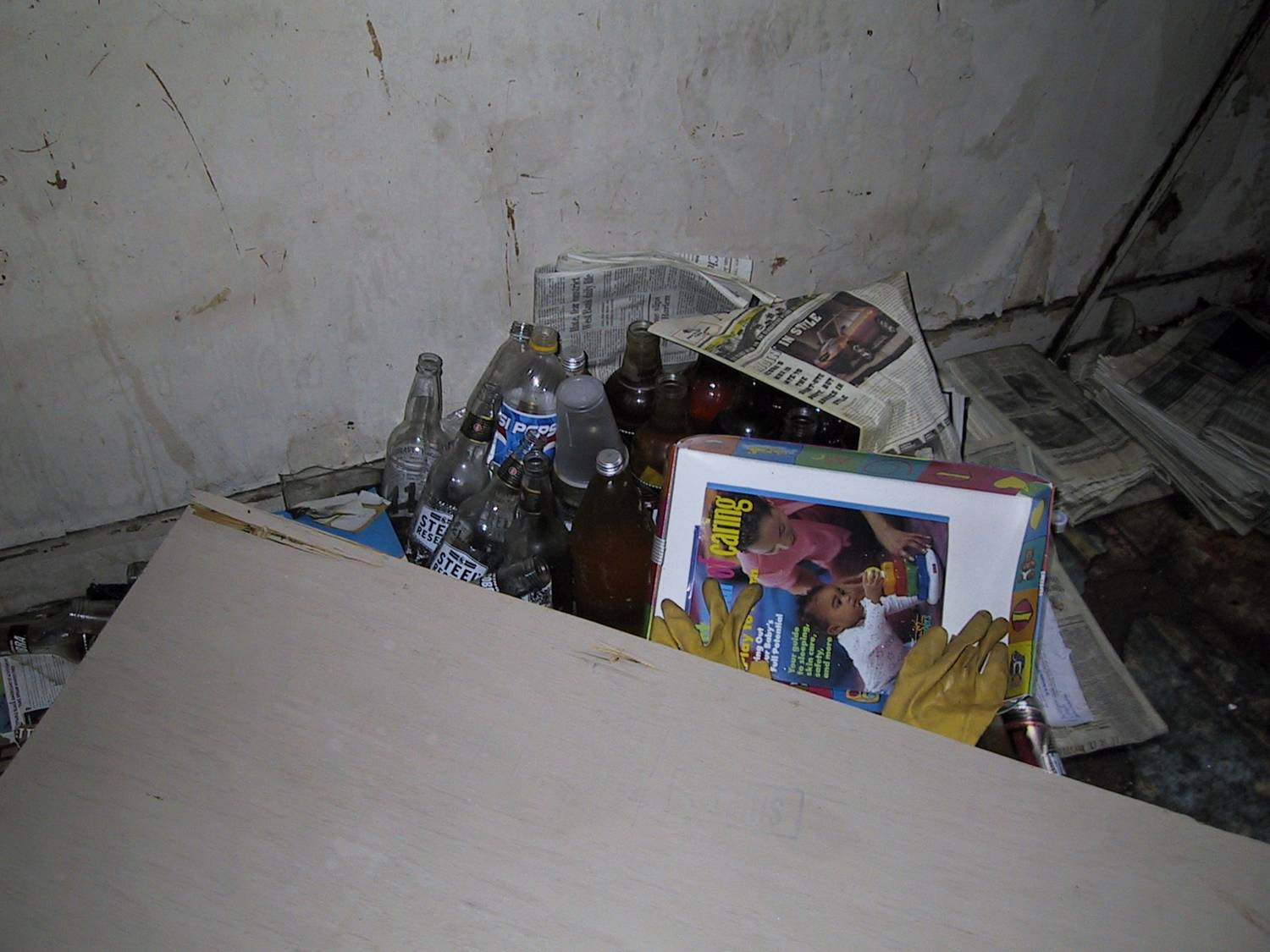
    #19) Another view of the main lounge and work area. Given the conditions, this is not where serious drug dealers do their work. This is a place for addicts to shoot up, relax, and scheme how to come up with their next $10 hit.
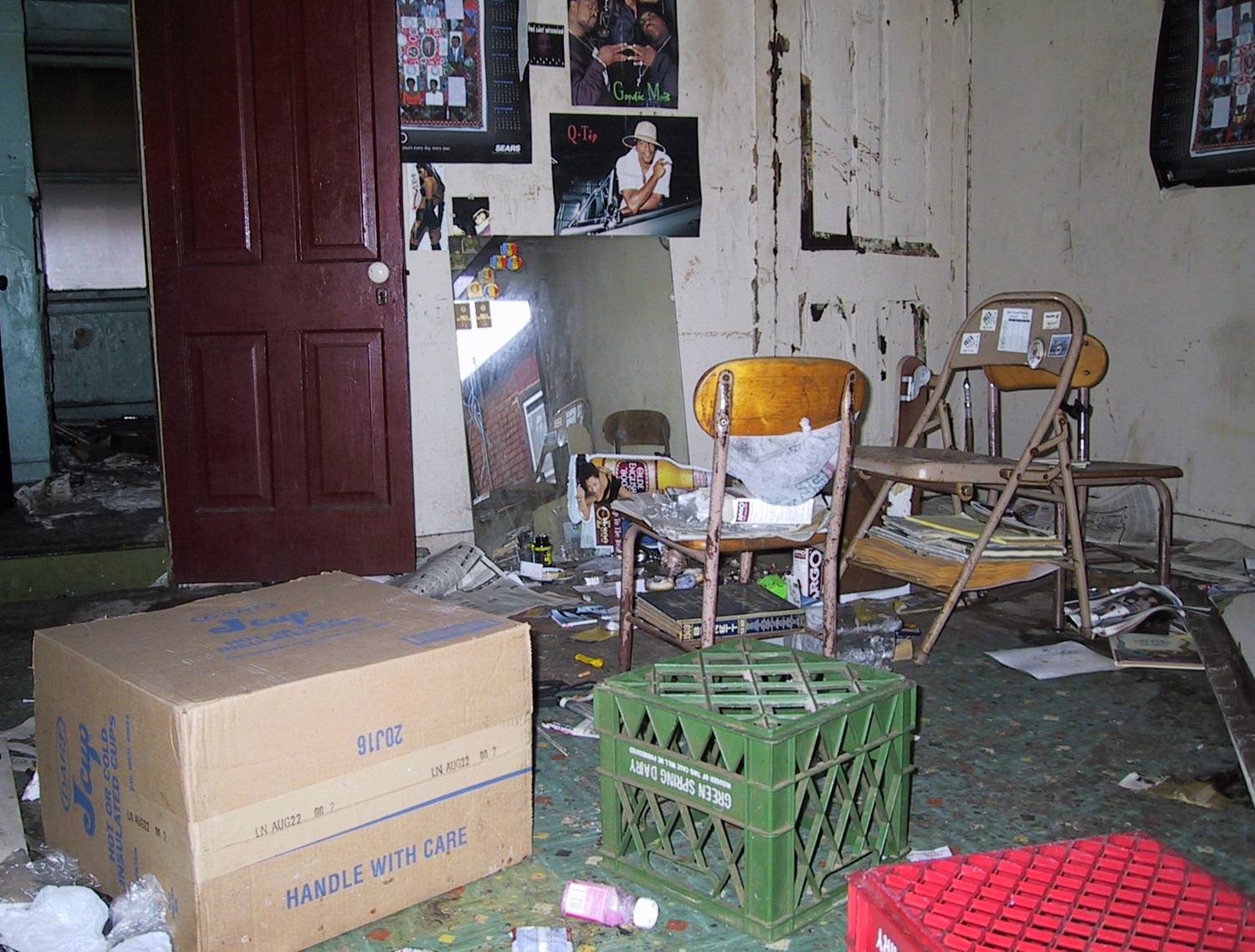
    #20) A few chairs are set around a collection of empty crack vials. There are also more shoes. Why all the shoes?
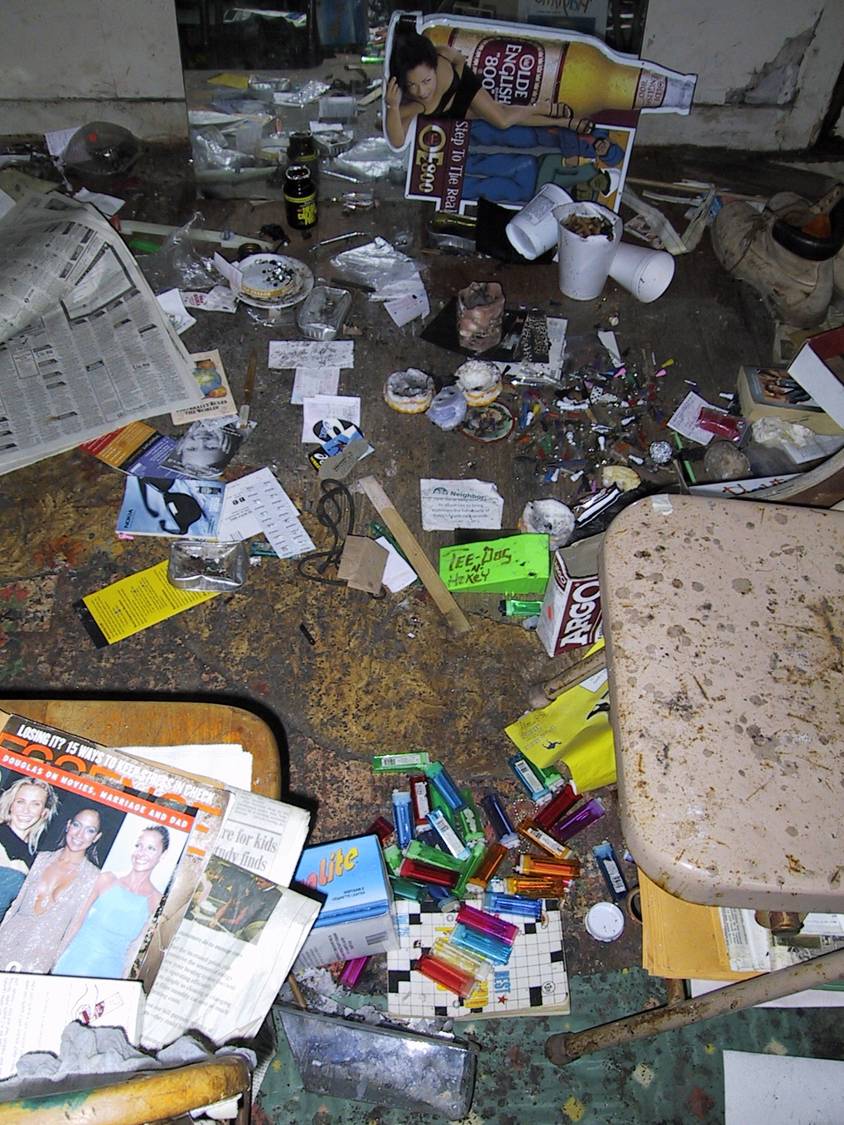
    #21) Looking closer, there are dozens of empty crack vials. Every color of the rainbow. The legal use for these vials in for perfumes and oils. The color of the cap on the vial often becomes a sort of brand name: red tops, blacks tops, or orange tops. Other good brand names: Uptown, Bodybag, Capone, and the more generic Ready Rock. Also on the floor are candles, cigarette butts, lighters (lots of them), tin foil, and bottle caps. Heroin and coke is an ever popular mix. John Belushi overdosed on it. Sugar, in the form of candy bars and tasty cakes can take some of the edge of the beginnings of heroin withdrawal.
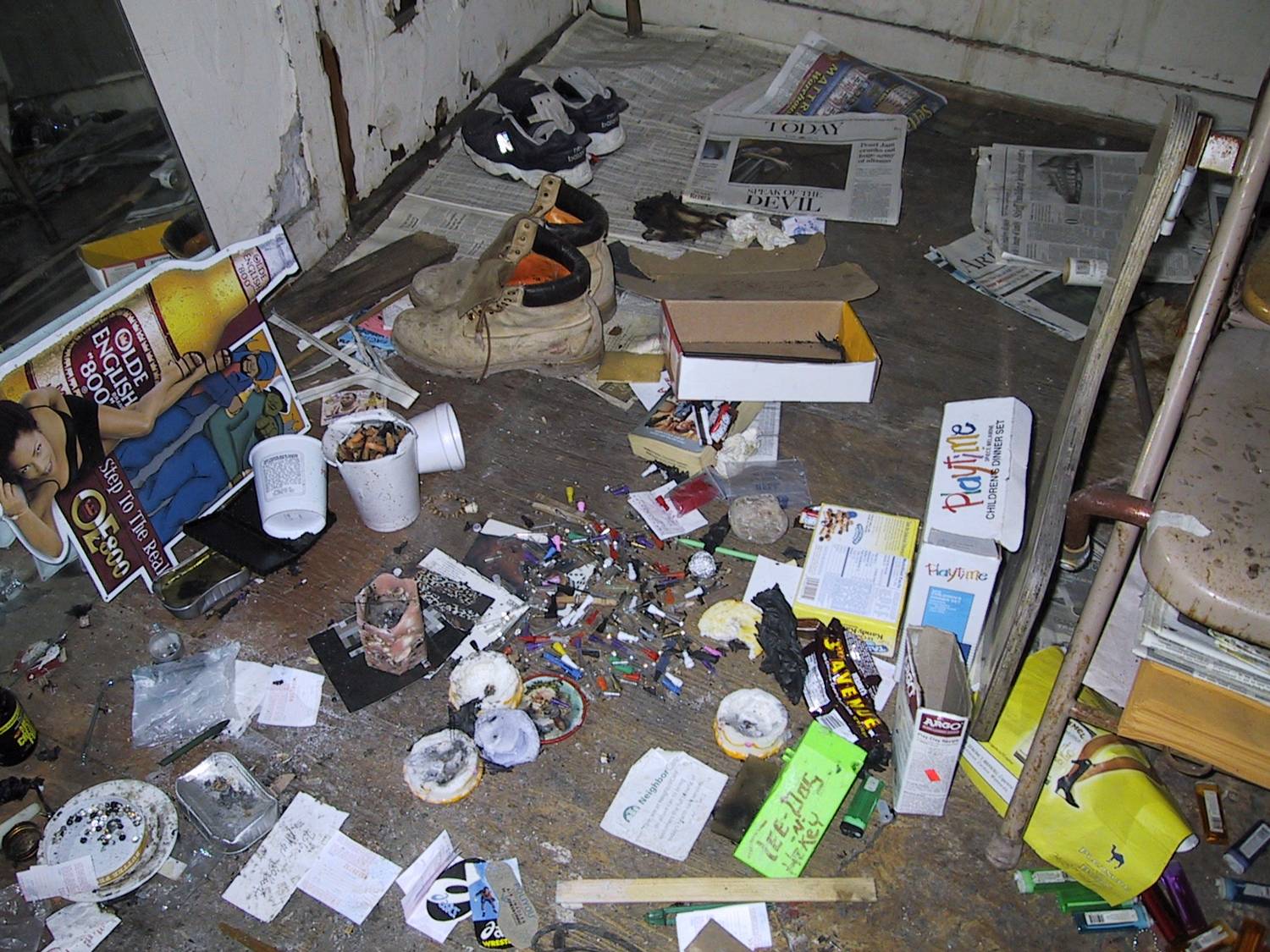
    Notice that the cup being used as an ashtray is standing and in use. The shoes are lined up. Paper is on the floor. In this disorder, there is order. But it’s almost inevitable that at some point in time they’ll burn the place down. And when that happens, you don’t want to be the neighbor next door.

    These pictures were taken in early 2001.
  • “Our Drug Policy is a Success”

    American has too many people behind bars, horrible levels of violence, foreign policy undermined by the War on Drugs, busts down the doors of citizens, makes poor people pee in cups to get a job, and–now this is important–the highest rate of illegal drug use in the world. Can John Walters really even write “our drug policy is a success” with a straight face? “One of Washington’s best kept secrets” indeed. Keep on keeping on. Walters has a piece in the Wall Street Journal.

    Much more convincing is Ethan Nadelmann’s counterpoint. Here’s to the end of prohibition!

  • Some Gave All

    Some Gave All

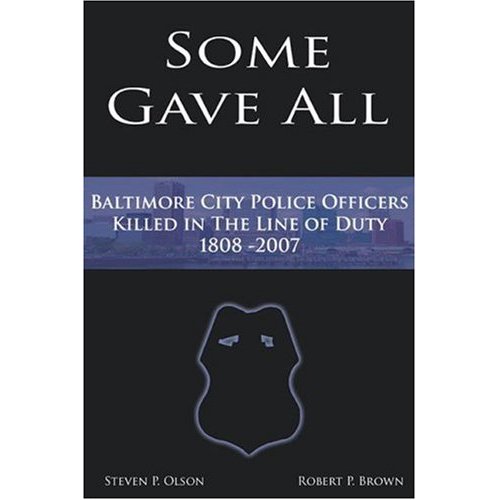
    I recently received Some Gave All: A History of Baltimore Police Officers Killed in the Line of Duty, 1808-2007 by Steve Olsen and Robert Brown.

    It’s a very nice work of history and a wonderful homage to those who died serving Baltimore City. While details on recent police deaths tend to be relatively well known, even I leaned some things about the circumstances about the death of my friend, Crystal Sheffield, to whom my book is dedicated.

    Some Gave Allreally shines in the history, going way back in the 19th Century. Most of thesenames have been forgotten. This book gives all these men (and one woman) who gave their lives the respect they deserve.

    There’s also an interesting story out of this. I recently received an email from the author, Sgt. Olsen, about a manuscript he found:

    In the same vein as your work, I have an original manuscript from 1974 by an officer who did exactly the same as you. His work, however, was suppressed by the Command at the time and it wasn’t discovered until 2008. (We found it in a retired Major’s locker.) It was called “The Socialization of the Urban Police Officer.” It’s a pretty neat read.

    We found what appeared to be the only copy sealed in an envelope. In 1975 the notes written on the outside of the envelope it said “Review and Hold” and initialed by someone that’s illegible. 10 years later, the note said, “Someday, somebody should read this.” So, what do police do? We ripped it open and read it!

    Turns out I’ve already read it. It’s by a guy name Mike O’Neil. It was his Masters Thesis at Brown. Later he got his PhD at Northwestern and who do you think signed off on his dissertation? None other than my father!

    Before I finished my dissertation in 2004, Mike got in touch with Howard Becker, because of their common interests in jazz music. Professor Becker told Mike about our parallel stories and Mike got in touch with me. Mike was nice enough to send me a copy. He’s no longer involved in the police world or academia, and doing just fine.

    In 2004 Mike wrote me this:

    Cherry Hill was close to the worst when I was there. Only redeeming feature, the city refused to license a bar in the area. That helped. Pomerlou was chief. Think the pay was about $8,000. Perhaps $5 for court (I don’t remember). The old cops back then also said the job wasn’t as good as the “good old days.” I suspect that that is a universal.

    More recently Mike corrected the record:

    By the way, it was never “suppressed” by the command. I doubt they ever knew about it. I shared it, as I recall, with two civilian police academy instructors and the judge in the Southern district. None officially.

    I recall this advice [about drugs] from my Sgt in Cherry Hill: “We don’t have the time to get involved with that shit. If you see something, go to a pay phone and drop a dime and call the Narcotics Unit; let them deal with it.”

    So it seems that at least in some ways, times certainly have changed.

  • More people behind bars

    The Bureau of Justice Statistics reports:

    * At year end 2007, federal and state prisons and local jails held just under 2.3 million inmates (2,293,157). The number of inmates incarcerated in prison or jail increased by 1.5% during the year.
    * About 1 in 198 U.S. residents was imprisoned with a sentence of more than 1 year in a federal or state prison.
    * Overall, more than 7.3 million people were under correctional supervision, 1 in every 31 adults.

    Adam Gelb Of the Pew Center said “this report is yet another reminder to states of the size of the prison problem. Especially in tough economic times, they have to ask whether spending nearly $50 billion a year to keep one in 100 adults behind bars is giving us our money’s worth in terms of public safety.”

  • Rioting eases in Greece

    Rioting eases in Greece

    It seems, as expected, that things are calming down in Athens.

    Apparently, nobody has been killed in the rioting. Apparently, the bullet that killed the kid was indeed a ricochet (that’s why US city cops are not allowed to fired “warning shots”).

    [Dec 12: today the Kathimerini reports the opposite conclusion:

    Meanwhile the results of forensic tests indicate that the bullet that killed 15-year-old Alexis Grigoropoulos, and sparked this week’s rioting, appears to have entered the youth’s body directly. This casts doubt on claims by the 37-year-old policeman charged with the boy’s murder that the bullet had been fired as a warning and ricocheted.

    According to sources, the results of a ballistics test revealed an as yet unidentified substance on the bullet, as well as marks, but experts ruled out the possibility of the bullet having hit a metal or concrete surface before striking the youth, fueling speculation that the marks on the bullet had been caused by contact with the victim’s bone.]

    Here are some of the better You Tube clips I’ve found. I automatically discounted any video set with a background of death-metal music. Come on, manges,you’re not helping your cause. I’m only willing to sacrifice so much for my cause (but bad music takes out probably 80% of the videos posted).

    Some tourists report here:

    And this is a news broadcast with some context.

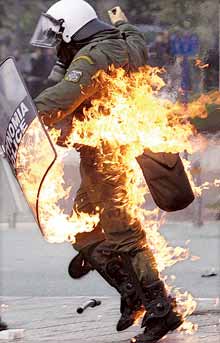
    [December 13: In response to Nick’s comment that the media has such a pro-police bias, I’d like to provide a caption to the picture to the right. Luckily, according to the Kathimerini (and to think, I was duped by their biased and horribly pro-police propaganda simply because they publish in English), the police officer in the picture was not seriously injured.

    But perhaps the caption could be:

    While wrapped in the enveloping warmth provided by unarmed freedom-loving youths and pondering the ever-present Greek quandary of freedom of death, a Greek police officer dances a celebratory Kalamatiano in an attempt to shake off the fascist symbol of his uniform and with it, the last vestiges of the Yoke of Ottoman Oppression.

    Ζητώ η Ελλάδα, baby.]

  • Sympathy for the Devil

    A reader turned me on to this articleabout life in the LA Hood: “Sympathy for the Devil: Crime Stats Say L.A.’s Streets Are Safer Than Ever, So Why Are Gang Hoods Still So Bloody?”

    It’s by Sam Slovick in the LA Weekly. It’s long. I’ll confess, I haven’t read it all (sheee-it, man… I got things I got to be doing). But if you’ve got an hour on your hands, check it out.