If any of you were planning on hearing me on the Phil Hendrie Show tonight, it’s been rescheduled for next Tuesday night, 1:30AM (eastern time). Something about breaking news. I bet it’s not the shootings in Harlem.
Category: Police
-
Police aren’t soldiers
And soldiers aren’t police. Going from the armed forces to a police department may seem like a natural transition. It’s not. A different mentality is needed. Most soldiers can make the transition. Some can’t. De-emphasizing the military aspects of police departments would help.
Here’s an interesting article in the Austin Chronicle about the problem for some soldiers’ reentry into the police world.
-
Cooking the books
In 2007, the Kansas City Police Department reported a 22% drop in crime to the state (and to the FBI’s Uniform Crime Report). Now it turns out that crime actually went up 10%. The department basically blames this mix-up on a paperwork mess. Sounds fishy. But having worked in a real big city police department, I kind of believe them. It’s a mess in there.
It is hard to overstate how completely overwhelming police paperwork can be. No matter what you do (except maybe if you deal with doctors, patients, and medical insurance), you have less paper work than police.
If police had less paperwork, they could do more policing. Think about that the next time you call for more documentation of police work. Much police work willbe undocumented. All police work can’tbe documented. That’s the truth we’ve got to live with.
Last year a different city reported low crime numbers to the FBI. After the crime stats got published and this city was reported as safe, the city “discovered” more stats and submitted them to be published in some unpublicized addendum. I don’t remember the city, but I don’t think this was an accident.
Here’s the worrisome thing. With my ear to the ground, I smell smoke (how’s thatfor a mixed metaphor?). There’s more and more pressure in the NYPD to produce lower crime stats. That’s not necessarily a bad thing… as long as lower crime stats reflect lower crime. But I’m starting to think that stats and reality are less and less related. I didn’t hear this a few years ago. Now I do. It’s worrisome.
The Compstat pressure to produce lower stats is overwhelming police ability to lower crime. A mid-level commanding officer gets a new asshole chewed out at a Compstat meeting. His numbers are too high. He tells his lower-level officers he needs lower stats. He doesn’t tell them to fudge data, of course, but funny things start happening. Reports start getting “reevaluated.” Or a foreign tourist is robbed (many tourists lie about being robbed, by the way, but that’s another story) and is leaving the country the next day. If the victim is gone, the suspect won’t be prosecuted. No victim, no crime. So the robbery is recorded as “lost property.” What’s the harm?
As a Baltimore police officer, I never felt any pressure to downgrade crime. Nor did I ever downgrade grade crime for the purposes of lower crime stats. But based on my professional judgment and discretion, I downgraded crime all the time.
There’s a fine line between common and aggravated assault. “Intent to cause serious bodily harm.” Who can say for sure?
There’s a fine line between misdemeanor theft and felony theft. How much is your laptop worth? Are we talking current value or replacement price? That’s the difference between a bit of paperwork and a major Part-One crime.
There’s a fine line between burglary and senility. What do you do if a “victim” “thinks” things are missing from his apartment?
There’s even a fine line between “rape” and “failure to pay.” A prostitute says she was raped. When an officer reports a rape, a lot of gears and department resources start moving. Plus the victim needs to go to the hospital and get tested. Maybe the “victim” just wants her money. Or, as I once dealt with, her three winter jackets back that the John took (it was a cold night). I could have reported a rape. That’s what she first said. But then all these gears would have turned in the wrong direction and nobody would win (and she would be cold). Instead, I investigated, got the real story, and got her jackets back. I could have locked everybody up. Instead, everybody left happy (sort of). I thought it was good policing. Best of all, there was no paperwork.
The point is there’s a lot of discretion in investigating and lots of gray in producing crime stats. Always has been, always will. This isn’t the problem. We need to acknowledge the gray, train and pay our officers well, hold them to high standards, and move on.
The problem is when a police department systematically–or non-systematically but on a large scale–begins to change crime data to lower the stats. This is a hole out of which you can notdig. Every year you have to keep fudging the stats just to match the fudged stats from the previous year.
There are only three ways out of this:
1) You fess up after the data is released, published, and reported in the papers. Then you just hope the follow-up story gets less publicity.
2) You get caught. You get fired. And your bosses (who directly or indirectly got you in this mess) get to gloat about how vigilant and angelic theyare.
Or 3) you get promoted and your replacements are stuck with a huge “crime” increase to manage during their first year. But they can’t say too much. You are, after all, their boss.
There is no great solution except to keep honest stats (“at least,” to quote H.L. Mencken, “within the bounds of reason”). It’s important to make clear from the top to the bottom that any stat fudging is not to be done.
But if you de-emphasize Compstat, you’re losing one of the tools that helped bring crime down.
If you bring in independent oversight, you bring in more layers of management and paperwork. Not good. (But having district commanders in charge of stat collection that can help or hurt their career is begging for shenanigans.)
Maybe you need a special number for police to call anonymously just to report problems with stats. Remember, cops don’t like fudging stats; they do so because they feel they have to. Perhaps if two anonymous officers complain, a little internal audit begins. That could scare some people straight and give honest cops the reason they need to remain honest.
For stats, you could focus solely on homicides. Homicide stats are much harder to fudge (but there’s still some room). But that only works in an area where there are a lot of homicides. What if the main problems in an area are quality-of-life issues? How do you measure these?
There is no easy answer. There never is. But the first step to a solution is pointing out that there may be problem.
-
Harlem Shootings (IV)–You read it here first
Now it’s officially in the news. The Daily News, to be precise.
-
Buy Cop in the Hood
 It’s a great book. And I’m not the only one who says so.
“Riveting…. An unsparing boys-in-blue procedural that succeeds on its own plentiful—and wonderfully sympathetic—merits.”
—The Atlantic“Never mind ‘The Wire.’ Here is the real thing.”
—The Wall Street Journal“[A] riveting tale of policing…. A must read.”
—Sudhir Venkatesh“Hard-edged sociological analysis…. A devastating critique of America’s failed war on drugs.”
—Orlando Patterson“[An] adrenaline-accelerating night ride that reveals the stark realities of law enforcement.”
—Publishers Weekly“Just garbage! … Who does he think he is telling me what to do?”
—My former boss, former Baltimore Police Commissioner (and convicted felon) Ed NorrisRead all the reviews here.
Go to your book store or Amazon.com to buy Cop in the Hood.
-
Harlem Shootings (III)
Seems like you’ve officially entered the blogosphere when you’re quoted in other blogs.
More on the Harlem shootings at Gothamistand NYC The Blog and great pictures at Harlem Hybrid.
Seems like my initial report of 14 guns and 7 shot was right on the mark (at the time I hedged the shooting number with “give or take one or two”). There were seven shootings if you believe an anonymous comment about “another, unreported shooting at Fred Doug and 127th.” I’m inclined to believe seven because that’s what I was told. But six or seven, I guess it doesn’t matter either way, unless, of course, you’re the seventh victim.
The old (high-school) journalist in me likes to be able to actually break some important(?) news.
-
Harlem shootings (II)
I did find this buried in the Daily News. Maybe it’s all about location. Location, location, location. Or, as they said in The Wire, “wrong zip code.”
The newspaper headline is “Fatal Gunfire on Westside.” One man was shot and killed. Then in the last paragraph it says this:
The slaying came after a chaotic night in uptown Manhattan. Six people were shot in a series of attacks in Harlem – starting at 8:30 p.m. – on an unseasonably balmy evening. None of the victims was expected to die.
Thanks for the weather report.
-
The way some live
This brings back memories. Bad memories. Cops deal with this sh*t all the time.
-
Willie Bosket
I recently finished reading Fox Butterfield’s excellent All God’s Children: The Bosket Family and the American Tradition of Violence.
Amazingly researched (Butterfield is a Class-A journalist), this 1996 book follows a culture of violence and its transference over time from white slave owners in the historically f**ked-up county of Edgefield, South Carolina to Willie Bosket and the contemporary ghettos of today. It’s not a feel-good story. But it’s a great read. Willie Bosket was a very bad boy.
The New York Timeshas a story on him today. He’s been in solitary confinement for two decades.
-
Florida Guns Increase Crime
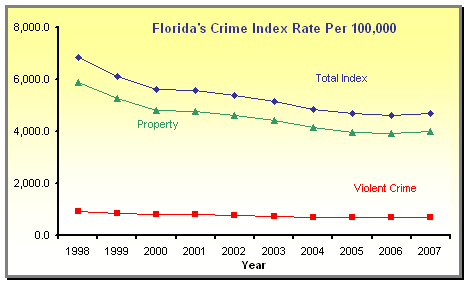
OK you gun fans (and I know you’re out there), explain this to me: I read in the paper today that licenses for concealed handguns have almost doubled in Florida since 2005. “Interesting.” I thought. “I wonder what’s happened to crime.” So I checked. Murder, robbery, and burglary are all up.
Now I know this is a simplistic analysis. But could somebody tell me something else that happened in Florida except another 200,000 people walking around with guns that causes this increase in crime between 2006 and 2007? Criminals can get concealed gun permits, too.
Let’s say crime went down, wouldn’t gun nuts be shouting about how this proves guns equal safety? Well, now crime is up. Where’s the clamor? (There are some good schools of criminal justice in Florida. I’d bet they’re working on such reports right now.)
Remember, I’m not a huge fan of gun control (but purely for pragmatic reasons: I don’t think gun control controls guns), but I do think guns equal crime. Florida seems to show this, no?
You can read the newspaper article (which interestingly does not talk at all about crime rates) and look at the crime stats here (it’s a PDF file).
update:
Florida crime trends over time (thanks to DJK). Looks like crime was going down until2005.
