Dave H. sent me the link to this cartoon by Chris Britt in the Peoria Journal Star.
Category: Police
-
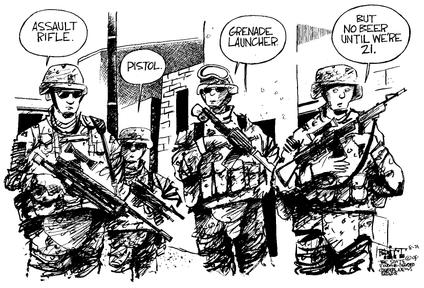
Makes you want to drink
-
Me on KPFT right now
KPFT. About drugs.
-
No wonder people like him
I am proudly liberal. I am not an economic libertarian or social conservative.
With that, I heard Ron Paul interviewed on National Public Radio yesterday. Of course like any politician, he was playing to his audience. On NPR, he’s talking about ending the war in Iraq and not, say, overturning Roe v. Wade. But with what I heard him say, he sure makes a lot of sense. I’d take him over George Bush any day. Of course, I’d take anybody over George Bush.
When it comes to the war on the drugs (he’s against it) and U.S. foreign policy (on Georgia: “Who cares who started it?” “Why are our troops there in the first place?”), I like him. And unlike too many of his supporters (those that read and comment on this blog excepted, of course), he doesn’t sound like the crackpot he probably is.
-
More bad news from the war on drugs
Thanks to the War on Drugs, submarines are slipping undetected into the U.S.
The Boston Globe has the latest story. -
The Wire
I have a secret. Until a few days ago, I hadn’t seen the last season of The Wire.
I love The Wire. But I don’t have HBO. And I don’t want to go somewhere to watch it in case I miss an episode.
So I wait until it’s out on DVD. On DVD you can binge and watch the Wire in four hour stretches. Along with being satisfying, it makes the plot easier (not easy, easier) to understand.
So this was the week. In three nights (2 hours, 4 hours, 4.5 hours) my wife and I binged. We just finished.
It was good.
I won’t spoil anything, but I don’t believe for a second police officers would do the “big lie.” So that’s the 25%that isn’t realistic. Like Hampsterdam. But somehow, the unrealistic parts only add to the show.
It was good, baby. Real good.
-
Colleges: Drinking age ‘not working’
Top university officials in Maryland – including the chancellor of the state university system and the president of the Johns Hopkins University – say the current drinking age of 21 “is not working” and has led to dangerous binges in which students have harmed themselves and others.
“Kids are going to drink whether it’s legal or illegal,” said Johns Hopkins President William R. Brody, who supports lowering the drinking age to 18. “We’d at least be able to have a more open dialogue with students about drinking as opposed to this sham where people don’t want to talk about it because it’s a violation of the law.”
“How many times must we relearn the lessons of prohibition?” the statement says. “Adults under 21 are deemed capable of voting, signing contracts, serving on juries and enlisting in the military, but are told they are not mature enough to have a beer.”
The whole story by Stephan Kiehl in the Baltimore Sunis here.
-
Police officer indicted for Taser death
This is rare: “A grand jury in a small Louisiana town last week took the rare step of indicting a police officer for repeatedly shocking a handcuffed suspect with a Taser.”
Here’s the story in the Pittsburgh Post-Gazette.
Race is involved. The tased guy was black. The officer, who was fired, was white.
Meanwhile, in Houston. It turns out that there was no wrongdoing in each and every of the 1,700 taser incidents. That includes the the guy who shocked his own stepson. Here’s the story. Good job, H.P.D.!
-
Baltimore City juries less likely than suburban juries to convict, study says
No shit, sez I.
Here’s the Baltimore Sunstory by Julie Bykowicz.
People talk about how the criminal justice system is biased against blacks. And it is. If it weren’t, nearly half the people in prison wouldn’t be black.
But, dot dot dot, if you are going to be arrested for drugs, it’s far better to be arrested in Baltimore City (where most people are black) than in the surrounding counties (where most people are white).
I talked about this in my book (which by now I hope you’ve read). This is from the Sun’sstory:
Among the findings: In the three counties, 45 percent of defendants were convicted and 27 percent acquitted. The remaining 28 percent were convicted of some charges and acquitted of other charges. Those numbers were different in Baltimore, where 23 percent were convicted, 43 percent acquitted and 34 percent given “combination verdicts.”
Conviction rates also vary between the city to the counties depending on the charges. In the city, 57 percent of drug defendants and 57 of defendants charged with personal offenses (such as murder, assault or robbery) were convicted. Those numbers in the counties were 95 percent and 69 percent, respectively.
[…]
The “starkest difference,” […] was that jurors in nearby counties are 30 times more likely than their city counterparts to convict a defendant of the most serious charge against him. The probability of a conviction on the top count is 2 percent in the city and 63 percent in the counties, the report says.Baltimore State’s Attorney Patricia C. Jessamy doesn’t like the report. But I, like any Baltimore City Police Officer, don’t like Patricia Jessamy.
Why won’t Baltimore City juries convict criminals? There are three basic reasons:
1) People who make up Baltimore City juries don’t like or trust police because they’ve had bad experiences with Baltimore City police.
2) People who make up Baltimore City juries have friends and/or relatives who have been accused of crimes and the jury members they simply refuse to believe are guilty. So they are quick to give the benefit of the doubt to the suspect. It’s not “us” versus “them.” It’s us versus us.
3) Some members of Baltimore City juries are simply stupid.
-
Real Police
I just received this email. It’s an interesting take on on the concept of being “real police.” “Real police” is both a concept and a compliment. It’s what in the NYPD they call a “cop’s cop.” Also, when you actually say “real police,” you have to stress “real” and the first syllable of “police.” Otherwise it doesn’t make sense.
I find the resentment over your book interesting. I would like to focus on the retired Major from the city who refuses to read it. I am very much “real police,” but I am not entirely sure my 4.5 years as a Baltimore City officer would qualify as “experience” according to this commander (I now have an additional 2 years in [***] police department). I guess you have to inefficiently manage a district and treat subordinates poorly in order to qualify for “real” experience in Baltimore City … a little cynicism I had to add.
Experience, in my humble opinion, does not have a definitive time frame; rather, it’s how you use your time while you are there. An officer can lazily choose to sit in their patrol car for a year, answer calls for service, never act proactively and consider that experience. Or that officer can choose to commit to hard work, be aggressive and gain the experience sought after by many. However, whether aggressive or not, I think it is accurate to say the average officer has a certain level of comfort for the job after one year.
Personally, I worked hard for two years in patrol which opened up the door for two years in flex. I have great experience, particularly in the field of drug work. Do I know everything? No. But I was able to handle myself efficiently and safely on the street. But then again, according to certain police, experience is seemingly based solely upon your sequence number, not in what you do.
Finally, I’d like to address a quote from his letter. The Major writes, “… that is why your book upsets real police; … when some opportunist such as yourself, exploits a mere year of service, converting it in some way to confer expertise on his puny observations, which were subsequently recorded for future use and gain!”
Again, I am “real police” and I am not upset. I thought the book was a great read. I felt your writings were fundamentally correct based upon YOUR observations and experiences in the city. If the Major would have read your book, he would understand your reason for coming to the city and for the book. From my perspective, it was research which turned into hands-on experience. What better way to do research than that? What is with the major’s anger with officers (in general it seems) coming to the city and leaving after a short period, to better themselves or perhaps even, dare I say, write a book. Countless officer’s come to Baltimore to gain experience and leave.
I cannot apologize for being unwilling to wallow in the disastrous Baltimore City Police Department and that complete hole of a city. Individuals like the Major are one reason (among the countless others) I cannot wait to leave law enforcement. When I am done with my graduate studies at [***], I am out the door not looking back!
I enjoy the blog. I’m sure I’ll continue to comment on what I read from time to time.
Respectfully,
[***]