Category: Police

  • No Parking = No Drugs?

    No Parking = No Drugs?


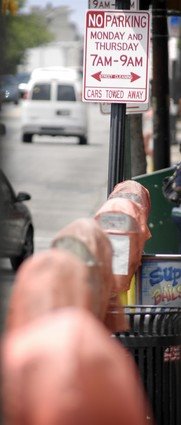
    In a comment, Timothy turned me on to an article by Liz Kay in the Sun, “No parking, Less Drugs.” Leaving aside the grammatical question (it should be “fewer drugs,” right?), what about the concept? They banned parking on part of the business strip of Pennsylvania Avenue to get rid of drug dealers. Apparently, it has gotten a little better. It’s also hurt business.

    [Sun photo by Andrew F. Chung]

    My firstthought is that it’s a dumb idea. As Mr. Sussman, pawnshop owner and president of the Merchants’ Association, is quoted as saying, “Sometimes there’s a worry that you can cure the disease and kill the patient.”

    And I also don’t like a vision that prefers empty streets to streets crowded with non-criminals. That’s very anti Jane Jacobs.

    That being said, there are many things in favor of this idea.

    1) It isan idea. Maybe it’ll work. Maybe not. But I’m all for trying it.

    2) The problem of public drug markets is big. Desperate times often do require desperate actions.

    3) Apparently the business owners support it. As long as the businesses support it, I will, too. In a business strip, the business owners should have a big say. Besides, probably the main people inconvenienced by this are the business owners themselves who park in front of their store and feed the meter all day. I wonder how many of these spaces were open to the public, anyway.

    4) The greater impact seems to result from increased police presence rather than the removal of parking space.

    Is it a long-term solution? Of course not. But I guess it’s worth a try. There are lots of places you can deal drugs in Baltimore. It would be nice if Pennsylvania Avenue weren’t one of them.

    From the article:

    Deidre Danois said she and a friend had to park across the street recently when they stopped on Pennsylvania Avenue to grab some breakfast.

    “I bet you police don’t go up to Roland Park and tell them they can’t park on their street,” Danois said as she shopped at Sweet Sixteen.

    That’s right, hon. Because they’re not dealing drugs in front of stores in Roland Park. She reminds me of one time when I was in the 7-11 at 2300 Orleans St (which is actually the Southeast but we would go there because it was next to 24 post and hell, we didn’t have a 7-11 in the Eastern). I liked this 7-11 because of Lorraine, one of the employees. Sometimes we would swap our respective soul foods. She’d bring me homemade collards and I’d give her just baked spanakopita. Lorraine quit when she won the lottery and got engaged to a nice Indian man. That’s two separate events. I didn’t want her to quit. But hell, could you blame her? Who works midnights in that 7-11 by choice?

    Anyway, this 7-11 could get pretty wild. One night they were out of chili and cheese and posted a sign by the hot dogs saying so. There were a bunch of yo-boys acting up, ordered hot dogs, and hadn’t seen the sign. They were upset that they couldn’t top off their “dugs.” Between curses, one guy shouts, “I bet the white man’s 7-11 has chili!”

    Sure thing, dog, and an open bar, too.

  • Much less scintillating that Whitey Bulger’s right-hand man

    So says Steven Levitt (of Freakonomics fame) about me and my book in his Freakonomics blog in the New York Times. And for that, I can only thank God. But I’m pleased that Levitt liked my book.

    Much less scintillating than a book by Whitey Bulger’s right-hand man? I should hope so. I was just a poor beat cop in Baltimore. I never killed anybody. But my book, Cop in the Hood, isn’t just a memoir, it has a point: end the war on drugs!

    My book also helps explain why so many poor black American men are in prison. And it’s not the reason you think it is, because it has nothing to do with being poor, black, young, or male. It has everything to do with police wanting overtime pay.

    I wish Levitt had liked my book a bit more, because I respect him deeply. Still, he read my book. He liked my book. And he’s happy he read my book. And you will be, too.

  • Still more police killed in Mexico drug raid

    Duncan Kennedy writes in the BBC:

    Seven policemen have been killed and four injured in Mexico’s latest incident of drug-related violence.

    The officers were killed during a raid on a home in Culiacan, in north-west Mexico, police said.

    Arriving at the house to search for weapons and drugs, police were fired upon and a grenade was thrown at them.

  • Officer Pete says (rule 15):

    If you’re going to get arrested, try and wear warm clothes. It’s cold in jail. And no, you can’t bring your cigarettes.

  • More on the Mexican drug war

    Despite obvious failure, the Mexican president has vowed to “stay the course” of drug prohibition. As if he were standing in front of a “Mission Accomplished” banner, President Calderón says the murder of Police Commissioner Millán, is a sign of government success against the drug cartel. He’s full of shit.

    James McKinley Jr. writes the story in the New York Times:

    Top security officials who were once thought untouchable have been gunned down in Mexico City, four in the last month alone. Drug dealers killed another seven federal agents this year in retaliation for drug busts in border towns. Others have died in shootouts.

    Drug traffickers have killed at least 170 local police officers. … Some were believed to have been corrupt officers who had sold out to drug gangs and were killed by rival gangsters. … Others were killed for doing their jobs.

    All told, 4,125 people have been killed in drug violence since Mr. Calderón took office.

    Several terrified local police chiefs have resigned, the most recent being Guillermo Prieto, the chief in Ciudad Juárez, who stepped down last week after his second in command was killed a few days earlier.

    As quoted in the Times, President Calderón says, “The question is, should we persevere and go forward or simply hide in our offices and duck our heads. No way is the Mexican government going to back down in such a fight.”

    Really? Why does it never occur to stupid leaders of failed strategies that they’re wrong? Is it pride? Hubris? How bad do things have to get before you try a new strategy? Apparently, much, much worse.

    Read the whole article.

  • Officer Pete says (rule 16):

    I know he says he loves you, but he says that to all his girlfriends.

  • Officer Pete says (rule 17):

    I know she says she loves you, but you have a job and a paycheck.

  • Is foot patrol right for you?

    Foot patrol may not be right for everyone. How do you know if foot patrol is right for you and your neighborhood? Ask your mailman. If your mail is delivered in a cart pushed by a walking mailman or woman, police should be on foot. If your mail is delivered by truck, foot patrol may not be right for you.

    Side effects of foot patrol include decreased fear, better quality of life, fewer broken windows, more fit police officers, greater interaction between police and neighborhood residents, and generally improved police/community relations.

  • Policing Green

    Cops want more money. Citizens want more foot patrol.

    We can have both. I call it “Policing Green.” Give cops the gas money for their shift if they agree to patrol without a car for that shift.

    The environmental link is mostly just a clever title to sell the idea, but it really would be green and save gas. At its core, though, it’s about policing.

    In an informal survey of my police officers students, every one of them would walk foot for their gas money. At least when it’s not raining.

    Police cars in the city probably go through about 6-8 gallons per shift. That’s $28-$32 right now. And even with giving this to police officers, departments would save money on cars upkeep in general. And as long as it’s the officers’ choice, everybody wins!

    Rather than asking what foot patrol does to improve matters (I believe it does, but it’s hard to prove), letting cops walk foot would shift the burden to asking what cars do to improve policing (and it’s been proven cars don’t improve patrol). Simply placing the burden on defending car patrol would be a huge and productive shift in police culture and patrol.

    Even better, you would let patrol officers determine the best way to police without cars. From the top down, it would never work. From the ground up, this could be effective.

    Here’s the system: at the start of the shift, officers either take the car keys or don’t. Anything else is up to them. They can grab their keys any time they want. But if they do, they don’t get the gas money for the day. They’re welcome to get a ride to their post. But they’re not allowed to team up with another officer in a car and split the gas money. That’s the only rule.

    Brilliant or crazy?

  • Overdose deaths

    In 2007, 235 Baltimore residents overdosed. The story in the Sunis here.

    Interestingly (and surprisingly), 74 of those were from methadone. I don’t quite understand the point of methadone. If it’s addictive and you can die from it, why not just give junkies heroin?