Category: Police

  • You heard it here first

    Looks like I wasn’t the only one bothered by the picture I posted of New Orleans Mayor Nagin smiling and pointing an automatic weapon.

    Mayor criticizes use of photograph
    by Times-Picayune staff
    Wednesday February 13, 2008, 7:58 PM

    Editor’s note: Late Wednesday evening, the office of Mayor Ray Nagin released the following statement regarding a controversial photograph of the mayor holding a gun at a Tuesday news conference. The photograph appeared inside The Times-Picayune’s metro section on Wednesday and in various presentations on nola.com. The image of the mayor smiling and holding a weapon kicked off controversy all day Wednesday on talk radio and in internet postings.

    The full store is here.

  • More on IRBs

    Fair warning:
    If you’re not interested in Institutional Review Boards (IRBs)–and there’s no reason you should be–you should probably just skip this whole post.

    Brief background: Federal regulations require IRB approval is required for all professors’ research on people. Since 1991 (I just learned this from Shrag’s blog), IRB approval was expanded to cover, among others things, participant-observation research (that’s what I do, with an emphasis on participant). You want to interview or observe somebody? You need IRB approval first. The purpose of the IRB is to protect research subjects. There’s a bit too much history about scientists doing bad things.

    Professor Zachary Schrag, a man who keeps a blog about Institutional Review Boards, left me an interesting comment in regards to a previous post:

    It’s quite possible that an inept IRB would have blocked Venkatesh’s research. But Venkatesh, by his own admission, “f[oul]ed up” by passing on information that people meant to tell him in confidence. So it is also possible that an adept IRB would have permitted the research while mitigating the harm. Not likely, perhaps, but possible.

    Rather than deal in such speculations, I hope you will elaborate on your own experiences with IRBs that led you to distrust them.

    I don’t distrust IRBs. My practical experiences have been more or less favorable. I just fundamentally question the very notion of needingIRB approval for non-experimental social-science research on capable adults. And I firmly believe that the simple nuisance and fear of conflict with an IRB limit social-science research.

    But first let me deal in some speculations:

    Not only do I think an IRB wouldn’t approve Venkatesh’s research. I don’t think an IRB doing its role of protecting research subjects shouldapprove Venkatesh’s research. The risk of some harm from his research was so great as to be virtually inevitable. But I think Venkatesh should do his research, and hence my problem with the IRB in general.

    I read one review of Venkatesh’s book that went so far as to to use the word “evil.” I don’t think it is. With regards to potentially violating protection of research subjects, I would draw the line between malum in seand mala prohibita. In other words: drug dealing OK, murder not. I don’t think Venkatesh crosses this line. But for Sudhir’s sake, I’m glad nobody shot somebody while exclaiming, “Am I going to make your book now, Mr. Professor?! Is this what you want?!”

    While in theory the IRB could have mitigated harm in Venkatesh’s case, it’s hard to imagine a scenario where this would actually happen. I’ve never heard of an IRB with follow-up. Thus the IRB, while failing in its basic mission, still managing to hinder good qualitative research.

    Too often, the quantitative researcher’s goal becomes how to outwit the IRB. I know of many good researchers and otherwise ethical people who admit to lying and deceit when it comes to the IRB. They feel, rightly or wrongly, that such deceit is necessary for research in their field to survive.

    For my book’s research, I honestly don’t remember or have a copy of what I gave to Harvard’s IRB ten years ago. I know it took three of four drafts and I agreed to make an announcement on day one of the academy stating who I was. It was good to be forced to make this announcement as it wasn’t easy to make (so thanks, IRB). That being said, I also didn’t want to remind my classmates every hour that they were being watched by a researcher. Is this ethical? I think so. My point was to be honest and overt. And I was. But I think I was supposed to post something that never got posted.

    I never got IRB approval for my switch in research plans when I actually had to get hired as a police officer. Between the heat from the P.D. brass disallowing my original research plan (for not being a cop) and the heat from my dissertation adviser for my new research plan (for being a cop), well, I had other priorities.

    Alas, my fear of preserving confidentiality and protecting my research subjects went so far that I didn’t leave any way to link specific people at different times to their actions and quotes. What if I get subpoenad(?!), I thought. This was a mistake. I could have written a better book if I had characters. I would have, if it weren’t for the IRB.

    My own experiences with John Jay College’s IRB have been pretty good. But there are still problems:

    1) The line between doing research and not doing research is not as clear cut as the IRB want to believe. My book is done. I’m no longer doing research for it. But when a friend calls or writes, I’m still going to note information for my records. Am I supposed to get IRB approval before going to a Bull Roast? Am I to stop going to Baltimore now that my “research” is complete? Am I to ignore everything I see and do since I don’t have IRB approval?

    2) Signed consent forms are simply impossible in police research. First of all, cops won’t sign them. Second, the social situation is flux. You arrive on a scene and officers come and go. Are you supposed to ask every arriving officer for signature? If signed consent forms were required and if this requirement were actually enforced, qualitative police research would simply end. Researchers who say they’re going to get signed consent forms from police officers are lying. Yet IRBs love signed consent forms. It’s like court overtime pay is for police. Just give ’em some and they’re happy.

    3) IRBs want a guarantee of confidentiality. I won’t do that unconditionally. Luckily, Baltimore police behave pretty well, at least within the bounds of reason.

    For those interested (and you might be if you’ve read this far), I’ll include the more original parts of my successful IRB submissions for approval withoutsigned consent forms and withoutunconditional guarantees of confidentiality. And they said it couldn’t be done.

    Requiring a signed consent form from every research subject would so limit my participant-observation research as to effectively kill it. Given the fluid nature of social interactions in a police station, it is not possible to have every police officer who enters a room or call for service to read, understand, and sign a consent form. My research methods are overt, but informal. While the bulk of police officers will be familiar with me and my research, it is inevitable that I will see and hear police officers who initially will not know who I am. Such confusion is usually clarified immediately by asking me or another police officer.

    My research is confidential and offers minimal, if any, risk to police officers.

    Police officers are not normally considered an “at-risk” group (quite the contrary, police officers are often seen as the group that places marginalized people at risk). Given the constant risk of observation by their supervisors, the public, the media, and internal affairs, an outside researcher who promises confidentiality present little risk. Police officers are used to being on-guard around people they do not know.

    A Note on Criminal Behavior and Confidentiality

    While IRB boards consider harms that may come to research subjects, the potential of research subjects harming others should not be ignored. Should a researcher remain quiet if confronted first-hand with research subjects who commit genocide, mass torture, or major war crimes? Of course not.

    In reality, I do not expect to witness any war crimes. But I believe that in extreme cases, a researcher’s obligation as a human being come first. Were I to witness a police officer in severe violation of criminal law, I would have to weigh any promises of confidentiality with my moral and legal responsibility to do the right thing.

    I would not violate confidentiality for violations of departmental regulation or even most criminal acts. In my years both as a police officer and as a researcher (often the two overlapped–I was a Harvard University graduate student researcher during my entire two-year tenure as a Baltimore City police officer), I have never participated in nor witnessed an act that would make me consider violating confidentiality.

    But if, hypothetically, I witnessed a police officer rob and kill, or sexually abuse a 10-year-old child, or anally violate an innocent man with a plunger, I would feel little compunction legally and ethically to violate a vow of confidentiality. Of course the odds that I will witness such a scene are almost zero. I do not expect such a situation to occur. But I and the IRB must be aware that the possibility, however slight, exists.

    I realize that it might facilitate approval of this project if I stated that all research subjects will sign consent forms and confidentiality would never be violated. But to pretend the former denies the reality of participant-observation research on police officers; to pretend the latter is morally irresponsible. I believe it is the combined duty of researchers and the IRB to promote ethical research and protect research subjects. This process begins with the presentation, discussion, and approval of an ethical and honest research proposal.

    All researchers are free to use this for their own IRB submissions. I’m happy to try and help the field.
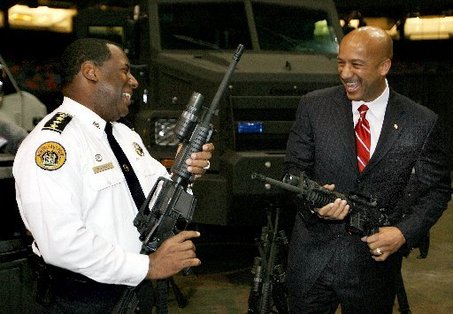
  • Cops love toys

    Cops love toys

    So much bothers me about this storyfeaturing this picture by Eliot Kamenitz of The New Orleans Times-Picayune The captain reads:

    Mayor Ray Nagin and NOPD Superintendent Warren Riley try out a pair of the NOPD’s new M-4 rifles Tuesday at the Superdome. Money from the state also provided 600 bullet-proof vests.

    The storybegins:

    New Orleans Mayor Ray Nagin and Police Superintendent Warren Riley on Tuesday used the floor of the Superdome to display more than $1 million in new armament and other equipment, largely for use by the SWAT squad in emergency and riot situations, including a fully equipped mobile command post, two armored cars and modern assault rifles.

    Nearly all of the equipment was financed from a $6.6 million state allocation to New Orleans police that was earmarked for crime-fighting items or strategies, Riley said.

    The city officials said the new equipment reflected a determination by the Police Department to root out and arrest criminals and make New Orleans safer, as well as to help police handle any emergency situation encountered.

    The money will also pay for 600 bullet-proof vests.

    The 27- and 14-ton armored cars, costing about $380,000 and $270,000 respectively, will provide cover to officers in SWAT situations and help them safely evacuate citizens from dangerous situations, Riley said.

    How this will reduce the murder rate, I’m not sure. Actually, I am sure. It won’t.

    This money should be spent on more police, on better police, on a pay raise, on foot patrol, and on giving language classes so police can communicate with the growing Spanish-speaking community. The bullet-proof vests are good. Half-a-million dollars on armored cars isn’t

    Automatic weapons and swat teams don’t stop muggers. They do lead to innocent people getting killed and cops busting down the wrong doors in drug raids.

    Congrats, Mr. Mayor and Mr. Superintendent! Have fun playing with your new toys. But Mr. Mayor, one bit of advice: you really shouldn’t “laser” a police officer. Pointing a gun at a police officer will likely get you killed.

  • I didn’t say that!

    I am misquoted in today’s Baltimore Sun. This is the first time I’ve been quoted by a reporter and said, “no!” when reading my words. It particularly irks me to be misinterpreted in the Sun because police I know and like will read it and think I’ve sold out (I’m not quite sure to whom, I guess Hillary Clinton and the liberal media cop-hating cult or something like that).

    I said:

    “I think that cops are terrified of video cameras,” said Peter Moskos, a former Baltimore police officer who is now a sociologist at John Jay College of Criminal Justice in New York. “I think the end result is cops will police a little more carefully.”

    I don’t like this quote. I didsay those words, but the way it reads is not at all what I meant. The quote makes it sound like I think that cops are terrified because they have so much to hide. That’s not what I said or believe. I don’t like the clever use of non-ellipses. What I said in the long discussion between those two sentences–what isn’t in the article–makes my sentiments clear: Cops are terrified of video cameras because they don’t want some out-of-context 2-minute clip on YouTube ruining an otherwise good career! And judging from this case, this fear seems to be justified. (For my longer and more nuanced argument, see my previous post)

    In the long run, I think cops willbenefit from more cameras. Not just because they may police better, but because more cameras will show entire situations and not just the part when cops get aggressive. It will show people acting like idiots and cops behaving professionally. Getting aggressive is sometimes an essential part of police job. You don’t want police not acting because they’re worried about how they will look on camera. Hesitation can get you killed.

    Police officers have a career worth of history with the people, neighborhoods, and problems they police. All this matters and is part of good policing. A video clip can rarely show the whole story.

    Good police need to do things that may not look good taken out of context and when judged by people who have nothing to do with the communities, cultures, and police involved.

    I’m sure that there are 2-minute moments from my policing days that I wouldn’t be proud of (and not just when I fell asleep), but that doesn’t mean I have anything to hide. I don’t want my brief police (or professorial) career judged by my worst moment. It’s just not fair.

    All the being said, I do believe that police should be accountable at some level to the public that supports them and pays their salary. I also believe that police shouldn’t be, well, dicks (sorry, but I still can’t think of a better word). If that comes from policing more carefully, then video cameras may play a positive role.

  • Candid Camera and Why Waiters Make Good Cops

    There’s a story in the Baltimore Sun about a police officer that got suspended over his conduct as shown on a YouTube video.

    You can’t skate in the Inner Harbor (why, I’m not sure). You can’t bike either (I got busted once for biking through an empty Inner Harbor at 6:45AM on my way to the police academy). These kids were skateboarding and the cop goes off on one of the kids. Really, you shouldn’t call a police officer, “dude.” But on the video, the cop is being, well… a dick. I showed it to my class and my students think, well, the same.

    The reporter, Annie Linskey, called me and asked for my thoughts on the video. I told her my first reaction. But I also said I couldn’t be sure. At least not sure enough to go on record in the Baltimore Sun criticizing a Baltimore City police officer.

    We don’t know what happened before the video starts. Is it a school day? (probably not) Did the cop already tell the kids three times to stop skateboarding in the Inner Harbor? Did the kid flip off the cop right before the video starts? I think there are lots of possible situations that could justify the cop’s behavior. As a former cop, my first instinct is to give a cop the benefit of the doubt. Patrolling the Inner Harbor is a plum assignment and the officer had no previous complaints. So he’s probable a good officer.

    The truth is that cops, including myself, are all too willing to excuse other officers as to how they do they job. Though I would tell a cop in private how I think he or she could do better, I don’t think everything a cop does should be second guessed by people who don’t understand the nature of the job and the specific situation. In legal jargon, the totality of the circumstances.

    Different cops handle different situations differently. Some cops are better at being aggressive. Some are better at talking to people. Sometimes cops should be courteous. Sometimes cops shouldn’t be polite. Cops have to make quick decisions. Sometimes they’re right. Sometimes they’re wrong. Sometimes they’re just having a bad day.

    Now let’s say, for the sake of argument, that the video shows the whole story. If that’s the case, then the officer handled the situation horribly. If your goal is to get three kids to stop skateboarding, there are much better ways to do it.

    To put it bluntly, how do you get cops to stop being dicks? It’s a serious question. And I’ve thought about it lots. I still don’t have a good answer. I think cops are rude simply because they can be. If you deal with the public at your job and you could be rude, would you? Nobody starts a job wanting to be rude. But if you’re dealing with a random selection of the public (or worse), it often ends up that way. Every wanted to really tell somebody off? Well, cops can. And some do.

    I often half-seriously propose that the six months of the police academy could be better spend waiting table is a fine-dining restaurant. I’ve waited a lot of tables in my life. And one thing you learn in a fancy restaurant working for tips is an important lesson for police (and everybody). In stressful situations where people are rude to you, good waiters learn how to be polite to people they hate.

    [Other skills from waiting useful for police: how to multitask, prioritize situations, stay calm under pressure, deal with idiots, work without sitting down, eat quickly, and bathroom breaks, and wash your hands a lot.]

    Still, sometimes a person does need a lesson. Sometimes an arrest isn’t appropriate. Or legal. So as good police, you’ve got to put on an act: yell, threaten, cajole, lecture. All these are part of the job. But it’s important to have an objective when you deal with a situation. Then you have to figure out the best method to achieve your goals. Yelling for the sake of yelling isn’t good policing. I rarely felt I had anything to prove as a police. I had a job to do.

    Cops tend to be scared of video cameras. Precisely because of videos such as this. How would you like it if you were suspended because of an incident at work seven months ago you may not even remember? But in the long run I think cameras will help police more than hurt police. It would be nice to have videos of criminals misbehaving. It would be nice to have videos backing up cops’ version of stories. It would be nice to see cops handling situations well.

    It’s good to police assuming you’re being watched. These days, you probably are. If videos make cops less rude, all the better. My problem with asshole cops isn’t so much that they’re being an asshole, it’s that being an asshole is usually bad policing. It escalates. It has no ultimate goal. And it’s dangerous. I don’t want to backup a cop who provoked a fight because he and some kid got all macho with each other. I don’t want my work defusing a domestic ruined because some cop shows up and feels (sometimes incorrectly) like he’s being dissed by some idiot.

    A police friend of mine saw the video and wrote this:

    I saw part of the video and I know the cop. He is your typical Italian to say the least. He is a pretty nice guy but I guess by the looks of it he had a bad day. You know that I always give the cop a very heavy benefit of the doubt, but the kid was skateboarding. I mean shit, find a drunk or something. Shit, I felt bad just watching the tape. Granted the kid smoked or huffed way to much earlier but still they were riding skateboards. To top it all off, it was at the Inner Harbor in daylight for god sakes!!! I will stop ranting now.

    So will I.

  • Outing the insiders

    There’s a very interesting exchange on Slate.com between Sudhir Venkatesh and Alex Kotlowitz. These are two authors I respect deeply (and not just because Prof. Venkatesh was kind enough to offer to write a blurb for Cop in the Hood).

    Their letters discuss the role of researchers vis-à-vis their research subjects. You should read all four.

    I just finished reading Venkatesh’s Gang Leader for a Day. It’s a great book (and not just because Prof. Venkatesh was kind enough to write a blurb for Cop in the Hood)! I stayed up till 6am to finish it. Sudhir, as you may or may not know, got his hands on the books of a gang in Chicago. Like the actually financial books. With payments, employees, salaries. What a coup! He’s done great research in the old Robert Taylor Homes in Chicago. This book is the story of his research.

    I’ve read two of Alex Kotlowitz’s books: There Are No Children Here and The Other Side of the River. They’re both great (and Mr. Kotlowitz didn’t write a blurb for my book). The former is about growing up Chicago projects and the latter about race and economic relations in St. Joseph and Benton Harbor, Michigan. He writes about cities and race honestly, fairly, and with great style.

    In Gang Leader for a Day, Venkatesh arguably does some harm to his research subjects. This is a big no-no in the world of academic research. Venkatesh has gotten some flack for kicking a man who was in the process of getting a beat down. That doesn’t bother me, because in addition to arguably “deserving” the beat down, the man was attacking a friend of Venkatesh. More worrisome, at least to me, is Venkatesh taking part in business extortion and unintentionally “outing” the semi-legal hustles people use to get by in the projects.

    Venkatesh could never have done his research if he had to go through a Human Subject Review Board (or I.R.B., Institutional Review Board). As a grad student, he somehow skirted this requirement. But I think the world would be a worse place without Venkatesh’s research. It’s good work and shame on the institution of I.R.B.s that wouldn’t allow it!

    I’ve never been a fan of the I.R.B. Few professor are. I don’t think that overt non-experimental academic researchers should need approval to observe and interact with most human subjects. We’re not giving out experimental drugs. We’re not running experiments. We’re watching and talking and living. I don’t even like the term “human subjects.” It’s dehumanizing. They’re people, damnit! It’s condescending to think that adults aren’t smart enough to make their own decisions about what to say to whom. And if they’re not, well, such is life.

    Nor am I convinced that research subjects who harm others deserve institutional protection. I believe academics should act under a code similar to journalists. But federal law disagrees with me. And the press has explicit constitutional protection that professors don’t.

    Kotlowitz, a journalist, doesn’t have to worry about I.R.B.s. But as human beings, both Venkatesh and Kotlowitz are naturally concerned about harms that may come from their presence. They both wonder about the obligation they have to their (poor) research subjects. Especially since they, the authors, are likely to benefit both financially and professionally.

    Most research is done on the powerless and abused. In my study of police, I wasn’t dealing with what is traditionally considered an “at risk” group. If anything, police are considered by others to be powerful abusers! I wasn’t particularly concerned about my research “changing” my subjects. I want my research to change things for the better. I want a better police department and better policing.

    But I had my concerns. What if I saw a Rodney King? What if I was asked to conspire in crimes? Should I stop my “research” and quit my job? Should I turn in other cops? Luckily, and hard as it is to for police-haters to imagine, I didn’t see any criminal or horrible police behavior (though I do think that somebody needs to keep better tabs on correctional officers—jail guards in particular).

    Perhaps I’m underestimating the value of my Ivy League education, but I feel that any of my police colleagues could write a book as good as mine. Unfortunately they can’t write as well(and I give my public high-school English teachers more credit for that than Harvard or Princeton).

    Researchers who “do” rather than just “watch” are always accused of not being “objective.” I’m not a big fan of objectivity. For starters, unless you’re a psychopath, I don’t think objectivity is possible. And even if it were, I’m not convinced it’s good. Too often objectivity is just a euphemism for ignorance. Objective outside research—that is to say, most research—runs the risk of being too ass-kissing and desperate, simply in an attempt to gain the access that naturally comes from an insider. Ethnography can’t and shouldn’t strive for the same level of scientific validity as found in the hard sciences. Ethnography isn’t chemistry.

    What’s strange to me is the dearth of good social-science research on the police. I do think that it’s tougher to write about police officers than it is to write about gang members. You can write about who a gang member is, because there’s something more exotic there (at least to outsiders). The lives of people who go to work usually isn’t that interesting (so kudos to Ehrenreichfor making it so). Workers provide for their families. I don’t think I have the writing skills to make a police officer interesting. But I do have the analytical skills to notice what police officers do. Luckily, what police do is often very interesting.

    People also say police are closed to outsiders and hostile to researchers. That may be true, but only if you’re an outsider. Compared to Venkatesh befriending gang members, my becoming a police officer was a synch! And it’s very easy to become a police insider. They hire. And they even pay you.

    You might say that my job as police officer was, to use Venkatesh’s language, a “hustle.” I used the police department to advance my academic career. I didn’t hide this fact. The Baltimore City Police Department knew this (and to their credit still hired me). Other police told me, “If you can use this job as a stepping stone to something better, more power to you.” I actually heard those exact words more than once. I had the luxury of being an insider.

    If you’re studying the poor, or the working class, or prison guards, or restaurant workers, or taxi drivers, or drug dealers, you can simply become one or make friends with those who are. Maybe all groups aren’t open to outsiders, but most are. It’s human nature. The fact that most academics don’t even talk to the people they claim to study is either horrible class snobbery or a simple lack of cojones.

  • How not to get my ass kicked by the police

    Last night I was stopped by police. It was about 1AM on the coldest night of the year and I was biking back from work. I needed some groceries and passed an unfamiliar grocery store. I went up on the sidewalk to look inside, trying to decide if it was worth my while to buy some stuff or wait till I got back to a store with a familiar layout.

    I was stopped in front of the store, figuring this out, when po-po pulls up next to me. The passenger side window rolls down and a man asks, “Do you have ID?” “Sure,” I say almost happily. Given my cop background and professional interests, I actually kind of like being harassed by police. I’m good at talking to cops. Don’t play dumb. Don’t lie. Don’t act pissed off (even if you are). Don’t say, “don’t you have anything better to do?!”

    Does he think I’m looking for drugs in the projects across the street? Does he think my balaclava means I’m going to rob the store? Or is he just going to bust me for being on the sidewalk or not having a bell? I give him my work ID.

    He looks at my ID for a moment and says, “We stopped you for riding on the sidewalk. You know that’s not allowed?” It was 20 degrees out. At 1AM. In Queens. But I put on my sheepish face. “Yeah, I know it’s not allowed. But I just wanted to look in this store and figured you wouldn’t care because it’s ten below out. I’m sorry.” My tone was nice, conversational, even respectful. We actually exchanged some pleasantries and then they left. I continued to break bike laws all the way home.

  • “Unfortunate accident”?!

    This was five years ago and more than an unfortunate accident, it was bad policing and a bad shooting:

    “Here you got two of the sweetest kids on the Earth going to the mall and having Slurpees, getting shot through the car window. It’s a mess. Yeah, I’m angry,” Harkum said from his Pasadena home.

    It goes down something like this: After a bank robbery, FBI agents make a car stop, perhaps their first ever car stop. One agent orders the passenger to unlock the door. The other agent demands to see his hands. Joseph Charles Schultz, the passenger, listens to the first FBI agent and gets shot in the face by the by the second. Oops. Also, it was the wrong car. Schultz and his girlfriend really were just minding their own business.

    In July 2007 the government settled. The agents were absolved.

  • Read Chapter One

    The book is at the printers, the press is excited, and I can offer you a sample from the book. Read Chapter One. Read it, like it, and then buy the book. Release date is May 1 but you can preorder from Amazon. What better way to celebrate May Day than to march under fluttering red banners for the workers of the world while holding aloft a copy of Cop in the Hood?

  • Sean Bell shooting trial to stay in Queens

    The latest delay in the trial of police officers for killing Sean Bell comes from defense lawyers. They wanted the trial moved out of Queens. This motion was denied.

    I don’t really have a position on the trial location. But this is still a big decision. It’s not going to be easy to convict the officers (and for good reason), but there was no chance of conviction if the venue was moved outside of the city. It’s not the officers can’t get a fair trial in Queens. It’s simply that city juries, on average, are much less pro-police than suburban juries.

    The officers who beat Rodney King would not have been acquitted if their trial hadn’t been moved to conservative (and much more white) Simi Vally. The killer of police officer Kevon Gavin would have been convicted had his trial not been in Baltimore City. Justified or not, city folk, particularly African-American city folk, are less likely to trust police. In a police-related trial, jury bias–both pro- and anti-police–can outweigh the facts.

    In the case of Sean Bell, conviction is still unlikely. Mistakes are usually not crimes, especially for police officers.