Category: Police

  • The 1 percent

    Out of 12,000 Chicago Cops, 124 are responsible for a third of misconduct lawsuits settled by the city since 2009, costing $34 million. The Tribune(behind a paywall unless you good for the article) reports that 82 percent of the department’s officers were not named in any settlements. (Keep in mind that a good chunk of that 82 percent haven’t interacted on-duty with a member of the public since Richard J. Daley. The proper denominator here would be the number of cops on the street.):

    Of the more than 1,100 cases the city settled since 2009, just 5 percent were for more than $1 million…. [The rest still] cost the city millions of dollars…. A vast majority, 85 percent, were settled for $100,000 or less, which meant the deals did not require City Council approval. And Chicago officers accused of misconduct are rarely disciplined.

    Of course there are many unfounded complaints. Just as there are many BS lawsuits filed for a quick monetary settlement. I know that. But just like a criminal arrest 20 times — God only knows how many crimes he committed without getting caught — a cop with 57 complaints? God only knows how much shit you really did. Not every mope complains.

    While many officers as well as police union officials attribute claims of misconduct to the rough and tumble of working in crime-ridden neighborhoods, complaints against Campbell, Sautkus and their colleagues have often occurred while the group patrolled relatively low-crime areas, focused on quality-of-life issues.

    The three officers have earned hundreds of awards and commendations from the department for their work. They’ve also racked up 16 lawsuit settlements since 2009 among them and two other officers who also live in the neighborhood… The city paid $1.5 million to settle those cases.

    How the hell does one officer get sued (with payout) seven times in seven years and average about 6 complaints a year? Good God. Hundreds of awards. As long as he kept finding the drugs, he gets awards. Doesn’t anybody look for red flags?

    I can’t help but think of my friend and squadmate who retired as a noble patrol officer after 33(!) years on the mean streets of Baltimore. He once confided in me, half gleefully and half sheepishly, that he hadn’t received a single serious complaint in his entire career. Now mind you, in his 30th year, he wasn’t exactly setting the curve in number of arrests. But he did his job and did it well. His secret? He was a good cop. He didn’t take shit, but he also treated everybody with respect, even those who didn’t deserve it.

  • The Denominator Problem: Throwing stones from glass houses

    There’s something bordering on the absurd when newspapers write stories about police racism based on claims like, “90 percent of those arrested are African-American while African Americans make up only 65 percent of the population.” The assertion, sometimes explicit and sometimes implied, is that cops are racists hunting black men. Same thing with papers that assume that any arrest not prosecuted is a bad arrests. [That link is particularly great because it features a video from 3 days after the riot explaining, in a progressive wet dream, how “Gangs work together to restore peace in Baltimore.” Aw, how sweet. How did that work out?]

    The absurdity comes from the lack of consideration for the denominator. If you want to talk about race and arrest or traffic stops or use-of-force or anything, you need a relevant denominator. What percent of those with whom cops interact are black? What percent of those who commit violent crimes are black? Answering any one of these won’t answer the question, but it does help complete the picture.

    I mean, what if I told you that 40 percent of the people arrested for murder were black in a country that is 13 percent black. Knowing nothing else, it’s a meaningless statement. Does that imply cops are disproportionately arresting black men for murder? Well, actually… yes. But whether that disproportion is a problem is something else. The arrest and incarceration rates should reflect the crime rate more than the population demographics, I would think. Without looking at the racial disparity in homicide, the racial disparity in the arrest rate for homicide (or incarceration rate or those killed by police) means almost nothing.

    Police use of lethal force, I would posit, should reflect the demographics of armed violent criminals more than the US Census count of population.

    And yet time and time again you see police blamed for racial disparities in society. I honestly don’t know if reporters make these errors out of statistical ignorance or ideological conviction. But either way, college educated journalists should know better. In a similar manner, let me call outsome of the same papers that make these claims. The American Society of News Editors calculates minority representation at newspapers. The Washington Post is 31 percent “minority” (and 14 percent black) in a city that is 60 percent minority! (And 51 percent black.) The New York Times is 19 percent “minority” (and 8 percent black) in a city that is 65 percent minority! (And 25 percent black.)

    [I put minority in “quotes” because minority percentage is often used as a cover for just how few actual blacks are involved. As if, given America’s legacy of slavery and racism, hiring a Chinese immigrant, a “person of color,” is the same as hiring a born-in-Baltimore African American. (Fun fact: did you know that Italian-Americans are an officially recognized minority group at my school when it comes to hiring and promotion?)]

    So should the workforce at a newspaper represent the demographics or the city? I don’t know. Maybe. Or should it reflect the demographics of its readers? Or maybe the demographics of America (36 percent minority). Or maybe just the demographics of those who graduate from journalism school? I don’t know. Sure, it’s a good debate to have. Just like the debate about minority representation in police departments is good to have. But it seems odd for a newspaper that is 46(!) “percent points more white than the residents” to fault police departmentsthat actually does a much better job and reflecting the diversity of the community it serves.

  • How much I make (III)

    How much I make (III)

    I received a courtesy call from John Jay’s legal department about a FOIL (freedom of information law) request made for my records. One person, whom I won’t name but I presume reads this, wanted A) my letter of appointment and B) to know how much I make. You’ll have to trust me that I did get my job, but my salary is public record! Here, as they say, let me google that for you.

    Of course it always is a bit creepy to know somebody cares enough about you to file a FOIL request. But dude, why waste your time? Just ask.

    I’ve always been open about how much I make. People, workers in particular, should talk more about how much or little they make. Knowledge is power. Only your boss and rich people want everything hush-hush.

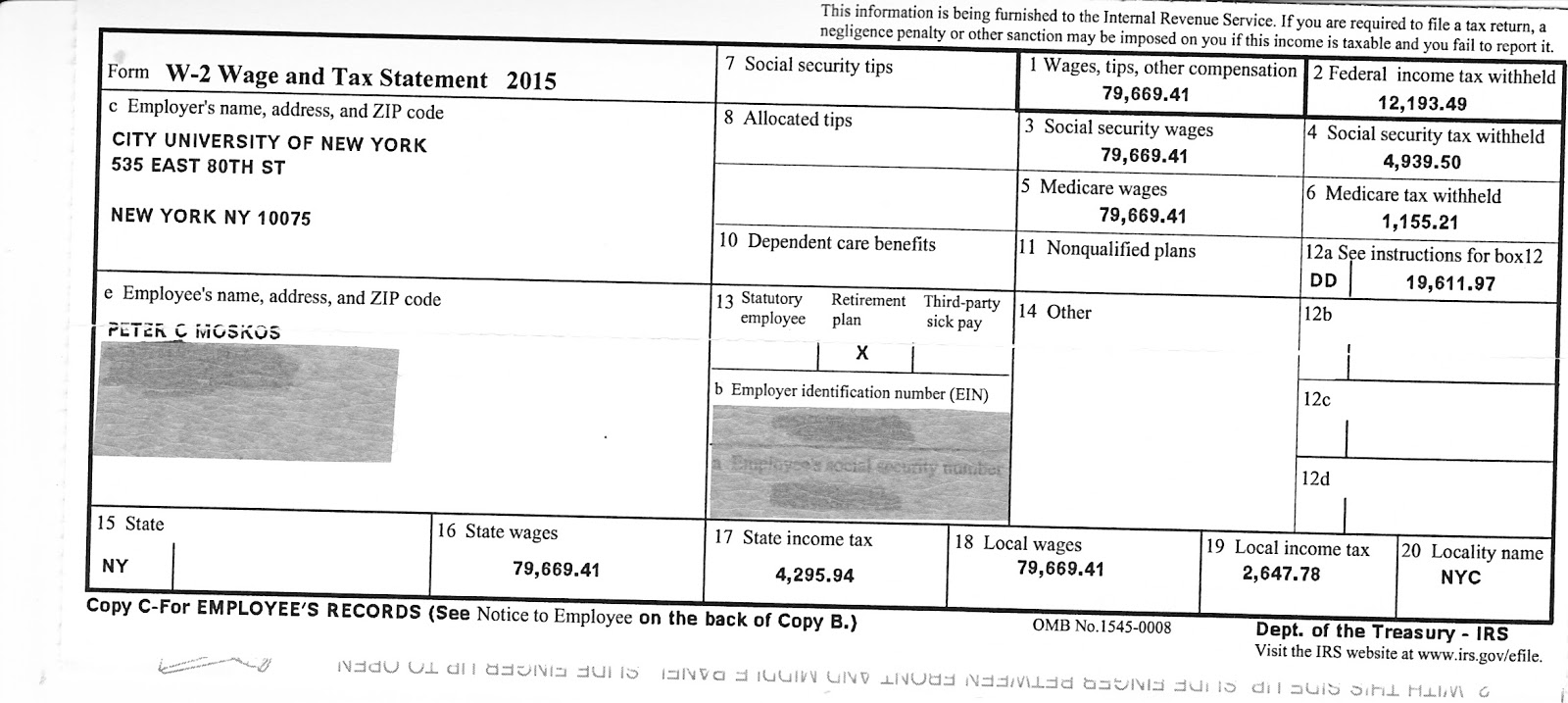
    Here, this is better than what you got from John Jay. It’s my W-2:

    My base salary is $88,418 (I had to look that up). My pay check? My monthly take-home pay? About $4,000. My income was lower last year because I was on sabbatical for the academic year 2014-2015, which meant I was earning 80 percent.

    Add to that a couple thousand dollars from Princeton Press royalties for Cop in the Hood, a few hundred for Greek Americans, $1,200 for my published op-eds, and $2,300 income from airbnb rentals. There were a couple “modest honoraria” in there as well, probably less than $1,000 total. With no kids, no car, an affordable mortgage, and a working wife, we are, as they say, comfortable.

    If there’s anything else I can help you with, just let me know.

  • The Baltimore 6 Effect

    To paraphrase Tip O’Neill, “All policing is local.” But that doesn’t mean that something in one town can’t have an effect on policing nationwide. And a trend can be large and worrisome — and national — without being universal. That’s why they call it a trend.

    I don’t know what’s going on everywhere (or even most-where), but I can tell you a bit about Baltimore. And I suspect it holds true in many cities.

    I looked calls for service, arrest numbers, and crimes. Most dramatic is the drop of arrests in Western District. I looked at arrests with a post number assigned to it. The majority of arrests by patrol officers are discretionary. These are the ones I presume were not being made. Arrests listed without a post (a geographic beat) would be a specialized unit that didn’t know or care about the post, a court arrest, or a probation violation. Arrests with no post listed also declined, but not nearly as much.

    Arrests in the Western District, from May to December, were down a whopping 47 percent comparing 2014 and 2015 (39 percent overall in the city).

    Look, the link between police and crime prevention will always be shrouded in some mystery. Causation in the real world can never be “proved” with certainty. But at some point, if you get enough correlation and no alternative causation, correlation might actually be indicative of causation! [queue stats-class thunder bolts.]

    Now there are good and not so good reasons for this drop in arrests. But leaving that why: it happened. Police were less involved, by choice and necessity, and violence skyrocketed. Just because correlation does prove causing, correlation certainly doesn’t mean causation is impossible or even unlikely. I mean, what else changed in the Western except police and crime?

    Arrests and crime vary a lot during the year. Winter is slow. Late spring and late summer hot. But the drop in Baltimore arrests began before the riots of April 2015. They started going down in July and August of 2014, after the deaths of Eric Garner (Staten Island) and Michael Brown (Ferguson). That’s when attention turned to police. That’s when officers started feeling they were being targeted, not for malicious actions but for trying to do good. And there’s a huge drop is arrests in December of 2014 (when protests really got going). Just 2,126 citywide (probably the lowest monthly figure in 50 years). December 2014 was 28 percent off 2013.

    And then May 2015, when normally you’d see more arrests as the weather warms and kids get out of school, arrests were down 50 percent from the previous year. (I looked at arrests that have a post number listed in Open Baltimore data. I can’t be 100 percent certain, but I think these are more likely to be on-view arrests from patrol officers and in response to calls for service. Arrests without post number are more likely to be specialized units and administrative arrests.)

    Cops stopped making discretionary arrests and being proactive in clearing corners and frisking subjects. Look, it’s no surprise where shootings happens and who gets shot. There is a criminal class in Baltimore. You can police aggressively or wait for somebody to call police. Even then, when responding, you can get out of your car or not risk “harassing” the “innocent” youth.

    Arrests, especially non-domestic misdemeanor arrests, are a good proxy for discretionary officer interaction with the public. Arrests can also tip the crime stats up because many crimes aren’t recorded unless an arrest is made (which is why, as an indicator of crime overall, I trust shootings and homicides more than anything else). In 2015, arrests in the Western District went down from 215 April to 114 in June (and an outlyingly low 79 in May, when cops were busy with post-riot curfew). The previous year, 2014, saw 259, 292, and 265 arrests in April, May, and June, respectively. To put this in perceptive, my squad (one of three working midnight and one of nine total in the Eastern District) used to make 60 arrests a month on average.

    Meanwhile, after the riots, with police demoralized and understaffed and politicians wasting resources prosecuting innocent cops, criminals in the Western were shooting or killing another black man every other day. These deaths are real. They are evidence. And they matter.

  • Ferguson and Death in Baltimore’s Western District

    Ferguson and Death in Baltimore’s Western District

    Usually I focus on the Eastern District, because that is where I policed. But I was looking at stats for the Western District, where Freddie Gray died. Homicides in the Western went from a long-time record low (but still shamefully high) 21 in 2014 to a record high 66 in 2015. Holy mackerel, that’s a huge increase! (The Eastern went up from 34 to 55. Baltimore as a whole from 211 to 355 homicides.)

    People, crime is up.

    If memory serves me correct, the entire Western District is like 2.7 square miles and has a population of 40-some thousand. (Without going to block-level census data, population for Baltimore’s police districts is not easy to determine. And even with the census, could any area be as hard to count accurately?)

    66 homicides is about 25 murders per square mile. In one year. Extrapolated over a lifetime, you’re more likely to be murdered in Baltimore’s Eastern or Western District than die in the D-Day Assault on Normandy.

    I just spent a day in Malta, perched over the Grand Harbour, looking at Open Baltimore data. This is my view:

    (Which goes along great with this book.)

    Here’s what bothers me about all these killings: the concerted effort to shift focus elsewhere, specifically to police. And one result of this police-are-the-problem narrative is more dead people. I’m all for fixing society and even fixing police. In the meantime, can we let police do their job? In the Nation, Mychal Denzel Smith writes:

    The fight to end police violence is not separate from that to end intra-racial violence, because they are direct results of the same system, and must be addressed through the same measures.

    Actually, no. They’re not the result of the same system. Police violence does, some of the time, represent America’s history of racial oppression. But other times it represents nothing more than a good cop having a bad day or a bad cop simply being bad.

    Intra-racial violence may be a legacy of slavery (though I find it interesting that the Left doesn’t like subscribing to this belief) or it may be because of more recent discrimination. It also may be because people choose a culture and lifestyle that thinks it’s OK to pick up a gun and shoot somebody. It may — get this — be all of the above.

    But at some point, from a police perspective, I don’t care what caused it; I care what causes it. A homicide happens when somebody has a beef, gets a gun, loads it, finds the sucka, goes up to him, pulls out the gun, pulls the trigger, and aims well enough to hit the person. And then the person has to die.There are a lot of steps. So much can go wrong! If any one of those steps breaks down, the person lives! A homicide postponed is often a homicide prevented. This is where police can be effective.

    Except for the death of Freddie Gray, things had been looking up in Baltimore. People were moving into the city for the first time in decades. Homicides were near a multi-decade low. Police were arresting a small fraction of what they had been just a few years earlier. And then Freddie Gray done dies and some knuckleheads decide police are the biggest problem facing Baltimore City. Next there were protests, and then riots, and then six cops were criminally charged, at least most of them, for being in the wrong place at the wrong time.

    Nothing else changed in Baltimore. Not in the macro sense. The “system” didn’t change when some Baltimoreans decided to riot.

    Smith links to some post, Stop Pretending the “Ferguson Effect” is Real:

    In fact, 2015 has been one of the safest years in the past two decades. … As such, fears of a national “crime spike” are not based in reality.

    Really?!

    2015 saw a huge increase in murder, perhaps the largest increase in the homicide rate in US history. Just because we don’t yet know the accurate numbers doesn’t mean those bodies aren’t dead. Those dead bodies are a reality some people prefer not to see.

    The “system” didn’t get more racist and unjust on or after April 27th. There is “evidence” — no matter how much it is denied — that A) violence is up, B) policing matters, and C) Ferguson, broadly defined, changed things.

    But Smith says:

    This position rests on a few different fallacies: first, that police are being less aggressive out of fear of being the next cop to have their tactics publicly scrutinized, and secondly, that aggressive policing leads to a reduction in violent crime. There is no evidence to support this.

    Except it is true. I’ve been noticing this “there is no evidence to support this” a lot recently. And it’s always from those who deny the efficacy of police. It’s a smug assertion from people ideologically biased or simply too lazy to open their eyes to reality. Usually it’s from those who simply wish they could wish the existing evidence away, be it the effective Broken Windows policing in 1990s or the dramatic rise in violence last year.

    Smith turns to incidents of cops being violent to prove his point. But dammit, a schoolgirl brought to the ground in a classroom really does not prove anything about policing a drug corning in Baltimore. If you want to say the whole damn system is guilty, great; y ou might even be right. You still haven’t told a single police officer how to confront a violent criminal. And God only knows you’ve never done it yourself.

    So after Freddie Gray’s death and the riots of April 27, calls for service in the Western went down some 20 percent, compared to the previous year (this is a bit of an educated guess as Open Baltimore data goes back only to Jan 2015). Maybe people bought the narrative that police were no good. Maybe people thought police were too busy with real problem to bother with their petty bullshit. For whatever reason, calls for service went down and crime went up. (Even at a reduced load, there were still 280 calls dispatched a day, just in the Western District. As one friend put it, “If they hate us so much, why do they keep calling for us to be with them?”)

    Those racist cops, most of them black and other minorities, were worried about their safety and worried about being arrested for making on honest mistake or no mistake at all. Moreso, police were disgusted at a political system that made them the scapegoat and a liberal narrative that made police out to be the bad guys while simultaneously making a hero out of some two-bit junkie criminal who never held a real job and cycled in and out of the criminal justice system. Of everybody who’s died in Baltimore. Hell even if you think Freddie Gray was killed, of everybody who’s been killed in Baltimor — hell, of everybody who’s been killed by police in Baltimore, you go make make a hero out of this guy?! It just don’t make sense. Of course that affected how police do their job.
  • “Embrace the police”

    “Embrace the police”

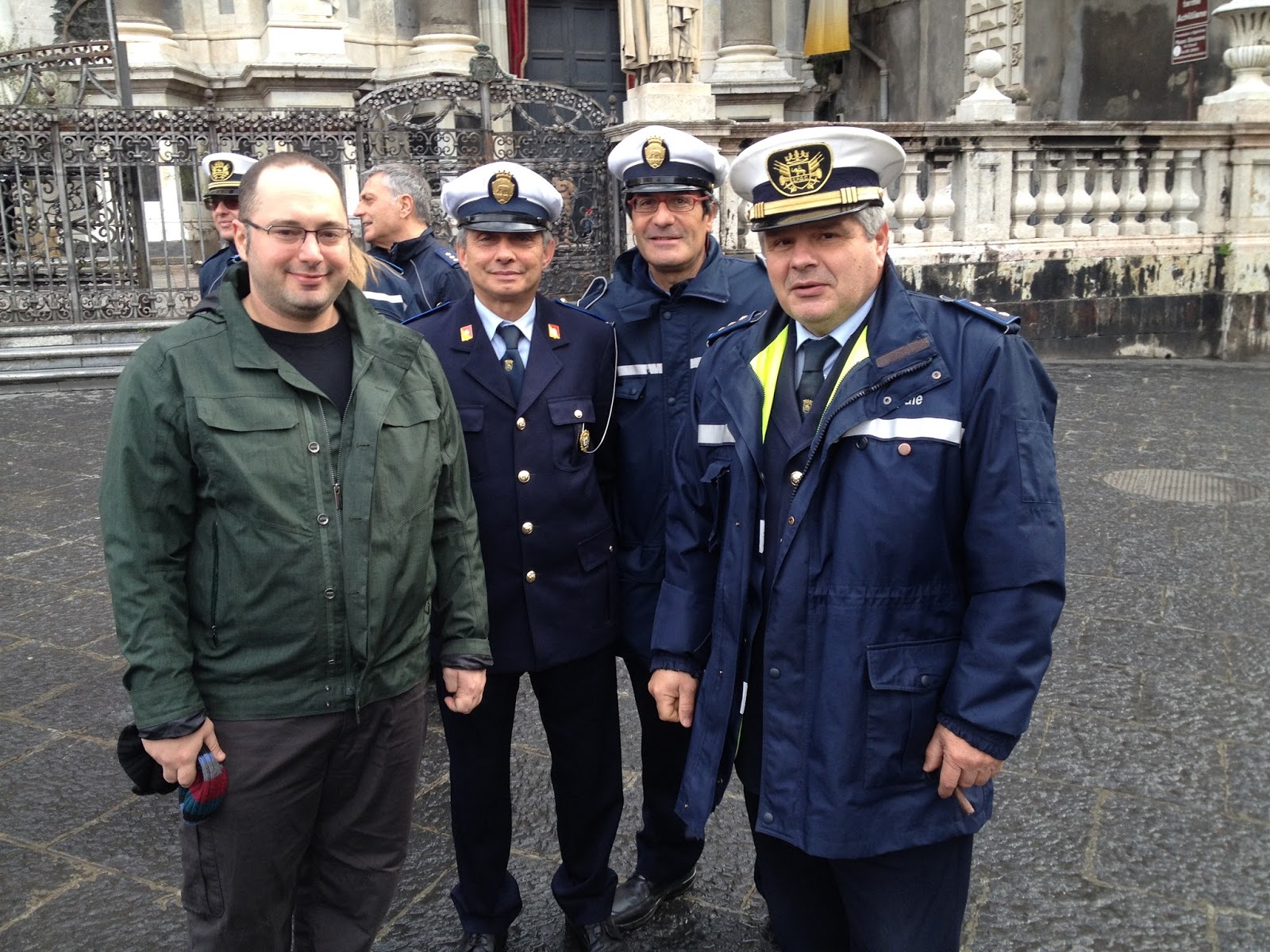
    Like Dan Aykroyd, I continue to “embrace the police,” here in Catania, Sicily. (Though I’m currently in Malta.)

  • “Pander to audience expectations”

    There’s a nice article about Alice Goffman in the Times magazine. Overall it’s a great piece about Alice Goffman, who has written one of the best sociology books ever, and the state of sociology in general. One line I find funny is the assertion that she “panders to audience expectations” by this description of a house: “[it] smelled of piss and vomit and stale cigarettes, and cockroaches roamed freely across the countertops and soiled living-room furniture.”

    In Cop in the Hood, here’s my description:

    Police are called into people’s homes because the residents have, at some level, lost control: intensely overcrowded apartments next to abandoned housing and empty lots, families without heat or electricity, rooms lacking furniture filled with filth and dirty clothes, roaches and mice running rampant, jars and buckets of urine stacked in corners, and multiple children sleeping on bare and dirty mattresses. Simply entering a “normal” home, well furnished and clean, perhaps to take a stolen car report, is so rare that it would be mentioned to fellow officers.

    The criticism against Goffman is just petty semantic BS and academic jealousy.

    Part of the problem is that if even a well intentioned person goes so far as to describe such conditions, much less befriend the people who live there, as Goffman did, they’re accused of pandering or “orientalism.” And what kind of country do we live in where a white girl can’t choose to live anywhere and befriend anybody she damn well pleases. This isn’t apartheid. It’s not taboo.

    And if we don’t accurately describe reality, how will people ever know? And though I’m probably wrong, I’d like to think that if people really did know about this reality, they might care. Instead, when we close our eyes to such conditions and then, when confronted with it, blame teachers or cops. Cops, for their part, blame liberals and Hillary Clinton.

  • You cheap lazy bastards!

    So I go to my school office today (the first time since before X-mas), and what’s there for me? A nice letter from somebody thanking for my blog. That’s very sweet. You’re very welcome.

    But you know what made it even better? No, you don’t, because it wasn’t from you, you cheap lazy bastard! (Except for you who sent it to me, of course.)

    I’ll tell you what’s better than a nice thank-you letter: the $20 bill that fluttered like manna from the note.

    Hell, yeah!

    So what do I do? I followed the instructions and had a few drinks.

    I may not be posting till February. But please do keep the cash coming.

  • We Got Another Kingpin! (16)

    It’s been awhile since we’ve gotten a Kingpin. Almost a year. El Chapo. We’ve gotten this guy before. Like non-sequel movies, are we running out of Kingpins?