Category: Police

  • Looking forward in Baltimore

    On a slightly more positive note (than the last post), Mark Puente has a good story on Baltimore Commissioner Kevin Davis and the US DOJ report due in 2016. This articleis worth one of your monthly free Sun articles, assuming you don’t subscribe:

    In other cities, such investigations have exposed problems such as brutality and outdated training, leading to federal oversight that can last for years and cost taxpayers millions of dollars.

    Davis said large groups of officers might attend a lecture at the Reginald F. Lewis Museum of Maryland African American History & Culture to learn about African-American history. Local experts will teach the courses for free, not out-of-state consultants.

    “If we do that right, we will achieve cultural sensitivity, Davis said.

    Ordering officers out of cars, Davis said, doesn’t work if they aren’t properly trained.

    Johnson said the agency needs to improve record-keeping and the analysis of what leads to those arrests, adding: “That’s a major problem.”

    Many of the arrests come from hard-charging, aggressive officers looking to clean up the streets, officials have said.

    Baltimore is no different from other cities where police leaders identify “super cops” based on monthly arrests, Davis said. It’s important to examine the outcomes of those arrests with prosecutors and public defenders, he added.

    “If I’m a superstar cop in the Western District making 40 arrests a month, where did [the arrests] end up in court?” Davis said. “Did those arrests make society better, or did you just leave the community pissed off in the wake of your apprehension?”

    Most patrol cars don’t have computers, radar equipment or license-plate readers. Officers must wait to communicate with dispatchers for the information and complete nearly all paperwork by hand.

    “The inside of Baltimore police car looks like mine from 1992,” Davis said, noting that expected federal reforms will be costly — but mandatory.

    That’s all well and good, I suppose. Things can be made better. They need to be made better. Cops shouldn’t hate the city and those who live in it. Too many do. Cops and church-goers should like each other. Maybe it is an essential first step. But meanwhile nothing is being said about the criminal class killing each other.

  • Dying in Baltimore? Blame the Police.

    Dying in Baltimore? Blame the Police.

    I saw a Tweet about something I already knew, and it still shocked me.

    This year 1 in every 2,000 Baltimoreans will be murdered.

    I know this number is true. I’ve done math. But I still needed to double check. And in many ways it’s even worse. Because we know most people in Baltimore aren’t going to get murdered. 86 percent of those killed in Baltimore are black men. Collectively, you can group together all whites, all black women, all hispanics, and all asians. Together they account for just 11 percent of Baltimore homicide victims. (Race is unknown 3 percent of time.)

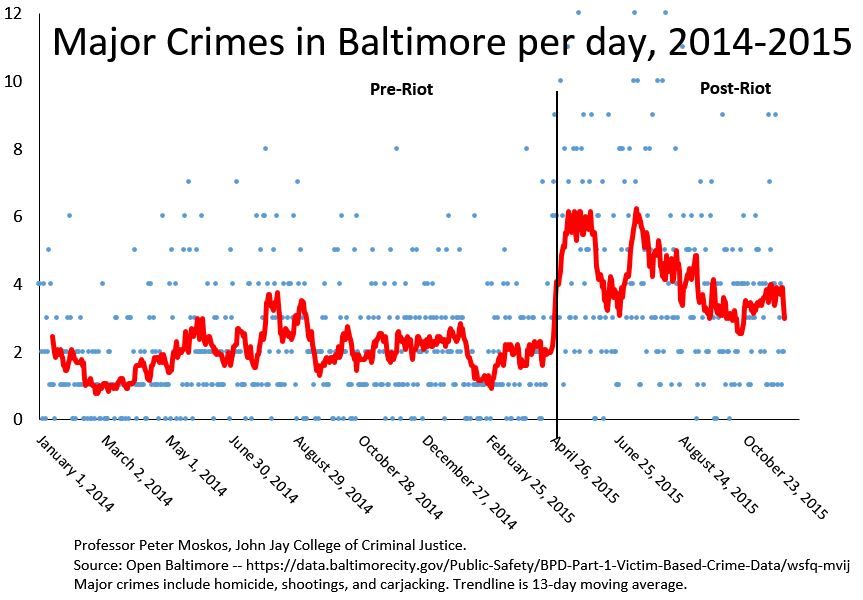
    Lethal violence doubled after riots.

    I still want an apology from those idiots who went on national radio and TV with me saying police were the main problem and violence wasn’t even up in Baltimore the riots (they used, “uprising”). Bet I’m not going to get one. I don’t know if anybody still claims that, but nobody ever admitted they were wrong.

    I spend my Saturday night playing with Excel and SPSS. I made three charts that all say the same thing in slightly different ways. I’m not certain which one is the best. Here they all are.

    There are about 180,000 black men in Baltimore. To date 273 have been murdered. Yes. This year, one in every 660 black men in Baltimore has been murdered.

    [Update: 304 black men were killed in Baltimore in 2015. One in every 600 black men was murdered in 2015.]

    And it gets worse. There are only about 45,000 18- to 35-year-old black men in Baltimore. By year’s end, more than 200 will have been killed and another 500 will be shot but live. 45,000 divided by 700 is 64. One in 64 black men 18 to 35 will be shot or killed. One in 225 will be murdered. One year. Think of those odds. Officer William Porter, a black guy from Baltimore who survived those odds, he was working to save lives. He was trying to make his city a safer place. Now Portor is on trial for basically doing his job. Who are the only people who see every bloody crime scene? Who do we send in to deal with this literal and figurative bloody mess? Police officers. “Do something!” we order them.

    And the mayor and State’s Attorney? They’re using their precious resources to lock up the same exact cops they told to “do something” about the drug corner Freddie Gray was on when he ran from police. And poor Freddie Gray? The lead-poisoned drug-addicted barely-literate low-level habitual criminal? He’s a victim, too. But he’s not a hero. They’ve name a “Youth Empowerment Centers” after him? If you can’t find a better role model for black youth in Baltimore, you’re not looking hard enough.

    Maybe if we can keep the focus on the police, nobody will ever get around to noticing the who real is to blame. No need to blame Freddie’s mom, the drugs, lead paint, the schools, the city, the neighborhood, the corrupt politicians, the self-serving religious leaders, the violence, the racism, the criminals, the blight, the lack of jobs, or even Freddie himself. Nope. None of them’s on trial. Only the PO-leece.

    Pa-leeze.

  • Chicago Cover Up

    From the mayor on down to the officer on scene, the cover-up seems pretty big. Multiple false reports are very worrisome. Though a detective taking a statement from Van Dyke shouldn’t qualify as another false report. But Van Dyke’s partner, Walsh, is certainly culpable.

    Update: The New York Timessays “at least five other officers on the scene that night corroborated a version of events similar to the one Officer Van Dyke.”

  • Jew for a Day

    So I was in this 3 AM bar fight last night. More of a scuffle really. Technically I won, if such a thing is possible. (Does anybody really win a 3 AM bar fight?) Now those who know me know my fuse in long. I don’t go looking for fights, because I don’t want to lose a fight. Hell, I’ve never even been in a bar fight. But sometimes, well, a man’s gotta do what a man’s gotta do.

    I was minding my own business (of course) nursing a Smithwicks, and next thing you know, not far from me, a guy is getting choked out. Hmmmmm. The choker has the guy in a classic arm-bar choke hold. I’m looking at this thinking, is he choking him by the throat or carotid artery? While I’m processing the scene, the guy I was talking to, a cop (recently retired), starts shouting, “Don’t choke him out. Let him go. Don’t kill him. Don’t choke him out.” It was a carotid hold; the cop was thinking faster than me.

    The choker lets up. He doesn’t choke him out. The chokee stumbles to his feet. The choker gathers his belongings and high tails it on out of the bar. Word at the bar is that the chokee, a white guy maybe 30 years old, started the mess by accusing the the choker, a brown skinned guy, of being a terrorist. A Muslim terrorist.

    The cop informs the loser that since he, the cop, just saved his life, he, the loser, needs to buy him a drink. The chokee slides the cop his Jägermeister. The cop turns it down and demands a real drink. The loser buys him a whiskey.

    I’m thinking it doesn’t seem right that the guy who got called a terrorist left (thought it a wise choice to do so) and the guy who thinks called a brown person a terrorist is still here. There’s some side debate as to whether the choker even was Muslim. But whatever.

    Maybe fifteen minutes later a few people go out to smoke or pee and now there’s nobody between me and self-proclaimed patriot. I ask him, “Did you really call him a Muslim terrorist?” He hems and haws but does not deny. A press a bit and he he admits that yes, he thinks he is a terrorist.

    I say: “You called a stranger in a bar a Muslim terrorist? Well, you deserved to get choked out.”

    In an ignorant way too common among fools, he boasts, “I’m an American!”

    “We’re all Americans here.” I point out, “This is America.”

    He gets closer to me. I take note that he’s drunker and slower than me as he points his finger at my chest and says, “Are you a Christian, or A JEW?”

    No. Not in my city. Not in my bar. I figure if a first scuffle didn’t get him kicked out, a second one sure will. I don’t lose my temper. I’m not angry. In a calculated move I knock him from his bar stool and drag him to the ground and try and get my hands around his fleshy throat.

    He resists, of course. My glasses go flying (which shows I’m a novice–an experienced fighter would know to remove any glasses before a scuffle). I end up on top. A patron rescues my glasses. No punches are thrown. We get separated. I don’t even get an adrenaline rush.

    I inform the bar, “He has to go.” He bellies up and tries to order another drink. “No,” I instruct him, “you have to go.” The bartender says, “Not before he settles up.” The bartender makes him pay (no buy-backs for him), and he leaves.

    The cop buys me a drink.

    The bartender (who actually isn’t an American) sheepishly admits in his Slovak accent, “I’m not a fighter.” Neither am I.

  • Coverage of the trial

    There’s good live twitter coverage of the Portor trialover at the Sun, if you’re interested. I am.

  • [Not Following] General Orders

    [Not Following] General Orders

    You want to know why cops are always bitching? You want to know how cops can feel like they’re the victims? You want to know what it’s like to be on trial for violating a General Order? (In the NYPD this in known as the Patrol Guide. Same thing.)

    Sun columnist Dan Rodricks is unfairly dismissive of the ignorance defense when he writes:

    Not knowing the law — not noticing the speed limit on a street or stretch of highway, as a simple example — is usually not an acceptable excuse. A police officer not knowing a policy (or missing the memo about one) isn’t much of one, either.

    In terms of breaking the law, it’s important to point out that General Orders are not laws. Also, speed limits are posted.

    And yet it seems reasonable to expect cops to know the rules of their organization. But it’s not. It’s impossible. If you want to point fingers, blame the organization. But the issue remains: what are well meaning cops supposed to do?

    This is going to be boring, OK? But if you want to understand police, I’m going to take you into the weeds. Because the devil is down there in those weeds.

    [Actually if you can figure out why cops are always bitching, let me know. Because I’ve never figured that one out.]

    I wanted to look up the Baltimore City Police Department’s General Order on seat belt regulations for prisoner transport. Why, because it seem like Officer Porter might go to jail for ignorance of this one.

    First I had to go to my school office because that’s where I keep my old binder of G.O.s. The binder is too big to carry with you. So as a cop you don’t have it on you for reference. Mine was last updated in June of 2001. Fourteen years later it would be even thicker. Orders go into the G.O.s. They never come out.

    I easily found the binder and discovered with it a folder of loose things that I was given during my brief career that I couldn’t or didn’t file in the binder.

    Now keep in mind, it’s been awhile since I’ve done this. So I might be a bit slow. But hell, I do have a PhD from Harvard and graduated Magna Cum Laude from Princeton. What I’m saying is that even though I’m not a rocket scientist, I’m not the dullest tool in the shed. And I’m a good researcher! Nevertheless, it took more than half an hour from the start of my quest to the start of writing this. And I got lucky. Almost unbelievably so.

    So where does one start? [A professor just came to my office and told me students today don’t even know what a table of contents is. Or an index. Whoa. That’s mind blowing, but off subject…] Except the book of General Orders has no index. Hell, it doesn’t even have page numbers! But there is a Table of Contents, without page numbers:

    I’m going with Section K: Adult Arrests. Flipping forward a few pages my bet is on K14, persons in police custody. G.O. Number 06-92. So I flip open to K. My binder actually has tabs with writing on them. Because I’m nerdy and organized like that. Or maybe they made us do that in the police academy. I don’t remember.

    So I open to K and K-1 is something about Career Criminals Program of 1982. I couldn’t care less. I assume it’s long irrelevant even in 2000. But how would one know? It modifies the Career Criminals Program of 1976. Signed by Commissioner Battaglia? He doesn’t even ring a bell. He must have not been in for long.

    And then you just start flipping. After K-1 comes Annex A, Annex B, then K-2. The top of the page doesn’t say which K you’re on. And there are lots of “Annex.” It’s easy to get lost. Eventually I find K-14. Signed by Commissioner Edward Woods. He signed a lot of these.

    Note the “Rescission” section to remove from the manual. How would you even find Memorandum 2-82? I have no idea.

    Is this it? Annex A on Custodial Safety and Welfare of Persons in Custody.

    It doesn’t say anything about seat belts. Does that mean there is no G.O. on seat belts? In this case I know there is. But what if I didn’t? How would you know? There is no index. But I think I need to find a section on prisoner transport.

    Oh, here’s a doozy from 1985, amending an order from 1977.

    “Make the following pen changes to Annex D, Section I, page D-3: Paragraph 1, lines 3&4 — Delete: [blah blah blah].” You know it’s old because it’s signed by Commissioner Bishop Robinson. First black commissioner. I always liked his name. Pomerleau is the oldest one finds in the G.O.s. He was commissioner from the Mayflower landing till 1981.

    There are 18 pages of K-14. I go through them. Nothing seems to concern seat belts.

    I don’t know what to do. So I go through my G.O. Supplement folder. Slim chance. But you never know.

    I see the pages on ethical conduct.

    These were my favorite. I used to check them off one-by-one when I violated them. I’m hilarious that way. But this matter because if they can’t pin anything else on you, they can always get you for “conduct unbecoming.”

    I may have missed a few, but of the first 31 rules of conduct, I checked off all but 12 as violated. And I was a good cop, an honest cop. And yet in less than two years on the job I managed to violate the majority of good conduct rules. My favorite was “Section 7: Members of the department, while riding gratis on any type of public conveyance, are not permitted to be seated while other passengers are standing.” This is off duty, mind you. And it doesn’t say “give up your seat if the bus is full.” Nope. If anybody is standing, you must stand.

    Some of the rules, of course, you need to violate in order to do your job. (Section 2, for instance, prohibits use of slang while talking to the public. I never did violate Section 28 by playing cards, which I could have done.)

    Now at this point I, like you, am distracted and have kind of given up. And right then… I’ll be damned at what literally flutters from the folder. This very sheet: “The Police Commissioner’s Memorandum 19-99, Subject: Seat Belts.” I’m not making this up. This literally fluttered down from heaven above, or at least the binder I was holding. Like Mana from fucking heaven!

    This came out before I was hired. So there’s no reason it’s not in the binder. But it’s not in the binder and I have no idea where it should be filed. It’s not like it says K-14 part 3 or anything. Is there a special section for “Memorandum”? I don’t know. One can’t know. And that’s my point.

    But there it is, halfway down (while on the back of the sheet is something unrelated about dog bites):

    • Use a seat belt when operating or riding as a passenger in any departmental vehicle.

    • Ensure that all other occupants of a departmental vehicle that you are operating use a seat belt or a federally approved child safety seat when applicable.

    • [Don’t use child safety seats in the rear of cage cars.]

    • Ensure that prisoners transported in prisoner transportation vehicles are secured with a seat belt. [emphasis added]

    • Use extreme caution when transporting anyone in departmental vehicles. [Thanks for nothing.]

    This one is signed by much-hated Commissioner Thomas Frazier. He was just before my time but was the guy who initially approved my research! (The best thing that ever happened to Frazier’s reputation was Commissioner Batts.)

    So that is it, right? Buckle up prisoners. No exceptions. That’s certainly what I thought the rule was. But maybe I was wrong. Supposedly there was a rule saying you didn’t have to, for officer safety? I doubt it. but maybe that happened after 2001. And the new 2014 G.O. was going back to the old May 1999 G.O.? Unlikely. But…

    I don’t know, and there’s no way to find out

    And I still haven’t found the section on prisoner transport, assuming there is one. But there must be. Unless there isn’t. And then what if I did find it and there are two General Orders that conflict with each other? Then what?

    When I quit the police department, one of the things I told myself was that if I could change the system of General Orders, I would be the unsung hero of police officers who had never even heard my name. I could make the world a better place and die a happier man. But how does one change the system? Better people than I have run police departments and yet General Orders and Patrol Guides get worse and worse.
  • Trial of Officer Porter, Day 4

    Here’s the recapof Day 4 of the trial of Officer William Porter.

    I’m not there and I’m no lawyer, so far be it from me to figure out what’s going on.

    But I’m having a tough time figuring out Porter’s role in a crime. Today seemed to be focused on seat belts. Gray wasn’t Porter’s prisoner. It wasn’t Porter’s job to buckle him in.

    I’m curious about this line: “The defense grilled him [Capt. Bartness] about the complexity and inanity of internal police rules, but Bartness did not take the bait.”

    Other useful facts.

    From Sun columnist Dan Roderick:

    For one thing, the revised rule about seat-belting all prisoners went out on a department-wide email blast with an 80-page attachment. Porter was assigned to the Western District, and the officers there complained about the district’s slow, antiquated computer system. The Baltimore Police Department had general computer network issues earlier this year. And there was some kind of a virus back in the spring. And there’s no way to know if Porter ever received the email with the new seat belt policy. And the memo about the seat belts apparently was not read aloud at roll call.

    I find it hard to believe that Porter or any cop would be unaware that a prisoner should be buckled in. But keep in mind I was there 15 years ago. Things can change.

    But perhaps more important is this: the old rules, until a week before Gray’s death, said you didn’t have to buckle in a suspect if it wasn’t safe for the officer to do so. It’s absolutely probable that Porter did not get the new memo, that disallowed the “officer safety” exception. The new rule made a rule that I thought was the old rule. But there’s no good way for an officer to get the new rule.

    But I had no idea, from when I was there, that there was ever an “officer safety” exception to the seat belt rule. Keep in mind I never drove the wagon. And we (almost) never took prisoners in normal patrol cars. We had one cage car, so I did transport a few prisoners. But not often.

    I’m not certain why this matter, but it does show you the SNAFU environment of a police department. When I was there, new G.O.’s were read at role call. Usually. If you weren’t at work that day, you didn’t get the memo. Or maybe you sergeant would give you the memo to put in your bursting binder. Now G.O.’s come out pretty often, and most are irrelevant to your job. So you ignore or don’t understand them.

    Now, apparently, they come in an email. With an 80-page attachment. And you have to access it on a shitty district computer that may not work. What is an officer supposed to do? Seriously? Does the whole squad line up and take turns reading the attachment? Or do go out and answer calls for service? Or better yet, give special attention to the drug corner by the church that the State’s Attorney Mosby — the current prosecutor — pressured you to get rid of?

    I mean when is the last time you read you read the fine print to the changes of your credit card? Or read the legalese before clicking “accept” on something online?

    Should police officers be familiar with the rules? Of course. Can a police officer be familiar with every General Order? No. Is ignorance of the law ever a good excuse? Well, legally no. But morally, actually, yeah, it can be. And is the whole damn police organization one reflexive CYA designed to fuck a cop for violating some General Order when somebody needs to be fucked? Abso-fucking-lutely.

  • But they made him write it down!

    From the Twittersphere:

    The idea that the academy would keep your B.S. classwork just to f*ck you is what gets my goat. “See, we didn’t actually try and teach anything but we made him write it down!” Though I’m not surprised. That’s the academy I remember from 15 years ago. And I have no reason to think anything changed (and keep hearing that it hasn’t)

    Anyway, I tweeted (maximum 140 characters each) a bunch of lessons I learned from Baltimore’s academy, back when it was on Guilford St. One guy just wrote me and mentioned that when they moved to the new academy, his class “didn’t see an instructor for 4 weeks straight.” Classic. And that wasn’t even the worst. That would have to be the trainee who got shot.

    This is all taken from Cop in the Hood.

    What was the Baltimore City Police Academy like?

    Overall there was little emphasis on subject retention. Very little attempt was made to relate class material to actual police work.

    As one trainee said, “They’re not doing it to protect our ass, they’re doing it to cover theirs.”

    The Baltimore Police Dept’s book of General Orders, without index or page numbers, comes in at a binder-bursting 5 inches thick.

    BPD academy instructor: “Every knows this is a joke, but I just have to teach you what the General Orders say.”

    Deviation from G.O.s–no matter how smart, creative, well intentioned–potentially subject to dept disciplinary action

    Yet some violations of General Orders are so ingrained as to be standard operating procedure.

    At end of academy, less than half the class saw relation between what they learned and what police need to know on the street

    One of few useful lessons in Balto police academy come on Day 1: “When in doubt, shut your mouth and look sharp!”

    Primarily, the point of the academy is to protect department from legal liability that could result from negligent training.

    Yet police patrol demands lesson wholly lacking in the academy: bold, independent, intelligent, and thoughtful actions

  • “The Deadliest County for Police Killings in America”

    Oh, Bakersfield. Now it’s in the Atlantic. Of course you heard about Bakersfield and Kern County here first, back in April. And even gave Bakersfield an honorary mention, back in 2014, too.)

    The actual reporting is going on in the Guardian, the only paper, and an English paper, that seems to honestly care about investigating the issue of trigger happy cops (as opposed to just highlighting individual cases of questionable shootings).

    In the Atlantic piece, I think Conor Friedersdorf lets #BLM off the hook too easily. And it’s worrisome when the left-wing media starts blaming the media:

    Perhaps that’s partly because the Black Lives Matter narrative has dominated press coverage of police misconduct–in Kern County, most of the victims are Latino. But the issues raised by the Black Lives Matter movement affect a variety of communities, even if that’s not always acknowledged in the media.

    But a limitation of Black Lives Matter is a laser-like focus on state-against-black violence. Black Lives Matter can and should focus on whatever they want. Certainly blacks in America have specific and unique and legitimate grievances not shared by other minority groups. But the problem of bad and/or unnecessary police-involved killings affects a lot of poor America. But if one attempts to shift the focus to other communities by, say, substituting another word for “black,” one faces immediate racial reprimand. Still, and to Black Lives Matter’s credit, we wouldn’t be talking about this at all were it not for #BLM.

    Along with more investigative coverage in American papers, it would be nice to see more attention placed on where the problem seems to be worst (west of the Mississippi and in high Latino areas). The flip side of this is to look at departments, like the NYPD, that have have low rates of police-involved shootings. We have departments that could be used as case studies in best practices. But the police-are-the-bad-guys crowd can only see all police as an outlet for criticism.

    I’ve said it before and I’ll say it again: if we want to — and we do want to — reduce the number of black people shot by police, we need to reduce the number of people shot by police. On society’s side this happens with reductions in overall violence. On the police side this happens with better hiring, training, and tactics.

  • Does rhetoric incite violence?

    Why don’t anti-abortion politicians who say ‪#‎BlackLivesMatter‬-rhetoric endangers cops take responsibility for Officer Swasey’s murder at Planned Parenthood?

    If anti-abortion rhetoric doesn’t have any relation to the murder of Officer Swasey and innocent women at Planned Parenthood, how could anti-cop rhetoric have any relation to people attacking cops? On the flip side, if anti-abortion rhetoric does incite violence against abortion clinics, why wouldn’t the same be true for anti-cop rhetoric and subsequent attacks on cops?

    As to the question of rhetoric inciting violence, shouldn’t we at least be consistent? It’s frustrating when ideology and making political points seem more important than the murder of police officers and other innocent people.

    Update: When I posted this idea on Twitter, I got one response saying that we shouldn’t “jump to conclusions” that the attack on Planned Parenthood has anything to do with anti-abortion rhetoric. Of course not.

    On the other side, somebody from the Left informed me that #BlackLivesMatter isn’t anti-cop, “it is [just] against the abuse of law enforcement in taking of black lives.” Besides, “violence in #BLM rhetoric is self-defense.” Of course….Just like pro-life people are really only against the abuse fetuses take when aborted.

    So can rhetoric lead to violence? Sure, sometimes. But if so, do we just accept it as an unfortunately side-effect of free speech in a gun-loving society? I would say yes, at least up to a point. But regardless, we shouldn’t say that only people on the other ideological side can be inspired into violent action by idiotic rhetoric.