Chava Gourarie at Columbia Journalism Review with a great piece on data and police-involved killings.
Category: Police
-
Officer Down
NYPD Housing Cop Randolph Holder was shot and killed a few hours ago around 120th and FDR Drive. This is about a mile from my house (but a world away in East Harlem). Rest in Peace.
Update: Apparently the killer was also a “non-violent drug offender.” From the Times:
Last fall, the man suspected in the shooting, Tyrone Howard, was arrested along with 18 other members of a drug crew that had spread violence through a stretch of public housing along the East River and was ordered into a drug diversion program, which is meant to keep some drug offenders from further crowding already overcrowded jails.
In May, he stopped taking part in the program, the officials said.
“If ever there’s a candidate not to be diverted it would be this guy,” Mr. Bratton said. “He’s a poster boy for not being diverted.”
The police said Mr. Howard was believed to have been involved in the shooting of a 28-year-old man on Sept. 1 in East Harlem.
-
“Adrian Schoolcraft is no Frank Serpico”
Lenny Levitt on Adrian Schoolcraft:
Larry [his father], who appeared to be calling the shots, hired and fired half a dozen lawyers….
Over the years, their behavior became increasingly bizarre. For months at a time they would disappear. They continually changed their phone numbers. At one point, one of the lawyers asked Frank Serpico, who lived nearby and had befriended them, to track them down….
Serpico also struggled in dealing with Larry, who, it turned out, had been a police officer in Fort Worth, Texas and had sued that police department on grounds similar to Adrian’s in New York. His claims were dismissed in 2000 by a Texas Appeals court, records show….
Serpico is no longer in contact with him or Adrian….
So what to conclude? One thing we can say with certainty is that Adrian Schoolcraft is no Frank Serpico.
Levitt also critiques Ray Kelly’s book, which I may never read, so I’ll take Levitt’s word:
In the end what tarnished Kelly’s legacy was his own ego, his running the NYPD for 12 years as Management by Narcissism. He refused to listen to others, and took no responsibility for his misjudgments. His stated conviction of protecting the city was belied by his bitterness and vindictiveness. Like others before him, his tragedy was he had started to believe his own news clippings.
(Update with working links to all the posts on Schoolcraft.)
-
“Was the Shooting of Tamir Rice ‘Reasonable’?”
Another good story by Leon Neyfakh in Slate. This one with some legal analysis on the two reports that judged the shooting of Tamir Rice in Cleveland “reasonable.”
Here’s a link to the audio of the radio dispatch.
-
Baltimore in The Onion
I’m totally stealing this from the Baltimore Sun:
Camden Yards Concessions To Stop Selling Crack After Seventh Inning
Final Police Report: Only 20,000 Killed During Ravens’ Super Bowl Parade
Real Estate Developers Push To Rebrand Murder Heights Neighborhood Of Baltimore
Buck Showalter Terrified To Walk Alone To Mound At Night
Ravens Warn Rookies To Save Some Extra Money For Bail
And last but not least:
Cal Ripken Jr. Moves Into 8 Billionth Place On Consecutive-Games-Not-Played List
-
Prop 47 in California
In the Washington Post.
In the 11 months since the passage of Prop 47, more than 4,300 state prisoners have been resentenced and then released. Drug arrests in Los Angeles County have dropped by a third. Jail bookings are down by a quarter.
…
Robberies up 23 percent in San Francisco. Property theft up 11 percent in Los Angeles. Certain categories of crime rising 20 percent in Lake Tahoe, 36 percent in La Mirada, 22 percent in Chico and 68percent in Desert Hot Springs.
It’s too early to know how much crime can be attributed to Prop 47, police chiefs caution, but what they do know is that instead of arresting criminals and removing them from the streets, their officers have been dealing with the same offenders again and again. Caught in possession of drugs? … Caught stealing something worth less than $950? That means a ticket, too.
…
“Frustrating, frustrating,” said Zimmerman, the police chief…. “Just sending our officers to deal with problems that never get solved.”
…
“Aren’t we lulling him into a sense of security?” Goldsmith said. “How does it end? There’s no more incremental punishment. We let the behavior continue. We let the problems get worse. And all we can do is wait until he does something terrible, until he stabs somebody or kills somebody, and then we can finally take him off the street.”
Does America have problems? Yes. Is prison the answer? No. Seriously, if we can’t figure out a better solution to mental illness, drug addiction, and vagrant crimes than — at great expense — locking losers in cages forever, we’re pretty effing stupid!
-
Tamir Rice shooting “reasonable”
From when it happened I said the police shooting of Tamir Rice — though tactically shameful and morally tragic — was “reasonable.” That didn’t make me too many friends outside the police world. But “reasonableness” is judged from the perspective of a reasonable police officer. And now outside two reports have come to a similar conclusion. They “justify” the shooting (in a legal/constitutional sense at the “moment of threat,” not in a moral or good policing sense).
From the Times:
The reports released Saturday night — one written by a retired supervisory special agent with the F.B.I., the other by a Colorado prosecutor — examined the shooting’s legality under the United States Constitution, not Ohio law. But each reviewer found that Officer Loehmann had been placed in a volatile situation with minimal information and had acted reasonably in shooting Tamir.
…
The decision to pull the cruiser so close to Tamir and the dispatcher’s failure to relay some of the caller’s caveats were worthy of further review and were potentially relevant in civil court, but should have no effect on the evaluation of whether Officer Loehmann was criminally culpable for shooting.
I wrote about it here, here, And here: “So this was bad policing. But that doesn’t make it a bad shooting.” Norm Stamper said pretty much the same thing: “A more mature, experienced, confident police officer would have better understood what he was facing…. [But] if you point a gun at a police officer, you have punched your ticket. I don’t care if it’s a toy gun.”
I also said this:
Here’s what you don’t do: drive right up to that person on muddy slippery ground to put your partner in an unprotected and defenseless position a few feet from the suspect.
…
The problems here abound. The dispatcher didn’t relay information that the caller said the gun was “probably fake.” That could have have changed things. By my main problem with the police here is driving right up to an armed suspect. The only reason to do that is to drive into the armed suspect.
Why would you drive in a snowy park to put yourself on slippery turf within feet of an armed suspect?! It makes no sense. You should do everything you can so you do not put yourself in what James Fyfe called a “split-second decision.” Because that is when mistakes are made.
So you park your friggin’ car half a block away and approach on foot. Why? Because your aim is probably better than his. Why? Because you can suss the situation. Why? Because you can issue commands with distance on your side. Why? Because you might notice that it is a 12-year-old kid. And while that may mean nothing, it increases the chance you notice it’s a fake gun. Why? Because you shouldn’t be a lazy f*ck, you lazy f*ck!
-
“We can’t walk away.”
Baltimore’s Acting Commissioner Kevin Davis speaks about this video where officers fight with a suspect:
The community doesn’t expect police officers to walk by that type of thing.
…
I’ve watched the video 5 or 6 times and think the officers showed remarkable restraint.
…
This is where the art form of policing is really best spoken about. What does the community, what does leadership expect police officers to do in that scenario?
We can’t walk away. I don’t expect those officers to walk away.
Well spoken, Commissioner Davis.
This made me think of the Blake takedown, the tennis player wrongly identified and cuffed in a fancy hotel lobby. In another post commented:
I’m certain the tactic [Frascatore] used to bring down and cuff Blake could have been just what was needed… in another situation.
You know what? This is that situation.
The CCRB just ruled against Officer Frascatore for the force he used against Blake. My guess is Bratton will throw Frascatore under the bus. (Not just because of the Blake incident, but for a pattern of earlier abuse.)
I am impressed with both cops in Baltimore for staying in the fight. Everybody has got a plan… till they get hit. She doesn’t back down. She gets in there. He gets back up after being hit. But the officers were not able to get the guy under control. [They also, apparently, didn’t get on the radio. You gotta call it in. Not a 10-16. Just a 10-23 or a 10-14 or an address so other cops know something is up and can point their cars in the right direction.]
Cops will be in fights. But cops should never be in a fair fight. Once an “unarmed” suspect gets the upper hand and stand pounding the shit out of an officer, you shoot him. So let it be said — given the wonders of 20/20 hindsight not available the the cops at the time — these officers were not physical aggressive enough. Either that or they needed to maintain until backup arrived.
This is exactly the situation where you want an Officer Frascatore to make a good aggressive takedown and keep the fight from happening. And then you need a department to back you when a video shows good physical tactics under the banner: “police brutality!” But then in a hotel lobby with a calm person suspected of a non-violent crime you need officers like Frascatore to have enough mental skills to not use their physical skills.
Like most of policing, it’s complicated.
-
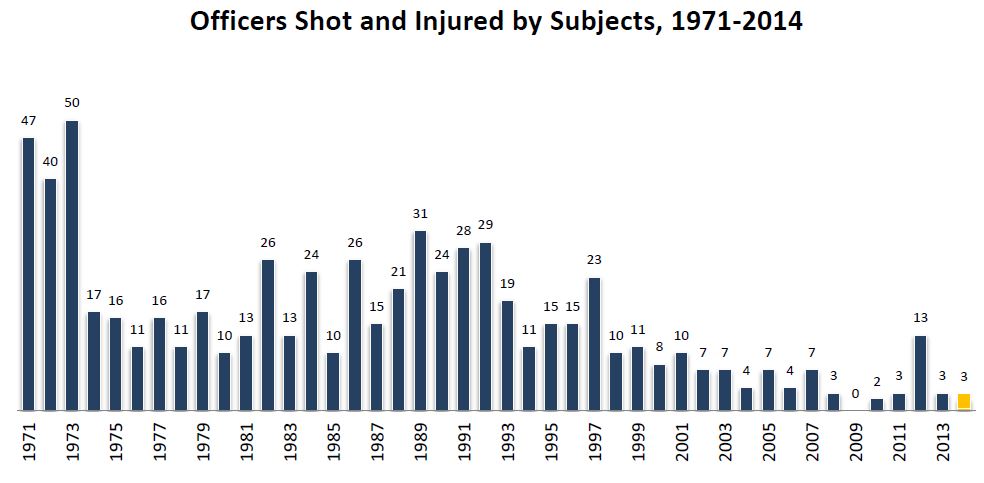
2015 NYPD firearms discharge report
From the NYPD firearms discharge report for 2014:
In adversarial conflict, 58 NYPD officers fired 201 rounds in 35 incidents.
In total, 104 NYPD officers fired 282 rounds shot in 79 incidents.
18 incidents involving animal attack.
There were 4 suicides.
In adversarial conflict:
41% of officers fired one round. No officer had to reload.
52% of those shootings were in Brooklyn.
14 suspects shot and injured.
8 shot and killed.
1 suspect was “unarmed.”
4.9 million “radio assignments involving weapons.”
4,779 gun arrests.
1,172 criminal shooting incidents.
2 officers injured.
2 officers killed.
To put the NYPD in perspective, according to the data from the Guardian’s The Counted, 7 people have been killed in New York this year (2015). Compare that some other cities:
Miami and Indianapolis: 8 each.
Dallas and Oklahoma City: 7 each.
San Jose, San Francisco, Austin, Las Vegas (NV): 6 each.
Bakersfield, CA: 5.
Collectively those cities have fewer people than New York City. And those other cities have seen 53 people killed by police this year.
For the NYPD:


-
The Freddie Gray investigation
Haven’t read this yet, but looks interesting. By Justin George in the Baltimore Sun:
In the days following Freddie Gray’s death, The Baltimore Sun had exclusive access to police investigators as they gathered evidence, debated legal issues and weathered public pressure.