Category: Police

  • Wife of Melvin Santiago’s killer wishes husband had killed more cops

    Wife of Melvin Santiago’s killer wishes husband had killed more cops

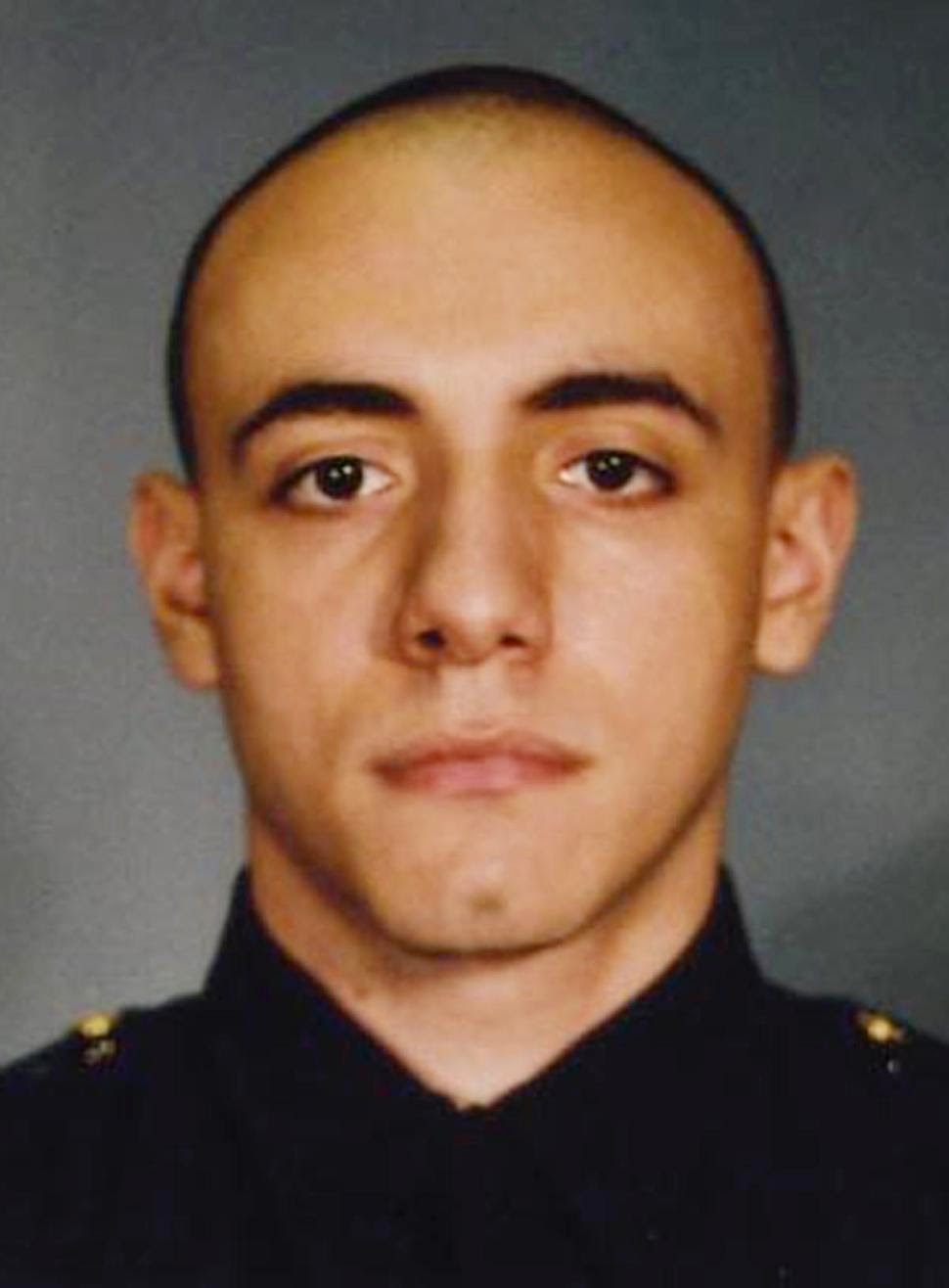
    Melvin Santiago, a rookie Jersey City cop was killed — ambushed while sill inside his police car — responding to a 4am call for an armed robbery.

    Sometimes, after a cop is killed, (just between you and me) I think, “man, that cop messed up” (knowing full well that we all mess up some time). Other times I think, “Man, maybe the cop shouldn’t have been so eager to search that car, fishing to find drugs. If it weren’t for the war on drugs, that officer would still be alive.”

    Other times, like in this case, I just get sad and think, “There but for the grace of God go I.”

    Officer Santiago gets a call at 4am for a robbery. What cop hasn’t? He responds to the scene and is immediately shot and killed.

    The killer, a suspect in a previous homicide and with many previous arrests, first cut and took a gun from an armed Walgreens’ security guard. Apparently he then tried to kill the guard (but was perhaps foiled by the gun’s safety). He said, “I killed your security guard” and told a customer to watch the news because he was “going to be famous.”

    So instead of leaving, he lingers for four very long minutes, waiting for the cops to show up. When the first police car pulls up, he shoots and kills Santiago: “Bullets flew through the cruiser’s windshield, 13 in all. The suspect was shot multiple times, and officers slapped handcuffs on him.”

    This horrible story has been well reported, so I had nothing to add.

    But now we’ve got the words of the killer’s horrible wife. See the problem, according to her, wasn’t that her husband is a cold-blooded killer. No. The problem is that he didn’t kill more cops. Because apparently, in her twisted world view, a man has a right to go out robbing and killing without society being all judgmental.

    She says, in what may be the most twisted attempt for sympathy ever:

    He should have took more with him. If they was going to stand over my husband and shoot him like a fucking dog, he should have took more with him. That’s how I feel.

    Sorry for the officer’s family. That’s you know. Whatever. But at the end of the day he got a family too. All they care about is the officer. All they care about is the officer.

    Meanwhile, the mother of the Santiago poignantly stated the obvious:

    [The killer] is a piece of shit. My son was 23 years old and he was a good boy, and he didn’t deserve to get a bullet in his head for no reason. For just doing his job. It was his dream and … he didn’t have to die like that. All because somebody wanted to be famous.

    [thanks to anon]

    [see later post as well]
  • Crime isn’t up

    Crime isn’t up

    Man, if you read the NY Post, you might think the city is going to hell. And all because a liberal is mayor and cops’ hands are tied: “The attack raised fears of a new wave of anti-cop violence — with a police union president blaming the assault on Mayor Bill de Blasio and his crackdown on stop-and-frisk.”

    I don’t want to minimize the danger of “air mail,” people throwing things from high above. It can indeed kill. But I doubt this potential murderer threw a bike at cops because police no longer make quota/productivity-goal based stops.

    I also don’t want to minimize the unfairness of potential lawsuits brought against individual police officers who are, in good faith, trying to do their jobs.

    Even my old sergeant from Baltimore couldn’t resist telling me how New York was not longer safe without all those stops, not to mention a liberal Sharpton-loving mayor in charge!

    But there’s one problem with crime-is-up-because-stops-are-down theory. Crime isn’t up! So until crime actually does increase, can we all just stop talking about the rise in crime so matter of factly?

    Here’s my theory: Cops have, are, and always will stop people when they have reasonable suspicion. Why? Because that’s what cops do! Call it doing your job or professional pride or whatever. Cops want to stop crime and catch criminals.

    But what cops are not doing much of making stops just to meet some perceived quota. This means that literally hundreds of thousands of guys a year are not being stopped because they’re wearing baggy pants in a high-crime neighborhood.

    I understand that logic of why massive stop-and-frisks could have a deterrent effect on crime. And yes, school is now out, the summer is hot, and stops have been way down for almost a year.

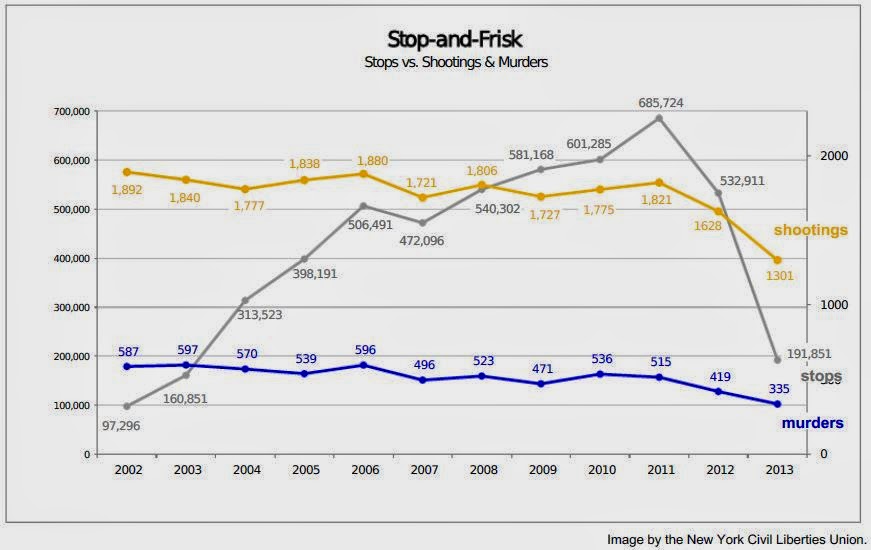
    Now this chart only goes to last year. This year stops are down, murders are down a bit, and shootings are up a bit. Overall, according to the stats, crime is basically unchanged (down 3%). But I make it habit not to rely on any crime numbers other than shootings and murders.

    So stops are down and crime is still down. Yes, crime is up in some places, but it’s down in other and overall constant. In the 75, stop are down 90% and shootings are up 30%. And leave it to a real news source to find local residents saying police need to start up those stops again!

    As somebody just put it (I forget where I just heard this), “what we have now isn’t a crime problem but a newspaper-selling problem.” I might also add there’s a bit of a problem with an ideology that believes the only effective policing is repressive policing.

    Is there a correlation there between police inaction and more shootings in East New York? Almost certainly. But we can deal with that without going back to blanket (and now illegal) police of massive stops and frisks.

    People feel safe when they see police and normal life functions. Police presence is key. Police getting out of their car is key. Police need to know the people — good and bad — in their area. Police need to stay in one area for a long time so that knowledge isn’t wasted. But 600,000 stops a year? That’s too many. And zero? That’s too few. But somewhere in between the two — and toward the lower end — it’s going to be just right.

  • Who made that? And when?

    Who made that? And when?

    The mighty flex-cuff…

    Anybody know when they first appeared? I do not. And I just get a query from MOMA asking me them and I’ll be damned, I have no idea. I’d like to know the answer.

    I write to you with the hope that you might help with our research. We are featuring Flexicuffs and Bite/Spit Masks (the plastic iterations of both) in an upcoming post and have run into a dead end regarding their provenance. With all design objects featured on the site, we do our best to include as much “museum caption” information as possible. Unfortunately, we have found very little information as to when these two objects came into being in their plastic forms. For example, the most specific date we have for the plastic handcuffs is “1960s.”

    By chance do you have any additional information that would help us fill in the gaps? We have been in contact with both the Police Museum as well as the NYPD (in addition to our own independent research) and continue to draw a blank.

    Personally, I always liked using proper metal handcuffs because they’re easier (and more fun) to put on, but then you had to take them off to trasnfer a prisoner to the wagon. So if you knew you were going to arrest somebody, you always brought the flex-cuffs. No fuss, no muss. (Except that one time when one dumbass “unarrested” somebody and decided to remove the flex-cuffs with his pocket knife. It was a minor cut, but still…)

  • “Just the world we live in”

    “Just the world we live in”

    A stun grenade exploded in a baby’s face. According to the BBC:

    The Swat officers had used a stun grenade, called a flash bang, as they entered the residence. The device, which creates bright bursts of light and noise to temporarily disorient its targets, landed in 19-month-old Bounkham “Bou Bou” Phonesavanh’s playpen, where it burned the child’s face and created a gash on his chest deep enough to expose his ribs.

    OK. I mean it may be standard to use SWAT teams and flash grenades, but that isn’t supposed to happen. But mistakes do happen. So I bet the chief is pretty apologetic.

    But not in Habersham County, Georgia. According to Sheriff Joey Terrell:

    Our team went by the book. Given the same scenario, we’ll do the same thing again. I stand behind what our team did…. Bad things can happen. That’s just the world we live in. Bad things happen to good people…. The baby didn’t deserve this.

    I’m sorry, but that’s not good enough.

    I mean look, I know this is just another example of our idiotic war on ourselves, I mean drugs. That’s nothing new. And bad things do happen to good people. But that doesn’t mean bad things should happen to good people at the hands of police. And when they do, as they inevitably will sometimes, you say you’re sorry, figure out what you did wrong so it doesn’t happen again, and probably shell out some dough to the victim.

    When “the book” results in innocent babies being maimed by police, then rewrite the fucking book, you brainless fool! What you don’t do is say no mistakes were made, and you would do the same thing again. See, if you did the same thing again in the same situation, then the same thing would happen again. And if you’re OK with that, then you’re a dick.

    From the BBC:

    Meanwhile, Bou Bou Phonesavanh is no longer in a coma, but he is still undergoing hospital-based rehabilitation. His long-term prognosis has yet to be determined.

    Wanis Thonetheva, the original target of the raid, was eventually located and arrested for drug possession. As the Guardian’s Pilkington notes, police officers knocked on his door, and he went with them without resistance.

    That’s worth repeating: “Police officers knocked on his door, and he went with them without resistance.” Wow, so you mean the whole SWAT team / flash-grenade thing was unnecessary? Why… yes.

    Anyhow… with Thonetheva off the streets, I’m sure it must now be impossible to get meth in Habersham County.

    Update: It’s worth noting, and it’s taken me a while to realize this, that this is the same jurisdiction and sheriff that were involved with the killing of innocent Rev. Jonathan Ayers in 2009. It’s amazing to me that such multiple instances of gross incompetence in law enforcement could come out of the same small place.

  • Thomas Frazier directs the Oakland Police Department to comply

    I was just spell checking Thomas Frazier’s last name for something I’m writing and learned, though the wonders of google, that Frazier is now running the Oakland Police Department. And he’s running it in a way I’ve never heard of:

    The former Baltimore police commissioner, who rose up the ranks in San Jose, is accountable only to the federal judge who last week appointed him to ram through reforms that Oakland police were supposed to have completed five years ago.

    Despite the modest title of compliance director, Frazier, 68, will have authority to overrule top commanders, spend city funds and even oust Chief Howard Jordan and demote his deputies if he determines they are obstacles to the decade-old reform drive.

    Damn…

    Frazier is the guy who originally approved my Baltimore research, though he was gone before I got there. He and Kurt Schmoke were universally disliked by the time I got to Baltimore in late 1999. Among the rank-and-file, Frazier was never able to live down his line about police being “social workers with guns.”

    “He won’t be intimidated by any outcry from the rank-and-file or the public,” said Gary McLhinney, the former head of Baltimore’s police union and a staunch Frazier critic. “When he gets an idea in his head, he’ll run with it. He doesn’t care if it’s popular.”

    “Academics loved Tom; rank-and-file cops despised him” McLhinney said. “Tom was into the community policing model really to the extreme. He wasn’t really interested in locking up bad guys. That wasn’t his focus.”

    Between 1995 and 2000, murders in Baltimore dropped from 325 to 261.

    There’s some irony that Frazier is now trying to clean up the mess in Oakland that Anthony Batts, now the Baltimore police commissioner, couldn’t fix.

  • Number two, shooting for number one

    The good people over at How-to-Become-a-Police-Officer.com have just informed me that by some fancy measures they use, I have the second most popular law enforcement blog. How ’bout that?

    I wouldn’t complete trust that list since it doesn’t include Second City Cop which is quite good and has many more readers, judging from the number of comments. But hey, who can argue with numbers?

    The problem with good cop blogs is they don’t last long. I can keep going because I’m no longer a cop. But if you are on the job, no good can come from keeping a blog. And trouble is always just one click away. I just went through my blog role and eliminated far too many moribund links.

  • 3-Adam-22

    3-Adam-22

    I just found this photoshopped file in an old folder on my computer. I honestly have no idea who made it or how I got it. (Needless to say, it is not a original comic and has nothing to do with creator of the comic.)

  • “Woman Not Guilty of Chemical Warfare; Constitution Saved”

    Nice article by Garrett Epps in The Atlantic about Bond v. United States, prosecutorial overreach, and rare victory for the 10th Amendment:

    There’s an established rule of construction called the avoidance doctrine: If there are two ways of reading a statute, and one way would cause a serious constitutional problem, a court should read it the other way. That’s what the majority in Bond did. It concluded that Congress did not intend its statute to extend to local disputes like the Bond-Hayes feud.

    Prosecutorial overreach happens every day. It is to the Court’s credit that six of its justices contented themselves with addressing this real problem, leaving the terrifying specter of treaty abuse for a case that really presents it.

  • Bratton tweak Operation Impact…

    …By putting rookie officers with more veteran officers. This should have been a no-brainer years ago. Partnering dumb with dumber — both right out of the police academy, both sometimes clueless white boys from Long Island — was never a brilliant idea (though even then it did help reduce crime). Rookie cops faced with quota pressure who could not distinguish class differences in the ghetto led to a lot of unwarranted stops, questionably legal marijuana arrests, and political backlash that hurt the NYPD. It also reinforcing the idea that foot patrol was just something to be endured before you got to become real police.

    The story in the Daily News.