Category: Police

  • That damn liberal media (for real!… sort of)

    That damn liberal media (for real!… sort of)

    It hasn’t been a bad week for off-duty NYPD officers. There was the drunk cop who shot himself or his partner in the wrist (actually he was on-duty, but whatever). Then there was the cop in the car who f*cking tried to kill the guy in the car next to him. And perhaps a few other incidents… who can say? Whatever (hey, I’m sure you can google any of this).

    You take any population of 35,000 mostly young males and you will get many stories of bad and amusingly bad behavior. But that’s not my point.

    It’s this headline from the Times that I find strange: “Former New York Police Officer Charged With Painting Anti-Semitic Graffiti.”

    “Former New York Police Officer”?

    It’s crap like this why cops hate “the liberal media.”

    The story actually isn’t so bad. But the headline editor? Shame on you!

    It’s like if I got arrested for something — tax charges or pedophilia or whatever (just hypothetically speaking, of course) — and they were like “former Baltimore City Police Officer arrested!” I’ve been off the friggin’ job since 2001!

    Except this is much worse. Because I wasn’t kicked out of the police department. Had I wanted to (God willing), I could now have 14+ years on the job (poor me). This guy, best I can tell, was basically fired, perhaps while on probation. Why? Because he’s a hate-filled schmuck!

    This guy is obviously crazy because not only did he spray paint “Jews suck cock” but he did so right under a camera.
    Why can’t the headline read, “Crazy Guy Arrested for Anti-Semitic Graffiti.” Or, because the cop thing is news, “Crazy guy NYPD fired is, in fact, crazy.” Or “NYPD thought this guy is crazy. Turns out the NYPD was right!”

    From the same story that calls him police:

    Mr. Setiawan, of Bellerose, Queens, was a police officer for two years before resigning in 2007…. The reason he left the department was not immediately clear. In the years since, the police said, Mr. Setiawan has been arrested six times.

    He isn’t a “former police officer.” He is a “fired police officer”!

    And don’t just blame liberals. The conservative press, the New York Post, made the same mistake. But, as usual (or at least since the Times moved Al Baker, who was a great police reporter, for “being too close to police”), other papers captured a better story. Why is the Queens Courier better with police reporting than the venerable Grey Lady?

    It’s actually not because of any political or liberal/conservative bias. It’s all about the reporters. The Times often hires upper-middle class “nice” people out of journalism school. These are the educated folks, like me, who correctly or not, are perceived as never having worked a blue-collar day in their lives. The hostility of police is very class based. Do you learn that in J-school? I don’t know. But I didn’t learn that at Princeton or Harvard.

    The Queens Courier, on the other hand, is now edited by a former police officer. I suspect their crime coverage is going to be pretty effing good! At least for this story they use “ex” and not “former.” You may not get the difference. But I do. Beat that, Grey Lady.

    To be honest, by far the best coverage of this story was in the Daily News.
  • Destructive Culture

    Najee Thomas, the 14-year-old son of Ronnie Thomas, was shot and killedin Cherry Hill (south Baltimore). You may better know Ronnie Thomas as Skinny Suge, he who 10-years ago created the semi-famous/infamous “Stop Snitching” DVD and is now in federal prison.

    Now I know it’s not popular in liberal circles to allow people to talk about “culture” — at least in any form except as related to mainstream dominant hetero-normative white male oppression. But social scientists can’t let conservatives co-opt and define the cultural perspective when talking about the ghetto.

    You don’t have to be a racist to note something is toxic about the culture of the Thomas family (see, for instance Stop Snitching parts one, two, three, and four). Not only are Skinny Suge’s life choices morally repugnant, they fail to succeed even by their own street-code values (unless these goals are to actually remain poor, in prison, or be killed).

    To blame America for America’s failings may be morally cathartic and even factually correct, but it does a great disservice to those who make better choices to ignore the culture of a community (and by “better,” yes, I’m using judgmental bourgeois standards of, like, holding a regular job and being a good parent.)

    Let me turn to one of my favorite takes on the matter, written back in 2006 by Harvard Sociologist Orlando Patterson (who was my PhD dissertation adviser). It’s well worth reading in its entirety, but here’s a bit in edited form:

    Why have academics been so allergic to cultural explanations?

    First is the pervasive idea that cultural explanations inherently blame the victim; that they focus on internal behavioral factors and, as such, hold people responsible for their poverty, rather than putting the onus on their deprived environment. (It hasn’t helped that many conservatives do actually put forth this view.)

    But this argument is utterly bogus. To hold someone responsible for his behavior is not to exclude any recognition of the environmental factors that may have induced the problematic behavior in the first place.

    Second, it is often assumed that cultural explanations are wholly deterministic, leaving no room for human agency. This, too, is nonsense…. Cultural patterns are often easier to change than the economic factors favored by policy analysts.

    Poor schools, per se, do not explain why after 10 years of education a young man remains illiterate.

    Nor have studies explained why, if someone cannot get a job, he turns to crime and drug abuse. One does not imply the other.

    And why, finally, do [so many young unemployed black men] murder each other at nine times the rate of white youths?

    Socioeconomic factors are of limited explanatory power.

    [When] the economy grew at a rapid pace, providing millions of new jobs at all levels[,] the jobless black youths simply did not turn up to take them. Instead, the opportunity was seized in large part by immigrants — including many blacks — mainly from Latin America and the Caribbean.

    One oft-repeated excuse for the failure of black Americans to take these jobs — that they did not offer a living wage — turned out to be irrelevant…. Such jobs offered an opportunity to the chronically unemployed to join the market and to acquire basic work skills that they later transferred to better jobs, but that the takers were predominantly immigrants.

    To understand self-destructive culture, one would be better served by disaggregated culture from its greater environmental causes rather than adopt, what is at its core, an old-fashioned functionalist and determinalist perspective.

    To say something is fucked up in ghetto culture is not to say that everybody in the ghetto is fucked up or even that everything ghetto culture is necessarily bad. Certainly people don’t have a choice as to where and to whom they are born. Certainly the criminal justice system contributes to the problem and can make it next-to impossible to succeed. And certainly people logically have survival skills to best suit their geographic and class-based-cultural environment. But the effed-up part of ghetto culture isn’t about survival, it’s about bad parenting, non-inevitable decisions, and poor life-style choices that are often distinctly counter-productive to actually surviving.

    Yes, oftentimes street behavior does make rational sense in street culture, but other times impulsive short-sighted street-behavior is just impulsive, short-sighted, and wrong.

    [Also, odds are nobody will ever do time for Najee Thomas’s murder. I can’t help but wonder how Skinny Suge feels about snitching when it comes to the guy who killed his baby boy.]

  • Guns and Homicides

    Guns and Homicides

    We all, er, know that guns don’t kill people (even though that is what they’re designed to do).

    But what I didn’t know was that guns really didn’t kill people until just a few decades ago.

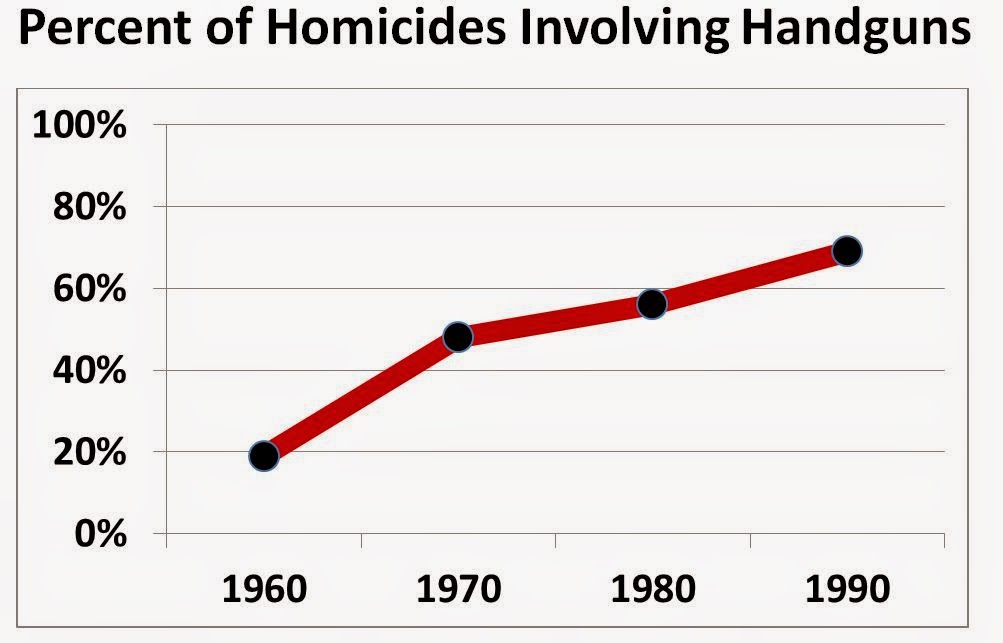
    As recently as 1960, just 20 percent of NYC homicides involved a gun! That went up to 48 percent in 1970 and 69 percent in 1990. And I think it’s remained at about two-thirds ever since.

    The jump from 1960 to 1970 is amazing. Remember, this isn’t the crime rate or the number of homicides but the percent of homicides using a gun. What happened? How and why did guns suddenly spread to the criminal class?

    (And feel free to applaud me for an all-too-rare use of full-and-honest scaling on the y-axis… you know want to.)

  • Cliven Bundy and the Law

    Cliven Bundy and the Law

    There is justifiable liberal outrage over Cliven Bundy’s land-rights claim, his refusal to recognize the federal government, and his kookie armed supporters who forced the government to back down. And by kookie, I mean men who say they’re going to use woman and children as human shields (in other contexts we blame terrorists for that).

    It is also indeed true that were the group armed non-whites (or even unarmed liberals) who broke the law (or not) the government would be much less likely to back down.

    But that’s not the take-home lesson here.

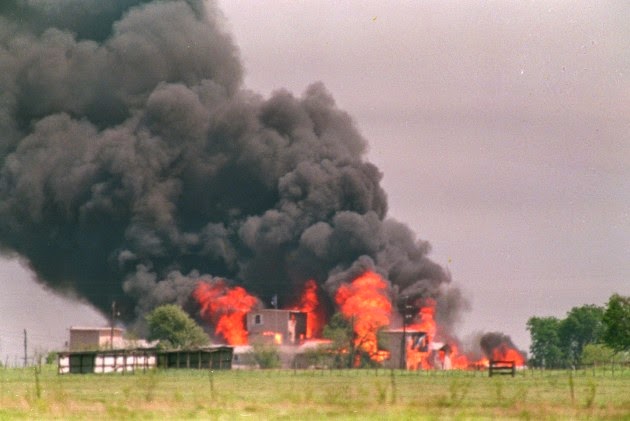
    And in fact, law enforcement has gone after armed whites before. In places like Ruby Ridge. And Waco. It didn’t end well.

    Janet Reno never apologized for the Waco killings. And liberals were shamefully silent (or downright supportive) about these events because, well, there was schadenfreude at seeing guns turned on them, for a change. But that didn’t make it right. You don’t have to like somebody to think they shouldn’t be assaulted (or assassinated) by the government!

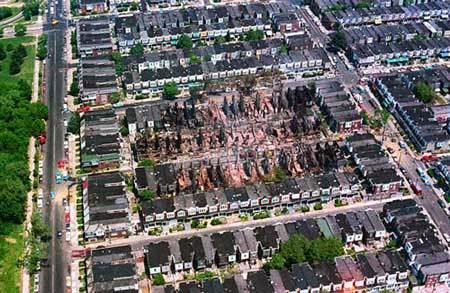
    And then there was MOVE. They were bad neighbors (and not white conservatives). And the law didn’t back down. How did that end up for the neighborhood?

    In the case of Cliven Bundy and his seditious friends, it’s fabulous the government backed down!

    What we saw here was law enforcement avoid a violent confrontation that was a lose-lose situation.

    Why? Because the alternative would have been bloodshed. Sure, it would have been their fault and their blood. But so what? (Though I imagine there is nothing more than some lefties might like to see more that cops and right-wing kooks killing each other — personally, I’d just settle for an interesting Venn diagram of those categories).

    But does it really take Bill O’Reilly to speak common sense and grill a Bundy supporter as to why his movement is any different than Occupy? Of course the right does a disservice to Occupy by comparing the two movements (For the record, Occupy has does much morein the public’s servicethan Bundy, and Bundy is destroying property), but there are similarities. Does it really take Glenn Beck to provide a voice of reason?:

    I don’t know who these people are. They all might be great. But here they are, they’re acting, they’re enraged, they’re enraged. And they’re confronting the federal government officials. I get that. But this is not the way to win…. I want to be clear, 100 percent clean on one thing all of us should agree on, and unfortunately, I don’t believe we do, both left and right. And that is, we need to agree on, we condemn those who use violence. Inciting violence doesn’t solve anything. I vehemently denounce anyone who even hints at such tactics.

    I suspect the law hasn’t given up on Bundy, it’s just some wise person saw a road leading to death and decided to take a different path. I suspect that Bundy will be prevent from trooping his cows over federal land in the not-too-distant future (at least I hope so). At the very least the government can put a lien on his land and take it when when he dies (hey, what’s the rush?). There are better ways of getting him to follow the law than starting a gunfight and making him, as required by his state’s constitution, pledge allegiance to the federal government.

    There’s this belief, too common in the conservative law enforcement community, that you can never back down. Sometimes a tactical retreat is just what is order. Live to fight another day. All the above (except maybe the MOVE situation) could have been resolved peacefully. Johhnie Law doesn’t have to get in a my-dick-in-bigger-than-your-dick pissing contest with every person who disrespects authority.

    The Bureau of Land Management and other involved law enforcement agencies should be applauded for their common sense and willingness to not make a bad situation worse. Rather then provoke a fight, they focused on preserving life and a goal-oriented style of policing. That is the take home lesson. Well done, Feds!

  • Sorry, but…

    Sorry, but…

    From the Daily News: “Devastated mom to sue city, driver over Queens creek crash that killed four friends”

    I’m sorry for your loss, but my first thought upon hearing of this — actually my second thought since my first thought was “Where the hell is there a creek in Astoria you can drive a car into?!” – was not sympathy but, “I’m happy the speeding bastard drove into the water rather than driving into me!”

    This is about a mile from my house and even I didn’t know of Steinway Creek existed. (Yes, that Steinway, next to where the make the pianos, and turns out this unknown creek also goes by the name Luyster Creek).

    See, massive speeding is not OK. No more so than drunk driving (maybe even less). If you can’t stop quick enough to see an even poorly labeled end of the road, you can’t stop enough to see me crossing the street. If a speeding car kills me biking or jaywalking, it’s considered my fault. So if a speeding car kills the passengers in that car… why is that also my fault? Here’s a good rule, if you’re speeding (or drinking, or texting, or putting on makeup, or cooking on the passenger seat with a 12-volt plug-in hibachi grill) and then crash it is your fault.

    “How could they have ended up in the water?” said Fletcher’s brother. “There was a lack of barriers, signage, anything that would prevent that tragedy. There was nothing to identify that was the end of the road.”

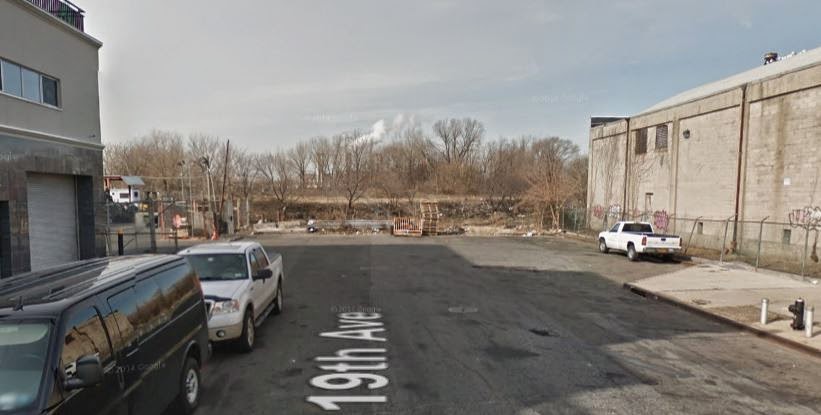
    You know what signifies the end of the road? The end of the road:

    Stop speeding. Or if you must speed, accept the consequences of your actions. You were driving too fast. You and and your friends didn’t deserve to die. And that’s a tragedy. But it’s not the city’s fault. And as a New York City taxpayer, I don’t want to pay one red cent.

    [And as criminal justice tidbit, 19th Avenue was formerly Rikers Avenue. (Yes, that Rikers, next to where they hold all the arrested folks)

  • High Crime Neighborhood + Cops on Bikes = Less Crime

    From the Chicago Tribune:

    The [Chicago] impact zones, established in February 2013 after a violent 2012, comprise just 3 percent of the city’s geographic area but account for one-fifth of its violent crime, according to the department.

    From the Sun Times:

    In March 2013, the department began assigning foot patrol offers to the high-crime areas. McCarthy said feedback from the communities has been positive, as have the results. Since Feb. 1, 2013, in the impact zones, murders are down nearly 50 percent, shootings are down 43 percent and overall crime is down 26 percent, doubling and outpacing citywide reductions, he said.

    How is the different than NYC? Hopefully, one would think, the cops in Chicago are doing something other than feeling quota pressure to write citations.

    In numbers, though, we’re not talking many cops. 360 officers in total. 140 on bike 220 on foot. That’s 18 cops per impact zone, which means about 4 or 5 on duty 16 hours a day. The zones seem rationallysized. The few I checked are about one-quarter to one-half square mile (or 30 to 55 blocks).

  • On jaywalking and giving tickets and 84-year-old men: “If the ends of justice are not met…”

    In a comment Kyle W was kind enough to get me going about the situation in which a Manhattan resident Kang Chun Wong suffered injuries after an officer attempted to give him a jaywalking ticket and Mr. Wong seems to have tried to walk away. Mr. Wong is 84.

    I wasn’t there, so it’s hard for me to talk about this specific incident. But I have plenty to say in general about jaywalking and ticketing old men…

    First of all, it is never the fault of an 84-year-old man for getting hurt at the hands of police for something non-criminal and non-violent. Why? Because he’s 84.

    Yes… I’m saying different rules apply to people who are 84. (Or in a wheelchair. Or mentally ill. Or pregnant to name just a few). This is common sense. This is why officers have discretion. And this is why their bosses should chew them a new one when they abuse such discretionary potential with such absolute stupidity.

    So you’ve got an 84-year-old man jaywalking in NYC. How about not giving him a ticket at all? This might not be understand by non-New Yorkers, but jaywalking is OK in NYC. You do it in front of cops. Cops do it. Everybody does it. With rare exceptions, you will not get a ticket for jaywalking in NYC. Nor should you. Such is the culture of our city. And it’s good.

    Last year there were 531 jaywalking tickets issued. For the whole city. For the whole year. That’s 531 citations out of exactly 8.4 gazillion incidents of jaywalking (By comparison there were roughly 23,000 misdemeanor marijuana arrests.) This year jaywalking tickets were up to 10 a day. So *if* you want to to be one of those 10 lacking-in-common-sense not-living-in-NYC officers who choose to write a jaywalking ticket, don’t friggin’ pick an 84-year-old man to write up! I guarantee you there were at least dozen other jaywalkers during that light cycle alone.

    [Jaywalking may even be good, collectively, for pedestrian safety here. It keeps cars from going too fast because pedestrians walk like the own city, because they do. Individually it can be good for safety to jaywalk when there are no cars coming. If you wait for the walk sign, then cars also get the green light who can and do turn into you. If the choice is between crossing with no cars and waiting for the light and putting myself at great risk, you should always cross when it’s safest. But that’s for another day…]

    If your bosses tell you to write jaywalking tickets, you could as an adult and professional, and as police did when Giuliani “cracked down” on jaywalking in 1998, simply refuse to do so (unless somebody jaywalks while flipping the bird or something). Or, as one real po-lice put it back then: “The only incentive they have to make me is fear, and that ain’t gonna work because writing these is up to our discretion…. This is just taking hard-earned money from people who can’t afford it, and I’m not going to prostitute myself for the Mayor or anybody else.”

    But let’s say you do choose, for whatever reason, to write a ticket to an old man. Then you, as a young officer, need to remember you’re dealing with an old man. He can be restrained, if absolutely necessary. He should not be pushed to the ground. Why? Because he’s 84!

    Clearly this was bad policing. I just can’t be certain if it happened early in the situation (deciding to ticket an old man), in the middle of the situation, at the end, when things got physical, or all of the above.

    At some point, if push came to shove, because he’s 84, let him go. Why? Because he’s 84 and we’re talking about the non-offense of jaywalking. Unlike letting some young thug walk away, this old man is not and will not be a permanent threat to your authority. Don’t get into a pissing battle with an old man. Why? Because you can’t win.

    Once, year ago, I almost got into a fight with an old man in Amsterdam. He was dumping wheelbarrows of trash into a canal after Queens Day. I asked him to stop dumping trash into the canal. He told me to fuck off. I informed him he didn’t need to dump trash as the was going to clean it all up anyway. He continued to tell me to fuck off. I tried to prevent him from dumping trash in the canal. Words were exchanged. I was in the right. He was ready to fight….

    So I walked away. Why? Because I couldn’t win. I was like 26. He was like 84. What if, by some happenstance, mano-a-mano, he beat me down. Then I lose. I got beat up by an 84-year-old. What if, on the other hand, I ducked his first punch and then put him down with a strong right. Then I still lose. I beat up an 84-year-old.

    Remember this truism when it comes to fighting an 84-year-old men: you cannot win. If he wins; you lose. If you win, you *still* lose. And a smart cop would never put himself into a situation he couldn’t win.

  • The Real Peel

    One of the reasons I like NYPD Commissioner Bill Bratton is that he is prone to quoting Robert Peel, the man who invented police as we know them back in 1829 London.

    Bratton has reprinted “Peel’s” principles online. Those nine principles are an excellent philosophical base for policing, they’re just not Robert Peel’s. And now the New York Times — the Grey Lady, the paper of record — has perpetuated this error. Not once but twice. (They don’t even seem to “regret the error.”)

    What are known as “Peel’s Nine Principles of Policing” do not come from Robert Peel. They come from a 1948 book on British Policing. Does this matter? I don’t know, but I do like to get my facts straight. Mind you, Peel might not disagree with the nine principles attributed to him, they’re just not his. (I’ve written about this before). And if you want a handy one-page easy-to-print pdf that I give to my students, here you go.

    So what are Peel’s actual principles? Based on the original 1829 Patrol Guide, I see five:

    1) The purpose of police is to prevent crime.

    2) Know your beat; patrol your beat.

    3) Maintain order.

    4) Use common sense and discretion.

    5) Be polite and control your temper (it may save your ass).

    Those aren’t bad rules to live by

  • Common Sense from the NYPD (X2!)

    Common Sense from the NYPD (X2!)

    I love any memothat instructs police officers to “use discretion and common sense” and the arrest “as a last resort.”

    This is the type of common sense one would expect from Bratton because jaywalking in NYC is not a “broken window.”

    It’s actually quite poetic. Whoever wrote this should be promoted to editor of Spring-3100!

    The second bit of common sense to come out of the NYPD is the decision to give 200 cops in Staten Island naloxone (aka: narcan). This saves the lives of people ODing on heroine. From the Times: “the initiative went straight to the heart of ‘what we want to do, save lives.’”

    According to the Times, paramedics have saved 42 people on Staten Island this year, and police in one precinct 3 people.

    Administering a life-saving drug to people about to die should be a no-brainer, but not much about the war on drugs involves brains. So unless you’re a paramedic, saving the life of a addict is considered controversial, even when the alternative is certain death.

    When I was a cop, this was an injection (and cops didn’t give it). Now it’s a nasal spray. From my experience, watching somebody get this drug come back to life is a great spectator sport… but not for the reason you’d think. He or she whose life was saved wakes up really pissed off! It’s ha-larious, in a you-had-to-be-there kind of way.

  • Laments of the Qualitative Researcher

    I don’t apply for many grants, in part because they’re so hard for a qualitative researcher to get. Ethnographic work and qualitative research isn’t taken seriously in a generally quantitative field. My research doesn’t follow the standard “theory, hypothesis, experiment, verify” model of hard science. Nor should it. But it’s hard to get grants or get published in Criminology if you don’t. (The quantitative/qualitative ratio leading journals is roughly a depressing 90%/10%.) So why is this work not valued in research grants and journal publications? I do my research the old-fashioned way: I talk to people. Perhaps it’s worthless research, but professors do assign my books to students. But why is the worth of qualitative research only recognized after the fact?

    [If you look at Amazon’s list of “best sociology,” you have to get to number seventy-six before you find one written by an actual sociologist! I would see this is a crisis of the field (even given issues with how Amazon classifies sociology).]

    So here’s my next book idea: I’m going to research and write an oral history of the Great New York City Crime Drop. Why? Because crime went down more than anybody thought possible, and there is still no academic consensus about what actually happened. It’s one thing to talk about Broken Windows and Compstat in theory. But I want to explain the crime drop from the perspective of the NYPD officers who were actually there. What police have to say may be profound. And nobody ever talks to the lowly beat cop. At least what they have to say will be revealing. And if nothing else, it should be a very good read.

    The grant rejections (I wanted money to pay for transcribers) were check-the-box, so I don’t want to read too much into specifics. And the single most important reason may be: “Proposal needs stronger organization or writing.” Had they just left it at that, I would said, gosh, maybe they’re right. That’s a good reason for rejection. I could have spent more time writing it. (But then, in a catch-22, I didn’t want to waste more than a few days writing a grant application that would probably be rejected…)

    It’s the other specific reasons that I have issues with, such as:

    • Proposal does not clearly state a testable hypothesis, goal or aesthetic vision

    Well of course there’s no clearly stated testable hypothesis because I’m not testing a hypothesis. It’s called Grounded Theory, if you want to get fancy (I don’t). I’m going to talk to people to listen to them and try and understand what they have to say. There’s no shame in that (nor, apparently, grant money).

    • Research methodology is underdeveloped

    I’m going to interview a lot of cops who worked the streets from the late 1980s to the mid 1990s. And then I’m going to write a book about it. Just because you don’t like that plan doesn’t mean it’s underdeveloped.

    • Proposal fails to convince reviewers of scholarly significance

    Murders in NYC decreased eighty-some percent and we, the so-called “experts” in the field, still can’t agree on a theory that has any practical use. If explaining the crime drop doesn’t have scholarly significance, I don’t know what does!

    • Proposal does not demonstrate sufficient understanding of the state of the discipline or field

    Really? This is my field, and I don’t think I’m an idiot. I guess we’ll just have to agree to disagree.

    I’ve done some pretty good research in my day. I’ve written good books and social science. But because I choose not to follow the hard-science model of methods and writing, I still feel like an idiot when my grant applications are rejected. It’s not so much the rejection that hurts (don’t “poor baby” me; I have thick skin). This wasn’t a large grant. And I’m good at research on the cheap. Still, it’s the stated reasons for rejection that make me throw up my hands in frustration.