Category: Police

  • Good Ideas from the Baltimore FOP

    Maybe I’ve become a bit cynical after my time in New York, but I don’t normally think of the police union as a good source for rational and cost-effective advice on better policing (though protecting workers’ rights is an important part of the union).

    But I’ve got to hand it to Robert Cherry, president of my old Baltimore Fraternal Order of Police for their Blueprint for Improving Policing. (But Bob, I’m still a bit peeved that my name is misspelled as “Moslos” on my FOP, Lodge #3 card! You can send a replacement to my school address.) [The FOP is one of the major police unions. The other, which represents the NYPD, is the PBA. In my mind the FOP is somewhat better about caring for the police and the public. The PBA has a bad history of stoking public fear, which isn’t really in anybody’s best long-term interests.)

    From the FOP report:

    Our police officers are appalled by those individuals who betrayed their oath and have now pled guilty in the Majestic Towing scandal, along with others which have come to light in recent years. Many now feel embarrassed to tell others they work for the BPD. The rank and file officers attribute this scandal directly to the lax hiring practices of the BPD. 

    Specifically, maybe it wasn’t a very bright idea to go poach officers from what an incredibly corrupt Puerto Rican police department.

    The FOP report continues:

    The approximate average number of officers suspended in the BPD is 80-100 at a time, which is more than half of the officers needed to staff an entire district.

    Many officers took pride in being a police officer in one of the most challenging policing environments in America. This is simply not the reality anymore. Essentially, Baltimore city taxpayers are being duped. Their tax money is funding the training of Baltimore City police officers who, in turn, leave to work for other jurisdictions, including Baltimore County. The cost is more than just fiscal—taxpayers are losing protection and it’s a waste of resources in general. In addition to losing qualified police officers, according to in-service training surveys, not one Baltimore City police officer said he/she would recommend joining the BPD to potential applicants. At this moment, the Baltimore County Police Department has initiated a 50 member lateral class focusing on recruitment of Baltimore City officers with fewer that five years of experience.

    A recent study shows that an increasing number of BPD officers live in Baltimore City. The BPD should make certain that the trend continues by offering incentives for police officers to live within the city limits. The greater the number of officers residing in the city, the more personally invested the police force as a whole will be in the welfare of the city.

    The report also calls for getting rid of the “white shirts” (to be clear: just the shirts, not the people in them), a shockingly overdue redrawing of district and post boundaries, more patrol and more visible patrol, more focus on community focused policing and quality of life issues, a more productive (and less stat-and-blame) Comstat, and two years of college or military as a hiring requirement. It all makes a lot of sense. Kudos to the FOP.

  • Behave! (Big Brother is Watching)

    I was interviewed by Videosurveillance.com about my thoughts on video surveillance’s effect on crime. I’m skeptical. (But impressed that a company such as theirs is willing to print my unadulterated skepticism.)

    Cameras are no substitute of cops. 

  • The Pearl of the Levant

    The Pearl of the Levant

    Our home in Beirut (near the Greek Orthodox part of town, which my wife swears was just a coincidence).

    If you look closely you can that our 4th floor landing was once a sniper’s nest. The bullet pock marks on the wall are outgoing (incoming can be found if you lean over and look down). It’s amazing (and sad) that there doesn’t seem to be a single building that was around during the war (1975-1990) that wasn’t the scene of a battle.

    But why talk about war when we can talk about cheesy breakfast sandwiches across the street?

    On Hamra Street, looking at the Starbucks. You forget just how many
    chain coffee shops there are until you see them all within three blocks.

    The ever-romantic corniche.

    And the fashionable (and up-scale mall-like boring) downtown.

    With free concerts on five stages.

    From our hike, between Jezzine and Barouk. In the mountains can be found the famous ceders of Lebanon, the oldest of which is about 3000 years old.

  • While I’m out…

    Check out this lengthy piece (and well worth reading the whole thing) by David Simon about murders, stats, the BPD, the state’s attorney’s office, and the need for main-stream media. (And thanks to an anonymous comment for cluing me in.)

    The Stat:

    In 2011, the Baltimore Police Department charged 70 defendants with murder or manslaughter.

    Yet in 2010, the department charged 130 defendants with such crimes.

    What is happening?

    Are Baltimore’s killers showing more cunning, are murders becoming
    harder to solve?  No indication of that from any quarter.  Did the
    homicide unit lose a ton of veteran talent?  Nope.  Not between 2010 and
    2011 at any rate.  No, the dramatic collapse of the department’s
    investigative response to murder is the result of a quiet, backroom
    policy change that has created a bureaucratic disincentive to charge
    people in homicides.

    Also, and unrelated, McCarthy in Chicago says police don’t have to answer stupid 911 calls for service anymore. It might seem minor, but this could have a huge impact on policing (as Chapter Six of Cop in the Hood — “911 is a Joke” — describes in breath-taking page-turning detail). McCarthy is talking about “beat integrity” and says he’s willing to face the political flack for fewer police responses. He also wants to give powers of where police go to police bosses (instead of giving all the power to the dispatcher). This is all good. (Maybe in Baltimore they’ll actually bring a box back to put call in!) From the Sun-Times:

    McCarthy replied that the change was
    already under way, with the goal of creating, what he called “beat
    integrity.” That means leaving police officers to patrol their assigned
    beats, instead of chasing their tails by running from one 911 call to
    another at the behest of dispatchers. …

    “Previously, the dispatcher would direct
    the resources, while the sergeants in the field would basically just be
    receiving them. [Now], sergeants in the field are in charge of
    dispatching resources if they don’t like the way [dispatch] is doing it. …

    [Dispatch] has also abandoned what McCarthy called the “clean screen concept” at the 911 center.

    “They would dispatch a car from one end
    of the district to the other end of a district to simply get the job off
    the screen. That’s the clean screen concept,” he said.

    “What we’re now doing is maintaining
    beat integrity. … If a job comes in in a neighboring beat and it’s not
    an emergency call for service, that job will actually get stacked until
    that beat is available to handle it. That’s what beat integrity is all
    about. Same officers in the same beat every single day. Those officers
    are not only accountable for what’s happening on the beat, they also
    know who the good kids are from the bad kids. They’re not stopping
    everybody. They’re stopping the right people because they know who they
    are.”

    McCarthy said a more dramatic change is
    coming soon, when the Chicago Police Department determines “which jobs
    we’re not gonna respond to” anymore.

    “That’s a call that I’m going to make — and there’s going to be some wrankling about that,” he said.

    “We don’t need to respond to calls for
    service because, ‘My children are fighting over the remote control.’ We
    don’t need to respond to calls for service because, ‘My son won’t eat
    his dinner.’ Unfortunately, believe it or not, those are calls we
    actually respond to today.”

     And the political flack will come when one of the my children are fighting over the remote calls turns into a homicide. But you can’t dedicate half the police department to every idiot who can pick up a phone.

  • Fourteen Evenings in Beirut

    Fourteen Evenings in Beirut

    I’m off to Beirut to see the missus, who has been there for a month already. Yes, Beirut, the Pearl of the Levant, The Paris of the East, Chicago by the Sea. 

    Except for rolling blackouts, a near civil-war next door (in the country that imposed peace in Lebanon, naturally), and some burning issues in the city of Tripoli in the north, I hear it’s great this time of year. Wish me luck and an uneventful two weeks. We plan to do some hiking (seriously). Don’t expect much here in the meantime.

    I expect our average evening to unfold something like this:

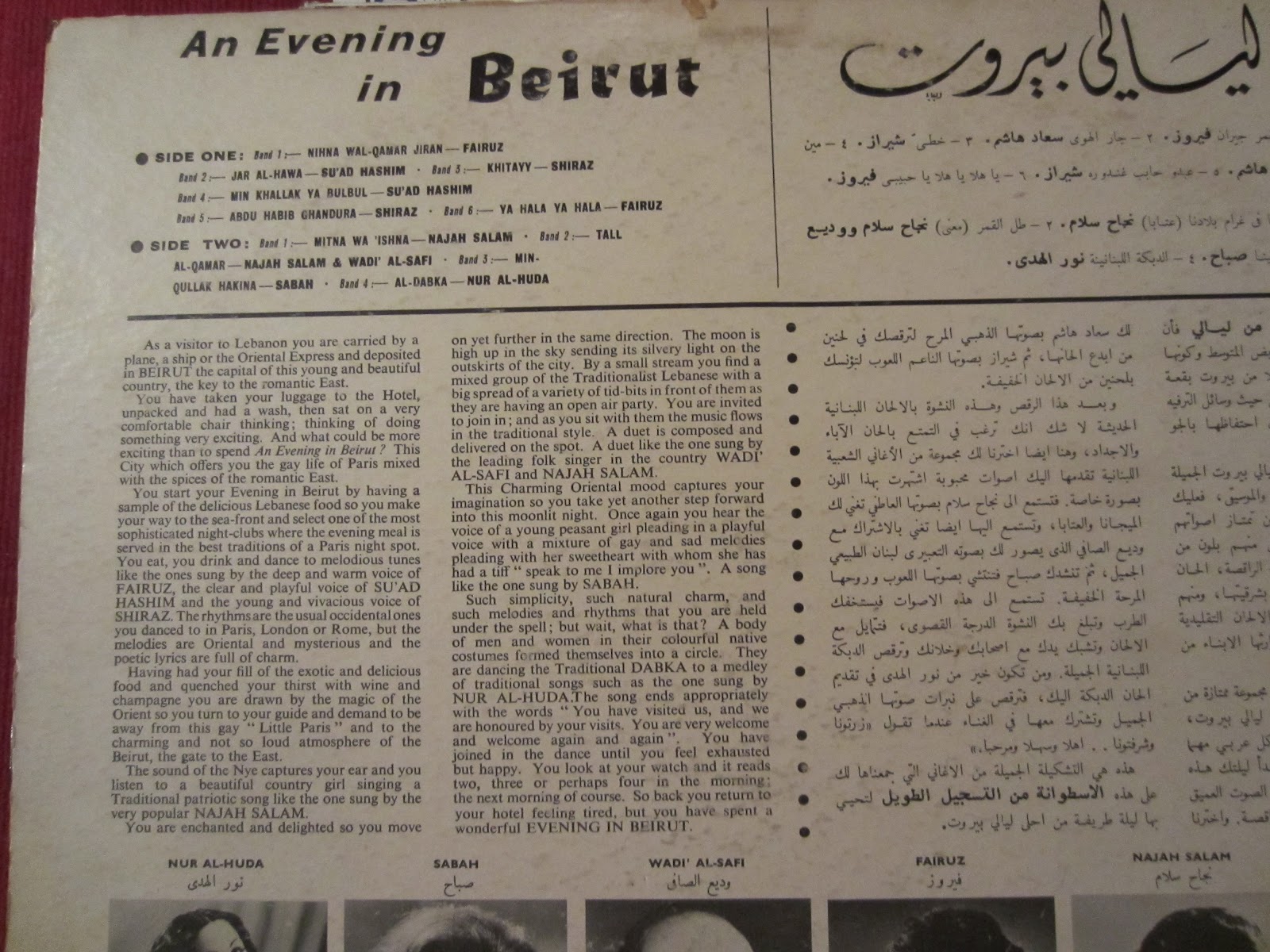
    I picked up this
    record from the $2 bin at a record store in Greenpoint the other night. Nothing has changed in Beirut since the 1960s, right?

  • Eliot, by Michael A. Wood Jr.

    Eliot, by Michael A. Wood Jr.

    Need some good summer reading? Why not Eliot? It’s fiction set very firmly in Baltimore’s Eastern District. I know those streets well (even if the cameras are new to me). (and I love that he gives a shout out to Larry, the world’s best dispatcher.)

    I don’t want to spoil anything, but I will say I enjoyed taking the turns around my old stomping grounds. And Michael swears there’s no connection, but I could swear I went to the academy with the homicide detective. Here’s the cover and you can read the back of the book:

    You can get more info and buy a copy on Michael Wood’s website. [Update: you can’t, and don’t] While you’re there, if you’re a cop, check out his promotion guide. I can’t personally vouch for the promotion guide (I’m not up for Sergeant or Lieutenant) but I do have a copy and think it gives you the straight dope on what you need to know.

    I can vouch for Eliot: good crime fiction.

    Next on my list is Cop Stories: The Few, The Proud, The Ugly by Dick Ellwood. Ellwood’s career goes back to 1965, so I look forward to what is now a bit of history.

    And previously I wrote about Badges, Bullets, & Bars by Danny Shanahan.

    Who would have though so many books would come out the ranks of the BPD?

    And let’s not forget Michael East’s Beyond Hope. East isn’t a Baltimore Cop, but he did write a very good book.

    Update: Turns out Michael Wood Jr. is an narcissistic SOB who confessed to crimes but tried to play it off as being a “whistle blower.” And then he he stole money from veterans. http://www.copinthehood.com/2018/09/15/michael-wood-jr-took-money-from-veterans-2/ The other books I stand by, though. And writing this years later, I particularly remember Michael East’s book. Outstanding.

  • Ben Franklin and the first police force

    In his autobiography Benjamin Franklin wrote:

    On the whole, I proposed as a more effectual watch, the hiring of proper men to serve constantly in the at business; and as a more equitable way of supporting the charge the levying a tax than should be proportion’d to the property…. It paved the way for the law obtained a few years after.

    And he said so in 1732, ninety-seven years before Robert Peel gets credit for London’s Bobbies. What ever happened to the Benny’s (as I will dub Franklin’s police)? How long did they last? What did they do?

  • Christopher Coke sentenced to 23 years

    Remember Dudas (AKA Christopher Coke), the Jamaican drug lord? He was sentenced in Manhattan (though most of his criminal acts were in Jamaica). When he was holding out in Tivoli Gardens, I did not think this he would ever be sentenced, much less by a US court.

    I wonder if life today is better or worse in Tivoli Gardens without Dudas. Seriously. Seems like an important question to ask.

  • Judge Rules Against NYPD in Brooklyn Bridge Arrests

    From the Times:

    A federal judge ruled Thursday that the police did not sufficiently
    warn Occupy Wall Street protesters against walking on the roadway of the
    Brooklyn Bridge before arresting about 700 of them in October.

    The ruling, by Judge Jed S. Rakoff of the Federal District Court in Manhattan, allows a class-action suit filed by protesters
    to proceed against police officers and other police officials involved
    in the arrests. But the ruling dismissed the mayor, the police
    commissioner and the City of New York as defendants in the suit, saying
    that there was insufficient evidence that those parties were responsible
    for any misconduct by the police.

    This may be one of those cases were both sides are right: The police did warn; the protesters couldn’t hear. The burden is (and should be) higher on the police.

  • Golden Schmucks, Violence, Immigrants, and Greece

    And the report by Jerusalem Postreporter Gil Shefler, who got beat up by extremists on one end of the spectrum, but isn’t sure which.

    I’m amused that Gil asks the Greek Nazi party (Golden Dawn) how they differ at all from the German Nazi’s of WWII. All the party member can come up with is: “The Nazi’s didn’t like Greece. We are nationalists who love Greece.” That’s the only difference?

    It bothers me that this group is called, “extreme right” or, as the New York Times so inadequately put it, “Far Right.” Well, yes, technically correct. But Golden Dawn is is actually a Nazi Party. Not like the Nazis, but actual Greek Nazis… with messed up swastika and all. 

    And here’s the Greek Nazi party leader — an elected member of parliament — throwing water at a person on a talk show and than slapping another woman. Class act. I hate Greek Nazis.

    He is now wanted for arrest on assault charges.

    When I lived in Greece, I was amused because the graffiti for “Golden Dawn” — in Greek, by morphing an “η” into an “α” — can very easily be changed into “Golden Eggs” (Χρυσή Αυγή becomes Χρυσή Αυγἀ). Good stuff.