From Rolling Stone:
The very rich on today’s Wall Street are now so rich that they buy their own social infrastructure. They hire private security, they live on gated mansions on islands and other tax havens, and most notably, they buy their own justice and their own government.
An ordinary person who has a problem that needs fixing puts a letter in the mail to his congressman and sends it to stand in a line in some DC mailroom with thousands of others, waiting for a response.
But citizens of the stateless archipelago where people [the very rich] live spend millions a year lobbying and donating to political campaigns so that they can jump the line.
…
Some of these people take that VIP-room idea a step further. J.P. Morgan Chase CEO Jamie Dimon — the man the New York Times once called “Obama’s favorite banker” — … orchestrated a deal in which the Fed provided $29 billion in assistance to help his own bank, Chase, buy up the teetering investment firm Bear Stearns. You read that right: Jamie Dimon helped give himself a bailout. Who needs to worry about good government, when you are the government?
Dimon, incidentally, is another one of those bankers who’s complaining now about the unfair criticism. “Acting like everyone who’s been successful is bad and because you’re rich you’re bad, I don’t understand it,” he recently said, at an investor’s conference.
Nobody hates them for being successful. And not that this needs repeating, but nobody even minds that they are rich.
What makes people furious is that they have stopped being citizens.
Most of us 99-percenters couldn’t even let our dogs leave a dump on the sidewalk without feeling ashamed before our neighbors. It’s called having a conscience: even though there are plenty of things most of us could get away with doing, we just don’t do them, because, well, we live here. Most of us wouldn’t take a million dollars to swindle the local school system, or put our next door neighbors out on the street with a robosigned foreclosure, or steal the life’s savings of some old pensioner down the block by selling him a bunch of worthless securities.
As someone from a middle-class public-school background who has rubbed shoulders with the 0.1% (that’s what happen when you go to Princeton and Harvard), what bothered me about the uber-rich I met in Princeton (you don’t meet so many uber-rich in grad school) wasn’t that they were rich… It was their absolute sense of entitlement! They never counted their blessing. They didn’t need to. They knew the game was rigged and that were going to win it.
Now I benefited from the same game, and by most of the world’s standards I’m uber-rich (something mostly due to where and to whom I was born, for which I’m very thankful), so I can’t complain too much.
No, what bothered me about these people–our current masters of finance and industry–is that they somehow believed that they had earned their privileged position. And I’m talking about 18-year-old prep-school kids who at that point had never worked a day in their lives!
They had convinced themselves that somehow, because their parents were rich and they went to Princeton, that theyhad won a meritocratic game. They thought they were better–not just richer, mind you, but better–than working people, especially the janitors and cooks and service workers (students and professional alike) who took care of them (and had made the best of their life’s situation). I saw it all the time. The rich really are different than you and me: they have no clue.
[thanks to Alan for the link]
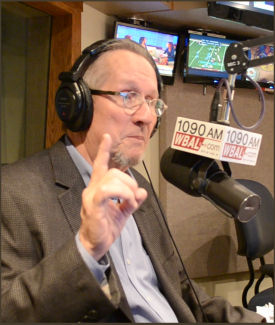
 Ron Smith was a newspaper columnist and radio host on WBAL in Baltimore. He
 From the