Copinthehood.com has moved to qualitypolicing.com

  • Tasers safe on people who won’t be tased

    An NIJ report says Tasers are fine when used on “healthy, normal, nonstressed, nonintoxicated persons.” Okaaaay…

    [Thanks to The Agitator]

    [Update: I just read the report. It is quite an unambiguous green-light for Taser use: “Law enforcement need not refrain from using CEDs to place uncooperative or combative subjects in custody.” It’s that “uncooperative” part I do not like. The report concludes: “CED use is associated with a significantly lower risk of injury than physical force, so it should be considered as an alternative in situations that would otherwise result in the application of physical force.” But what about when the alternative is verbal persuasion? And isn’t somerisk of increased physical injury justified if it saves a life? An approximately 1 in 400 chance of serious injury or death are not odds I would want to play.

    Here’s the latest one. And Electronic Village keeps a pretty good list of Taser deaths. Or, should I say, people whose time happened to come coincidentally just a few moments after they happen to be Tasered.

  • I’ll smoke to that

    I just got this gem of a line from a police officer who just turned in his retirement papers: “This job is like cigarettes–hazardous to your health, addictive, and occasionally strangely satisfying.”

  • Prison for life, as a free man

    I received an email yesterday from Lorne Caplan, who gave me permission to republish it with attribution. I’ve edited it slightly:

    As a former investment banker and having recently been freed from prison in 2007, I have to agree with much of what you said today. Most importantly, it is the culture of eternal punishment that has developed in this country.

    My own situation suggest you are absolutely right to try to avoid prison, since once you have a felony on your record, it is like being branded for life. My own prospects for work have been essentially taken away by what I did and what the system continues to do, as Google can’t seem to lower the references to my incarceration and conviction, and any company with an HR department won’t even consider me.

    As for qualifications, that is also funny, since I have been published in trade and consumer magazines, have the Masters, etc. It doesn’t matter. It only makes me overqualified.

    I am curious if you have run across organizations for white collar criminals that have found no support and a complete taking away of family (my children haven’t had food on occasion because I can’t find work, UPS won’t hire me, McDonald’s and so many others), friends, work prospects etc…. Yes, there should be consequences to peoples actions, but a lifetime of no prospects hurting family, children, etc? I don’t think that is what the US population really would want.

    I was first interrogated as a witness in 2002 and after 21 or so meetings with the FBI, a wire tap, and the usual threats to family, I heard nothing for 3 1/2 years, until one day they showed up at my ex-wife’s door looking for me. The perp walk ensued, lawyers and their expensive (useless) defense, the pleading, sentencing, etc. And all the while, no work, income, devastation to the family, etc. I got out to no prospects, the joke of half-way house, and programs that are menial and insulting. All to say, almost 10 years into this and I am still suffering from the decisions and consequences. I don’t believe those in industry understand that it isn’t just a couple of years and some time playing tennis at a minimum security prison in the US. Your life will be destroyed, completely.

  • Probation for Baltimore Officers

    These were the two officers who stranded two 15-year-olds far from their home. They were not the first officers to do this. They may be the last. (My earlier post.)

    From the Sun:

    [Judge] Doory said the fact that Johnson was left in Howard County without shoes “stood like a monument” in the middle of the case and remained inadequately explained. “What I don’t understand is the ‘why,’” Doory said. “I can only conclude that this was done for fun … or as homage to the legends of the good old boys, or was a convoluted attempt to teach someone respect.”

    Or perhaps all three.

    While I admit this activity is awfully hard to defend, I’m still not convinced it’s always wrong. Especially given the alternative of arrest, CBIF, going through the system, and a criminal record.

    Like the espantoon, shooting at fleeing felons, drinking at the American Brewery, and “keying” up your radio, this venerable Baltimore police tradition is probably history.

    Despite the judicial slap on the wrist, the officers still risk being fired. I say cut them some slack. If the powers that be don’t want this to happen anymore, bang down hard if there’s a next time.

  • Then and Now: NYC

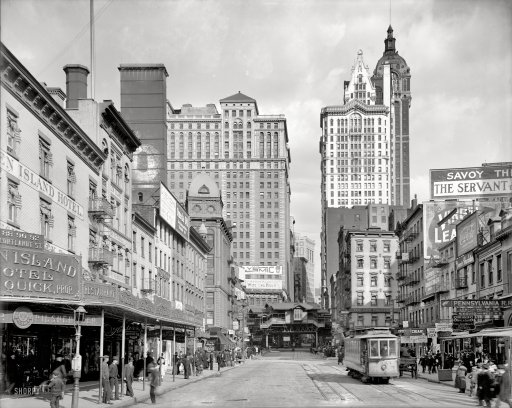
    Then and Now: NYC

    New York City is certainly not immune to destructive urban “progress.”

    Here’s a shot from Shorpy of Cortland Street from 1908.

    Here’s the view today:

    But what’s really interesting is what happens when you turn around. Back then, it would have looked much like the picture above. You were in the heart of what was known as “radio row.” But they tore down that area for… The World Trade Center. Here’s the view today (or really about a year ago):

  • A black man catching a cab in New York

    The other day I saw a young black man on the corner of 32nd Street and 6th Avenue with his arm up, trying to hail a cab. He wasn’t particularly well dressed, but he didn’t look like a hoodlum (the same could have been said of me). “How many empty cabs are going to pass him by before one stops?” I wondered.

    The answer: three.

  • Poverty doesn’t equal crime

    James Q. Wilson writes some good stuff on crime in the Wall Street Journal. But this worries me:

    Culture creates a problem for social scientists like me, however. We do not know how to study it in a way that produces hard numbers and testable theories. Culture is the realm of novelists and biographers, not of data-driven social scientists. But we can take some comfort, perhaps, in reflecting that identifying the likely causes of the crime decline is even more important than precisely measuring it.

    Culture doesn’t create a problem for social scientists like me. If social scientists can’t deal with culture, who can? It’s time for sociologists to step up to the plate. And it’s time to take qualitative methods more seriously.

  • Breaking News: Global War on Drugs has Failed!!!

    OK. That’s not really news. But this report is kind of a big deal. So says the BBC, the “Global war on drugs has ‘failed’.” Imagine that. The panel included former UN Secretary General Kofi Annan, the former presidents of Mexico, Colombia, and Brazil, the former US Federal Reserve chairman Paul Volcker, the current Prime Minister of Greece, George Papandreou, former US Secretary of State George Schultz, and Virgin rich man Richard Branson. That’s a heavy lineup.

    The White House?

    “The White House rejected the findings, saying the report was misguided.” Thanks, Obama. Hope you enjoyed that blow when you were younger. And the fact you weren’t arrested for it.

    The BBC story is worth quoting at length:

    Their report argues that anti-drug policy has failed by fuelling organised crime, costing taxpayers millions of dollars and causing thousands of deaths.

    It cites UN estimates that opiate use increased 35% worldwide from 1998 to 2008, cocaine by 27%, and cannabis by 8.5%.

    The authors criticise governments who claim the current war on drugs is effective:

    “Political leaders and public figures should have the courage to articulate publicly what many of them acknowledge privately: that the evidence overwhelmingly demonstrates that repressive strategies will not solve the drug problem, and that the war on drugs has not, and cannot, be won,” the report said.

    Instead of punishing users who the report says “do no harm to others,” the commission argues that governments should end criminalisation of drug use, experiment with legal models that would undermine organised crime syndicates and offer health and treatment services for drug-users.

    It calls for drug policies based on methods empirically proven to reduce crime and promote economic and social development.

    The commission is especially critical of the US, saying it must abandon anti-crime approaches to drug policy and adopt strategies rooted in healthcare and human rights.

    The office of White House drug tsar Gil Kerlikowske rejected the panel’s recommendations.

  • Less/Fewer

    Less/Fewer

    I not a fan of arbitrary grammar rules. And now I’m going to bore you with one.

    I don’t like rules for rules’ sake (eg: split infinitives, ending sentences in preposition, etc.) Along with being based in some bizarre Latin-lover’s 19th-century wet dream, such rules get in the way of style. Rules are supposed to clarify and–to a lesser but still important extent–tell you how not to sound stupid.

    I’ve always wondered about the old less/fewer distinction. People generally say less for everything. I couldn’t figure out if it matters. As I understand it, “fewer” is for things you can count (like anything in the plural); “less” is for everything else. Fewer liberals; less intelligence. Because you can say “two liberals,” but you can’t say “two intelligence.” Yeah, “less liberal” has a different meaning that “less liberals” (when it should be fewer), but so what? There’s still no ambiguity.

    Once again, ViceMagazine comes to the rescue. And this time not with nudity and/or slutty American Apparel ads. From the ever important Department of Dos & Don’t comes this Grammar Don’t:

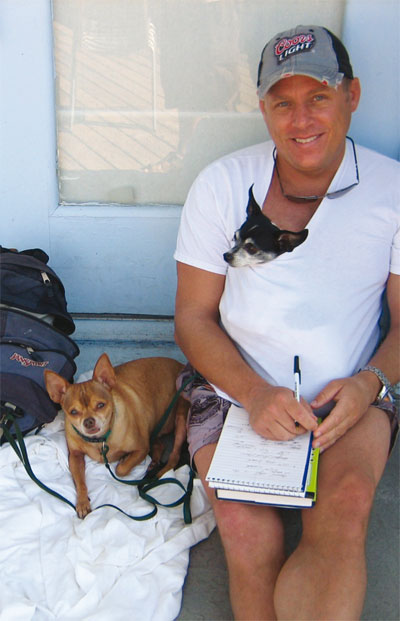
    Momentarily sidestepping the crotch shorts, public writing project, and twin loneliness mascots, nothing says “I know less than three black people” more than a Coors Light hat that was pre-tattered at the time of purchase.

    Really? How much dothree black people know?