Seems to be what’s happening in Newark, which laid off 163 police officers last month.
Copinthehood.com has moved to qualitypolicing.com
-
Mexico
First, as my wife sits near me working on a guidebook to the Yucatan (that’s Cancun, Playa del Carmen, and the Mayan Riviera for you tourists in Mexico), I feel obliged to point out that the Yucatan has a lower homicide rate than Canada. And Canada is safer than America. So not going to Cancun because of violence in Tijuana is like not going to Disneyland because of crime in Detroit. It just doesn’t make sense.
OK… not that I got out of the way… have you see how f*cked up the war on drugs in Mexico still is?! I mention this because one day, hopefully sooner rather than later, murder will go down in Mexico. And when it does, you’ll hear about how great the latest get-tough police leader is. And how now we’re really winning the drug war. Of course that will be B.S. But just like you (I’m certain) I was wondering, “gee, I haven’t heard much about killings in Mexico recently. Maybe things are getting better.
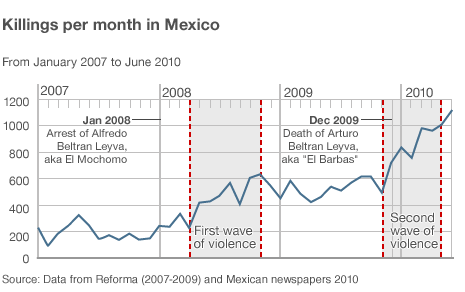
Then I came across this diagram in the BBC:

No. Things are as bad as ever. And now police are shocking the balls of suspected corrupt cops (not all of whom are corrupt). But it doesn’t work. Yet another bit of proof that “getting tough” usually fails. In fact, things are worsethan ever. It turns out that things are twice as badas when this stuff last seemed to be in the news. There are now more than 1,000 killings a month. To put that in some bit of (admittedly not quite fair) perspective, total US casualties in Afghanistan topped 1,000 this year.In 2006, before Mexico got really tough in the war drugs, there were about 60 drug-war deaths a month in Mexico. Now those were the good old days.
The war on drug increases killing. We know this. People… STOP!
-
Pat Robertson for Legalized Pot Possession
Stranger things have happened. But I can’t think of when.
I saw this the other day watching the 700 Club [not true].
“We’ve got to look at what we’re considering crime.” Robertson also comes out against mandatory sentences. “It’s costing us a fortune and it’s ruining young people.”
Preach on, Brother Robertson.
[Update: Robertson clarifies his perspective]
But seriously, it’s about time so-called compassionate Christians started being a little less filled with Old-Testament vengeance and little more filled with Jesus-like New-Testament forgiving.
Besides… it’s (almost) Christmas. Merry Christmas.
Like good New York City Jews [also not true] the wife and I will be eating Chinese food and perhaps seeing a movie.
But we’re going to cook the Chinese food.
We happen to have a haunch of hunted Wyoming antelope in the freezer [this part istrue, thanks to the Mighty Nimrod (Genesis 10: 8-9), Dan Baum]. And what says Christmas more than Chinese-style antelope? Any antelope-cooking suggestions are more than appreciated.
-
What you learn on the job
I compiled a little top ten lost of things police learn on the job. You can see it at Criminal Justice Programs.com.
Peter Moskos is a former police officer and author of the popular law enforcement blog, Cop in the Hood (www.copinthehood.com). He is currently a professor of law and police science at New York’s John Jay College of Criminal Justice, where he specializes in police culture, crime prevention and ending the war on drugs.
It should go without saying that policing isn’t like what you see on TV shows and in the movies. But it’s not so easy to learn what policing islike. Here are a few of things I learned policing the streets of Baltimore’s Eastern District.1. Policing is really about the men and women you work with. People are willing to risk their lives for you—it’s a powerful feeling.
2. Despite what police say, officer safety is not the number one priority. If it were, you’d never leave the police station. Danger is part of the job.
3. The job can be dangerous, but it’s the drudgery of routine that wears you down.
4. On the street, everybody lies. Some of the lies are more entertaining than others!
5. To cops, overtime is like a drug. It’s something you’ll crave, and something that influences far too much of what you do on and off duty.
6. Interactions with the public go much better when people show you their hands and sit still when asked.
7. Policing is a job like no other. But, when the day ends, it is just a job. Don’t take things personally. Even when other people want you to. Especially when other people want you to!
8. If they call for a doctor in the house, you might be the next best thing.
9. You’ll be amazed at the things you laugh at. Anything can be funny… at least to a cop. And if you didn’t laugh, you’d cry. Laughing is much better.
10. You won’t save the world, but you might save somebody’s life. What other job can offer you that?
-

Change is Bad: Poughkeepsie
I like then-and-now shots of life in America. I posted two of Newburgha while back and got some interest.
This one of downtown Poughkeepsie, NY, isn’t as dramatic or depressing a change as was Newburgh, but is it really to much to ask for things to be bettertoday than they were 99 years ago? Apparently, when it comes to our downtowns, the answer is yes.
Then:
Now:
Then there were businesses and streetcars and pretty brick streets with wide sidewalks (and people using them). Then they narrowed the sidewalk, removed the nice street lights, paved over the bricks and streetcar tracks, and replaced handsome buildings with ugly buildings. Now the street is wide and smooth enough to accommodate parked cars, parked right in front of vacant store fronts.My point isn’t that change is bad (though it often is), but that we can choose how we want our cities to look and live. And a lot of bad choices have been made. All in the name of “progress.”
The old picture is nice enough that it’s worth going to the Shorpy website to see the full-sized image.
-
Speaking of private justice
Halliburton pays Nigeria $250 million to drop their case against former CEO Dick Cheney… for paying Nigerian official $180 million between 1994 and 2004 to secure a $6 billion contract. So says the BBC.
-
Private Prisons in Maine
1) Corrections Corporation of America (CCA), the nation’s largest for-profit prison operator, spends $25,000 for Maine Republican candidate Paul LePage. He wins the election. But state law prohibits private prisons. This kind of law is one of the few good things to come from prison guard union lobbying.
2) A few weeks before becoming governor, according to Lance Tapley in the Portland, Maine, Phoenix Lepage meets with CCA’s reps
3) The governor-elect’s spokesman says LePage “will try to get the law changed.”
4) CCA says they will build a giant prison in remote, impoverished Piscataquis County.
5) The last step is to fill the prison by lobbying elected officials for more and longer prison sentences. To not do so wouldn’t be in the best interest of your shareholders. It’s nothing personal; it’s just business.
6) Repeat. Since 1970, the US prison and jail population has gone from 338,000 to 2.3 million.
And check out CCA’s creepy website which includes what seems like a parody video from one of those dystopic-future movies like Starship Troopersor Blade Runner.
Also of note from the Phoenix:
CCA officials have talked about a prison housing 2,000 to 2,400 inmates with 200 to 300 employees. If true, that would be an extraordinarily small number of staff for such a large number of prisoners. The Maine State Prison has just over 400 workers — most of them guards — to deal with just over 900 prisoners.
Remember the rule of thumb that you need roughly six employees to man one shift. So CCA would have approximately one guard for every 60 prisoners. Maine currently spends $41,000 per prisoner.
-
National Intelligence, hard at work
The Air Force is blocking its personnel from using work computers to view the Web sites of more than 25 news organizations and blogs that have posted Wikileaks. So says the Times (one of the blocked sites).
Phew. God forbid Air Force personnel would know what is free information to the rest of the world.
“Classified information, whether or not already posted on public websites or disclosed to the media, remains classified, and must be treated as such by federal employees and contractors, until it is declassified by an appropriate U.S. Government authority.”
Don’t forget to close that barn door on the way out. U.S.A., baby!
-
Politics and the Courts and Health Care
It always bothers me when people bitch about court decisions because they don’t agree with the politics. It’s one thing to be pro-abortion (as I am) or pro illegal immigration (got me there, too) or anti-2nd Amendment (not too fond of how some people interpret it, personally). It’s another to think that every Supreme-Court decision needs to be decided in favor of your particular belief rather than the greater issue on which the courts are supposed to make such decisions.
The Supreme Court doesn’t (or shouldn’t) decide if a specific law is good or bad; it decides if a given issue is constitutional. I think Roe v. Wade was a pretty weak Supreme Court decision. And yet I believe that every woman should have the right to have an abortion on demand.
Much of the Civil Rights Movement was helped by court cases that relied on greater moral issues more than strict constitutional interpretations. That’s fine by me too. I also understand that every decision shouldn’t be decided on technical grounds or original intent (see, for instance, the 7th Amendment).
Bush v. Gore? Now thatwas a terrible decision. But the court has always been political. And to some extent it should be.
Why do I mention this? Because I love Obamacare!
OK, actually, I’m just saying that to be provocative. I think Obamacare is too limited and health care should be single-payer, for everybody, and nationalized! But what do I care? I havehealth care.
I support health care as both a political and moral issue. The free market does not and cannot provide health care. That said, I could fully support a court decision that says that federal government shouldn’t be able to tell citizens they have to buy anything. I’m a states’ rights liberal! But not too many of us in this club, I can’t help but notice.
I just wish more conservative so-called states’ righters were equally supportive of states’ rights when it came to issues they don’t like, like drug legalization, or highway funds. The power of the federal government should not be a liberal versus conservative issue. But as long as it is, here’s to health care surviving court challenges!