I’m not posting much here because I’m finishing my book. But I’ll be back in full force after November 8.
It’s 5AM. Time for bed.
I’m not posting much here because I’m finishing my book. But I’ll be back in full force after November 8.
It’s 5AM. Time for bed.
The human drama of survival in closed spaces, the utter boredom and brief moments of joy, the gathered crowd — why, there’s nothing like the minute-to-minute Twitter updates of my wife’s jury duty.
Any moment now the doors of the metal lift will open and she’ll be sprung into the open air of Queens County and Camp Jamaica. I hope there’s no mistress waiting for her at the Sutphin Ave. subway stop. Maybe I should have gotten my hair done.
So says Radley Balko: “If lawmakers are serious about saving lives, they should focus on impairment, not alcohol.” I’m not certain where I stand on this, but it does make some sense. Plus, I always appreciate counter-intuitive thinking.
Former Republican Governor of New Mexico, Gary Johnson.
People sometimes think I don’t work much (an opinion only reinforced when they see me having my morning coffee at 2pm and still in my bathrobe at dinner time). But I’m a night owl and I work from home.
So along with teaching four classes (a very heavy load for a college professor), I have to write. And writing is work. To those who think it’s easy to write a book, I suggest they try it. To those who can churn out a book a year, I applaud them (and wonder how they do it). Writing is hard work. And it’s not fun.
A friend and fellow academic author put it this way in an email:
There are days in writing (for me usually when I have a decent draft of something and am crafting) that it flows, but most of the time it’s work, work, work, work.
People who don’t understand writing or who use formulas or hire ghostwriters who use formulas think that a book is like having a baby, nine months and it’s done. such total utter bullshit.
Now I’ve never had a baby, but I only wish writing was such a passive process that got pushed out after nine months (not to mention the fun that leads to babies in the first place).
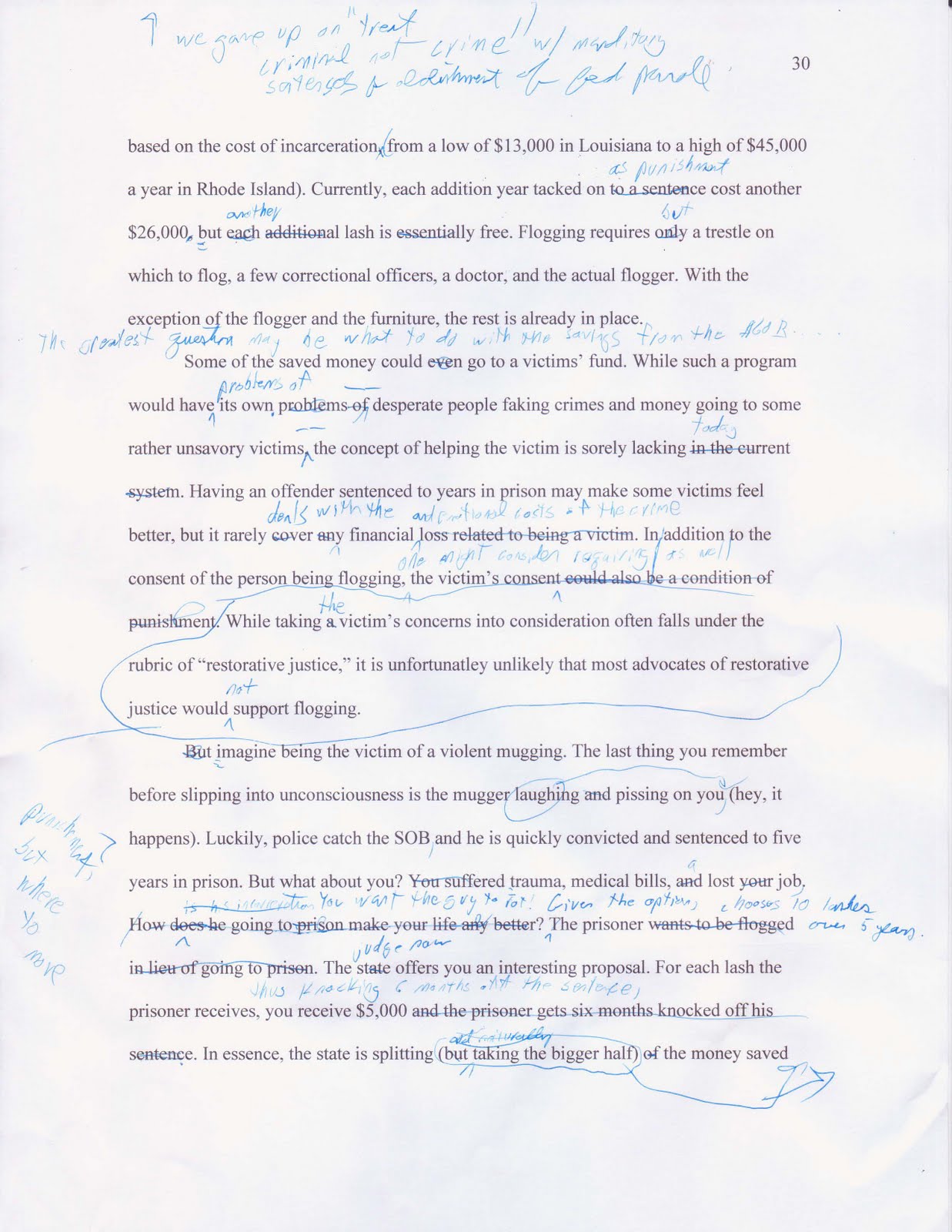
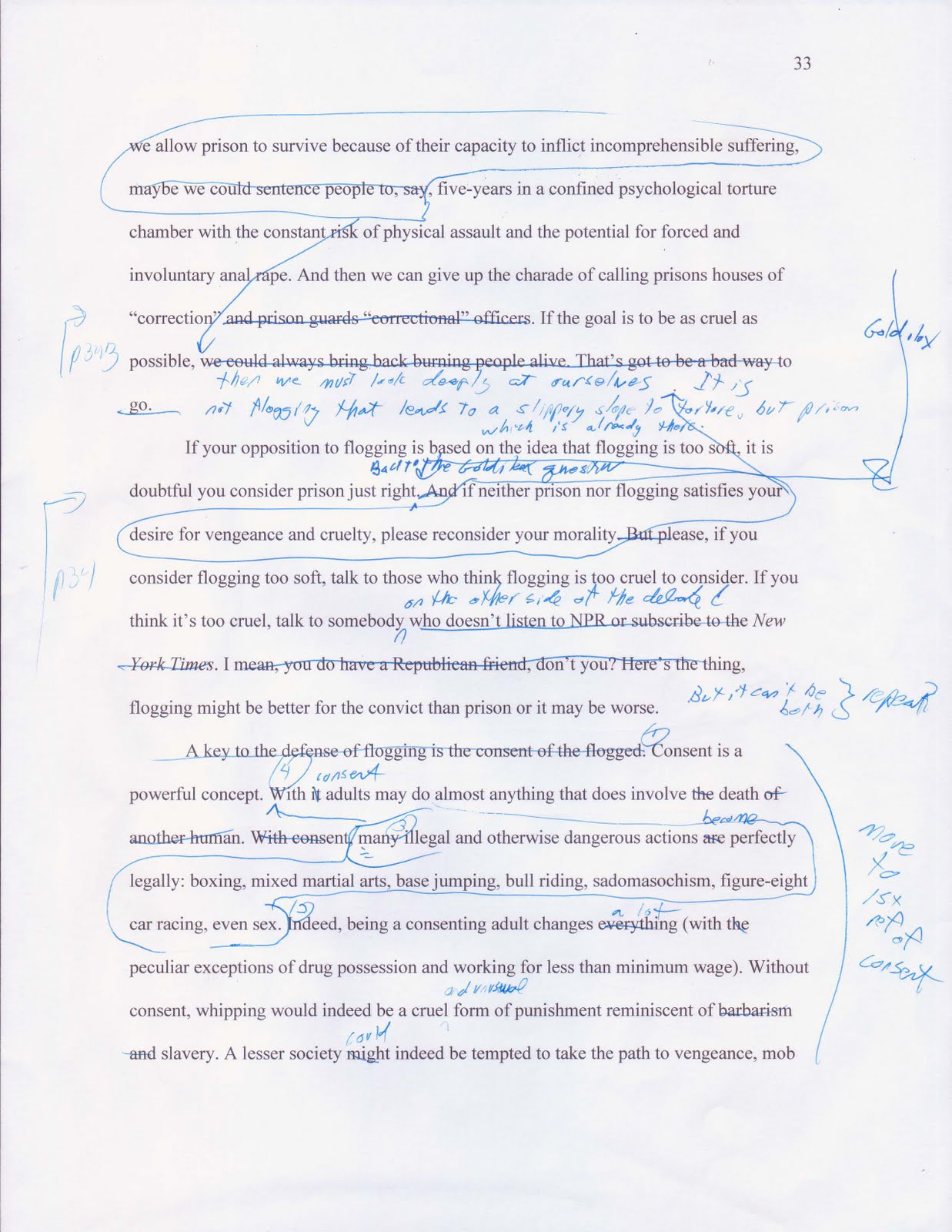
I’ve been working on this book for a while and I’m still not done. When writing, I can produce about 1,500 words a night. But that’s only some nights. Because I’m not productive most nights, my actually production is more like 100 words a night. And that’s just the first draft.
Now that I have a (rough) first draft of my book, it’s more work. Even after getting all the words on paper–and at 30,000 words it’s a very short book–it’s still a lot of slow painful work. Just to give you some idea of the editing process, here are a two pages of a draft of my forthcoming book, In Defense of Flogging.
So why do I do it? Sometimes I wonder. Every other job I’ve had has been easier, and yet still I choose this vocation. What did I create as a cop? Hopefully I helped some people, but Baltimore is no worse off without me there. And as a waiter I helped rich people enjoy their dinner, but waiters are just supporting cast to the food. And when I was a boat captain in Amsterdam I learned about boats and made a lot of tourists very happy. That was fun. But at some point I got tired of the same old tourist conversations (and rainy weather).
The work in those jobs created no lasting product. And none of it could be mistaken for art. Maybe I write because I can’t draw and don’t make sculpture. A book is, or at least should be, a little piece of art. Maybe I like that idea. I really don’t know.
On any objective level, 99 percent of all writers don’t get enough credit or money to make it all worthwhile, but still people write. I guess there’s something satisfying about creating something from nothing, at least when you’re done with it all.
But while doing it? Man, there’s very little I wouldn’t prefer to do than write. When I’m sitting at my computer at 4AM, sometimes I think about how nice it would be to have some other job where I could show up, do my job, and go home and watch TV guilt free.
And yet I wouldn’t change my job for any other (except major league baseball player and Supreme Court Justice). Why is that?
Perhaps writing involves a deeper calling. I’d like to think I’m doing something that will last and might actually (in some small way) change the world for the better. And though the craft of writing is a tough, I’d like to think I’m good at it. Plus, publishing is, in theory, part of my job.
It’s great to have written. Too bad it’s not more fun to write.
Look for my new book, In Defense of Flogging, to be published by Basic Books, in 2011.
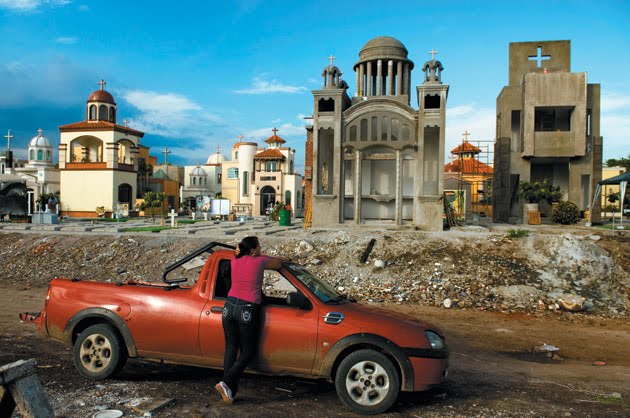
How to write about Mexico’s drug war? There are only a limited number of ways that readers can be reminded of the desperate acts of human sacrifice that go on every day in this country, or of the by now calamitous statistics: the nearly 28,000 people who have been killed in drug-related battles or assassinations since President Felipe Calderón took power almost four years ago, the thousands of kidnappings, the wanton acts of rape and torture, the growing number of orphaned children.
It may not be easy, but Alma Guillermoprieto does a pretty good job of writing about Mexico’s drug war in The New York Review of Books. I haven’t read any of the books reviewed, but the review itself is well worth reading (as a good review always is).
 Guillermoprieto ends with this:
There is little doubt that Calderón’s strategy of waging all-out war to solve a criminal problem has not worked. Whether any strategy at all can work, as long as global demand persists for a product that is illegal throughout the world, is a question that has been repeated ad nauseam. But it remains the indispensable question to consider.
There are the books reviewed:
Atentamente, El Chapo (Sincerely, El Chapo) by Héctor de Mauleón
La Ruta de Sangre de Beltrán Leyva (The Path of Blood of Beltrán Leyva) by Héctor de Mauleón
Drug War Zone: Frontline Dispatches from the Streets of El Paso and Juárez by Howard Campbell
Mafia & Co.: The Criminal Networks in Mexico, Brazil, and Colombia by Juan Carlos Garzón, translated from the Spanish by Kathy Ogle
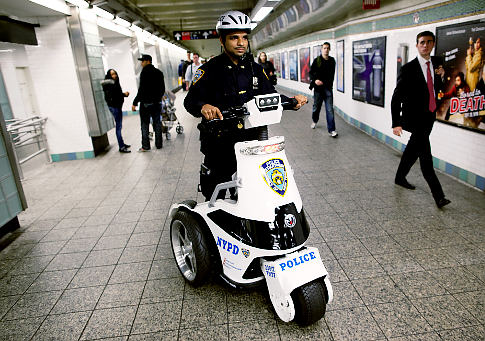
Does anybody believe this is a good idea for subway patrol?
 Granted with only 13 the NYPD isn’t making a major investment, but it’s still a big waste.
“Their biggest benefit is increased police visibility, as they put an officer heads and shoulders above the crowds, police said” in the Daily News. What? Actually, no. It puts police about six inches above their normal height. And if that were so important, hire taller cops. Or stand on a phone book. Or how about putting police in top hats? (personally, I would love to have an official NYPD top hat.)
The downsides of these overpriced toys are almost so obvious I feel dumb for even having to point them out–along with cops in bike helmets looking incredible dorky–what about stairs? What about turnstiles? What if the elevator to the street breaks? And God forbid an overweight cop is seen on one of these. I mean, really, cops are supposed to ride up and down one subway platform?
Once again, I’d like to point out there’s nothing wrong with walking!
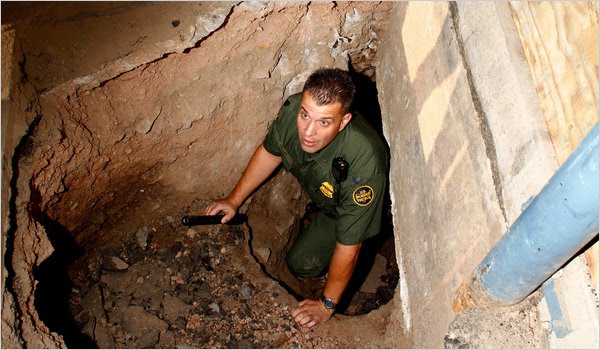
“The longshoremen were paid $50,000 to $100,000 for unloading a single duffel bag of cocaine.” I’m glad nobody has offered me that kind of money for that kind of work, because I don’t know what I would do.
Meanwhile the tunnel from Mexico business is booming, which is an unfortunate but inevitable result (along with migrants dying in the desert) of building a big wall in a stupid attempt to “seal” the border. It may not sound ideal (hell, it’s not) but we have to accept that we can’t completely control our borders. I’m sorry if you don’t like it, but that’s the realty. Does that mean we shouldn’t tryto seal our borders? Well, actually, yes. Because attempts to “close our border” creates unintended consequences that are even worse.
 So we need to figure out the best policies we can implement with porous borders. It actually isbetter to have people and contraband cross on land than underground. Sure, people could always have built tunnels, but they didn’t. It’s an scary development because we have almost no control over what goes through the tunnels. We actually had a bit more control over what came across on land.
And once again, I’d like to point out that these problems are not caused by drugs. They’re caused by the war on drugs. It happens again and again.
I’m telling you, you can’t make this stuff up!
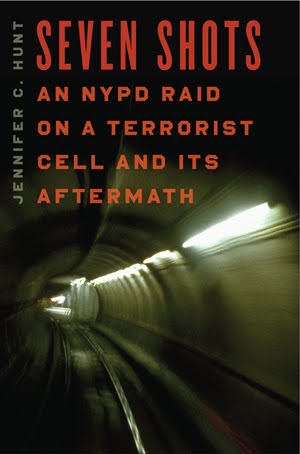
I read this book by Jennifer Hunt. I loved this book. I’ll tell you more about this book… but only when I’m done writing mybook.
On July 31, 1997, a six-man Emergency Service team from the NYPD raided a terrorist cell in Brooklyn and narrowly prevented a suicide bombing of the New York subway that would have cost hundreds, possibly thousands of lives.
In the meantime I’ll leave you with my breathless blurb they put on the back of the book (I had an advance copy):
Seven Shots uncovers the stories, rivalries, and human beings behind the New York City police officers who defused the subway bomb attack that foreshadowed September 11th. With unparalleled access, Hunt uncovers the never-before-told stories of heroism, September 11th, and petty rivalries that drive and destroy life in the NYPD. This is a true-life crime story that shows, warts and all, the unrequited love of good police officers toward an organization that doesn’t love them back. At times gripping, tragic, and theoretical, Seven Shots penetrates deep into the police world. Seven Shots vividly brings me back to my own policing days with laughs, tears, excitement, and adrenaline-filled moments of sheer terror. A groundbreaking, page-turning work.
[I just wish they had edited the redundancy out of the “unrequited love… toward an organization that doesn’t love them back” part. There’s no other kind of unrequited love. Things like that bother me more than they probably should.]
It’s a great book and a wonderful ethnography with amazing insight into the police culture. Plus it tells a story about a big bomb that almost wan.
You can buy it here.