Copinthehood.com has moved to qualitypolicing.com

  • Stealing bricks right off off the buiding

    Sounds like a headline you might expect to hear out of Baltimore.

    But it isn’t! This story is out of St. Louis.

    (Though I’m a bit ashamed to mention that the only reason this probably isn’ta problem in Baltimore is because Baltimore brick isn’t particularly good. Hence Formstoneand painted brick. Baltimore brick is pretty enough, but kinda soft and easy to tunnel through, as many a burglar knows. Speaking of which, are they still stealing lampposts in Baltimore or has that somehow stopped?)

  • A Slow Work Day at the FBI

    The FBI has slow work days? I kind of hoped they were pretty busy. But I guess we all have slow work days. But when I have a slow work day I like to listen to a Cubs game or write blog posts or play pinball.

    But when the FBI has a slow work day… well the the Justice Department’s inspector general has released a pretty damning report about FBI work on domestic terrorist organizations. Specifically a 2002 rally in Pittsburgh sponsored by a nonviolent anti-war group was “An ill-conceived project on a slow work day.”

    Did it really start with two agents, feet up in the office?

    “What do you want to do today, Marty?”

    “I don’t care. What do you want to do?”

    [Kudos to anybody that can tell me where that line is from. I don’t know and get this: can’t find it on google! It’s probably a movie from the 1950s as I learned it from my dad. Update: I figured it out. It’s from the movie Marty. Google wins again.]

    “We could keep an eye out on the war-protesters. They’re probably up to no good.”

    The New York Timesreports:

    The IG also concluded that the factual basis for opening some investigations was factually weak and that in several instances there was little indication of any possible federal crime, as opposed to state crimes.

    Regarding the Pittsburgh rally, controversy erupted in 2006 over whether the FBI had spied on protesters at the event several years earlier because of their anti-war views.

    At the time, the FBI issued a news release saying the surveillance had been based on an ongoing investigation.

    FBI Director Robert Mueller told a Senate hearing that the bureau had been trying to identify a particular individual believed to be in attendance.

    Turns out that was not true.

    Why does this matter? Well the Timespoints out that, “Domestic terrorism classification has far-reaching impact because people who are subjects of such investigations are normally placed on watchlists and their travels and interactions with law enforcement may be tracked.”

    My issue is more primal. Every time I hear that anti-war protesters and pacifists are considered a national-security American threat, I reach for my gun. Especially given the FBI’s has a long and shameful track record of investigating “subversives.” Certainly that was the case under J Edgar Hoover. But we’ve moved on, haven’t we?

    And I also have a much more basic complaint. The FBI, part of the Executive Branch, is not a police force (no matter how much they act like one on TV). The line between local police and federal law enforcement can at times seem like very fine line indeed. But it’s an important distinction to keep. For starters it’s a constitutional issue. But it’s also important because local police can be held accountable to local (and state and federal) politicians. And because law enforcement is supposed to be work for us and not become a domestic spying organization.

    Truthfully, I don’t mind the FBI investigating subversives. What I mind how this category is defined. Why do liberals and pacifist seem to get a lot of attention? I mean, you may not agree with them, but pacifists are, well, pacifist. And it just so happens that these anti-war folk (myself included, though I’m not much of a protester) happened to have been right. Maybe the FBI should spend more time investigating those who want to get us into these wars.

    [Since I’ve been around, off the top of my head I can think of US troops occupying, bombing, or invading Kuwait, Iraq, Panama, Grenada, Serbia, Afghanistan, Somalia, and Lebanon (I’m sure I’m forgetting one or two). Did any good come from anyof these? Maybe. But it’s damn hard to make an argument that good has come from all of these collectively.]

    Does that make me suspicious? Maybe. I guess it makes me a liberal. And I suppose the FBI, like most law enforcement, is basically conservative and suspicious of liberals.

    [I just thought of this one: You know you’re a liberal when… the thought of Michael Moore as president scares you less than Sarah Palin.]

  • East St. Louis lay off police.

    Fifteen percent of the department. The St. Louis Post Dispatchreports on a raucous city council meeting at which:

    East St. Louis Mayor Alvin Parks announced that the city will layoff 37 employees, including 19 of its 62 police officers, 11 firefighters, four public works employees, and three administrators. The layoffs take effect on Sunday.

    For budget reasons.

    [Update: This is bit outdated. See comments.]

  • Missouri Tells Judges Cost of Sentences

    Fascinating. And I think a great idea. Cost is irrelevant only to those who don’t pay.

    From the New York Times:

    But critics — prosecutors especially — dismiss the idea as unseemly. They say that the cost of punishment is an irrelevant consideration when deciding a criminal’s fate and that there is a risk of overlooking the larger social costs of crime.

    “Justice isn’t subject to a mathematical formula,” said Robert P. McCulloch, the prosecuting attorney for St. Louis County.

    That’s laughable coming from a prosecutor who cuts plea bargains all day.

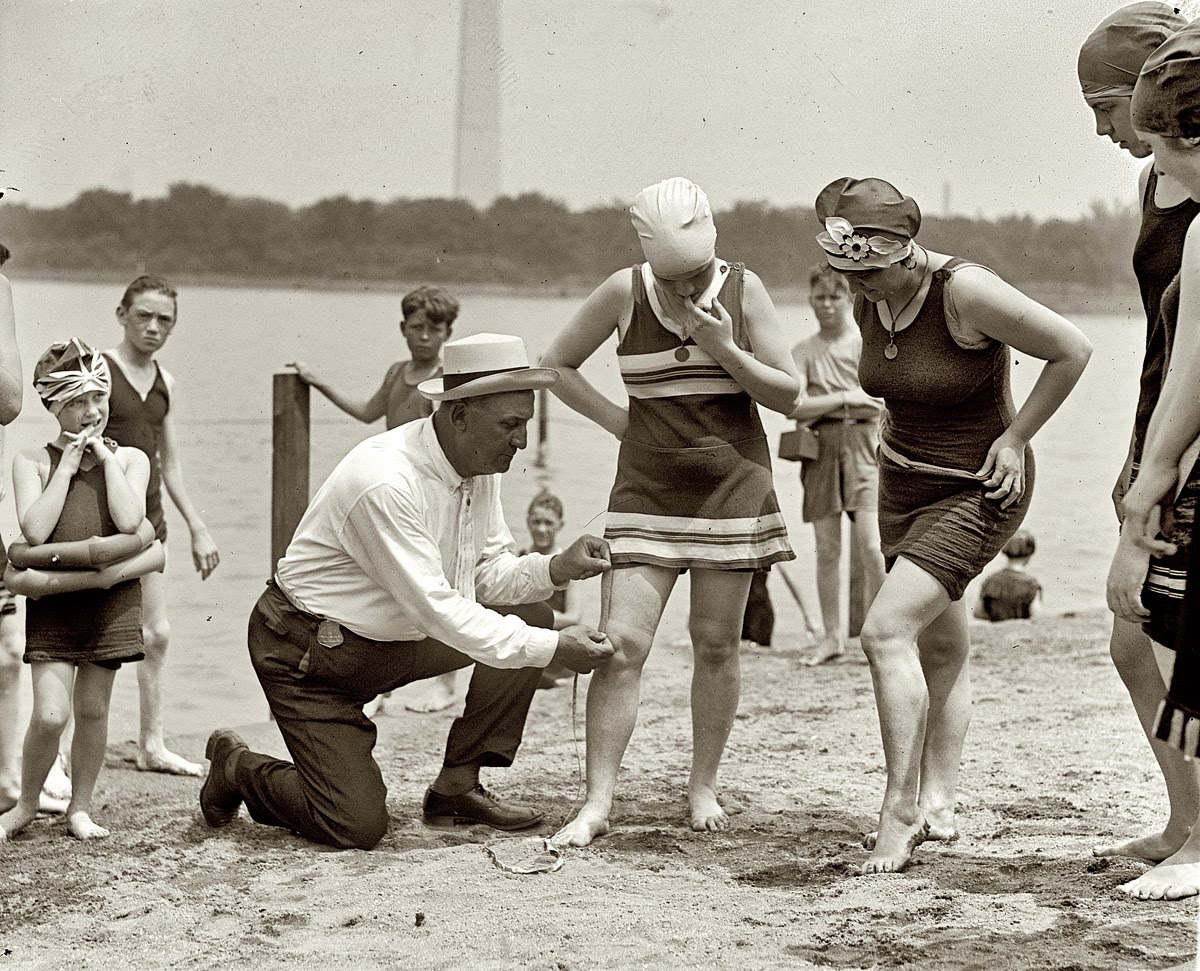
  • Back when the job was fun

    Back when the job was fun

    “Washington policeman Bill Norton measuring the distance between knee and suit at the Tidal Basin bathing beach after Col. Sherrill, Superintendent of Public Buildings and Grounds, issued an order that suits not be over six inches above the knee.” June 30, 1922.

    From Shorpy.

  • Five myths about prostitution

    So says Sudhir Venkatesh in an interesting articlein the Washington Post.

    Here are the myths:

    1. Prostitution is an alleyway business.

    2. Men visit sex workers for sex.

    3. Most prostitutes are addicted to drugs or were abused as children.

    4. Prostitutes and police are enemies.

    5. Closing Craigslist’s “adult services” section will significantly affect the sex trade.

    Read the whole article here.

  • A little excitment on 324 Post

    Justin Fenton and Peter Hermann report:

    So many police officers are at Hopkins at this hour that the department had to call in officers from other districts and detective units to help answer other 911 calls in the Eastern District. One plainclothes officer reported being out in his personal car, and he warned his dispatcher he was patrolling “with no lights, no sirens, no nothing.”

    Needless to say, usually shootings in the Eastern don’t get such a massive response.

    Update:I just heard on the radio that the gunman was shot and killed (apparently self-inflicted). Hopefully Baker Shift will get home on time!

  • Bernstein defeats Jessamy!

    Jessamy may finally be on the way out as Baltimore City State’s Attorney. And good riddance to her!

    If these results hold, it’s good news for police and good new for Baltimore. Do I know anything about Berstein? No. Nothing than the fact he’s not Jessamy, who has been at the post since 1995. And while it wouldn’t be fair to blame Jessamy for Baltimore’s crime, she has, to put it mildly, never done much to help police. A sign of that was Police Commissioner Bealefeld’s public endorsement of Bernstein.

  • Clever Disguise!

    Clever Disguise!

    Some of the September 11th killers flew right over the Indian Point Nuclear Power plant on their way to NYC. Perhaps they didn’t crash into the “Energy Center” (that’s really what it calls itself) because it looks just like a big mosque. You never know.

  • Lunch in Newburgh, NY

    Lunch in Newburgh, NY

    “Let’s bike over that bridge and have lunch in Newburgh.” That’s what I told my wife. It seemed like a good idea at the time. Unless you know Newburgh, NY. I didn’t.

    My wife and I were on a weekend biking getaway and found ourselves in Beacon, NY. Beacon is a pretty but depressed place (though it’s less depressing since Dia: Beacon opened in 2003). I figured Newburgh, on the other side of the river, must be the “nice part of town.” Mostly I wanted to bike over the two-mile bridge that crosses the mighty Hudson.

    The bridge is impressive. Over we went. And then we biked downhill and saw signs to a ferry. We were elated at the though of not having to bike back uphill. There are a few restaurants by the river, but they all looked new and touristy and none-too-inspired.

    We can do better, we said. So we locked our bikes, crossed under a train track, and headed up a grassy slope looking for some hipster cafe or yuppie coffee-shop.

    At this point, if you know Newburgh, you’re laughing.

    There are lots of “cute” towns on the Hudson. Newburgh isn’t one of them.

    We were greeting by old no-longer courthouse and rundown buildings. The black part of town, I thought. We made a right on Liberty Street looking for the business district of this very historic port city.

    I don’t mind run down and rough around the edges. In fact, I’m rather fond of it (for instance, two days earlier we had spent a very nice day in Peekskill, which you won’t find in any guidebooks). But this quickly got grim. Very grim. I’ve rarely seen such grim. It was kind of like Baltimore’s Eastern District, but the buildings and view in Newburgh are prettier.

    Like most urban ghettos, Newburgh is heartbreaking. There used to be city here. And Newburgh, if you squint hard enough, is beautiful — the view, the buildings, the history! But between the vacant lots and boarded up buildings live human beings with no jobs, little school, and no hope.

    An entire class of people forgotten and abandoned by everything but lame social services and the criminal justice system. Is it a failure of capitalism? Maybe. But regardless of who is to blame, it makes me a bit ashamed to be American. Can we really not do better?

    I was thinking all these heady thoughts and more but at some point I just had to ask, “What the hell are we doing here, and where are we going!?”

    Now I’ve found that most people in the ghetto are incredibly nice, especially to a polite lost white boy. But I’m still not going to ask directions from just anybody lounging about. So I stopped when I saw a very old man painting his house.

    “Excuse me, sir, but can you tell me where…,” I was kind of at a loss for words here, “downtown is?”

    The old man looked at me quizzically. I wondered if he could hear. I also realized how stupid my question was because I was literally in the down part of town. Newburgh is on a steep slope. We were standing at the bottom. And I’m asking which way is down. At this point words kind of failed me. What was I looking for? Luckily, the man figured me out, “You mean, where are the stores? The businesses?”

    “Yes. Where can we eat lunch?”

    “Broadway,” he said, “a few blocks back that way. You can’t miss it.”

    It was back in the direction we came from. So we went up a block (we try not to retrace our steps in any part of town) and headed back.

    “He’s not going to finish painting that house,” my wife said glumly.

    “Why not?”

    “He’s not going to last that long.”

    Who can say? But Broadway indeed could not be missed. It’s truly broad. And also sad. Nowhere non-ghetto to eat. Chinese take out. A very greasy dinner. Ninety-nine-cent pizza. There was a Mexican restaurant that seemed like the best option. But even that was a sad looking place with no customers.

    There’s a bit of immigrant influx in Newburgh. But not enough. I felt sorry for these guys standing on a corner waiting for a bus that runs once an hour (till 5pm). Can you imagine trudging across Mexico, risking your life to cross the border illegally, all while driven on by dreams of the promised land and a better life, and then ending up in Newburgh because rent is cheap?

    What I can’t get over, though, is all this good infrastructure abandoned. They built things to last back in the days. Train stations and ferry terminals and homes and streetcars. And rather than deal with problems, we just left them literally to rot as we built suburban roads and homes and malls and roads — all with government money — and left the city.

    I mean, even a parking lot was abandoned! How do you abandon a parking lot? Never before have I felt wistful nostalgia for a parking lot, but there was a great big old sign advertising “safe overnight municipal parking” pointing to a block of chest-high weeds.

    That grassy hill we climbed? Used to be beautiful buildings. Run down, but they could have been saved. Instead, in the 1970s, they torn them down for “renewal.” But they ran out of money before they could actual “renew” anything.

    Here’s a “then” picture. I think of Water at 2nd, looking north.

    And now:

    For what it’s worth, the homicide rate of Newburgh isn’t that high. It’s lower than Baltimore’s and a fraction of where I policed. But, I’ve since been told, it’s still the most dangerous city in New York State. I’m sure there are nice parts of Newburgh. But I didn’t see them.

    Then we worked our way over to Liberty Street on the south side of Broadway. It’s considered the newly “gentrified” part of town. I put that in quotes because it means a few stores have opened. And that’s better than nothing, I suppose.

    At one, an old lady missing some teeth ran out of her store when she saw us reading a flier in her window about an “Art Bus.” She told us about her wonderful cheesecakes. She didn’t have any that day because, “Business hasn’t been too good recently, and I don’t want things to sit around.” But she made us promise to come back. I doubt I will. But you never know.

    A list of art attractions that includes Razor Sharp Barber Shop does not inspire much confidence. And Hip-Hop Heaven was selling a bunch of white t-shirts. It was actually kind of funny to see “the uniform” on display. But I guess you gotta buy your white T’s somewhere.

    Ironically, we did end up having a very nice lunch in Newburgh. We ate at the Wherehouse and our glum spirits were lifted by Anita, the charming and ever-cheerful bartender.

    “One problem,” said Anita, “is that there are no art programs in school. Nothing to give kids the idea that there’s something bigger in this world. And then the few programs they do have, basketball and such, are all in school. What kind of kid wants to spend all day in school and then stay in school?”

    I wish I had the energy and willpower of others to make Newburgh a better place. But I don’t. Like most people, I don’t want my neighborhood to be a struggle or a place where I fear for my safety. Luckily, I have enough money to choose where I live. Not everybody is so blessed.

    And then we left. We walked back down the hill, got our bikes, and waited for the ferry. About to take a picture of the boat, I was told by the captain, “You can’t take pictures of the vessel. Homeland security.” Whatever. But he was nice enough about it, and I was too tired to question the logic or the absurdity of a terrorist putting Newburgh on their to-do list. But the picture I didn’t take of “the vessel” would have been better than this one I had already snapped.

    In the background, you can see a bit of the bridge we biked over. Newburgh faded into the distance.

    And the Hudson was beautiful as a storm passed nearby.

    A beautiful rainbow appeared in the east.

    And the captain saw no national security threat in me taking pictures of his cute dog.

    And here, for the hell of it, are a few other shots from our bike ride. New York City to Newburgh. Four days. Six counties. And a train ride back. No speed records were set.

    Beacon Falls.

    South Bear Mountain Pass.

    New York City drinking water. Sure tastes good.