Copinthehood.com has moved to qualitypolicing.com

  • The DOJ is wrong (3): That damn kid on a dirt bike in 2007

    Update: The links have changed (oops!) since these were first published. Here are links to all my August 2016 posts on the DOJ report on the BPD.
    1 https://copinthehood.com/initial-thoughts-on-doj-report-on-2/
    2 https://copinthehood.com/the-doj-is-wrong-1-2/
    3 https://copinthehood.com/the-dojs-war-on-broken-window-2/
    4 https://copinthehood.com/cant-you-take-joke-2/
    5 https://copinthehood.com/the-doj-is-wrong-2-n-word-2/
    6 https://copinthehood.com/the-doj-is-wrong-3-that-damn-kid-on-2/
    7 https://copinthehood.com/the-doj-is-wrong-4-on-diggs-dig-2/
    8 https://copinthehood.com/the-doj-is-right-1-2/
    9 https://copinthehood.com/the-doj-is-right-2-actual-department-is-2/
    10 https://copinthehood.com/the-doj-is-right-3-actual-department-is-2/
    11 https://copinthehood.com/the-doj-is-right-4-actual-department-is-2/

    Picture a seven-year-old on a bike. From pp. 86-87 of the report:

    Allegations of BPD’s unreasonable use of force against juveniles are not new. BPD has a history of problematic encounters with youth that pre-date the period of our review. For example, in 2007, officers arrested a seven-year old child for sitting on a dirt bike during an initiative to confiscate dirt bikes.

    It became a minor scandal: A cop grabbed a 7-year-old off his bike for no reason right in front of his mom! Well that’s how the false narrative grew. The paper somehow left off the seemingly important detail that it was a motorized bike. That kind of matters, doesn’t it?

    Long story short: 7-year-old is rolling down the street on a illegal motorized ATV. The keys are in the bike. Yes, that’s what (some) 7-year-olds in Baltimore ride motor bikes with parental encouragement. A cop sees what is going on and about to happen and does, well, what mom should have done. He takes the kid off the bike. Nobody is hurt. But mom-of-the-year files a complaint against the officer saying police assault her kid. She then (naturally) files a lawsuit for money. But the city (and this isn’t natural) doesn’t settle. The case goes to court, and the city wins hands-down.

    I wrote about this in 2008:

    Police had the nerve to stop the 7-year-old from driving an A.T.V. down the street. He wasn’t “riding,” says the mom; the motor was off. He was just “rolling down the street.” The kid was 7. On a motorized ATV that can start with a key. So the police do their job and take the kid off the bike.

    People blamed about “zero-tolerance” policing, by the way.

    This was bad parenting and good policing. It should not be Exhibit A in “unreasonable use of force against juveniles.” See, back then this case bothered me because it was still kind of rare in 2007 for a cop to be attacked for doing the right thing. And I bet those who wrote this report make their kids wear a helmet before they can even get on a pedal bike.
  • The Noble Lie: The truth does not matter

    Kim Hendrickson works on police and mental health issues and has this take:

    I am influenced by Plato so understand the importance–sometimes–of the noble lie. There is much to criticize in the investigations that lead to consent decrees. And they are often horribly unfair in the particulars. But in the Seattle context the process has done more good than bad even though the price has been high for many people (including taxpayers).

    Do I wish change would happen without scandal, lawsuits, gross mischaracterizations and federal scrutiny? Yes. But it typically doesn’t.

  • The DOJ is wrong (2): the N-word

    Update: The links have changed (oops!) since these were first published. Here are links to all my August 2016 posts on the DOJ report on the BPD.
    1 https://copinthehood.com/initial-thoughts-on-doj-report-on-2/
    2 https://copinthehood.com/the-doj-is-wrong-1-2/
    3 https://copinthehood.com/the-dojs-war-on-broken-window-2/
    4 https://copinthehood.com/cant-you-take-joke-2/
    5 https://copinthehood.com/the-doj-is-wrong-2-n-word-2/
    6 https://copinthehood.com/the-doj-is-wrong-3-that-damn-kid-on-2/
    7 https://copinthehood.com/the-doj-is-wrong-4-on-diggs-dig-2/
    8 https://copinthehood.com/the-doj-is-right-1-2/
    9 https://copinthehood.com/the-doj-is-right-2-actual-department-is-2/
    10 https://copinthehood.com/the-doj-is-right-3-actual-department-is-2/
    11 https://copinthehood.com/the-doj-is-right-4-actual-department-is-2/

    From Vice Magazine:

    Of course, some former Baltimore cops take issue with the tone of the federal report, which cited 60 complaints of racial slurs against black people.

    “The BPD is not a bunch of white officers calling blacks n****rs,” said Peter Moskos, a former Baltimore cop and professor at John Jay College of Criminal Justice. “I didn’t hear the word used once by a white officer. Not once. I’m not saying it’s never been used, but this isn’t fucking Ferguson. I suspect much of the usage they talk about is from black officers. Doesn’t that matter? But the report doesn’t tell us.”

    [Vice actually printed the whole n-word, which I still find bold. Too soon for me.] Ah, you say, but I wasn’t there for long. True. Or maybe nobody used the word around me. Maybe. I hope that’s the case, because if all it takes is one cop to totally change police culture, man, that is great news. No. I didn’t hear white cops call people n****r because white cops don’t call people n****r in Baltimore.

    [Just as a reality check, I did ask one black cop if he ever heard a white cop use the word in public. He said “no.” (Somewhat reluctantly, I kinda thought.)]

    The report cites race in just one case. And it’s white using the word; we know this because his partner filed a complaint. Good. See, even if some whites wanted to use the word (I’m sure some whites do), you don’t hear white cops in Baltimore calling blacks n****r because, even if for no other reason, there are too many blacks around! Whites are a minority in the city and the police department.

    Now did I hear black cop from black neighborhoods calling another blacks n*****s? Oh, did I. Is this objectionable? I don’t know. Seems so to me. (And apparently it is to the citizens who filed complaints about it!) But far be it for me to white-man-splain to a black cop that his non-standard English using isn’t up to my college-educated standards. But no matter where you fall on this usage issue, blacks being rude to other blacks is not a sign of systemic racism in the department.

  • The DOJ’s War on Broken Windows?

    Update: The links have changed (oops!) since these were first published. Here are links to all my August 2016 posts on the DOJ report on the BPD.
    1 https://copinthehood.com/initial-thoughts-on-doj-report-on-2/
    2 https://copinthehood.com/the-doj-is-wrong-1-2/
    3 https://copinthehood.com/the-dojs-war-on-broken-window-2/
    4 https://copinthehood.com/cant-you-take-joke-2/
    5 https://copinthehood.com/the-doj-is-wrong-2-n-word-2/
    6 https://copinthehood.com/the-doj-is-wrong-3-that-damn-kid-on-2/
    7 https://copinthehood.com/the-doj-is-wrong-4-on-diggs-dig-2/
    8 https://copinthehood.com/the-doj-is-right-1-2/
    9 https://copinthehood.com/the-doj-is-right-2-actual-department-is-2/
    10 https://copinthehood.com/the-doj-is-right-3-actual-department-is-2/
    11 https://copinthehood.com/the-doj-is-right-4-actual-department-is-2/

    This flew in over the transom:

    As someone who also works in a department with a consent decree in place, I found the DoJ’s report on Baltimore very interesting.

    It seems like a lot of what the DoJ objects to is not actually a constitutional violation, but rather a public policy decision to have “zero tolerance” policing. The words “zero tolerance” are used a lot (phrase used 32 times). There is much written about loitering (word comes up 35 times) stops and arrests.

    My jurisdiction has no loitering law, and no major problem with open air drug dealing in residential areas. Trespassing arrests are a rarity, to the point that citizens and business owners have become very angry with our lack of action at times. Technically, if someone (myself or a property owner or a posted notice) says that trespassing is prohibited, and someone trespasses after receiving verbal notice, they can be stopped and arrested. A property owner says “I told that guy to leave and he didn’t” – boom, we have PC. In practice, we almost never do this, because our supervisors and prosecutors don’t want us to and because we all know the DoJ is watching and dislikes this kind of police work.

    The DoJ’s objections to enforcement of these laws is written in such a way that the strict enforcement of these laws is then juxtaposed with extreme examples where officers probably violated Terry. In any significantly large department, if you look long enough, you will find Terry violations, including some pretty stupid ones. And there are some damn stupid ones in this report. But it’s not clear to me that loitering and trespassing arrests as a crime prevention strategy are inherently unconstitutional. Trespassing and loitering laws can be strictly enforced in a legal way, if you have supervisors and training that adequately address what is needed to establish probable cause and reasonable suspicion (which BPD may indeed lack).

    But it does seem to me that what the DoJ actually objects to is the policing strategy of low level pedestrian stops and enforcement. The DoJ’s message here is pretty clear: broken-windows policing is over, and if you do it, we will come at you for every Terry violation and make it out to be a pattern and practice brought about by a public policy decision to emphasize low level enforcement. “Broken Windows” policing might be a good or bad public policy, but it seems like an innovation for the DoJ to now claim it is inherently unconstitutional.

  • “Communities don’t commit crime; people commit crime”

    I love when other people do my writing for me! Thank you and keep these coming:

    On the racial disparity stuff, at least the DOJ is claiming they controlled for crime rates. (see p.63). But did they really? The report is full of boneheaded statements like “Despite making up only 41 percent of the Northern District’s population, African Americans accounted for 83 percent of stops in the district.” (p.65, n.72). Gee, how much of the violent crime in the Northern District is being committed in Greenmount [ed note: poor black] as opposed to Roland Park [rich white]?

    And people always talk in terms of higher crime rates in certain “communities” — as I just did. But communities don’t commit crime; people commit crime. Saying black people live disproportionately in high-crime neighborhoods is a euphemistic way of saying black people commit a disproportionate amount of crime. (And we’re talking about violent crime here, which is what drives street-level proactive enforcement). [Last year 93 percent of Baltimore homicide were black]

    If they tried to control for crime rates by focusing on the rates of crime in different communities rather than the rates of offending by black and white residents, isn’t that problematic? (Genuine questions here; I’m no statistician) [Ed note: Yes]. Doesn’t this all come down to how the DOJ drew the boundaries for the neighborhoods they studied? What did they use? Police districts? It seems like it. Look at p.63 (referring to disproportionate stops of African Americans despite “significant variation in the districts’ demographic characteristics and crime rates”).

    Let’s say the fictional North Central district is 100% white, and the fictional South Central district is 100% black. The crime rate is twice as high in the South Central, and people in the South Central are twice as likely to get stopped by police. I assume that would pass muster with the DOJ. But, of course, real districts in Baltimore don’t look like that. They’re mixed and largely segregated. They look like the Northern District, with lots of crime in black neighborhoods like Greenmount and hardly any crime in white neighborhoods like Roland Park. They look like the Southeast district, with far less crime in largely white Sector 1 than in Sector 2 (bordering the Eastern), where the population is mostly black. It seems to me this messes up any attempt to control for crime rates if they’re only looking at things at the district level. Better would be to break it down by individual neighborhoods, though that leaves room for error, too. Even better would be to study actual rates of offending by black and white residents. What percentage of robbery suspects were reported as black? What percentage of shooting suspects in cases that had eyewitnesses? What percentage of suspects from “CDS outside” complaints were described by the callers as black?

    Wouldn’t it be a powerful illustration to just look at the gender of people stopped? Men presumably account for about 50% of Baltimore’s population. Surely they make up a much higher percentage of those stopped and arrested. And I’m sure the disparity persists even if one attempts to control for crime rates in different “communities.” (I doubt the male/female ratio differs all that much district-to-district). Is that evidence that BPD cops are profiling men, and have an anti-male bias? Or are cops focusing on men because, well, men commit most of the crime in the city, and therefore it’s mostly going to be men who exhibit suspicious behavior that prompts officers to stop them?

  • A pattern of abuse?

    Today, no police departmentshould be surprised by what the Department of Justice is looking for,” said Chuck Wexler, executive director of the Police Executive Research Forum, which has extensively studied such investigations.

    I’m not a lawyer and don’t think like one, so I’m a bit slow in realizing how the DOJ goes about its business. It’s not enough for them to say “there are problems and here’s what needs to be done.” The goal is a consent decree (in this case one that shifts blame to long-gone mayor from over a decade ago), and this is a necessary precondition. The DOJ has a kind of template for this report:

    Provide anecdotes of bad policing. (Some of these will be true.)

    Highlight worst practices.

    Throw in some (dubious) statistical analysis to “prove” racism about use of force, bias, or unlawful searches and seizures.

    And voila! A “pattern” of “unconstitutional” and racist policing. Here’s one critique of this business from Matthew Hickman, a professor and former DOJ statistician, about their 2012 Seattle report:

    The Department of Justice investigation of the Seattle Police Department was launched over concerns about eroding public trust and confidence in the Seattle police, but I am far more concerned about whether DOJ deserves our trust and confidence. The public release of DOJ’s report highlighted two empirical findings that stretch credibility beyond its limits, and DOJ is presently trying to force the city to institute reforms without DOJ revealing the methods that produced its findings. If Seattle does not push back, DOJ will end up causing more harm than good.

    I’m frankly shocked that DOJ went public with such a ridiculous statistic; it’s totally inconsistent with the available research literature on police use of force, and stands in defiance of reason. I can only conclude that DOJ had no other goal than to incite the public and build popular support for a baseless political cause.

    If they had invested in collecting these data on a systematic basis, they would have the larger context that might make their “pattern or practice” investigations more meaningful. As a consequence, we simply don’t know if Seattle’s data are “too high,” “too low,” or “just right.”

    In sum, there are legitimate questions about the quality of DOJ’s analyses here in Seattle as well as the expertise of those who produced them. As of this writing, DOJ has failed to provide the details of its methodology. It is doing so in hopes that Seattle will voluntarily enter into a costly consent decree without questioning DOJ’s highly questionable findings.

    Yet there is ample evidence that DOJ has built a house of cards in support of a political agenda. The empirical findings of its investigation simply don’t pass the “smell test” and will not stand up to legal or scientific scrutiny. The city of Seattle should call DOJ’s bluff, and settle for nothing less than a formal apology.

    And when an agency did call the DOJ’s bluff, the DOJ lost.

  • Can’t you take a joke?

    Can’t you take a joke?

    Update: The links have changed (oops!) since these were first published. Here are links to all my August 2016 posts on the DOJ report on the BPD.
    1 https://copinthehood.com/initial-thoughts-on-doj-report-on-2/
    2 https://copinthehood.com/the-doj-is-wrong-1-2/
    3 https://copinthehood.com/the-dojs-war-on-broken-window-2/
    4 https://copinthehood.com/cant-you-take-joke-2/
    5 https://copinthehood.com/the-doj-is-wrong-2-n-word-2/
    6 https://copinthehood.com/the-doj-is-wrong-3-that-damn-kid-on-2/
    7 https://copinthehood.com/the-doj-is-wrong-4-on-diggs-dig-2/
    8 https://copinthehood.com/the-doj-is-right-1-2/
    9 https://copinthehood.com/the-doj-is-right-2-actual-department-is-2/
    10 https://copinthehood.com/the-doj-is-right-3-actual-department-is-2/
    11 https://copinthehood.com/the-doj-is-right-4-actual-department-is-2/

    One of the beliefs common to many conservative cops is that liberals can’t take a joke. I don’t think this is true (how many comedians are conservative?), but I hate when conservaes are right. From page 25 of the DOJ report:

    Indeed, many BPD supervisors who were trained under the prior enforcement paradigm continue to encourage officers to prioritize short-term suppression, including aggressive use of stops, frisks, and misdemeanor arrests.

    That’s something a bit sad and desperate about this report’s (and city leaders) constant attempt to blame today’s problems on 16 years ago.

    The report goes on:

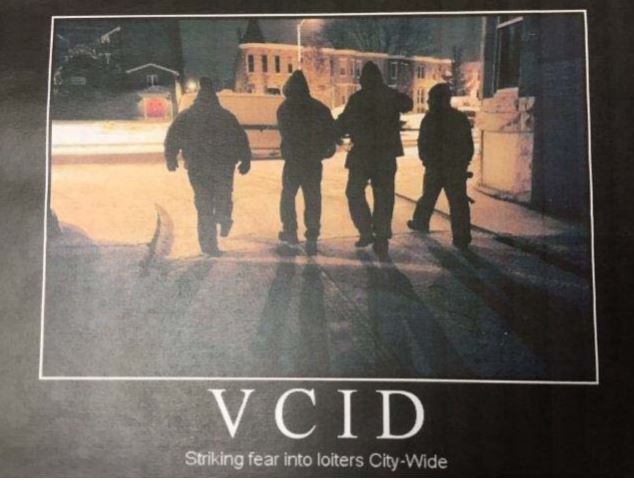
    A flyer celebrating loitering arrests was posted in several BPD districts. The flyer depicted three officers from one of BPD’s specialized units known as Violent Crime Impact Division, or VCID, leading a handcuffed man wearing a hoodie along a city sidewalk towards a police transport van, with the text “VCID: Striking fear into loiters [sic] City-wide.”

    People, this is not a motivational poster. It is not celebrating loitering lock ups. It is… a joke. It is making fun of — mocking even — a specialized unit for making bullshit loitering locks up.

    I find it funny. Do you have to be a cop to get it? I don’t know. But couldn’t they find anybody with a clue to read a draft and red-flag this? “It’s obviously a joke,” my liberal-with-a-sense-of-humor wife spells out for the humorously challenged, “because it’s using the template of the fake corporate motivational poster.” Get it?

    But if the DOJ observes don’t get this basic level of police culture (or humor), I question a lot of their observations. (I don’t know how much you can learn in “dozens” of ride along in “all the districts.” Because that means about 3 ride-alongs per district. Does it even equal one complete shift? I don’t know.)

    Chapter Three of Cop in the Hood does start with a “motivational” speech at roll call:

    All right you maggots, let’s lock people up! They don’t pay you to stand around. I want production! I want lockups! Unlike the citizens of the Eastern District, you are required to work for your government check.

    The sergeant even made a little sign out of the last sentence and put it up in our sector cubical. Personally, I thought it was funny. In the end, he was told to take it down. Seems like nobody can take a joke.

    Update: Over on twitter, I was trying to explain to a Sun reporter who also didn’t get the joke. David Simon, who speaks Police and Journalistic, stepped in to help translate:

    The office poster we’re talking about is actually a subtle and appropriate critique of bad policing.

    Everything I know about cop humor says that poster is there as sarcasm, to which cops are entitled.

    Poster not motivational, but a critique of weak arrests; station house humor to which cops are entitled.

    Every profession uses humor to critique lesser standards, affirm for better.

    Cop humor. And in the context of stationhouse ball-busting, rather funny. Not affirmation.

    The snark about bad journalism that used to be on the walls of The Sun was affirmation for better.

    One Xmas, Homicide unit pasted wings on morgue photos of dead gangsters & hung on tree.

    For attorney: “Anyone can convict the guilty. For an innocent man, you need a great lawyer.” Cynicism serving ethic.

    Fuck that much self-righteousness. Every profession is entitled to its own interior wit. Especially the tough ones.

  • The DOJ is wrong (1): Trespass

    Update: The links have changed (oops!) since these were first published. Here are links to all my August 2016 posts on the DOJ report on the BPD.
    1 https://copinthehood.com/initial-thoughts-on-doj-report-on-2/
    2 https://copinthehood.com/the-doj-is-wrong-1-2/
    3 https://copinthehood.com/the-dojs-war-on-broken-window-2/
    4 https://copinthehood.com/cant-you-take-joke-2/
    5 https://copinthehood.com/the-doj-is-wrong-2-n-word-2/
    6 https://copinthehood.com/the-doj-is-wrong-3-that-damn-kid-on-2/
    7 https://copinthehood.com/the-doj-is-wrong-4-on-diggs-dig-2/
    8 https://copinthehood.com/the-doj-is-right-1-2/
    9 https://copinthehood.com/the-doj-is-right-2-actual-department-is-2/
    10 https://copinthehood.com/the-doj-is-right-3-actual-department-is-2/
    11 https://copinthehood.com/the-doj-is-right-4-actual-department-is-2/

    There’s a lot of good in this report. I’ll get to that eventually. It’s a hard report to comment on in its entirety because there are different authors and different sections. Some are well documented and spot-on. Others are bullshit and fluff. But the parts that bother me most are the legal errors. I expect better more from the friggin’ Department of Justice.

    Let me get these off my chest. Late last night I wrote this to somebody:

    As a description of police culture and day-to-day to policing, the report too often just doesn’t get it. I found errors based on a few things I know or could fact check from home. And given that I know a few of the stories are bullshit, it makes me question all of them. This is the DOJ, not some anti-police rag. They need to make sure everything they say is true. And it’s simply not.

    Page 37 of the report describes a loitering arrest that “violates constitutional due process requirements”:

    The officer then–without any warning–arrested the men for trespassing…. In September 2011, a BPD officer similarly arrested a man “loitering directly beside the 2501 E. Preston Street Greater Missionary Baptist Church.” The officer made the arrest after asking the man “why he was in the area” and learning that the man “had no business near the area of the [church’s] steps.” Each of these arrests violates constitutional due process requirements because the arrested individuals lacked notice that their apparently innocent behavior was unlawful.

    This is the DOJ. These are serious charges. They need to be right.

    The loitering law does indeed state (among other things) that a person must be warned before being arrested. [The bigger violation among police in making loitering arrests is ignoring the essential “in such a manner as to interfere with the free passage of (pedestrian/vehicle) traffic” part of the law. But that’s another story.]

    [It’s why, if you’ve ever been to Baltimore, there are so many “no loitering/no trespassing” signs on stoops. Those signs tell cops, “Yes please, go right ahead and keep people from sitting on my steps.” Now whether or not we want police to make any loitering or trespass arrests is a another issue, but many residents (and churches) in Baltimore don’t want to come home from work and find drug dealers on their stoop. Honest people may not want to leave their house and have to ask drunks to step aside. Huh? Imagine that. But the DOJ doesn’t mention that a lot of low-level police enforcement is initiated by citizens and politicians. What are cops supposed to do? Ignore calls for service because it’s “just” a minor crime hardly worth enforcing?]

    Well I don’t police that block anymore (never did much, actually, it was Sector 3), but we can all zip over to 2501 E. Preston on google streetview! (What a world we live in) There’s a “no loitering/no trespassing” sign right there, clearly visible (if blurred out). Police do not have to issue a verbal warning for this trespass arrest, because the sign provides the warning. This is covered under §6-401 (formally Art 27 Sec 576, from which I’m copying): “…did trespass and enter upon the property of ______ said property being posted against trespassers in a conspicuous manner.” This arrest is clearly not a violation of “constitutional due process requirements.” How can the Department of Justice be ignorant of the law?

    [Originally I said “loitering” when I meant trespassing. That makes me a bit ignorant, too. But along with being a bit rusty on all the BS charges, I was thrown off because the damn report says he was “loitering.” Indeed, you arrest a loiterer for trespassing. I also think we would sometimes colloquially call such arrests “loitering.” But the actual charge is “trespassing.” I’ve updated the post a bit to reflect this.]

  • Forms, forms, everywhere forms

    Again from someone else. This is a former Baltimore Police Officer:

    What did you make the of the discussion on pp.25-26? [concerning massive number of stops] I happen to agree that lots of Terry stops go unreported. That citizen contact form is a pain to fill out. But in arguing that many Terry stops go unreported, the DOJ notes that a “stop form” wasn’t completed in ANY of the 335 handgun arrests that arose from Terry stops in 2014.

    Well, duh.

    Who the hell fills out a stop form when they’re arresting the suspect? The arrest report — a full-blown incident report as well as the probable cause statement entered during booking — serves as the narrative that explains all the facts. They expect the cop to write three reports for a stop-turned-arrest?!

    I expect hardly anybody fills out the stop form when the end up making an arrest. Did they really limit their study of Terry stops to cases in which the officer filled out a citizen contact form? If so, it seems they ended up excluding almost all of the cases in which the Terry stop resulted in an arrest. And then they triumphantly concluded that hardly any Terry stops result in an arrest or citation. (By “citation” they must mean a criminal summons. I would guess that a majority of BPD officers haven’t used that book a single time in the last year). Am I missing something?

    No, I don’t think you are.

    Another person picked up on this, too:

    This is starting to look sloppy. On page 26 they say these Terry stops lead to lots and lots of arrests. On page 28: “The lack of sufficient justification for many of BPD’s pedestrian stops is underscored by the extremely low rate at which stops uncover evidence of criminal activity. In a sample of over 7,200 pedestrian stops reviewed by the Justice Department, only 271–or 3.7 percent–resulted in officers issuing a criminal citation or arrest.”

  • Mr 34Stop

    From the DOJ report on Baltimore Police:

    This data reveals that certain Baltimore residents have repeated encounters with the police on public streets and sidewalks. Indeed, the data show that one African-American man was stopped 34 times during this period in the Central and Western Districts alone, and several hundred residents were stopped at least 10 times. Countless individuals–including Freddie Gray–were stopped multiple times in the same week without being charged with a crime.

    When I hear somebody is stopped 34 times, my first thought is “what the hell is he doing.” Indeed, this does not happen at random. (I’d be more worried about a non-criminal being stopped five times.) You don’t have to be charged with a crime to be an active criminal worthy of police attention. Stops (based on reasonable suspicion) can be a tool to get criminals to desist or change their illegal behavior. If this is targeted enforcement, so be it. Let’s not forget, Freddie Gray was a drug dealer. He was charged and convicted of plenty of crimes. The real question is what do we want police to do? Don’t we want police to have (legal) “repeated encounters” with drug dealers and those prone to shoot people?

    Here is a good response from somebody else:

    OK, so?

    Who was that guy stopped 34 times? Clearly they couldn’t get him on any serious crimes in this period, but who was he? What does he do for a living? Does he have a criminal history apart from any of these possible humbles? If so, what is it? And who are his associates, if any? What is their line of work? DoJ presumes that all must be treated equal. But modern policing has, and will continue to, begin targeting individuals based on data and intelligence. Everything from camera footage to CIs to past history to social network makes some people targets of police “proactive enforcement.” This is what that looks like in the cold type of a DoJ report: not pretty.

    But how does DoJ propose BPD (and all other departments) square this circle? Let’s assume for just a moment that Mr. 34Stops runs a sharp crew and moves several kilos per week into Sandtown and Bolton Hill. He’s never in the same room or parking lot as his product, and he has two or three henchmen who take care of the violence necessary to keep things running smooth. He stays off the phone and his people are loyal. Citizens in the neighborhoods he effectively controls are terrified and silent, but for a few nods and whispers. What is a district commander supposed to do about him?

    Now, this is speculation, admittedly. Mr. 34Stops could as easily be a life-long resident, truck-driver and crossing guard who works nights, rides the bus and, maybe, enjoys a can of beer while sitting on his own or a neighbor’s stoop sometimes. The DoJ–and the U.S. Constitution–does not distinguish between these two men. Everyone else does though, because they present very different threats to order and safety.