Copinthehood.com has moved to qualitypolicing.com

  • Time to Tell

    I have an op-ed in today’s Washington Post about my father and “Don’t Ask Don’t Tell.”

    It’s got absolutely nothing to do with policing.

    I was the first critic of “don’t ask, don’t tell.” It was 1993, and I was home on break from college. My father, Charles Moskos, and I were watching TV and drinking ouzo.

    My father … came up with the concept and coined the phrase [“don’t ask don’t tell”]. He had lots of crazy ideas. But this one, I declared, was “the stupidest idea you’ve ever come up with.”

    A few months later … “don’t ask, don’t tell” was the law of the land.

    Today … I am convinced that my father would support the repeal of “don’t ask, don’t tell.”

    Read the whole thing here.

    Of course I can’t be 100%certain that my father would support repeal… but with 100% certainty I do know he would have loved that I got a Washington Postop-ed out of this!

  • Shut yo’ mouth!

    The Supreme Court ruled that suspects must explicitly tell police they want to be silent or want a lawyer to invoke their Miranda protection during interrogations. I’m pretty liberal guy, but I’m all for this conservative decision by the court.

    Look, if you don’t want to be convicted, the smartest thing you can do is shut up. Period. Don’t talk. Demand a lawyer. It really is that simple.

    But if everybody did just that, a lot of criminals would get away murder.

    The point of the 5th Amendment isn’t so that people don’t confess. The point of a ban on forced self-incrimination is so that we don’t torture people–guilty and innocent alike–into confessing.

    I don’t want forced confessions. I don’t want false confessions. But I’m all for confessions. I mean if we’re so worried about the right to remain silent, we could ban allinterrogation of suspects. But that would be crazy.

    There’s not a hood rat in Baltimore or a person in America who doesn’t know his or “right to remain silent.” If somebody doesn’t want to exercise that right, good for the rest of us. It shouldn’t be the job of police to tell people to shut up.

    You’ve got a murderer in a room. Three hours later police invoke God and the bad guy fesses up.

    Good job!

  • More Immigrants, Less Crime

    I’ve said it before, but now there’s yet more academic support, this study by Tim Wadsworth. You can’t easily access the study and it’s not light reading if you can. But Christopher Dickey wrote a very readable article about the study. Dickey is the author of a very good book: Securing the City.

    Wadsworth’s research and the recent FBI data reinforce the judgment that the vast majority of immigrants make our cities safer, especially when police know how to work with them, not against them. To blame all immigrants for the crimes committed by a few, and give the cops the job of chasing them for immigration offenses instead of focusing resources on catching the real bad guys, is simply nuts.

  • “Police dem a wicked n’ a tief…soldier not so bad”

    “Police dem a wicked n’ a tief…soldier not so bad”

    According to the papers, life in Kingston begins to return to normal. Dudus has not been captured. Until he his, seems like you’d have to call the whole operation a failure.

    My quote of the day comes from The Observer’s Twitter feed: “Dem say Dudus hold us hostage but it Bruce [The P.M.]. Mi wana go look for mi son. Mi don’t know if ‘in dead!”

    cartoon from The Observer

  • Di President dat and anything possible wid him

    I know it’s wrong, but I’m kind of starting to root for Dudus. Of course I can’t really root for cop killers, but this is one guy taking on two entire nations. And, at least for now, he’s winning! Plus, the more I learn about Jamaica the less I want to root for the government. They’re crooks. And not in a “throw-dem-bums-out-of-office” kind of way, but in a corrupt working-with-the-mobsters kind of way.

    Well Dudus is still on the lamb and may have escaped the Tivoli Gardens dragnet. My quote of the day comes from the Jamaica Star: “Is like di man get a feeling and jus cut same time … It look like di Babylon [security forces] dem a get information pon him cause di building weh him did inna a one a di first building dem weh dem search.” But, kind sir, which way did Dudus go and how did he manage to get away? “Bway mi nuh know which way him tek eno but a di President dat and anything possible wid him.”

    Turns out that over the years the government has given Dudus’s consulting company million of dollars (and nice to see one America newspaper finallyget a reporter to Jamaica to cover this story). Dudus is part of the system. Dudus got paid to provide government services and keep the streets safe. And to some extend he did. Meanwhile he makes a lot of money. He reminds me a local ward alderman of 19th-century America (but with more drugs and bigger guns).

    The Daily Gleaner reports:

    Soldiers … were engaged in a more than five-hour gun battle with the criminals.

    One soldier was fatally shot during that battle while five others suffered gunshot wounds. Another soldier was injured in an undisclosed accident.

    Medical sources [said] that the civilian death toll had climbed to 44, with the number of injured moving to 37.

    The deaths included two men reportedly found in a neighbouring community with tags on their bodies, indicating they had been shot for refusing to participate in the fight to defend Coke.

    Meanwhile… “An appeal was made by Health Minister Ruddy Spencer for gunmen within communities in the vicinity of the Kingston Public Hospital to cease from attacking hospital workers.” Seems like a reasonable request.

    I think it’s a safe bet that in his area, Dudus would win any election. And the Jamaican government didn’t have much a problem with him until America demanded they turn Dudus over. That’s when all hell broke out. Dudus’s father met the same fate and was killed (or died in a suspicious jail fire) before he could be turned over to America (and rat out police and government officials).

    Once drug prohibition allows criminals to get rich and arm themselves, a massive crackdown doesn’t work. It just causes violence and highlights the impotence and corruption of the supposedly legit government. It’s kind of like Mexico. Except in Jamaica, unlike Mexico, the drug lords actually do seem to provide some kindof community service.

  • US Ends ‘War on Drug’

    Sounds like an Onion headline but it’s real.

    The Drug Czar himself said, “I ended the war.”

    You’d think this would be big news in America.

    Did we win?

    [thanks to Drug WarRant]

  • Stupid Drug Story of the Week

    I read this stupid AP story and it set off warning bells in my head.

    “ULTRA-POTENT HEROIN… MEXICAN DEALERS… $10 BAGS KILL UNSUSPECTING USERS INSTANTLY… NEEDLES STILL IN ARM AT THE DEATH SCENE!!!”

    OK, the caps and exclamation points are mine, but you get the idea. It’s a little strange because people who die from heroin overdoses rarely suspect it and often have needles in the arms. [I’m saying this in the most patronizing tone I can muster:] That’s why it’s called an accidental drug overdose and not a suicide.

    But I couldn’t articulate the bells in my head (they can are particularly unhelpful that way) until Jack Shafer of Slate wrote his response.

    One constant prohibitionist line of argument is that drugs these days aren’t like the drugs you were safely taking when you were a kid (the strange subtext being that it would have been OK to legalize drugs back then… but now they’re too dangerous to regulate).

    I love how Shafer points out that the AP story (headlined “Deadly, Ultra-pure Heroin Arrives in the US”) seems to ignore not one or two but 19AP stories over the past 25 years that all herald basically the same thing.

    [It is, of course, particularly ironic to use the risk of dying from an overdose as an argument in favorof prohibition. The one sure thing we know would come from legal and regulated drugs is a guarantee of consistent purity. Heroin overdose deaths could drop to near zero if users actually knew how much they were taking. It really is that simple. But to get there we would have care more about the lives of heroin users more than we care about “sending a message.”]

  • Oh, Jamaica

    Gun battles seem to be the order of the day. Police officers have been killed. There’s also looting. But a police spokesman says about the business district, “There was some shootings last night but some amount of calm has returned.” Phew.

    A state of emergency has been declared that basically give police carte blanche to do what they want. Prime Minister Golding says, “These are necessary measures to restore order to a community that is now threatened…. This will be a turning point for us as a nation to confront the powers of evil that have penalised the society.”

    Turning point in the drug war? Why do I not believe him?

    Meanwhile one newspaper says the police have taken a “soft-handed approach.” In the same paper the police commissioner is quoted as saying, “Do not hesitate to respond quickly and take decisive action when attacked by these criminals…. Police personnel have the full backing of the High Command to any response to protect themselves.”

    I wonder if they’ll get Dudas. And I wonder if they’ll get him alive. I’m sure many in government would much prefer him dead and silent than alive and talking.

    My quote of the day comes from Deejay Mavado: “Ask them if me ever bring a rifle come give them, but at the same time me nah tell them not to defend themselves.” That was at a peace meeting.

  • “He does what the government doesn’t do for us”

    “He does what the government doesn’t do for us”

    Jamaica is a rough place. 2.7 million people and 1,500 homicides. That’s a higher homicide rate than Baltimore… but lower than Baltimore’s Eastern District. It’s also dangerous for police, with 5 official line-of-duty deaths per year (though I suspect many more police die in less official ways).

    Jamaican police are known to kill a lot of people, probably between 150 and 300 each year. Now that’s getting tough on crime! Too bad it doesn’t work.

    Now I’ve never been to Jamaica and don’t know what I’m talking about. But here’s my take: You got the drugs. They’re illegal. So you got the drug lords. They got the money. And then you got the government. But the government don’t do anything for the poor folk. So the drug lords do a little and are pretty popular in certain parts. The drug lords are also linked to politics.

    As Amnesty International puts it:

    Gang leaders use the vacuum left by the absence of the state to control huge aspects of inner city people’s lives — including the collection of “taxes”, allocation of jobs, distribution of food and the punishment of those who transgress gang rules.

    Police? They’re in the middle. They probably don’t go into certain neighborhoods and many are bought off. But every now and then police do the right or wrong thing and get caught up in crime or trying to fight crime.

    The latest is that because of US presure, police are trying to get a drug lord, Christopher “Dudus” Coke. He’s wanted in the U.S. But this “don” isn’t going down without a fight. The Harder They Come, baby (I just never get tired of Toots and the Maytals singing “Sweet and Dandy”): A police station torched. Gun battles. Barricades. A government offering to bus people to safety. A Prime Minister saying violence will not be tolerated.

    Of course a lot of the people will fight for Dudus because Dudus keeps the streets safe (or safer than the police can) and Dudus dolls out some handouts, his version of government cheese, which of course is more cheese than the government gives out. Or, as one woman said, “We haffi support all a man like that because him a do what the Government naa do fi wi.”

    [abrasive sound of scratching needle-on-record]

    Say what?! “Naa do fi wi”? Let’s turn to Professor Harriott, political sociologist at the University of the West Indies (my dad did some research there years ago, had good things to say about it):

    The women would have enumerated those benefits, being safe from rapists, etc. Plus there are other traditional benefits like free light, etc, so there are tangible benefits. … It is a communal thing and there is a common identity — one benefits simply by being a member of the group…. There are privileges and obligations, one of which is to protect. If the don makes money and doesn’t let off, then the contract is broken. As long as the don upholds his end, there will not be a problem.

    Ah, that’s my language (I just knew an ivy-league education was good for something). But that quote isn’t as much fun as my girlfriend:

    Inna this area we feel safe, because man from outside and even dem whey live ya cyaan come in and rape we…. If any rape a gwaan, a when we go out a road and man try a thing. Up ya so nuh come een like a place like over Seaview [Gardens] where them don’t have no don in charge and everybody do as them like. Up ya so we have a one man who run things and when anybody bruk the rules, we report him and the boss deal wid him.

    Yesssss. Exactly. Does she know there’s drug money involved? Of course a little of that goes on, but those guys don’t make much money from that… “Lickle a dat gwaan, but dem man dey nuh mek much money offa dem things dey.” Of course they don’t.

    I want to go to Jamaica. I won’t understand a word!
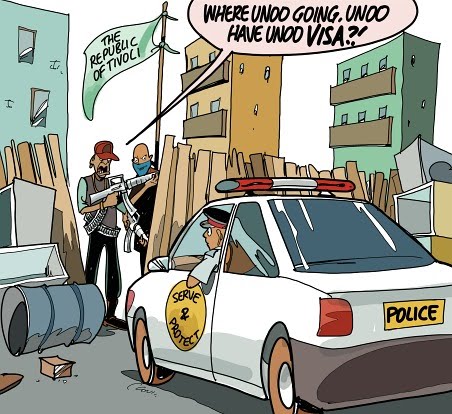
    Cartoon from the Jamaica Observer

    P.S. Jamaica is not going to win the war on drugs either.
  • Police Chief Endorses Marijuana Legalization

    Sometimes, as our drug war continues unabated, it’s easy to forget just how much progress has been made in fighting prohibition.

    Just a few years ago this kind of talk from an active police chief was inconceivable. It’s the kind of talk that encourages honest debate. Which is just what we need because advocates of the drug war will not win an honest debate.

    Meanwhile, a much more typical law-enforcement attitude can be seen in Texas: “We can’t just pull out… we are in it too deep to quit.” Too deep to quit. The logic is underwhelming. I’d prefer to stop digging.