News travels, even to Bangkok. The story in the Sun.
And while I’m at it, here’s a story about Commissioner Bealefeld wanting more foot patrol. Maybe he read my piece on foot patrol, “Angels in Blue: The Virtues of Foot Patrol.”
News travels, even to Bangkok. The story in the Sun.
And while I’m at it, here’s a story about Commissioner Bealefeld wanting more foot patrol. Maybe he read my piece on foot patrol, “Angels in Blue: The Virtues of Foot Patrol.”
“Most days I don’t miss being a cop; being a professor is a better job.” And so begins the thrilling story of Cop in the Hood.
Providing further evidence in support of this hypothesis, I’ll be on vacation for the next three weeks in Thailand and Bali.
Happy New Year!
And of all nights to stay safe, tonight is the big one. Please don’t get hit by any bullets, falling or otherwise.
Fatal stabbing suspect Cyan Brown, 16, was the aggressor in Christmas Eve New York subway fracas, police say.
This happened in an area I go through a lot. The original reports said: poor girl “fondled” by group of bad men and stabbed one in self defense. The cop in me knew that wasn’t the whole story (when will reporters ever learn?). The truth is never (or almost never) that simple. Now the real story seems to be coming out.
The account in the New York Daily News.
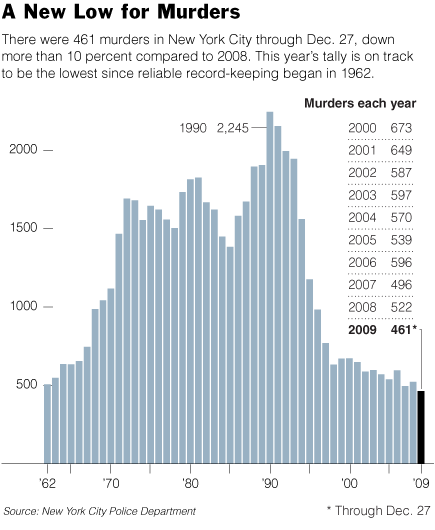
Illustrating once again that crime and the economy are not inherently linked. The storyin the New York Times.
The 9th U.S. Court of Appeals (never known for its pro-police views) to be precise.
This perhaps landmark decision has been called, “The clearest and most complete statements yet from an appellate court about the limits of Taser use.”
From the story by Hudson Sangree and Kim Minugh in the Sacramento Bee.
In the summer of 2005, Carl Bryan, 21, was pulled over for a seat-belt violation and did not follow an officer’s order to stay in the car.
…
During his second traffic stop in Coronado, he got out of the car. He was “agitated … yelling gibberish and hitting his thighs, clad only in his boxer shorts and tennis shoes” but did not threaten the officer verbally or physically, the judges wrote.That’s when Coronado Police Officer Brian McPherson, who was standing about 20 feet away watching Bryan’s “bizarre tantrum,” fired his Taser, the court said.
Without a word of warning, he hit Bryan in the arm with two metal darts, delivering a 1,200-volt jolt.
Temporarily paralyzed and in intense pain, Bryan fell face-first on the pavement. The fall shattered four of his front teeth and left him with facial abrasions and swelling. Later, a doctor had to use a scalpel to remove one of the darts.
…
McPherson could have waited for backup or tried to talk the man down, the judges said. If Bryan was mentally ill, as the officer contended, then there was even more reason to use “less intrusive means,” the judges said.“Officer McPherson’s desire to quickly and decisively end an unusual and tense situation is understandable,” Judge Kim McLane Wardlaw wrote for the court. “His chosen method for doing so violated Bryan’s constitutional right to be free from excessive force.”
The court decision is here.
I think it’s a very good decision, but I wish they had done so without hanging the officer out to dry. McPherson could end up in jail and lose his home. That’s not right.
The court wrote:
If an officer’s use of force was “premised on a reasonable belief that such force was lawful,” the officer will be granted immunity from suit, notwithstanding the fact excessive force was deployed.
…
A reasonable officer in these circumstances would have known that it was unreasonable to deploy intermediate force.
…
Where an officer’s conduct so clearly offends an individual’s constitutional rights, we do not need to find closely analogous case law to show that a right is clearly established.
…
No reasonable officer confronting a situation where the need for force is at its lowest—where the target is a nonviolent, stationary misdemeanant twenty feet away—would have concluded that deploying intermediate force without warning was justified. We thus hold that Officer McPherson’s use of significant force in these circumstances does not constitute a “reasonable mistake” of either fact or law. … Officer McPherson is therefore not entitled to qualified immunity for his use of the Taser X26 against Bryan.
Ouch.
How can the court say that “no reasonable officer” would conclude that force was justified? I’m reasonable (and against such Taser use) and I think what he did, prior to this decision, was legal! Given all the tasering incidents going on, it seems pretty obvious that many if not most officers would do exactly what McPherson did. Using a Taser in compliance situations has become standard operating procedure. That’s what needs to change. This is a problem of policy and training, not one sadistic cop!
So what’s the lesson with this guy? Seriously.
It’s damn hard to stop people from doing harm if they’re willing to kill themselves… but that’s no real answer.
Here’s one of many stories.
[poor Nigeria, their rep was bad enough with simply internet scams!]
[update:] Maybe it’s this, from David Brooks’ column in the New York Times.
At some point, it’s worth pointing out that it wasn’t the centralized system that stopped terrorism in this instance. As with the shoe bomber, as with the plane that went down in Shanksville, Pa., it was decentralized citizen action. The plot was foiled by nonexpert civilians who had the advantage of the concrete information right in front of them — and the spirit to take the initiative.
For better or worse, over the past 50 years we have concentrated authority in centralized agencies and reduced the role of decentralized citizen action.
Two of the best police books out there are little read. Too little read.
And top-quality and much more action packed than my book.
I’ve written about both these books before, but it can’t hurt writing about them again.
Beyond Hope? by Michael East is about policing in Saginaw, Michigan. Unless you live in Saginaw, you probably won’t find it in book stores, but you can buy it here. Beyond Hope? is one of those few books written by an active police officer under his real name. But East doesn’t pull any punches.
The other is another book about the Eastern District. But his experience was very different from mine. Badges, Bullets, & Bars by Danny Shanahan.
They’re both great books. I haven’t met either of the authors. But both know more about policing than I do. And they write well. What more could you ask for?
From the Wall Street Journal:
Growing numbers of Mexican and U.S. officials say—at least privately—that the biggest step in hurting the business operations of Mexican cartels would be simply to legalize their main product: marijuana. Long the world’s most popular illegal drug, marijuana accounts for more than half the revenues of Mexican cartels.
“Economically, there is no argument or solution other than legalization, at least of marijuana,” said the top Mexican official matter-of-factly. The official said such a move would likely shift marijuana production entirely to places like California, where the drug can be grown more efficiently and closer to consumers. “Mexico’s objective should be to make the U.S. self-sufficient in marijuana,” he added with a grin.
He is not alone in his views. Earlier this year, three former Latin American presidents known for their free-market and conservative credentials–Ernesto Zedillo of Mexico, Cesar Gaviria of Colombia and Fernando Henrique Cardoso of Brazil–said governments should seriously consider legalizing marijuana as an effective tool against murderous drug gangs.
Especially to those men and women working.
I don’t mind a mixed review of my book (Contemporary Sociology), but it does bother me when a reviewer calls my participant-observation research a “major flaw.” It’s like a man who doesn’t like olive oil, fish, and lamb bashing a Greek restaurant for being too “Mediterranean.” If you don’t like the concept, don’t review it.
Basically, goes the tired old sociological argument, because I was a cop, I can’t see police objectively. This is called “going native.” Like all sociology majors, I learned this in college (in my case as a Princeton sophomore in Professor Howard Taylor’s most excellent “Introductory Research Methods in African American Studies”–the class that made me a sociologist!).
While going native certainly is a possibility. Given the sum of my book and writing, to say I did so is a bit absurd.
The reviewer writes:
This raises the possibility that [Moskos] was not privy to some of the more sensitive issues and events that may have happened. He states categorically that he witnessed no instances of illegal police behavior while on the Baltimore Police Department which suggests that he failed to encounter them either because he was shielded from such events or he did not define them as illegal because he had adopted the police view that such activities were necessary to get the job done.
Actually, I stated categorically I saw no instances of police corruption. I wrote a bit about illegal behavior: “High-arrest officers push the boundaries of consent searches and turn pickets inside-out. Illegal (and legal) searches are almost always motivated by a desire to find drugs.” So much for a thorough reading.
I did write this (p. 78):
I policed what is arguably the worst shift in the worst district in Baltimore and saw no police corruption. … Incidents do happen, but thepolice cultureis not corrupt. Though overall police integrity is very high, some will never be convinced. But out of personal virtue, internal investigation stings, or monetary calculations, the majority–the vast majority–of police officers are clean.
Sometimes reality causes cognitive dissonance to people with strong prejudices. I guess the idea that most cops are clean (cleaner than professors, I like to add) is just too shocking for some in academe. Rather than face up to one’s own anti-police biases, I guess it’s easier just to bash ethnography.