Copinthehood.com has moved to qualitypolicing.com

  • Mass. Decrim Has No Effect On Schools

    Mass. Decrim Has No Effect On Schools

    So say some Massachusetts school officials–the same ones who say decriminalization “sends a terrible message to kids.” The story by John Hilliard is here (via the Agitator).

    This really is no surprise, but it’s important for a few reasons. Prohibitionists seem to care more about “the message” than about actual drug use and drug harms. For too many, it’s a moral issue and not a policy issue.

    I like to ask those who support the war on drugs if they would support legalization iflegalization and regulation decreased drug use. I’d say close to half say “no.” Better, they tell me, to keep drugs illegal regardless of drug usage rates. Sometimes increased drug use and overdose deaths can be useful, some drug-warriors even say, for having people overdose in the ghetto sends a powerful “message” to others.

    Hmmmmmmm. This sort of ends the debate. So it’s not about drugs. It’s about morals and the power and symbolism of the law.

    Prohibition is about a conservative world view that sees drugs as evil. And evil needs to be outlawed. Prohibition is about big-government telling people what to do and how to live their lives.

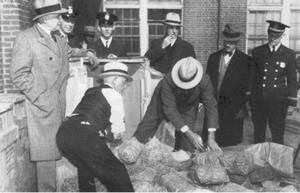
    Take Harry Asslinger (oops, honest typo but much too good to delete)–I mean Harry Anslinger. He was very happy, after failing to maintain alcohol Prohibition, to raise the false alarm about marijuana.


    Perhaps Anslinger’s greatest accomplishment was to push marijuana from a fringe drug into the mainstream. That’s what happens when you call it the evil weed and highlight the moral turpitude of minorities, immigrants, Catholics, liberals, and other city folk who, like Anslinger believed, were destroying the moral fiber of America.

    Whatever. Good or bad, those cool cats sure knew how to party!

    In my mind, the debate on drug decriminalization comes down to one main issue: in an era of legal and regulated drugs, would drug use increase or decrease? Of course we can’t be sure because we haven’t tried it. But the evidence strongly suggests the use would go up and might go down.

    System of liberalization and/or decriminalization result in no increase in drug use. Marijuana usage rates in the Netherlands (where it is publicly sold and legally consumed) are lowerthan in the U.S. Decriminalization in Portugal has also been a success.

    How does this work? Lot’s of reasons. Forbidden fruit. Distrust of authority. And consider what Diego Gambetta recently pointed out to me: there’s a lot more pressure in social situations to conform and partake in illegalactivities than for comparably legalactivities.

    If a joint is being passed around, you’re expected, especially in young crowds, to smoke a little. This serves two functions beyond social bonding.

    1) It shows you’re not a cop.

    2) You can’t blackmail anybody with your knowledge of illegal behavior since you’re guilty too.

    There’s a lot more pressure (especially for teenagers) to smoke a joint being passed around than to smoke an offered cigarette. These days cigarettes, regulated and taxed, aren’t even being offered much.

    Marijuana decriminalization in Massachusetts has not resulting in a bunch of school kids suddenly discovering the drug and firing up. Hell, the first time I ever saw marijuana was in school, watching a drug deal go down in the bathroom (regulated drugs aren’t sold in school bathrooms). And the best anti-drug lesson I ever got was from the guy who sat behind me in first-period German class. He would also come in late, stoned, and reeking of (tobacco) cigarettes. He never learned any German. But then neither did I.

  • The Murky World of CIs

    Peter Hermann has a good story in the Sun. “It is a murky, secretive place where cops and crooks mingle and exchange information for money, a place where the line dividing law and disorder often blurs.”

  • Baltimore Police Quarry

    Anybody in Baltimore know why the major from the Southeast was suspended? An old buddy of mine from Eastern was asking if I knew why. Sheee-it… like I know anything. I didn’t even know he was the major. But we both remember him a good guy.

    If you know, I’d appreciate it if you could send me an email directly rather than spread rumors via the comments. Of course I will hold the source (and the substance, if you wish) of any emails in the strictest confidence.

  • Tasers Get Support

    PERF says Tasers increase officer safety.

    Of note:

    Not all of the people who have died after being subjected to a CED activation were chemically dependent or had heart disease or mental illness; “some were normal healthy adults.”

  • He gave “all the money he had on him” – $23

    An anonymous reader sent me this link by Rob Moore and Donald Fraser of the Franklin County Citizen & The News Leader. Thanks. It’s an update on the shooting of Jonathan Ayers.

    The woman who was in the Rev. Jonathan Ayers’ car moments before he was shot by undercover drug agents in Toccoa on Sept. 1 is refuting reports that Ayers was involved in illegal activities.

    “I’m an addict,” 26-year-old Kayla Barrett admitted Tuesday, saying that Ayers was ministering to her on the day of his death.

    She said that, over time, Ayers had been lecturing her and trying to get her to straighten out her life and to get off drugs.

    “He told me I was too young to be living like I was living,” she said. “He didn’t want me to waste my life.”

    Barrett said Ayers offered her a ride back to the motel.

    Barrett said she asked Ayers if he could help her out with the back rent, and that he gave “all the money he had on him” – $23.

    “His last words to me were I didn’t owe him anything,” Barrett said. “Probably 15-20 minutes after that I could hear the shots.”

    Responding to allegations she has heard, she said, “No, we did not have sex.”

    “He [Ayers] doesn’t have any part in any kind of drug activity,” Barrett insisted. “He’s never solicited me for prostitution.”

    Barrett, who is charged with two counts of sale of cocaine, doesn’t deny that she sold drugs to an undercover agent.

  • “Help us get others”

    So says Chicago Police Supt. Jody Weiss. The Sun-Times reports. The police chief asking a bunch of high-school students to snitch? That’ll go over well.

    The sad part, at least to me, is that if it weren’t for the video, this would have been just another death in the hood. Another dead black kid, little reported and quickly forgotten. And some people, myself included, would have assumed that Derrion himself was partly to blame, getting himself into this mess.

  • “Zero tolerance for what?”

    Here’s a great interview from Investigative Voice with Baltimore homicide detectives Irving Bradley and David Hollingsworth.

    You had to be an actor. I had to convince you, what I was telling you to do was the right thing to do. Even though before I got you, you had torn out every window in the neighborhood, you had torn up somebody’s car, and threw a hatchet at somebody — all of this prior to my arrival. I had to convince you that fighting me was wrong, and that it would be better for you to come with me and let me lock you up so I could solve your problem.

    You see, we were on our own; the community is who you depended on. Those neighbors, they knew who the assholes were in the neighborhood. When they saw you confronting them, they would get on the phone and call the police and say, “Officer so-and-so is out there and I’m sure some shit is going to happen.” And you would look around the corner and an officer would be coming for back-up, but that was initiated by the community. Because you protected them.

    The worse thing they could have ever done is put everybody in a car and create this 911 system without proper instructions. Because what is an emergency to you is not necessarily an emergency to me. You call 911 and say, My cat is stuck up on the fire escape.” And another guy calls 911 and says, “I have stabbing in progress and if someone doesn’t get here soon he’s going to die.” Both are 911 calls.

    But the officer in the car has got to go; he does not have the discretion to say, “Okay, that cat got up there, he can stay there.

    You should know the players, you should know who is on your post. If you have a 64- year-old man on your post, I would know him. Like I said, it’s the basics that are lost.

    “You really can’t arrest your way out of the problem,” Bradley says.

    When I was a cop, I met the mayor in 2001. One meeting. One-on-one. Nice guy, I thought. I remember telling him, “You know, Mr. Mayor, you can’t arrest your way of the problem.” He looked at me quizzically and said, “Why not?”

    On Zero Tolerance, Hollingsworth says:

    Where’s the crime? They have no idea what a tolerable crime is, and what an intolerable crime is. It depends on the neighborhood. Your dog, you’re walking through Charles Village, and you have Foo Foo with you and Foo Foo craps on the ground, you put it in the bag and you keep walking. Well, on Mount Street, a guy is walking home with his bulldog and the dog craps in your yard… what are going to do, call a police officer and say, “He ain’t pulled that poop up?’ It all depends.

    Get out of the car. Walk in the neighborhood. They would see a world of difference if they could get out of that car. Get out of the car and you’ll learn real fast.

    These are real police. And they were Broken Windows when Broken Windows wasn’t cool.

    Part I is here. Great stuff on community policing back in the old days. (But they’re actually wrong–not morally, but legally–about the requirements for frisks. I couldlegally frisk almost everybody on my post. Reasonable suspicion and the Terry Frisk go a long way to get me touching your pockets).

    (And I’m glad Lt Peel is still raising hell. I liked that goof when he was just a crazy sergeant with a dirty shirt. Oh and the things he read! I couldn’t hang with him intellectually… and I was the Harvard Student! I got to send him my book. If you’re reading this, LT, will you get in touch with me? I’d love to hear what you’re reading this month.)

    Part II is here.

    [thanks to a Canadian reader]

  • A story of no story

    The other night I had a minor but perhaps brilliant idea. What if there were a correlation between the numberof prisons in a state and that state’s incarceration rate? Perhaps the more prisons there are, the greater the political influences that play in a state, leading to more people locked up! Prison-Industrial-Complex shit I’m talking about!

    Of course, biggerstates would have more prisons, but that’s the beauty of stats: they can take population into account and just compare the number of prisons with a state’s incarceration, holding population constant.

    So I found and put every state’s incarceration rate into an SPSS file. Then I added the state’s population. Finally I used wiki to get a decent number for the number prison institutions in each and every state.

    Then a crunched the numbers and found… uh, there’s no correlation. So I tortured the data a bit (maybe it only works for the highest and lowest levels of incarceration!). No dice. No brilliant idea. No publishable paper. Just a waste of a few hours that would have better been spent writing.

    Oh well.

  • Fight. Don’t Kill.

    Thinking about the street fight in Chicago makes me think Frank Zimring and Gordon Hawkins’ 1997 book, Crime is Not the Problem. They distinguish between crime and violence and argue convincingly that America’s problem is not crime but violence.

    Other nations have as much if not more crime, they say. They just don’t kill each as much. Zimring and Hawkins emphasize guns as part of our violence problem. But I think there’s something else. I’ve see some fights. Europe has their soccer hooligans. And a lot of drinking, too. And in Greece it seem like people are always yelling at each other. And there are even seasonal riots in Athens. But somehow it’s all controlled, almost ritualized. Maybe subconsciously. Somehow, in the heat of the moment, when the adrenaline is pumping, people in much of the world know to restrain from issuing that lethal blow. People let off steam, they save face, they vent, they even hurt. But by and large they don’t kill.

    And here, for no good reason I can understand, some kids pick up giant pieces of wood and wack each other, sucker punching others, and then stomping a man till he’s dead.

    I don’t buy the “it just don’t make sense” refrain. I mean, of course it don’t. But that’s not the answer. Is it something about American exceptionalism? Do we not understand how easy it is to kill someone? Do we not value human life as much as people in other countries? Do we have less self-control? Do we have no other means of having fun? All these may be true. But none of these seem to provide a satisfactory answer.

    How do you learn to enjoy stomping a defenseless guy for fun? I don’t know. Maybe you learned it from dad. More likely you never learned anything from dad because dad got locked up a long time ago himself. And your mom, who very well may be an idiot, tells you you gotta fight. Better to fight than get punked. That’s what you gotta do to be a mom.

    Maybe stomping a guy to death actually is fun. It’s easy to tsk-tsk others. Maybe there’s nothing better than hitting a guy upside the head with a two-by-four. Maybe that’s the dirty secret we who pass judgment from afar don’t want to consider. I don’t know. I’ve never tried.

    Update: Worth quoting T. Coates at some length here:

    I am aware of all the socio-economic forces at work they make black communities more subject to violence. I’m in all for trying to ameliorate those forces. In the meantime, I’m all for doing whatever it takes to protect the rest of us–particularly young black kids–from hooliganism.

    I can’t ever say this enough–there’s nothing inconsistent about trying to understand the broad societal forces, and still holding people responsible for individual action. Being black and poor sucks. But most poor black kids aren’t out smacking innocent bystanders with 2x4s.

    If all is as it appears for these kids who were arrested, then heaven help them, because we can not. Compassion–like all resources–has limits. It’s worth spending some time on what makes young boys do these sorts of things. It’s worth at least as much time to try and protect young boys who are just trying to live right. I know from personal experience that there are more of the latter than the former. Don’t ever forget that.

  • Nasty street fight in Chicago

    One 16-year-old high-school honors student student gets sucker-hit with a large piece of wood, then cold cocked, and finally stomped and beaten to death. All this caught on video in front of a large screaming (and sometimes cheering) crowd. Finally some nearby adults carry try and rescue him and carry him away, but it’s too late. Derrion Albert died.

    Foxhas video. The Sun Timesreports.

    The winner of the latest “Bad Parent Award”? The mother of one of the likely killer saying dismissively, “Gangbangers fight. That’s what they do!” Like it’s the natural order of things. Darrion, by all accounts, wasn’t a gangbanger.

    A few days later, in what seems like it could only come from a Monty Python skit:

    Some people stood nose-to-nose, arguing over whether the gathering [at the makeshift memorial] should be in memory of Derrion or a protest of the violence that killed him.

    Police responded.