“The trouble with the world is that the stupid are cocksure and the intelligent are full of doubt.” — Betrand Russell
Copinthehood.com has moved to qualitypolicing.com
-
Cost of a Car?
I’ve always wondered and never been able to figure out exactly how much police cars cost to operate. Somebody in motor-pool must know, but nobody has told me.
Here’s an article in the New York Times about a fleet for OTB. No doubt cheaper than cop cars. The vehicles cost an average of $6,700 each per year. They have 87 vehicles. And no doubt they’re cheaper to run since 1) they’re not being used much (that’s the point of the article), and 2) they’re not cop cars.
It has employed three automotive mechanics, seven drivers and a motor vehicle supervisor, who, combined, earned $500,000 a year. In addition to those salaries, the state comptroller found that gas, insurance and outside repairs cost $585,000 a year.
By my calculations that’s $12,471 per car per year. Anybody out there know more than me?
In my Policing Green concept, I propose that cops would walk foot for an extra $20 to $50 a shift, with that money coming from gas not burned. Maybe I’m thinking too low.
-
A Radical Solution to End the Drug War: Legalize Everything
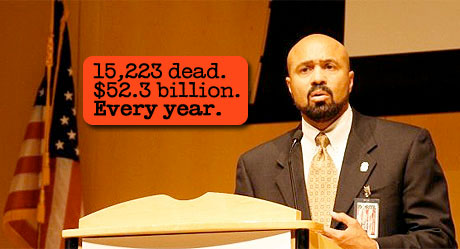
Esquire.com just published a nice piece by John Richardson about my op-ed co-author, Neill Franklin, on violence in the drug war.
We’ve heard a lot about the terrible death toll Mexico has suffered during the drug war — over 11,000 souls so far. This helps to account for the startling lack of controversy that greeted last week’s news that Mexico had suddenly decriminalized drugs — not just marijuana but also cocaine, LSD, and heroin. In place of the outrage and threats that U.S. officials expressed when Mexico tried to decriminalize in 2006 was a mild statement, from our new drug czar, that we are going to take a “wait and see” approach.
Still, we’ve heard nothing about the American death toll. Isn’t that strange? So far as I can tell, nobody has even tried to come up with a number.
Until now. I’ve done some rough math, and this is what I found:
6,487.
To repeat, that’s 6,487 dead Americans. Throw in overdoses and the cost of this country’s paralyzing drug laws is closer to 15,000 lives.

Read the whole article here.
-
Those Slippery Stats
Somebody tried to do to me what I tried to do to the Heritage Foundation. I was accused of playing fast and loose the numbers in my Washington Post op-ed.
In the old days I could have just challenged him to a duel. I’d feel pretty confident going into that battle! Instead I have to defend my honor with a written reply to this:
“In many ways, Dante Arthur was lucky. He lived. Nationwide, a police officer dies on duty nearly every other day.” [emphasis added]
Let’s see – 365 days a year. That makes nearly 180 such deaths each year.
I’ve been out of the crim biz for a while, but that number sounded high to me. So I went to the UCR. Sure enough, in 2007, 140 police officers died in the line of duty. As Moskos and Franklin say, nearly one every other day.
But 83 of those officers died in accidents, only 57 were homicide victims – one every 6 days. Still a lot. But how many of those were drug-related? The UCR has the answer:
One.
Nor was 2007 unusual. In the decade ending 2007, 1300 police officers died on the job. About 550 of these were in felonies, not accidents. And of these, 27 were drug-related. Three a year is still too many, but it’s a far cry from one every other day.
Maybe I should have looked at a DVD of The Wire instead of the UCR.
…
Moskos and Franklin argue that federal laws should allow states to make the manufacture and distribution of drugs legal and regulated rather than criminal. The authors make several good arguments against current drug laws, which have created many problems that legalization might ameliorate. But I’m skeptical as to whether legalization would make much of a difference in police safety.You can read the whole post here.
The Wire line is ironic since both Franklin and I actually policed the streets of The Wire.
I replied with this:
I take my numbers seriously and I criticize others for exactly what you’ve criticized me for. So I feel I need to defend myself thoroughly. You’re not being fair to me.
As is often the case, a little qualitative insight is needed to round out the quantitative data. The numbers aren’t showing the real picture. You have too much faith in the UCR numbers. For what it’s worth, I was in the unique position of actually putting data into the URC for a year before analyzing the same data coming out the other end. Sort of a unique position for a researcher (conflict of interest?), but I can actually identify some of the UCR homicides in 2000/2001 as “mine.”
First the non-disputed part.
The best source for info on officer deaths is The Officer Down Memorial Page. It’s much more detailed than the UCR (and probably more accurate, too). Over the past four years, the average deaths per year is 162.5. Not half of 365, but close enough to say “nearly one every other day.” But you grant me that.
But Dante Arthur wasn’t killed. He’s not a UCR or officer-down stat. And of course we’re all happy for that. But his life-changing war-on-drugs injury (he got shot in the mouth) all but disappears from the public record after a few days in the Baltimore Sun. It would be great to have a database on prohibition violence, but we don’t have one.
But the real issue you’re getting at is the circumstances of deaths and injuries. Fair enough.
It’s a generally accepted figure in Baltimore that 80% of homicides are drug related. How do we come up with that. Well… yes, to some extent it’s just made up. But it’s based on experience and common sense and made up by homicide detectives. And it rings true. So grant me that 80% figure for Baltimore homicides if you will.
Go to the UCR homicide supplement for 2006 (you could pick any year, but I just happen to have that file handy). There are 270 homicides listed for Balto. There were actually 276 murders that year, but that’s another issue.
Run a frequency table for “Offender 1: Circumstance.” Narcotic drug laws are listed as the cause in 3 murders, or 1.1 percent of all homicides. 1.1 percent?! That’s a big difference from 80%
At this point one of my favorite lines comes to mind, “What are you going to believe? Me or your lying eyes.”
I think it’s safe to assume that a similar under-representation exists for the drug-related circumstances of officers killed.
If two drug dealers are fighting and one kills somebody, that’s not listed in the UCR as drug-related. It’s an “argument over money or property.” If a cop is killed in a car crash responding to the scene, it’s listed as a motor-vehicle death. If another drug dealer is found dead along the way with no witnesses, the death is listed as “circumstances undetermined.” But it’s all drug deaths. The UCR doesn’t tell the whole story.
If the UCR listed officers injured, Arthur Dante’s injury would not be listed as drug related. It would be listed as “arrest” or “other arrest.” And I simply don’t believe the UCR data on officers assaulted. I think they’re worthless (but that’s not for this post).
I like your pie chart, but you’re not looking at the meaning of the data correctly. Of those 103 “traffic stops,” how many of those are drug related. I don’t know. But I’d guess 80-90%. Man wanted a drug warrant. Police trying to conduct a discretionary search of a car for drugs. Officers don’t get killed pulling over my mom.
“Disturbances”? I’d guess about 1/3 with the rest being domestic violence (though probably 1/3 of those are drug-related as well). “Other” and “Other Arrest”? Probably half. “Ambush”? Maybe 25% (I keep thinking of those crazy white kooks killing people. Those are not drug related.)
And I’d guess probably 10-15% of traffic deaths are drug-related. My friend Crystal Sheffield died in such an accident, trying to backup another officer involved in, yes, a drug-related dispute. But you won’t find that in the UCR.
So put it all together and what do you have? A lot of prohibition and drug-related deaths. And there are multiple times more injured than killed in similar circumstances. We don’t put a number in the op-ed because we don’t have a number (maybe you and I could keep that database?)
But from our experience and my participant-observation research, we both know (often personally) officers hurt and killed in the drug war. We both have a pretty good idea about how it fits into the total picture. So UCR data be damned!
…
Writing a 800-word op-ed is different that writing an academic journal article. But I wasn’t and don’t play fast and loose with the numbers. It just so happens that the UCR numbers themselves play fast and loose with the facts.(and I do graciously accept apologies.)
-
Alan F. Kiepper dies at 81
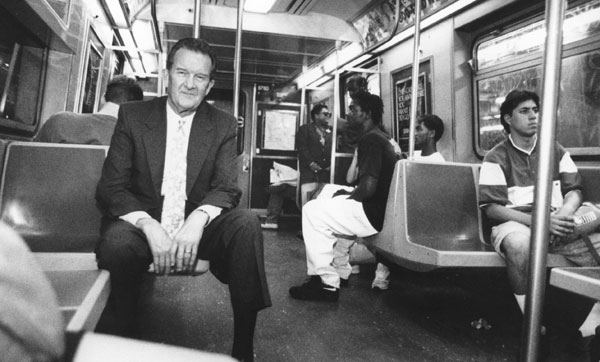
OK. I’ll be honest. I had never heard of the guy either. But it turns out he might be responsible for America’s great crime drop (not that he ever claimed such a feat). But he did hire Bill Bratton to run the New York Transit Police, and that was perhaps the start of it all.
“Effective management is doing small things well, and sometimes small things include picking up paper,” Mr. Kiepper told The New York Times in 1990. He had just picked up litter and a penny from a subway platform, drawing stares from straphangers. “The penny I’ll keep for good luck,” he said, “which anyone would need to run a system of this magnitude.”
Sounds like Broken Windows to me.
It seems like he took just as much pride as starting Poetry in Motion (something I, a subway rider, always appreciate):

-
Don’t Tase Me, Sis
A nice articlein Reason by Radley Balko. This one on police TV shows and use of force.
Of course, there isn’t “always a good time to use a Taser,” as the multitude of viral web videos depicting taserings of grandmothers, pregnant women, and children will attest. TLC’s ad campaign is offensive, though merely the latest iteration of a genre of television that trivializes the state’s use of force and makes a mockery of the criminal justice system.
…
Cop reality shows glamorize all the wrong aspects of police work. Their trailers depict lots of gun pointing, door-busting, perp-chasing, and handcuffing. Forget the baton-twirling Officer Friendly. To the extent that the shows aid in the recruiting of new police officers, they’re almost certainly pulling people attracted to the wrong parts of the job.Read the whole article here.
[thanks to Marc for the tip]
-
Portugal and Drug Decriminalization
The generally conservative and pro-legalization Economist reports:
The evidence from Portugal since 2001 is that decriminalisation of drug use and possession has benefits and no harmful side-effects.
…
IN 2001 newspapers around the world carried graphic reports of addicts injecting heroin in the grimy streets of a Lisbon slum. The place was dubbed Europe’s “most shameful neighbourhood” and its “worst drugs ghetto”. The Times helpfully managed to find a young British backpacker sprawled comatose on a corner. This lurid coverage was prompted by a government decision to decriminalise the personal use and possession of all drugs, including heroin and cocaine. The police were told not to arrest anyone found taking any kind of drug.
…
The share of heroin users who inject the drug has also fallen, from 45% before decriminalisation to 17% now, he says, because the new law has facilitated treatment and harm-reduction programmes. Drug addicts now account for only 20% of Portugal’s HIV cases, down from 56% before. “We no longer have to work under the paradox that exists in many countries of providing support and medical care to people the law considers criminals.”“Proving a causal link between Portugal’s decriminalisation measures and any changes in drug-use patterns is virtually impossible in scientific terms,” concludes Mr Hughes. “But anyone looking at the statistics can see that drug consumption in 2001 was relatively low in European terms, and that it remains so. The apocalypse hasn’t happened.”
Read the whole article here.
-
Request for a Title for a Speech on The Wire
In November I’m speaking at a conference in Leeds, UK, on The Wire (the HBO TV show). I need a title for my presentation. I can’t think of anything. Of course I have no idea what I’m going to say yet. But I still need a title.
Anybody out there have any good idea for a title? Maybe something clever? Maybe something taken from The Wire?
-

I Heart Crab
 I love Maryland crabs. Even more than I love Maryland venison. And I do love eating the deer. But I think steamed blue crab may be the most delicious food in the world.
Last night my friend cooked a true Maryland-inspired crab feast for twenty people. She’s gone down to Baltimore twice now for my sergeant’s church crab feast. She ordered and paid for two bushels of #1 males (jimmies)…
…and then received #3 females.
The worst part is the fish guy she bought them from wasn’t trying to rip her off. He was just ripped off himself. Such is life buying crabs here in New York City. People just don’t know crabs. But then I think she paid only $80 a bushel, which is way too cheap for jimmies, right?
Steaming the crabs is always great fun (for us, not the crabs), as the crabs are feisty and one or two always gets loose.
At least most of the guests, not knowing backfin from lump, didn’t know they were eating very small crabs. And despite their size, they did taste great.
Afterward, with Old Bay in the air and three of us sitting around a table drinking and picking, we probably ended up with less than 2 lbs of crab meat from a while damn bushel of crabs (many in this bushel were dead). Pretty pathetic. But crab meat is crab meat. So we had crab cakes tonight!
My wife went first. Fine by me! I had a beer. But then I came to face-to-face with this pan-fried hockey-puck shaped thing and my heart sank (though they tasted OK).

Is there something about New York that makes people want to mash delicious crabmeat into patties? Is there something in our water?So I took the rest of the meat and let me tell you, I showed her. Round, as loosely packed as possible, and broiled.
The sad truth is they looked better than they tasted (I used too much egg). But not bad for a New York boy winging it with a point to prove.


We were both loosely following Ms. Amelia’s crab cake recipe. Though next time I might try this recipe because I love Faidley’s and I like the idea of little worcestershire sauce addition.[And just for the purpose of science, we even made a crabcake from canned crab (“wild caught” from Vietnam). It tasted like crap and we didn’t eat it.]
Speaking of food. If you see the movie “Julie and Julia” (decent, though very very chick-flick), it’s all filmed in my Astoria neighborhood (which subbed for nearby Long Island City). I stopped by my corner fish store and congratulated them (not where the crabs were from, by the way) and K & T Butchers is only a few blocks away. Once I ran into Julie at a liquor store near her house. Alas, to my great dismay when I lived in Cambridge, I never did run into Julia Child (even though all my friends did).
-
Incarceration
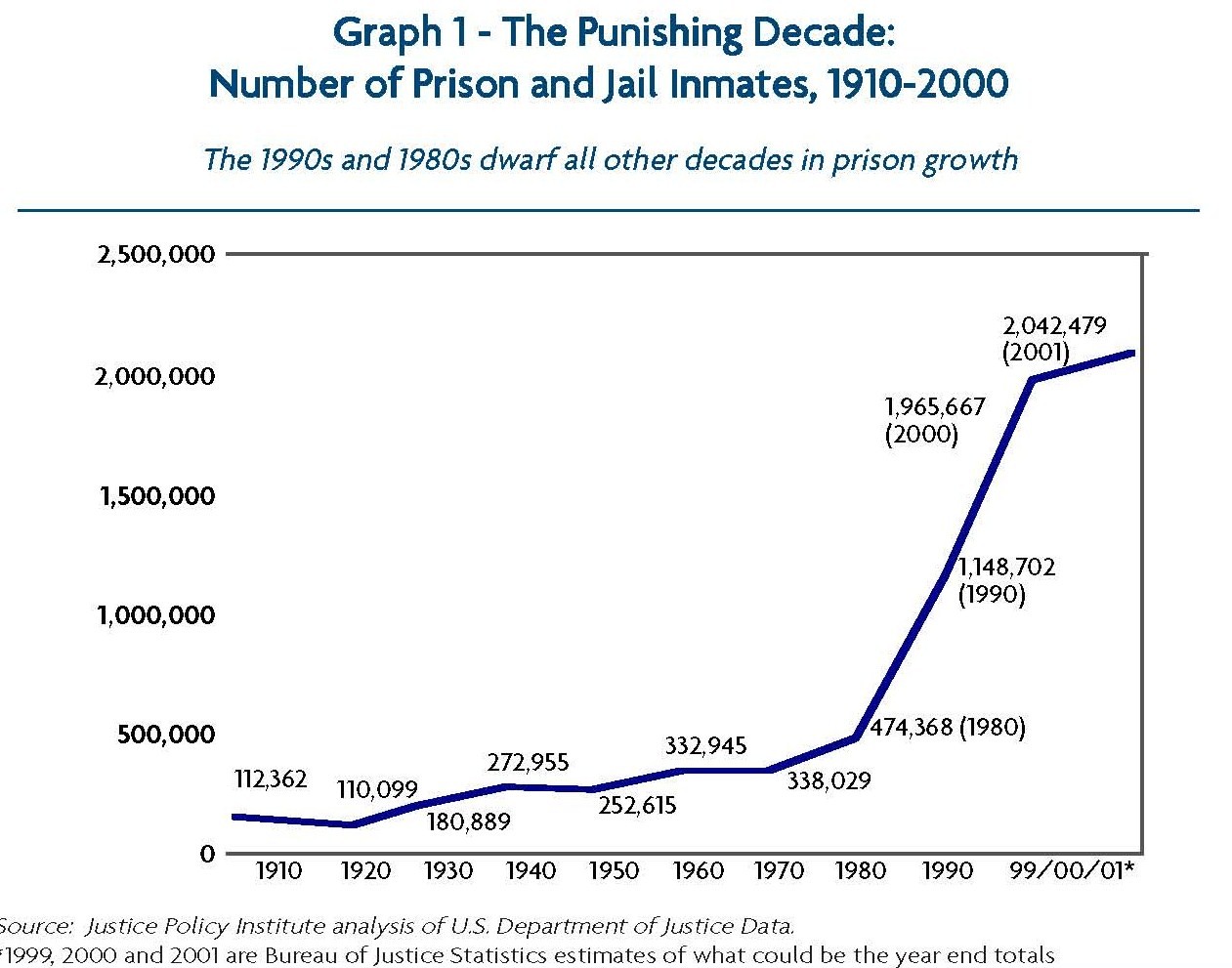
Nothing new here. But it’s good to have a refresher course every now and then. It’s too easy for prisoners to be out of sight and out of mind.
(plus these are the neatest diagrams I’ve found in the subject)
Now it’s 2,300,000 behind bars.
The increase is all since 1970 and the war on drugs.
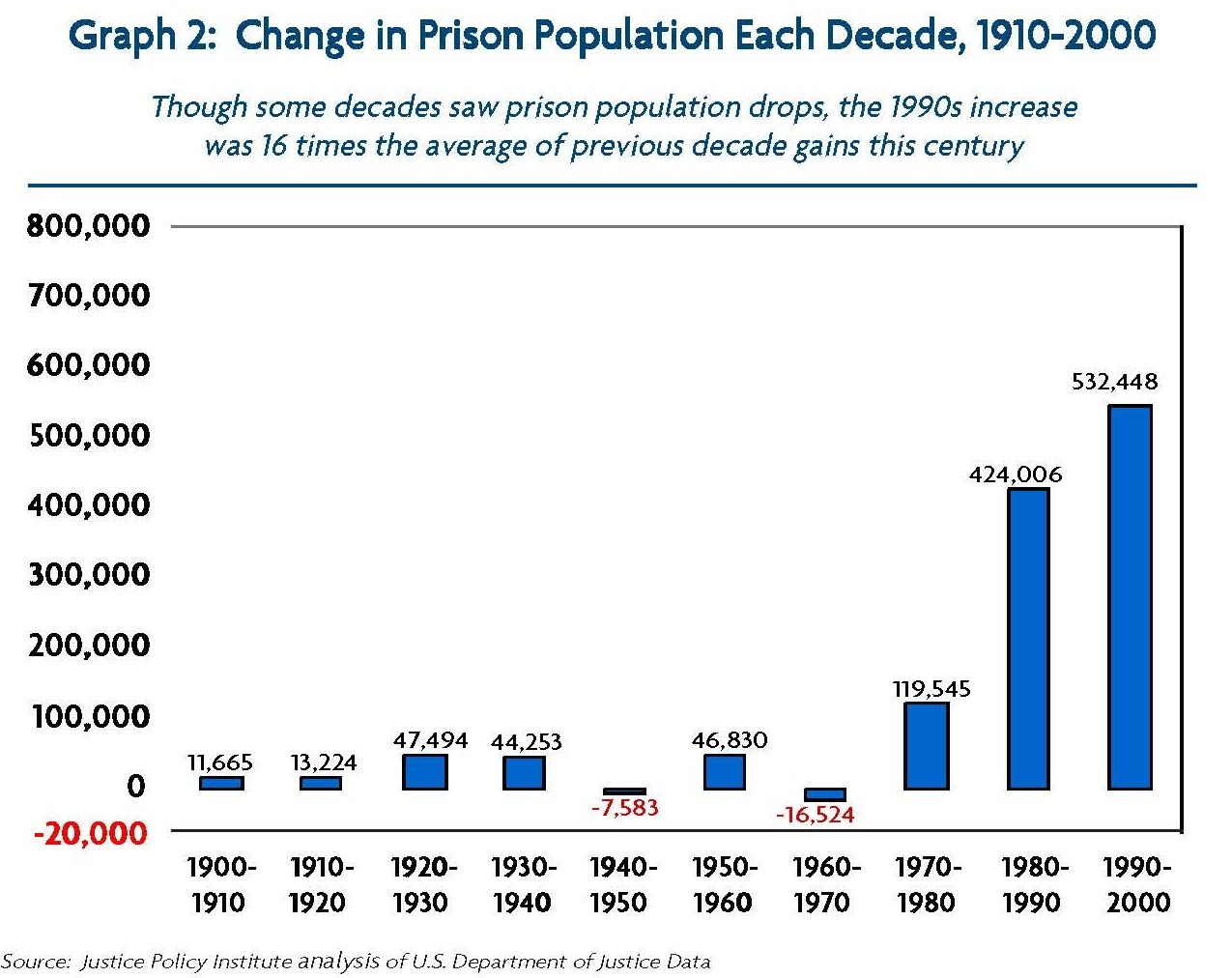
It has little relationship to the crime rate. This is important. Because people generally don’t have a problem with locking up criminals because there’s more crime. We’re just locking up more people. And the crime rate doesn’t change because of it.
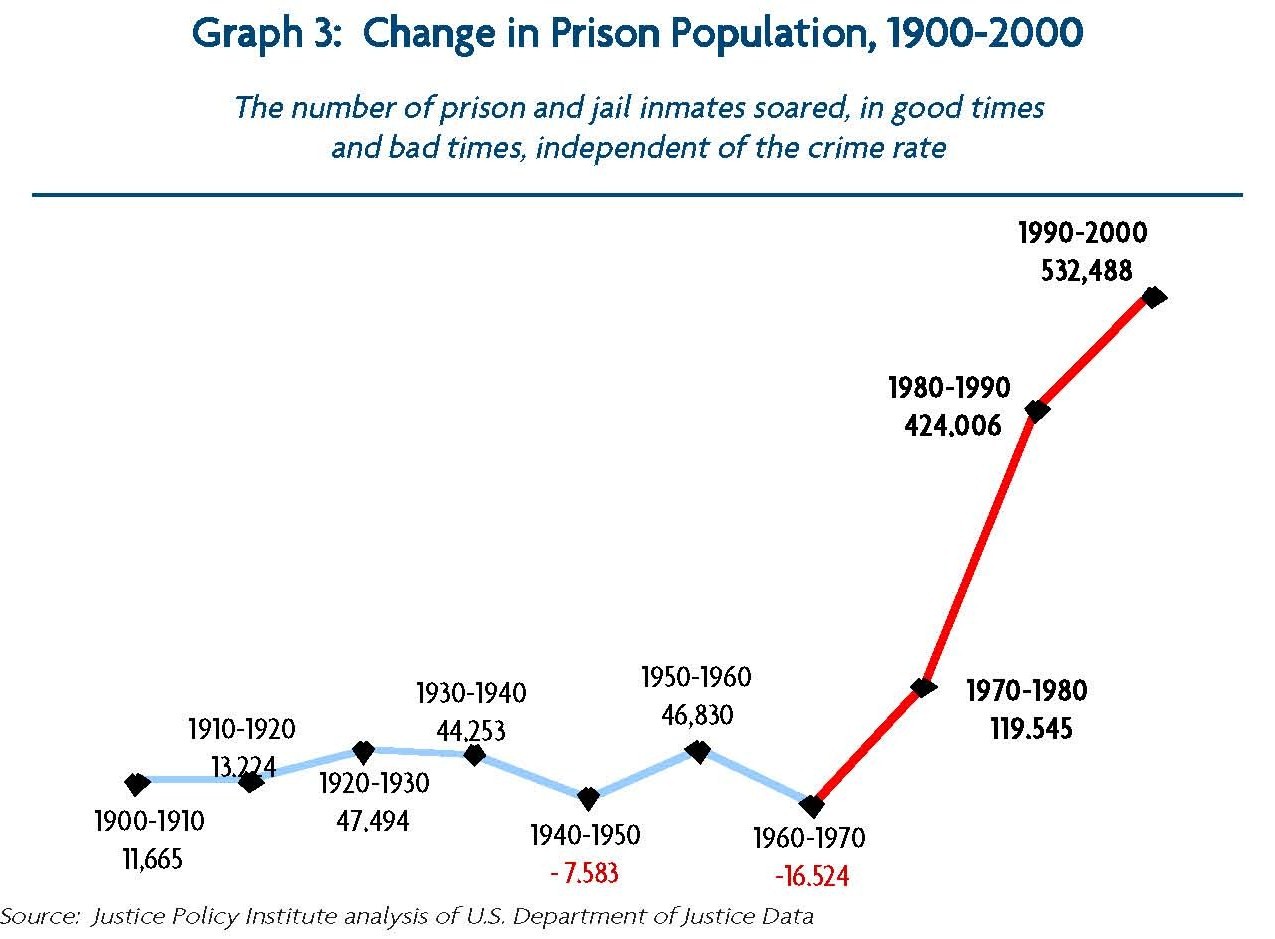
The incarceration rate is going still going up. Now it’s above 750.
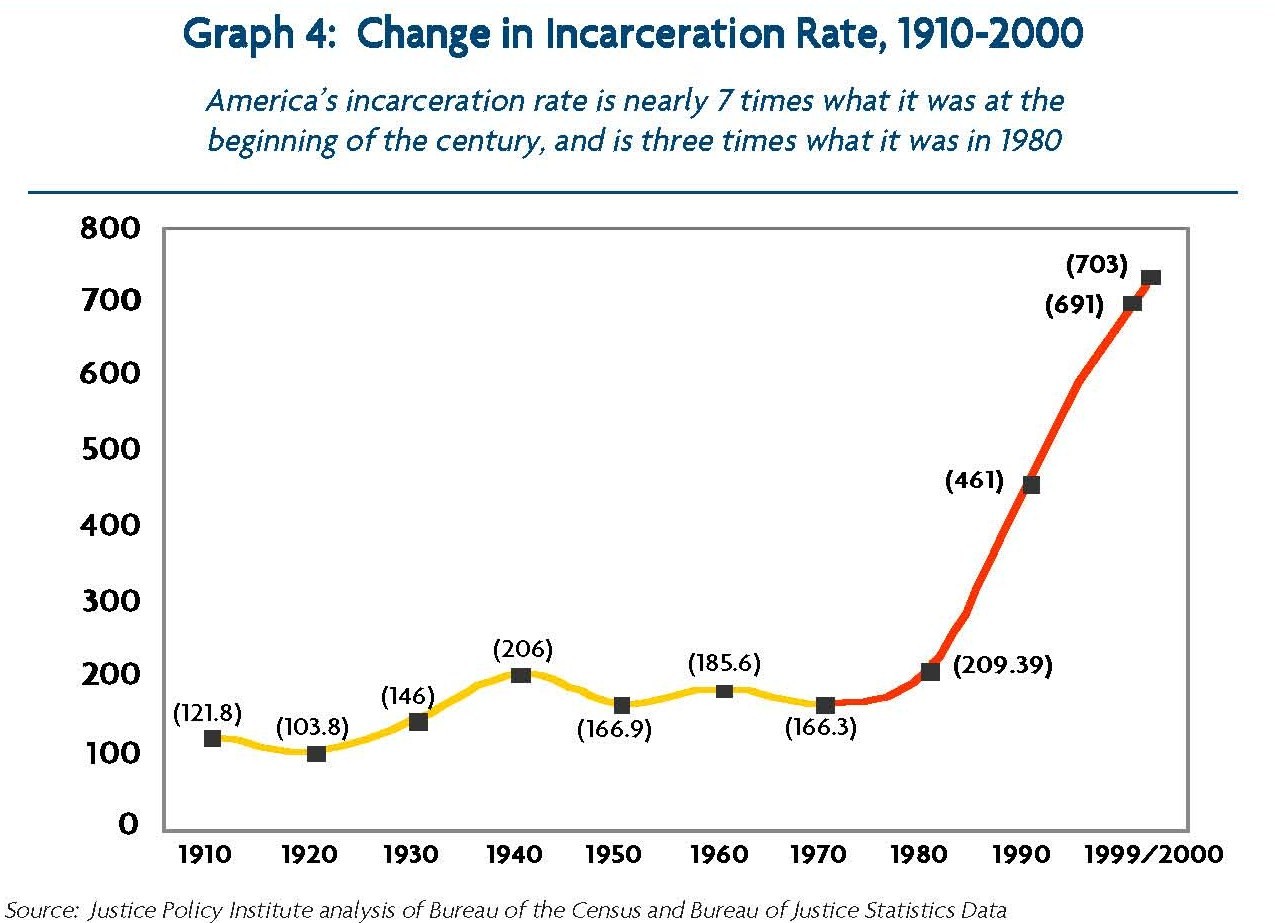
You can read the complete Justice Policy Institute report here. It’s from 2000, but the later reports don’t have the pretty diagrams. The latest report, Prisons in 2007, can be found here.