Copinthehood.com has moved to qualitypolicing.com

  • “Engaging, even riveting”

    Drug War Chronicle reviewed Cop in the Hood a while back and somehow I missed it.

    Here it is:

    I would imagine that most Drug War Chronicle readers… have little knowledge of or empathy for the men in blue.

    Moskos really shines at getting his comrades to speak openly and honestly about their attitudes, and in that sense, “Cop in the Hood” is as revelatory as it is sometimes disturbing. Such attitudes may be deplorable, but they are also understandable. When all you see is the worst of humanity, it’s easy to get alienated. As one officer put it, “You don’t get 911 calls to tell you how well things are going.”

    While Moskos by no means sugarcoats the behavior or attitudes of his coworkers, his reporting will undoubtedly help readers attain some understanding of how they got that way. Cop in the Hood is also useful for understanding the bureaucratic grinder facing police officers in large urban departments, where they are caught between pressures from above for more arrests, from Internal Affairs to do it by the book, from the neighborhoods to clean out the riff-raff and from the same neighborhoods to respect the civil rights of residents.

    Moskos brings the added advantage of not writing like an academic. Cop in the Hood is engaging, even riveting, and makes its points straightforwardly. Yes, Moskos references policing theory, but he does so in ways that make it provocative instead of off-putting.

    People interested in the nitty-gritty of street-level drug law enforcement need to read this book. Criminal justice students and anyone thinking about becoming a police officer need to read this book, too. And the politicians who pass the laws police have to enforce (or not), need to read this book as well, although they probably won’t.
  • What’s News?

    Why were the Oakland police shootings front-page nationwide news and the Pittsburgh police shootings not? I don’t think it’s just the difference between 3 versus 4 officers killed.

    Somehow an angry violent black killer makes for better headlines than an angry violent white killer. Am I supposed to believe that white killers just flip out and lose it while black killers are somehow symbolic of deeper problems of race and the community? If the media were really so liberally biased, wouldn’t it be the other way around?

    (On the other hand, I don’t hear of anybody in Pittsburgh heckling officers or setting up a shrine to the killer.)

    The Pittsburgh Post-Gazette has a lot of good coverage on the latest tragedy:

    Deadly ambush claims the lives of 3 city police officers

    Devotion to badge was slain officers’ common thread

    Hundreds of bullets fired in shootout with suspected cop killer

    Police risked their lives to rescue downed officers

    Suspect in officers’ shooting was into conspiracy theories

  • No Justice

    Officer Rafael Lora was trying to do his job. Now he has no job and is looking at prison. The story in the New York Times and the Post.

    I wasn’t there. But I believe the officer. Why? Because why else would have Lora shot the driver?

    This is one case where even an NYPD officer should have trusted a Bronx jury.

  • “Bad Cop” Good Book

    “Bad Cop” Good Book

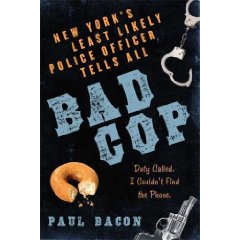
    Paul Bacon’s Bad Cop: New York’s Least Likely Police Officer Tells All is a good book. It’s a quick read and a nice look inside the NYPD.

    My problem is that the hits a little too close to home. Bacon is a self-professed liberal who only stayed in the police department a few years. Errrrr… Sounds like me. But I quit because I wanted something better. Bacon quit because he couldn’t hack it. Bacon was, as he readily admits, a bad police officer. And by the end of the book, I was convinced.

    That doesn’t sound like me. At least I hope not. Even worse, Bacon seems to blame his lack of policing ability on being a (gasp!) Liberal. I couldn’t disagree more. I’m generally of the belief that a lot of people could make good police officers. Paul Bacon does not help me make this case.

    Bacon’s problems didn’t come from his political beliefs, it is the fact that deep down he’s a slacker. A beach bum. His general mellowness and belief that everybody can just get along if just left alone is not liberal. It’s lazy. It turns out Bacon is a good at hanging out on the beach and being a dive-instructor. Perhaps it is those very qualities that made him a bad cop.

    All that said, I really liked the book. It’s a great read, if a bit “lite” (but a hell of lot deeper than most other lite cop reads). Bacon (and yeah, he already knows that’s a funny name for a cop) has a wonderful perspective on the daily life of police officers and some of the absurdities of policing in the NYPD. Plus it’s only $10 on Amazon. How can you go wrong?

  • Steve Bierfeldt’s Box Full of Cash

    In town for a conference, a director of Ron Paul’s Campaign for Liberty is detained by TSA at the St. Louis airport because when asked to explain why he’s carrying $4,700 in cash (it was proceeds from book and ticket sales at the conference), he asks the agents to tell him what law requires him to do so. He managed to surreptitiously record his conversations with TSA officers on a cell phone. The audio is infuriating.

    That’s from Radley Balko’s The Agitator. Radley is a bit too anti-cop for my tastes, but he’s on the mark more often than not. And his Cato work on police raids is a classic.

    Now I don’t fault the cops for asking questions. I would do the same. But I would be a bit quicker to realize that cash isn’t a crime, see the Ron Paul campaign link, and understand the man isn’t going to answer questions and let him go.

    Finally, a smarter officer (different agency?) realizes it’s campaign money, sees the red flag, and tries to set the original officers straight:

    “Campaign Contributions…. You guys stopped him because the metal box.” He doesn’t phrase that as a question.

    “Well that and the large amount of money that was in there.” Ix-nay on the ash-cay, chief! Cash isn’t a crime, even if it mightgive you reasonable suspicion for a stop. But after that, you got nothing.

    The complete audio is here. I like how Bierfeldt doesn’t say he “knows his rights!” Instead he says he doesn’t know his rights.

    It all goes back to the war on drugs. And every time the government asks you to give up rights in the name of fighting terrorism, it will be used in the war on drugs. We don’t give “implied consent” to be searched at airports because we’re worried about people carrying cash. We give up our rights so we’re not blown up by a terrorist!

    It doesn’t take a agitating libertarian to worry about a government that stops a person walking through an airport with cash.

    Back in 2004, an astute former police officer wrote in the Washington Post:

    What starts as a necessary security measure will quickly become standard law enforcement procedure even for crimes that are nonviolent and not related to terror.

    In order to stop and search any suspect, not just a terrorism suspect, law enforcement need only wait for a person to enter an implied consent area such as a subway or a shopping mall…. The true object of the search — most likely drug possession, but any contraband will do — is unrelated to terrorism.

    The difference between civilian employees searching for bombs in airports and government agents conducting random searches for suspicious objects is the difference between preserving a free society and creating a police state.

    The solution — the balancing of public safety with constitutional liberties — is surprisingly simple…. Limit the doctrine of plain view…. If the government must search without probable cause, let it search, but only for illegal weapons or bombs…. Any unrelated suspicious or illegal objects found must be ignored.

    Read the whole article here.

  • Say What?

    The Philadelphia Inquirer reports that, “A Philadelphia police officer has been put on desk duty after he was quoted spouting his disgust for the black residents in the community he patrolled.” And people wonder why cops don’t trust outsiders.

    The officer is said to have used the “N word” (though not at somebody). I won’t defend that. But I will defend other things the police officer supposedly said:

    “People in this neighborhood don’t care about each other,” Thrasher was quoted as saying. “They’ll shoot each other for drugs, for money, for bullshit. All they care about is their reputation. They want to look tough.” True.

    At another scene, where a man was shot in the back of the head by his daughter’s boyfriend, Thrasher said: “These people are . . . disgusting. It’s like they’re animals.” Sometimes.

    My book, Cop in the Hood, is filled with quotes like this. It’s not a white thing; it’s not a black thing; it’s a police thing. Police are coming across dead people with the brains blown out. People acting like fools. People killed for no good reason. What are we supposed to think?

    So what’s the bad part? To see these things? To think these things? To say these things? Or to say these things in front of a Temple University graduation student and then get quoted out of context.

    Is it not enough that we ask police to police in these neighborhoods while dodging bullets? But now police have to act like the B.S. they see is normal or acceptable behavior? And you wonder why police hate outsiders and the press? This is politically correctness gone haywire.

    The Guardian Civic League, an organization of black Philadelphia police officers, called for Thrasher’s firing. Maybe Thrasher is a mean S.O.B. I don’t know. I’ve never met the guy. Maybe he’s a good police officer. Maybe he’s not. But I guarantee you one thing: every member of the Guardian Civic League has said or thought the same things at some point.

  • Will Wilkinson Smokes Pot and Likes It

    Will Wilkinson Smokes Pot and Likes It

    Will Wilkinson interviewed me a while back on Bloggingheads TV.

    The Atlantic Monthly’s Andrew Sullivan has been documenting on his blog the stories of typical, productive Americans—kids’ football coaches, secretaries of the PTA—who smoke marijuana because they like to smoke marijuana, but who understandably fear emerging fully from the “cannabis closet.” This is a profoundly necessary idea. If we’re to begin to roll back our stupid and deadly drug war, the stigma of responsible drug use has got to end, and marijuana is the best place to start. The super-savvy Barack Obama managed to turn a buck by coming out of the cannabis (and cocaine) closet in a bestselling memoir. That’s progress. But his admission came with the politicians’ caveat of regret. We’ll make real progress when solid, upstanding folk come out of the cannabis closet, heads held high.

    So here we go. My name is Will Wilkinson. I smoke marijuana, and I like it.

    Read all of Wilkinson’s piece in The Week.

  • 3 Pittsburgh Police Officers Killed

    Three officers killed. Two wounded. This is too soon after Oakland.

    22-year-old man with bulletproof vest and assault riffle kills officers responding to a domestic call at 7:30am. The wounded cop killer surrendered to police at 11am.

    Some of the wounded officers remained for a time where they fell because other officers could not reach them because of the continuing fusillade…. SWAT officers were pinned down, with their protective shields up, at an adjacent house.

    Other friends said Mr. Poplawski had several guns, including an AK-47 assault-type rifle, a .357 Magnum revolver, a .380-caliber handgun and a .45-caliber handgun. They also said they believed he had not been getting along with his mother.

    Former classmates said they were surprised by this morning’s events. [A friend said the killer] was opposed to “Zionist propaganda” and was fearful that his right to own weapons would be taken away.

    “He always said that if someone tried to take his weapons away he would do what his forefathers told him to do and defend himself.”

    Read the whole story by Michael Fuoco and Jerome Sherman in the Pittsburgh Post Gazette.

  • Indictments in Baltimore

    Three officers, two retired, one of whom I know and like, are indicted five years after an incident. Gimme a break.

  • Coming home to roost

    Seems like the drug war is now chipping away at the freedom and privacy of police officers. In L.A., gang and narcotic officers will have to turn over detailed personal financial information. The story.