Copinthehood.com has moved to qualitypolicing.com

  • Publishing qualitative criminal justice

    [Fair warning: Intended for stuffy academics. If you think you won’t be interested, you’re probably right.]

    I received the latest issue of Journal of Criminal Justice Educationyesterday. I have to confess, I’m not certain why I get this journal. I don’t remember ever subscribing to it. Of the journals I get, it’s the one I generally find least interesting. Take for instance: “Why we Need Certification Standards in Criminal Justice Education and what the Impacts will be: a Response to the Concerns of JDs.” Yawn. Maybe it comes with membership in some professional criminal justice organization I belong to.

    But the latest issue is great. I mean don’t mean CSI excitement here. But most of this is good stuff:

    “Lombroso’s Legacy: The Miseducation of Criminologists”argues that because of the evil history of genetic-based criminology, we’re missing out on important developments now. Given the poor track record of genetically-based social science, I’m not so convinced that we should be quick to discard the legacy of Hitler and assume that this time, we’ve got it right. I don’t know. Perhaps. They didn’t teach me this stuff (and that’s the point of the article).

    “Reviewers’ Views on Reviewing: An Examination of the Peer Review Process in Criminal Justice.”Worth reading if you’re trying to get articles published.

    “The Great Books in Criminal Justice: As Ranked by Elite Members of the Academy of Criminal Justice Sciences.” No, my book isn’t there. But it’s good to see what some consider to be our canon. If you’re a student in the field, you should know these books. And if you’re a student in the field, there’s a good chance you’ll never all these books in one list, conveniently broken down by field.

    “The Quantitative/Qualitative Divide Revisited: A Study of Published Research, Doctoral Program Curricula, and Journal Editor Perceptions.” This was the best article and that one that made me open the journal in the first place. As a qualitative researcher, I’ve very concerned with this divide. Can you get published if your work does not include statistical regressions? There is good news and bad news. The bad news is that leading journals publish even fewer qualitative articles than I thought. The quantitative/qualitative ratio is roughly 90%/10%. That’s not good.

    The good news is that most editors claim to be open to qualitative works but simply don’t receive enough of them. The article also has what seems to be excellent advice on what you, as a qualitative writer, can do to increase the chances of acceptance in a leading journal. Simple things I didn’t know (basically, among other things, use the format standard for quantitative pieces).

    This article by Kevin Buckler is rare for an academic writing. Along with being a nice blend of well presented quantitative and qualitative data, it’s informative, convincing, well written, and actually enjoyable to read. If you are a qualitative academic trying to get published in criminal justice journals, it is, as they like to say, a “must read.”

  • Foot Patrol

    Foot Patrol

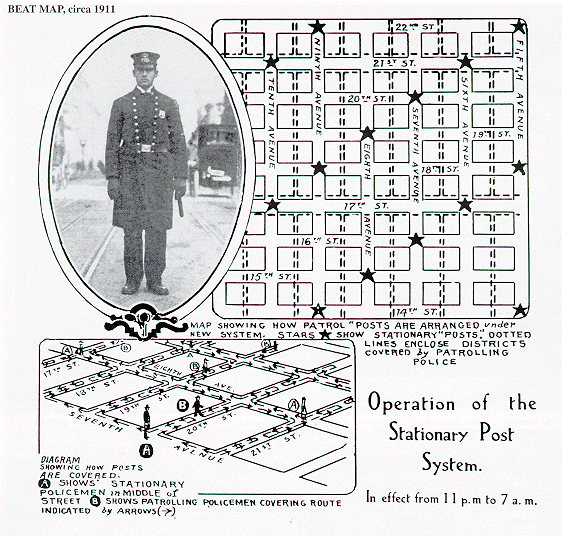
    Whenever people say there aren’t enough officers for foot patrol, I say, “hogwash” (or something with similar meaning). We used to have foot patrol. And we didn’t have more police. It’s a question of priorities, not resources. Here’s a interesting diagram from 1911.

    I don’t know if this was the theory, the practice, or a proposal. And perhaps standing in the middle of the intersection isn’t the best strategy. But it’s still very interesting to see. (Plus those old hand-drawn diagrams have style!)

    Basically foot patrol was replaced with making officers available to answer 911 calls. Too bad former is much better than the latter.

  • Can you order pizza?

    Maybe you don’t stay up at night thinking about cell phones in prison. And maybe you shouldn’t. But think about it for a moment… we can’t keep cell phones out of the hands of prisoners. Somehow I think that’s significant.

    The story by Dan Kane in the News & Observer.

  • CSI: Real World

    I wish more people would realize that the real world is not like TV.

    Problems in the Detroit crime lab.

  • Less overtime = More murder?

    Messing with police overtime is like messing with a dog’s food. You better makes sure it doesn’t come back to bite you. “It’s like our heroin,” one cop says in Cop in the Hood, “it’s just something we need.”

    The root of the problem is that half the department is assigned to patrol, chasing radio calls. So when it comes to officers that have the freedom to do police free from 911 calls for service–and we all know that 911 is a Joke–cutting overtime can have a huge impact on the kinds of policing that can actually prevent crime.

    Justin Fenton writes the story in the Sun:

    Killings rose as police cut OT
    Despite official denials, union chief sees effect on city safety

    Baltimore’s deadliest month of 2008 coincided with substantial reductions to the Police Department’s overtime budget – cuts that the police union president says are interfering with investigations and diminishing neighborhood patrols.

    Prompted by a directive from Mayor Sheila Dixon to cut more than $21 million this year amid the worsening economy, the department spent $800,000 less for overtime in November than in the same month the previous year, according to former homicide Detective Robert F. Cherry, who was elected union president this fall.

    The month saw 31 homicides, the worst November in nine years. The trend has continued, with six killings in the first six days of this month.

    “Detectives are being told, you can’t finish working a case, you have to go home. We can’t put foot men in a certain area, it will cost overtime. And district commanders are being beaten down if they spend over,” Cherry said. “You’re lying to the public if you say we’re attacking all forms of crime, and you’re lying if you say the budget cuts have no effect.”

  • More on the Greek riots

    The BBC has a good story about the Greek culture of “No.”

    And also goes into something I should have explained, namely why November 17 is a day of protest and why students are key: :

    On 17 November 1973, tanks of the then six-year-old [American supported] military dictatorship burst through the iron railings to suppress a student uprising against the colonels.

    The exact casualty figure is still unknown to this day but it is believed that around 40 people were killed. The sacrifice of the polytechnic was so significant that the post-junta architects of Greece’s new constitution drafted the right of asylum, which bans the authorities from entering the grounds of schools and universities.

    That is why places of learning are the springboards for the current wave of violence and it also explains why many of the riots are in university towns.

    Students and pupils have effectively been given carte blanche to carry on protesting, because their professors have declared a three-day strike.

    Greece also has long history of studentsgoing on strike. As an American professor, I find that very amusing. Also, it is illegal to have a private college or university in Greece. The state has a legal monopoly on post high-school education. That’s a shame. It’s why a lot of Greeks travel abroad to get a better education.

    Expect things to calm down by Thursday when the professors’ three-day strike ends.

  • Worse than the average Greek riot

    Worse than the average Greek riot

    Greek police shot and killed a 15-year-old boy in Athens Saturday night after a confrontation between police and a group of people.

    There have been some pretty big riots ever since. Here’s the latest from English-language version or Kathimerini. And the New York Timeshas a storyand slide show.

    The fact that there were copycat riots in other cities means this clearly strikes a nerve.

    These are probably worse than your average Greek riot, most likely the worst since Greece’s return to democracy in 1973. But… and here the rub… there issuch a thing as an “average” Greek riot.
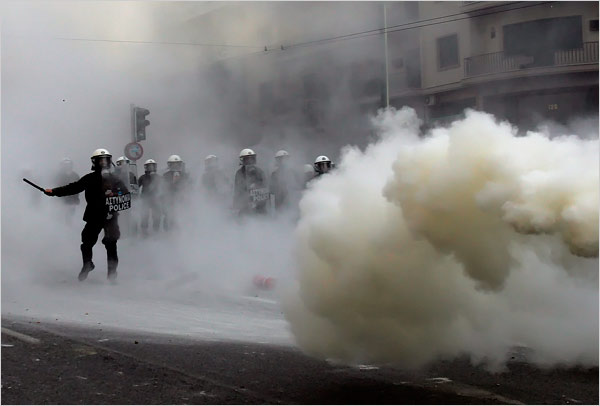
    Every year, on November 17, there are riots in Athens. As the BBC puts it: “Each year, on that date, tens of thousands of trade unionists, left-wingers and ordinary people march from the Polytechnic to the heavily fortified US embassy. Invariably the demonstration disintegrates into a ritual battle between riot police and anarchists.”

    I lived in Athens for a while back in the early 1990s. I speak enough Greek just to get into conversations whereby I can’t understand a thing (“It’s all Chinese to me,” say the Greeks).


    I’ve never felt Athens to be a dangerous place. So on November 17th one year, because it’s the kind of thing I do, I went to the University to check things out. Now I tried not to open my mouth and out myself as an American (though it probably would have been fine if I had) and I went a little earlier than I thought things would get really hot. But still, in the early evening I walked past the police line into a pro-riot zone and strolled around balaclavad youths filling Molotov cocktails with fuel.

    Dangerous? I don’t know. There was also an old man, a kafetzis, strolling though the crowd with full tray of coffee, selling frappe to the rioters. Frappe, Greek iced coffee, to the rioters. And yes, people were coming up to him politely, paying for coffee, and then going back their business. What kind of riot has a coffee vendor?!

    The only thing that comes close… and it really doesn’t come close, was when I was at an Ice Cube concert and people were buying and drinking tea, with cup and saucer and coffee cookie and everything. That was in Amsterdam at the Paradiso.

    To a certain extent, riots in Greece are ritualized. Injuries are kept to a minimum. And nobody gets killed. Maybe a bank gets burnt. A few cars. And a perhaps a small rocket-propelled grenade is launched at the American Embassy. Truman Statue tipping is always fair game. At some point, either to quell or to instigate, the MAT (that’s Greek for S.W.A.T.) comes in and fires tear gas and stands behind plastic shields blocking missiles.

    My point is simply that pictures of Greek riots are always worse than reality. If I may overgeneralize, Greeks are more full of passion than anger. I have no doubt there is real passion. There’s a huge left-right divide in Greece. The civil war in Greece came after WWII. There was a right-wring military dictatorship 35 years ago. Even the language your write in and the color of your graffiti have political connotation.

    Of course it’s not November 17. So this riot wasn’t on the agenda. And a kid did get shot and killed. The official police version seems to be it was a warning shot gone array. The cops were arrested, by the way.

    Plus, there’s also a lot of corruption in Greek police (especially in the night-life arena). And police brutality is probably more accepted there than it is in the U.S.

    No doubt when you’re dealing with anger, alcohol, Molotov cocktails, bottles, bricks, fires, police reaction, and less-lethal force, somebody could get seriously hurt. But usually nobody does.

    My point is just that this isn’t L.A. 1992. This isn’t the suburbs of Paris 2005. Yes, the rocks and firebombs are real. But if that man is still walking the streets selling frappe, I wouldn’t be too worried.

  • Oops

    “Massachusetts Chief Charged Over Event Where Boy Killed Self With Uzi.” The story by Michael Levenson from the Boston Globe. I kind of feel sorry for the Chief. It’s interesting the father wasn’t charged. Not that I think charging him would accomplish anything. It’s just that I can’t imagine the same courtesy going out to somebody from, shall we say, the “inner city.”

  • Lax gun laws? More killings.

    There’s a shocker. The story’s by Cheryl Thompson in the Washington Post.

  • Broken Windows in the Economist

    I got issues with this piecefrom the normally stellar Economist.I just happened to have lunch yesterday with George Kelling. He has issues, too.

    For one thing, Broken Windows is not Zero Tolerance.