Copinthehood.com has moved to qualitypolicing.com

  • More guns = More deaths.

    More guns = More deaths.

    I don’t like guns, but I’m not a gun control nut. I think there are a good many reasons that people can and should have guns. If I were a store owner in a dangerous neighborhood, I’d want a gun. If I were a resident in a dangerous neighborhood, I’d want a gun. If I were a hunter, I’d want a gun. If I lived in wilderness, I’d want a gun.

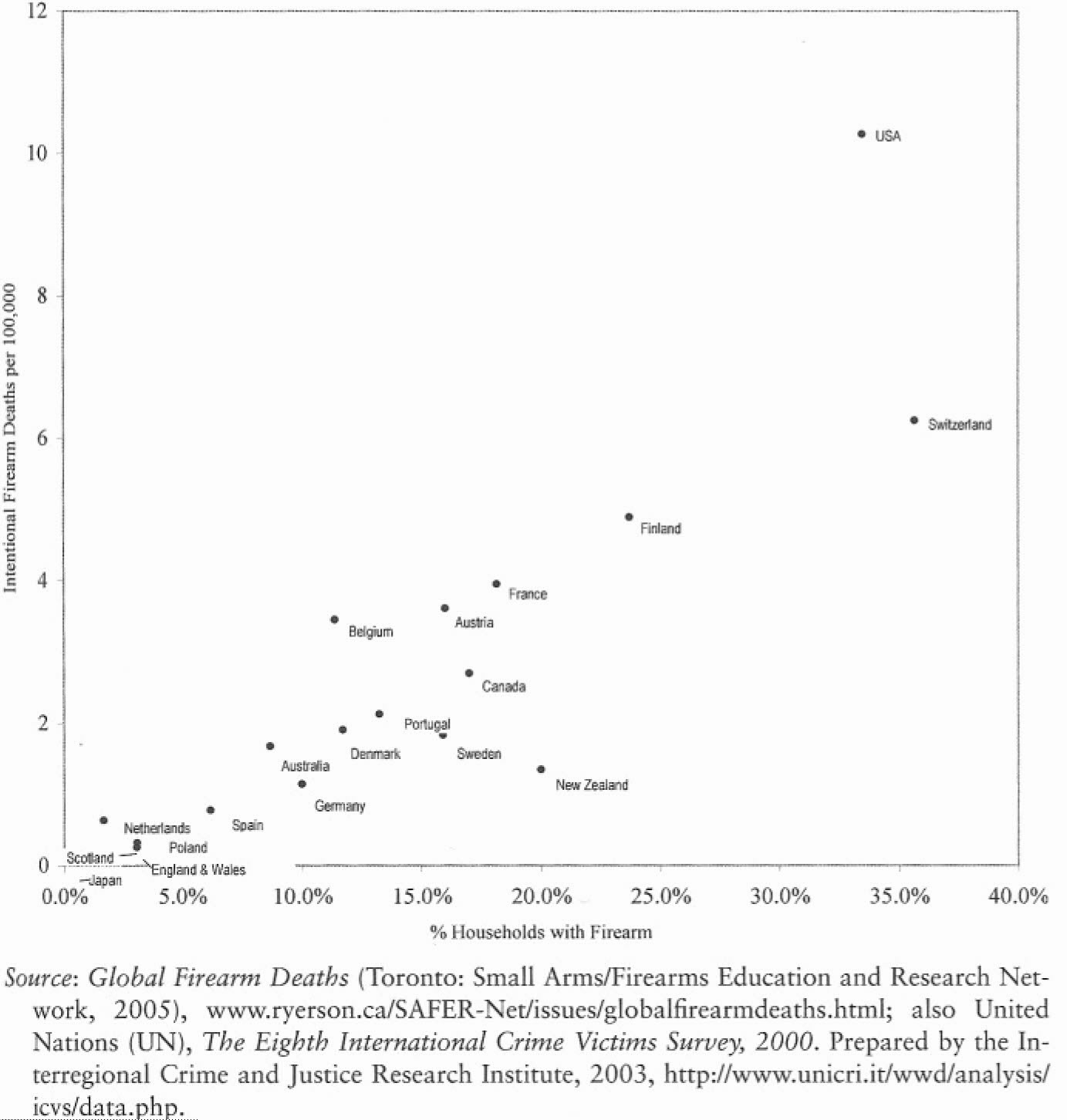
    But guns, equal death, not freedom. At least in a democracy. To me, this is obvious. But maybe it’s not. Here’s a little picture to make the point. For European countries (and America)–what I like to call civilized nations, the kind of countries I want to be compared to–the correlation is strong: the higher the percentage of households with guns, the more people get killed by guns. Duh.

    Of course the US tops the list. Switzerland is the only country listed with more guns, and their firearm death rate is lower than the US, because there’s more going on in American homicides than just guns. We’ve got the war on the drugs. We’re also rare in that we combine lots of guns and lots of poverty. One or the other is usually OK, but not both.
    Sorry the graphic is hard to read. Clicking on it makes it much bigger.

    There is no country with few guns and a lot of murder.

    By the way, my favorite argument for central government and gun control isn’t on the list. That’s Somalia. Land of the free.

  • U.S. War on Drugs: Bolivia

    U.S. War on Drugs: Bolivia

    George Washington, in his 1796 farwell address, warned about unnecessary foreign entanglements:

    The great rule of conduct for us in regard to foreign nations is, in extending our commercial relations to have with them as little political connection as possible. So far as we have already formed engagements let them be fulfilled with perfect good faith. Here let us stop.

    The U.S. messing up other countries to fight our failed war on drugs is nothing new. Here’s the latest, in an article in the New York Times about the U.S. meddling unproductively in Boliva.

    A few highlights:

    “Two months ago a mob of 20,000 protesters marched to the gates of the American Embassy, clashing with the police and threatening to burn the building down.” The president praised the demonstrators.

    “[President] Morales, a former grower of coca, the raw ingredient of cocaine, is both an antagonist and an active partner in American antidrug policy for the region. He often describes the United States as his leading adversary and has made the right to grow the coca leaf a top symbol of sovereignty and anti-imperialism.

    “Yet he has also gone to unexpected lengths to restrain coca cultivation, and he accepts about $30 million a year from the United States — almost his entire antinarcotics budget — to fight cocaine.”

    “For now, Mr. Morales and the United States remain uneasy bedfellows. Mr. Morales has been hesitant to sever ties with the United States, especially since it provides Bolivia with about $100 million in development aid each year. It also grants duty-free access for Bolivian textiles, an economic lifeline for his country.”

    “The American-backed Anti-Narcotics Special Forces, known as the Leopards, go about their job. Each day at dawn, eight-man teams in camouflage snake out of a military base here in new Nissan Patrol sport utility vehicles, driving down dirt roads into the jungle. Then they get out and walk, chopping through brush with machetes, grasping M-16 rifles, in search of small mobile coca-mashing factories that have pushed Bolivian cocaine production to a 10-year high. When they find one, they set it ablaze.”

    The commander of the unit says, “We depend on the Americans for everything: our bonuses, our training, our vehicles, even our boots.”

    Meanwhile coca cultivation has increased, up 8 percent in 2006 and 5 percent in 2007.

    “Mr. Morales, 48, spent his teenage years in the coca fields of the Chapare after his impoverished family migrated here from the high plains. He then rose through the ranks of the region’s coca growers unions in the 1980s and 1990s, a time when American-backed troops were aggressively trying to eradicate every illegal coca plant in Bolivia.”

    “In defiance, coca growers, or cocaleros, blockaded crucial roads and clashed with security forces. In a new biography of the president, the Argentine writer Martín Sivak describes one episode in which a group of Leopards beat Mr. Morales after he spoke at a rally, leaving him for dead. A photograph in the book shows the president as a wisp of a young man, lying beaten on a stretcher.”
  • In Texas School, Teachers Carry Books and Guns

    I don’t see what the problem is. And I’m a liberal who supports gun control. I’m all for a assault riffle and handgun free America. But it’s not going to happen.

    Maybe as a cop I’m not afraid of guns (in the right hands). Maybe as a teacher I want one. But really, I don’t.

    But I do have students in my class with guns. I got no problem with that. And I wouldn’t want guns in all school. But I don’t see the problem here.

    In Texas School, Teachers Carry Books and Guns

    HARROLD, Tex. — Students in this tiny town of grain silos and ranch-style houses spent much of the first couple of days in school this week trying to guess which of their teachers were carrying pistols under their clothes.

    “We made fun of them,” said Eric Howard, a 16-year-old high school junior. “Everybody knows everybody here. We will find out.”

    The school board in this impoverished rural hamlet in North Texas has drawn national attention with its decision to let some teachers carry concealed weapons, a track no other school in the country has followed. The idea is to ward off a massacre along the lines of what happened at Columbine High School in Colorado in 1999.

    “Our people just don’t want their children to be fish in a bowl,” said David Thweatt, the schools superintendent and driving force behind the policy. “Country people are take-care-of-yourself people. They are not under the illusion that the police are there to protect them.”

    Really. What’s the problem?

    The whole story in the New York Times is here.

  • Murders down in Eastern

    Buried in a small story in the Sun: “Nineteen people have been killed in the Eastern District this year, half as many as at this point last year.”

  • The poor mob

    Sometimes I kind of feel sorry for these guys. From the Boston Globe.

    The New England Mafia just is not what it used to be.

    In what would be an unusual move for a man of his rank, the family’s reputed underboss, Carmen “The Cheese Man” DiNunzio, is accused of personally delivering a $10,000 bribe to a near stranger, a man who turned out to be an undercover FBI agent.

    Some of his underlings have supplemented their incomes by shoplifting, and one aging soldier was spotted peddling electric toothbrushes on a street in the North End, State Police said.

    The big break against the mob happened when sentences shot way up. Guys were willing to serve 5 years for their crew. But the threat of 50 yearsmade them sing like birds.

    Legalized gambling also played a part. There’s a lesson in that.

  • Prop Joe? He Dead.

    Prop Joe? He Dead.

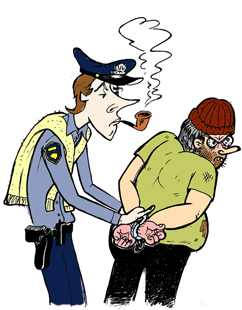
    That’s a Wirereference, if you don’t know. There’s a short Q & A about me in Vanity Fair titled “The Ivy Leaguer Who Took on Prop Joe.” The art cracks me up:
    While ace writer Jordan “slugger” Heller’s text makes me sound so rough and blue-collar, the art just captures my naturally effeminate and pompous persona perfectly.

    Hmmm, yes, indeed, I remember arresting that ruffian. It sure felt mahvalous to get that rapscallion and his dirty scowl off the street! I always carried a sweater just in case it got chilly or I needed to pat my high brow. In this arrest, I was just so thrilled that the scoundrel didn’t make me perspire (or even put out my pipe)! It was so nice to have that sketch artist capture the moment! What a dah-ling!

    When Harvard-trained sociologist Peter Moskos entered the Baltimore Police Academy, back in 1999, his objective was simple: observe up-close the methods and culture of an American police department. He never planned on actually becoming a cop. But one day after Moskos arrived, the police commissioner who’d approved his project left office, and the new regime was not so accommodating. “Why don’t you become a cop for real?” he was asked—or rather, dared—by the interim commissioner, who was threatening to throw him out on his Ivy League butt. Six months later, the Princeton/Harvard alum had a badge and a gun, and was patrolling the graveyard shift of Baltimore’s high-crime Eastern District, the same drug-riddled streets that served as a setting for HBO’sThe Wire. The result:Cop In the Hood: My Year Policing Baltimore’s Eastern District, Moskos’s book recounting his year in the ranks of the thin blue line.
    VF Daily: Your background is not typical for a police officer. Did you take much flak from your fellow cops?
    Peter Moskos: Actually, I found that I got surprisingly little flak from fellow cops about being a Harvard student. I got more shit from Harvard professors about being a cop.
    What were your professors worried about?
    Originally I wasn’t going to become a cop; traditional academics aren’t supposed to do that. [They’re supposed to observe, not participate.] So I think they felt I was pulling the bait and switch. But some of it I think was just class snobbery: “You’re a Harvard student, you’re not supposed to become a cop. That’s a blue-collar job.”
    The midnight shift in Baltimore’s Eastern District. That’s serious. Aside from the criminals you’d be dealing with, did you worry about encountering police corruption?
    [The Eastern District] could be perceived as the heart of darkness of police culture, so yeah, I was worried about it, but I didn’t see any corruption. What I did find, however, is that the average cop has more integrity than the average professor.

    There’s more. The whole Q & A can be found here.

  • Oh Nos!

    Rabid kitten discovered in North Baltimore

    A stray kitten that wandered into a North Baltimore backyard this month had rabies, the first city cat or dog found to have the disease in more than 20 years, officials said yesterday.

    Two people who tried to help the kitten are receiving medical treatment. Others who are concerned that they or their pets may have had contact with the kitten are asked to call the Bureau of Animal Control.

    The whole story is here.

  • L.A. Police Shift Discipline Away From Automatic Punishments

    I had no idea that any department could be so stupid to have a system of “automatic punishment.”

    “In a series of changes this year, direct supervisors are being encouraged to forgo suspensions of officers who they believe will change their behavior – or just made a one-time mistake – and instead opt for written warnings.”

    “Police officials believe the shift could turn around a department, forcing officers to think about their actions instead of automatically being suspended and often getting paid for those days by a union insurance policy.”

    You think?

    The whole story is here.

  • Police departments don’t enforce immigration laws

    Good.

    “Despite a nationwide clamor against illegal immigration, only 55 of more than 18,000 police and law enforcement agencies across the country have signed agreements to coordinate with U.S. Immigration and Customs Enforcement.” The whole story is here.

  • In our nation’s capital…

    “My one beef with law enforcement in general is I hate the top-down approach, that only people with rank can think.”

    I think I’vesaid that before. But that quote is from D.C. Police Chief Cathy Lanier.

    “Lanier wants to convert the department from a conventional military-style hierarchical culture into one driven from the bottom up. That means accountability and leadership need to come from all ranks, particularly from those at the bottom who play the most important role for citizens.”

    Here’s the whole story.