Copinthehood.com has moved to qualitypolicing.com

  • Study finds long benefit in psychedelic mushrooms

    Interesting story here.

    Meanwhile, in Amsterdam the move to re-criminalize psychedelic mushrooms has been postponed another year. They’re still sold legally in stores.

    Some of my friends in Amsterdam (from where I write this) are E.R. nurses. They complain to me about the summer influx of drugged-out people to the hospitals. They’re all tourists and mostly casualties of shrooms and spacecakes. They live. But they annoy the hell out of the nurses.

    Health care in the Netherlands, by the way, is notfree for tourists.

  • Man kills burglars

    A man in Texas killed two men who had burglarized his neighbor’s property. A grand jury decided not to indict the killer.

    In general, I don’t have much sympathy who criminals who get killed in the act of committing a serious crime. But this case pushes the limit because the guy wasn’t protecting his life or his property, he called 911 and the dispatcher told him to say inside, and the criminals weren’t any threat to him. Best I can tell, the man went out and shot two guys (illegal immigrants) because they had robbed his neighbors.

    If a cop had done it, he or she would certainly be indicted. I don’t think this killing was right. I think it’s murder. And yet, I don’t want anybody to be convicted for shooting burglars. I can’t quite explain this contradiction in my beliefs.

  • “Engaging as Well as Persuasive”

    So says Diane Scharper in the Baltimore Sunabout my book, Cop in the Hood. Here’s the whole review:

    In his classic book, On Writing Well, William Zinsser claimed that people and places were the twin pillars on which all good nonfiction is built. These three books – all with a local connection – prove that point. Their subjects qualify them as textbooks. Yet they are written so engagingly that any one of them could be beach reading. The secret lies in the authors’ attention to detail, story line, character and setting.

    Cop in the Hood By Peter Moskos

    When former President Richard Nixon declared war on drugs, he outlawed barbiturates, amphetamines and LSD. He also perhaps inadvertently set the stage for today’s system of jailing drug offenders, costing $22,000 per prisoner per year – a total of $8 billion annually – while propelling robbery and murder statistics to record heights. After nearly 40 years, it’s time to admit that this costly war has failed, says Peter Moskos in his Baltimore-based book, Cop in the Hood.

    An assistant professor of law, police science and criminal justice administration at the City University of New York, Moskos came to Baltimore while a Harvard University graduate student to gather “valid data on job-related police behavior.” It took him three years to turn that data into a Ph.D. dissertation and another three years to write this account.

    A Chicago native, Moskos knew Baltimore primarily from the films of John Waters and Barry Levinson, whose depictions of the city differ significantly from the conditions Moskos found. Moskos was both dismayed and fascinated by Baltimore’s Eastern District, which he calls “one of the worst ghettos in America” in terms of “violence, drugs, abandonment, and despair,” much of it caused by drugs.

    Chronicling his six months training in the police academy and the 14 months he patrolled Baltimore’s east side, Moskos blends academic writing with techniques of creative nonfiction. Moskos packs his account with anecdotes, details, dialogue and off-the-cuff observations about everything from the Baltimore dialect to ghetto slang to the recipe for crack.

    Ultimately, his story is engaging as well as persuasive. As Moskos aptly puts it, “If [after all these years] the war on drugs were winnable, it would already be won.”
  • Does cheap gasoline cause crime?

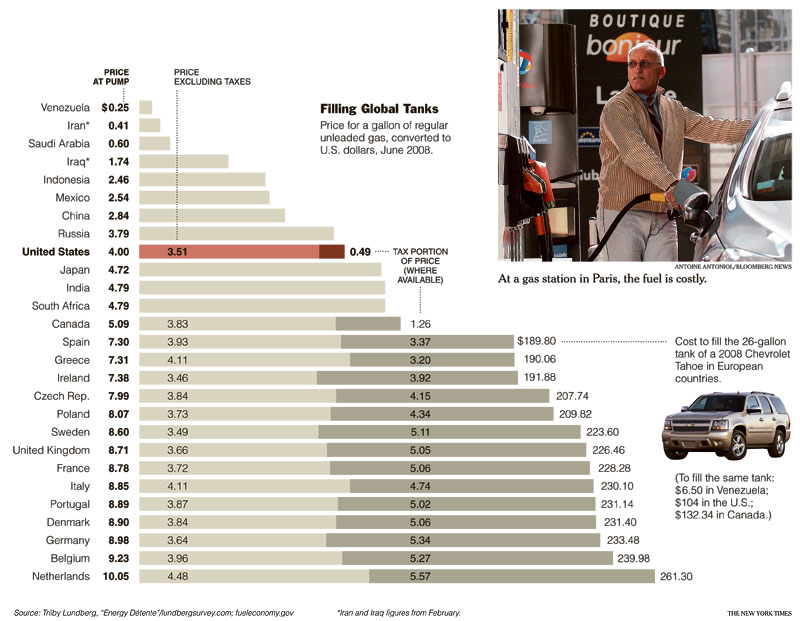
    Does cheap gasoline cause crime?

    I wish gas were taxed more. Much more. Luckily, I’m not running for political office. I saw this figurein an article in today’s New York Times. The point of the article is that gas in the U.S. is still pretty cheap compared to most countries. But when I look at the figure, I see what I think is an inverse correlation between the price of gas and crime. Leaving aside middle-eastern countries that produce oil, countries with cheap gas have higher crime rates and countries with expensive gas have less crime. I haven’t actually looked at the crime rates for these countries (and if somebody has the time and desire, please do and let me know), because I don’t think this correlation has any real meaning. But it’s interesting.

    While I’m pretty sure that higher gas taxes won’t cut the homicide rate, there does seem to be a pretty strong correlation between expensive gas and safe streets. I’m writing this from Amsterdam, the Netherlands. Gas here tops the chart at $10 a gallon. Yet the economy seems to be doing just fine and too many people still drive to work in SUVs.

    What does the government do with all this tax money? Along with more police and safe streets, there’s also health care, job security, paid vacations, public transportation, bike paths, and a secure system of dikes and levies that actually keeps the country from being flooded. Not bad for a few bucks a gallon.

  • “Couldn’t put it down”

    I don’t know who this guy is, but I like him because he likes my book. A lot. Certainly more than he likes O’Malley.

  • Officer Pete says (rule 1):

    Always keep your hands where I can see them.

    [All the rules of “Officer Pete says” can be seen here. Got any to add? Please do so in a comment!]

  • Officer Pete says (rule 2):

    Please sit still when I ask you to.

  • NIJ Taser Report

    The National Institute of Justice has released a report on Tasers. Basically, they say they’re safe, but with some important qualifications. I think those qualifications need more emphasis than the report gives them.

  • Ivy-League cops

    I had a piece in the Princeton Alumni Weekly about my experiences as a police officer. Turns out I’m not the only Ivy-League cop out there. Here’s an excerpt from an email I received from a North Carolina police officer.

    I thought I would take a bunch of crap for being an Ivy League guy – I try to keep it quiet as much as I can—but people eventually find out, and when they do, their first question is “why the hell are you here?” They assume since I could take my degree and go somewhere and make 6 figures, that must be what I would want to do. They are usually impressed that I would give up what their view of what a Princeton grad’s life should be and be a cop the same as them. As you wrote, I try to work hard and go home safely to my wife and daughter every day, and it has definitely given me a real appreciation for what I have in life. I do hope to move up in the department, maybe even be chief one day, but for now I enjoy being a patrol officer. For me, it’s so much better than sitting behind a desk or being in meetings or on conference calls.

    I replied:

    I got a lot of that “what the hell are you doing here?” too. But I had what was considered to be a good answer: “to write a book.” Still I was very surprised by what I considered the lackof flack I got from fellow officers for being a Harvard grad student. I also wonder if I would have stayed a cop had I been in a better paying department and a more pleasant work area. Part of the job I loved. Dealing with the same shits on the same corner every day, however, grew tired very quickly.

    I would take policing over a 9-5 desk job. But I’ll take being a college professor over policing.