Shouldn’t this be biggernews? This is shocking (at least to me). Sure, “all of the gunshot wounds are non-life-threatening.” OK… but… that doesn’t make it OK. I don’t get it. Do we not care just because, I don’t know, white people be crazy? Imagine the outcry had the shooters been Muslim. Or black.
Copinthehood.com has moved to qualitypolicing.com
-
What the War on Drugs was really about: “We knew we couldn’t make it illegal to be either against the war or black”
Dan Baumwrites about what the Drug War was really about:
In 1993, I was researching my first book, Smoke and Mirrors, which is the tale, starting in the 1968 Nixon presidential campaign, of how drugs were turned into a political weapon. I tracked down as many people as I could who had been involved in drug policy in the Nixon, Ford, Carter, Reagan, Bush, and brand-new Clinton administrations. Among the first I found was John Ehrlichman, who was at the time doing minority recruitment for an engineering firm in Atlanta. He looked nothing then like he had when he’d been a principal Watergate villain in the early 1970s and an evil god in the bad-guy pantheon of my youth. By 1993, he was fat, and wore an Old Testament beard that extended far below the knot of his necktie. He impatiently waved away my earnest, wonky questions about drug policy.
“You want to know what this was really all about?” he asked with the world-weary air of a man who, after public disgrace and a stretch in federal prison, had little left to protect. “The Nixon campaign in 1968, and the Nixon White House after that, had two enemies: the anti-war Left, and black people. You understand what I’m saying? We knew we couldn’t make it illegal to be either against the war or black, but by getting the public to associate the hippies with marijuana and blacks with heroin, and then criminalizing both heavily, we could disrupt those communities. We could arrest their leaders, raid their homes, break up their meetings, and vilify them night after night on the evening news. Did we know we were lying about the drugs? Of course we did.”
-
Right-Wing Lies (XI): Donald Trump says…
There’s something that’s starting to scare me about Trump and his supporters. I mean, is it really inconceivable that he will win the Republican nomination for president?
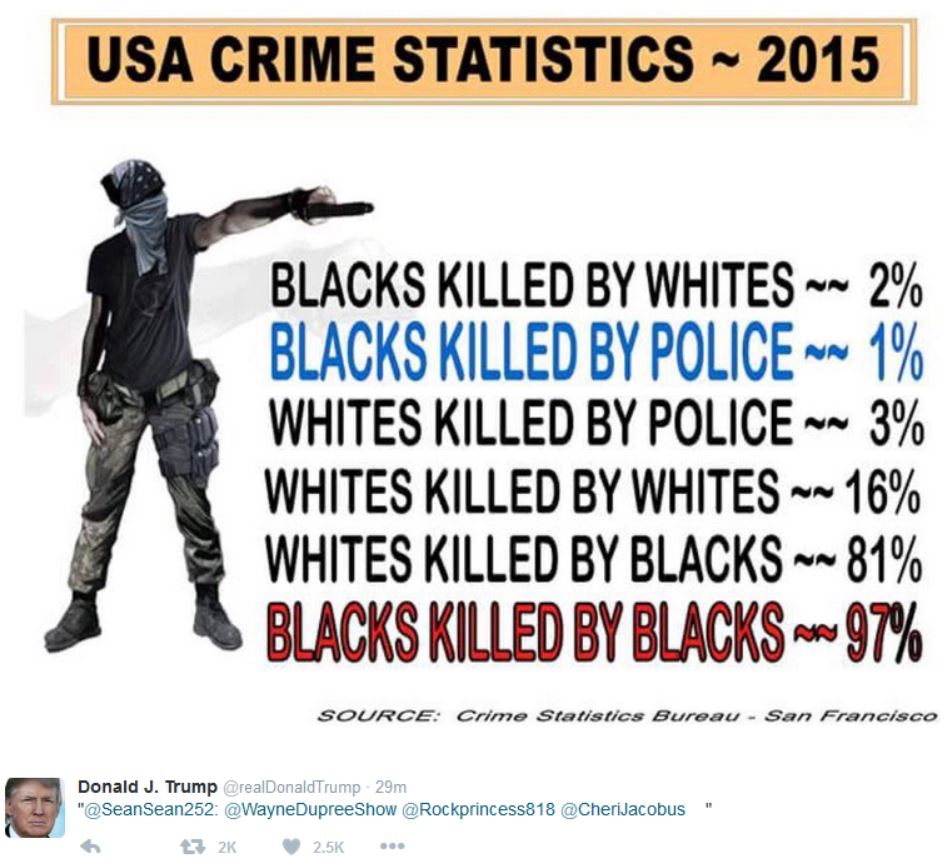
Here’s a doozy of a Tweet posted by Donald Trump:

Leaving aside the racist imagery, Trump’s numbers aren’t even close to being true.
Here are the (approximate, but true) numbers (which, like Trump, omits hispanics):
Blacks killed by whites: 11%
Blacks killed by police: 4%
Whites killed by police: 10%
Whites killed by whites: 84%
Whites killed by blacks: 15%
Blacks killed by blacks: 89%
Can people really believe that 4 in 5 murdered whites are killed by blacks? Or is just something the fearful Right wants to believe? Either way, such a belief, with no basis in truth, is somewhat between ignorant and terrifying. (Also, there is no “Crime Statistics Bureau — San Fransisco”)
When the leading Republican candidate for President has behavior entirely consistent with fascist thuggery, I think he needs to be called out. Whether it’s Trump’s thinking that it might be good for his white mob to rough up a minority protester, his openness to the concept of registering all Muslims in America, him calling Mexicans rapists, his lies about Arabs in Jersey City cheering the fall of the World Trade Center, or his overall tone of lies and fear mongering.
I don’t know if trump is a fascist. I think he’s more just an attention whore than an ideologue. But maybe he really does believe what he’s saying. Certainly his followers love it. America has a long and ugly history of Nativism. And while not all Nativists are fascists, there is a bunch of overlap.
Source: (an actual real one) UCR, 2010-2013. Yearly police-involved shootings extrapolated from the Washington Post. Hispanics in the Post are reclassified as 86 percent white and 12 percent black. This is to be consistent with the UCR, which does not count Hispanic as a race.
Update #2:
-
Sing with SATAAAAAN!
Apparently an officer in Sanford FL (pop 57,000, 30% African American) was fired for this (and quit before termination). I don’t know if he was on duty of off duty (or why it would matter).
A cop with a clean record gets on stage at a concert and shouts, best I can tell, “Let the journey begin!” I thought this is what touchy-feely community police are supposed to do. Now I hate death metal as much as the next guy. Probably more. And I’m sorry if you clicked on that link unaware that Jesus would promptly flee the room. But, seriously?
You may remember Sanford as the the place where George Zimmerman killed Trayvon Martin and got away with it. Maybe there’s a backstory we don’t know about. At least we don’t have to rehash the pointless “I wonder if this would would have happened if the cop were white?” debate. The cop was white; the chief who fired him is black. I wonder what would have happened if a black cop had introduced Ice-T’s Cop Killer. I wonder if… Oh, never mind.
Perhaps the real issue is that Chief Cecil Smith is offended by anti-Christian lyrics? I don’t take lyrics at face value; it’s a song! But maybe in small-town Florida, singing for Satan is still seen as a threat to our Lord and Savor the the moral fiber of America? I don’t know.
Anyway, this is further reason cops are paranoid. And also why police unions and due process have a role in protecting the job of civil servants.
(thanks to Julio)
-
“The Islamic State bombed a neighborhood [in Beirut], not a ‘Hezbollah stronghold.’”
My friend Annia Ciezadlo wrote this piece for the Washington Post. How come when innocent Parisians were killed by terrorists, everybody shed a tear? (as they should)
But when innocent Beirutis get killed by terrorists, they’re described as living in an “Hezbollah stronghold.”
If you’re too lazy to click though, here’s a chunk of it:
The Syrian refugee crisis has had a crushing impact here [in Beirut]. According to the official numbers, there is one Syrian refugee for every four Lebanese…. If the European Union took as many Syrian refugees as Lebanon has, proportionally, the number would be upwards of 300 million.
In Beirut you see the impact of this every day….Every night, Syrian women and children fill the streets, begging or selling Kleenex and flowers. Every winter, when the rain and snow come, a handful of Syrian children in flimsy tents freeze to death.
…
Does the world only care about Syrian refugees, or victims of the Islamic State, if they’re in Europe?
I don’t think so. As a writer, and a journalist, I think part of the explanation for this double standard is language.
In the Western press, Lebanon is a country perpetually at war. To Western readers, the pressures of a 25 percent population increase, a war next door, and another series of bombings don’t seem like an inconvenience, because most Americans think of war when they think of Beirut.
The beauties of everyday life — the smell of fresh bread from a bakery, the laughter of children on their way to school, lovers sitting in a cafe — don’t define Beirut’s image in the West the way they do for a city like Paris. And yet all those things happen here, too. They are the daily neighborhood life that the bombing here, like the one in Paris, was calculated to destroy.
But when there’s a bombing in Beirut, nobody mentions these things.
On Friday, my news feeds were full of articles describing Bourj al-Barajneh as a “Hezbollah stronghold.”
…
This language is ubiquitous: On Sunday, when French warplanes bombed the Syrian city of Raqqa, English-language newspapers described it as an “ISIS stronghold.” As an English-language reader, you could be forgiven for imagining the Middle East as a series of strongholds, linked together by stretches of desert and the occasional camel.
Why does this matter? Because it describes civilians in terms that make them sound, however subtly or unconsciously, like combatants. Like a bastion, or a battlement, the literal meaning of a stronghold is a location that people barricade themselves behind and launch attacks from. It’s not a neutral way to describe a civilian neighborhood that has just been bombed. It implies that the civilians who live there are part of the military campaigns of the people who are in charge.
…
In Raqqa, for example, plenty of civilians who are not Islamic State sympathizers aren’t able to leave. Describing it as a “stronghold” implies that they support the Islamic State when they are effectively being held hostage by it.
…
When a Western city is attacked, we see the city’s security measures as vindicated by the killings, not as subtle justifications for them. We do not cite them as evidence that the victims were living in a “stronghold” of militarism.
-
The Ferguson Effect
Another good piece by Leon Neyfakh at Slate.com. This one on the “Ferguson Effect.”
-
Jury Duty
How do I talk about jury duty without sounding like I’m whining about jury duty?
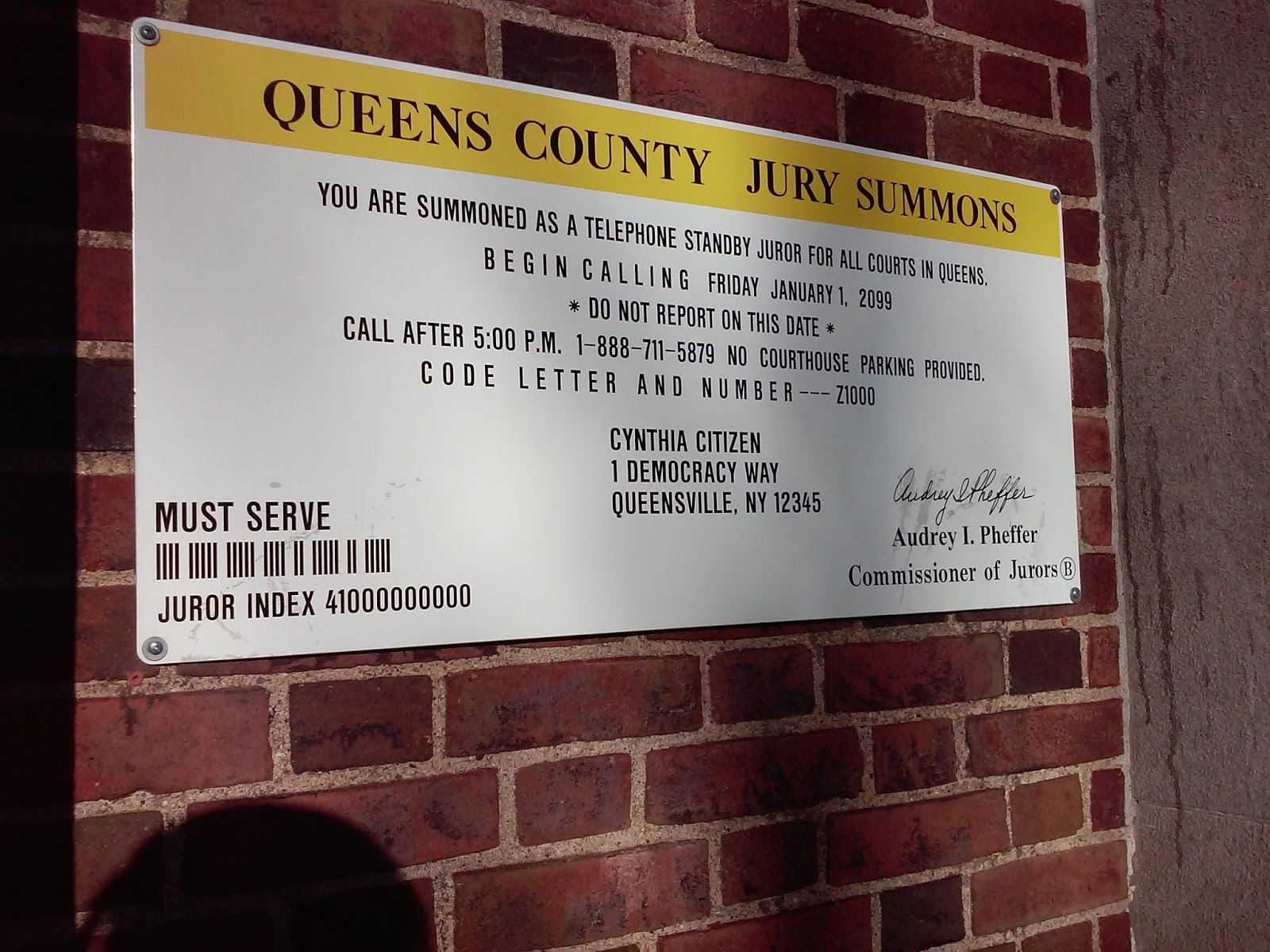
(As to Cynthia Citizen on 1 Democracy Way in Queensville…. They can’t fool me. I know the system. That’s no Queens address.)
I don’t want to whine, but I will mention the security line to get in the building in the morning takes 20 minutes. It makes airport TSA look incredibly efficient. Seriously.
There were 60 jurors in our pool. Add that to the cost of the drug war. It was a drug case. 60 people missing three days of work. If you figure $100 a day of missed wages (You get paid $40 if you don’t get paid because of jury duty), that’s $18,000 right there. And for what? I bet they’re still dealing drugs in Jamaica, Queens.
I found something slightly amusing about people griping at the inefficiency of it all. Leaving aside it’s not supposed to be efficient (but sure could be more efficient) I thought how this is a lot of peoples’ first real dealing with the justice system. And if you think it’s bad as a potential juror, just imagine how it works as a potential criminal! Still, I couldn’t help but think, “The last time I was waiting around in court, at least I was getting paid time and a half.” But except for getting up early for a commute that took an hour and a missed trip to DC, it wasn’t a terrible inconvenience to me. It could have been worse. I don’t have kids. I still get paid.
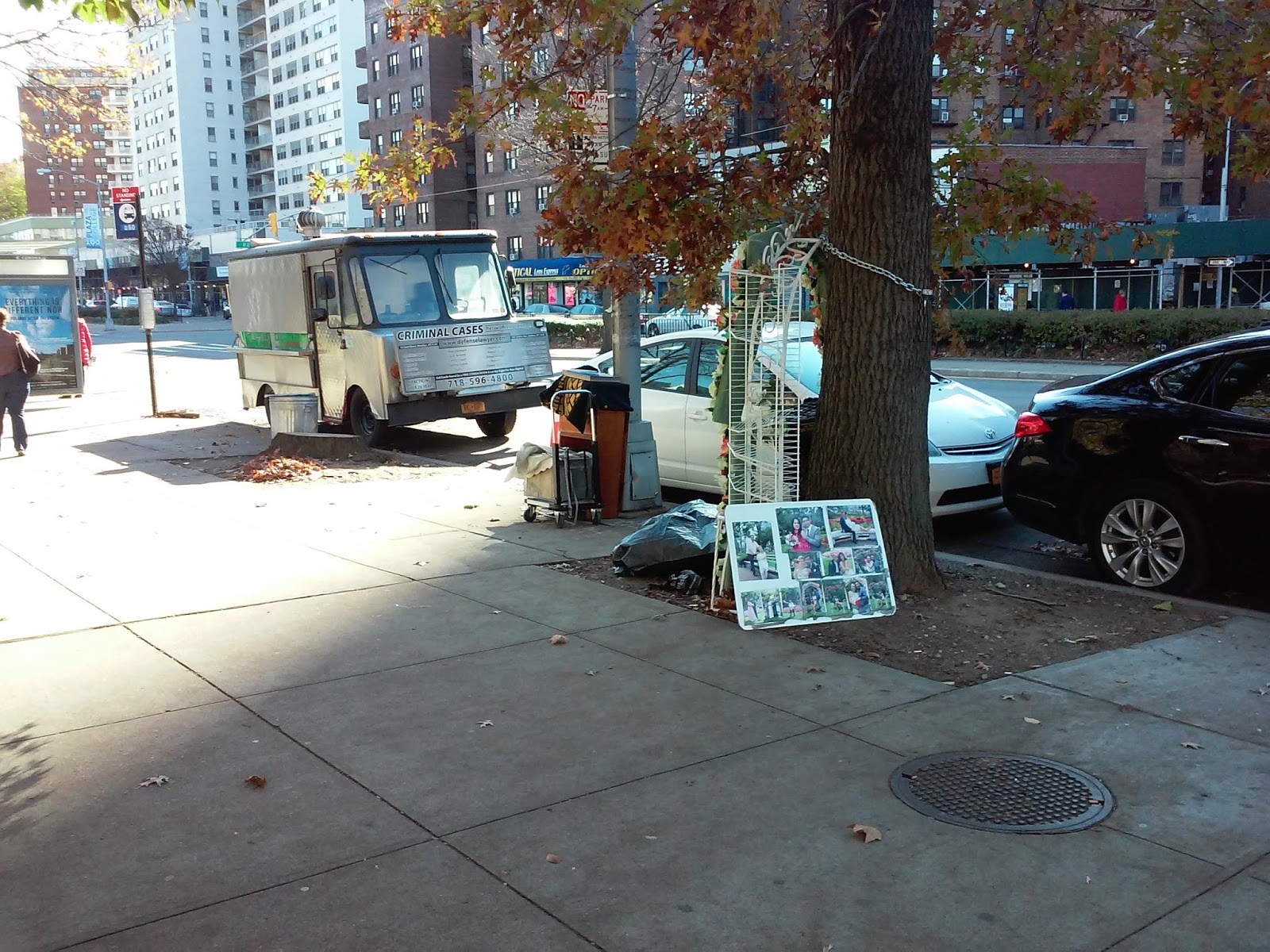
(Nothing says Queens County Court like a food truck with a lawyer’s ad and a two-bit street take-your-wedding-picture-here operation.)
I like “civic duty.” I actually wanted to serve. Given what I do professionally, I want to see the criminal justice system from the jurors’ box. But whatdayaknow? My educated friend-are-cops professorial ass was voir dired right off an undercover police buy-and-bust cocaine trial.
But I had time to think. A lot of time to think. I was on telephone call from last Monday. Last week would have been a good time to serve. But I wasn’t called into the Queens Courthouse till Friday. On Friday, we were told to come back on Monday.
On Monday, my afternoon class didn’t get taught. We were told to come back at 2pm. Half the jury was sat. The rest of us were told to come back Tuesday. I had a train ticket and hotel in DC Monday night for police conference in DC. I didn’t make it because of jury duty.
On Tuesday, the other half was sat. We were freed at 1pm. Can’t be called for four years. I’m at least happy I was kicked off rather than simply sent home.
Every jury was asked his or her education, marital status, occupation, occupation of family and grown children, criminal conviction, and if they or loved ones were ever the victim of a crime. The judge, the good natured and pleasantly demeanored Hon. Barry Schwartz, asked everybody if they could be fair, if they convict based on beyond a reasonable doubt, and if we wouldn’t demand more than beyond a reasonable doubt. This explaining takes a long time. Especially when it is done person by person. It was explained that most or all of the testimony would come from police, that the defendant, a black man about my age, didn’t have to testify, and that the burden of proof lay entirely on the prosecution.
The prosecutor made it clear there was no DNA or fingerprints. This was not TV. Could we still convict based only on eyewitness testimony? Yes, I nodded.
The prosecutor raised silly examples about the chefs at a hypothetical “Cheesecake Factory” being an important part of your dining experience even though you can’t see the chef. And annoyingly did this to each box of jurors, even though we were all in the courtroom. So we got to hear it twice. She used the Cheesecake Factory as a kind of everyman’s restaurant. Something we would all know. (“What an stupid example,” said my wife, “There are no Cheesecake Factories in New York City!” Good point. The only Cheesecake factory I’ve ever seen is in Chicago. I suspect the young prosecutor lived in suburban Long Island.
She also made a point about how you might be a teacher and students might say you’re mean just because you told them to be quiet a bunch of times and they wouldn’t listen. Just because students complain doesn’t mean you really are mean. Right? This could happen. Yes. Yes. I get it. There are complaints against the cops.
I’m pretty sure I was nixed by the defense attorney, because it was he who was asking me a lot of questions about what exactly I taught. He also asked, “do you know what a buy-and-bust case is?” I said I did. I wanted to add the Ali G line, “I’ve done a few of them myself,” but that wouldn’t have been true. It never actually came up I was a cop. I guess they figured I was too educated for that. But they did confirm I have lots of cop friends. And it was the defense attorney who admitted to me in the jury box, that this is your basic undercover buy-and-bust case. I suspect he didn’t want jurors to know how routine it was. The harder to cast reasonable doubt.
Too bad the defense attorney had no idea that this had the potential to be the jury-nullification non-violent drug case of my dreams! Sure, I think the defendant is guilty as sin. That doesn’t mean I wouldn’t put my money where my mouth is. Hell, I was probably the only hope he had.
My own personal highlights?
• The Muslim who discovered religion on Day Three when he said he couldn’t possible convict based on just one person’s testimony. “It is against my religion!” There’s something in the Quran about needing three witnesses or something. He didn’t mention any religious objection when asked the day before. He was not sat.
• The chatty older white “hard-working day laborer, your honor” who complained in the hall about losing $300 a day. A fair enough complaint. But then I didn’t believe him when he said he couldn’t possibly be a fair juror given that he had a family member who had been the victim of a crime. “I just don’t like criminals.” The judge reminded him he didn’t have to like criminals. He was here to judge if this guy was a criminal. The laborer stuck to his guns, promising he couldn’t be fair, logic be damned. He was not sat.
• I actually recognized and called out a Kinyarwanda name! That’s never happened before. She was a very nice older woman, the wife of a retired African diplomat. We sat next to each other on the jury box and had a very pleasant conversation about life and politics during pauses in the action. Her favorite posting? Ottawa. Why? “We still have friends from there. It was the only place we became good friends with out neighbors!” Oh, Canada. Try to be nicer, why don’t you?! She got sat.
• The young black woman who, the day before, tried to get out by saying she drove through the intersection we were to stay away from (where it went down) to get to work. The judge pointed out A) she wouldn’t be working and B) she could drive an alternative route. She later asked a court cop what would happen if she didn’t come back. She did come back. And then told the judge she couldn’t be fair. I don’t remember why. I don’t think she got sat.
• The majority of the jurors had been or had close family members who had been mugged.
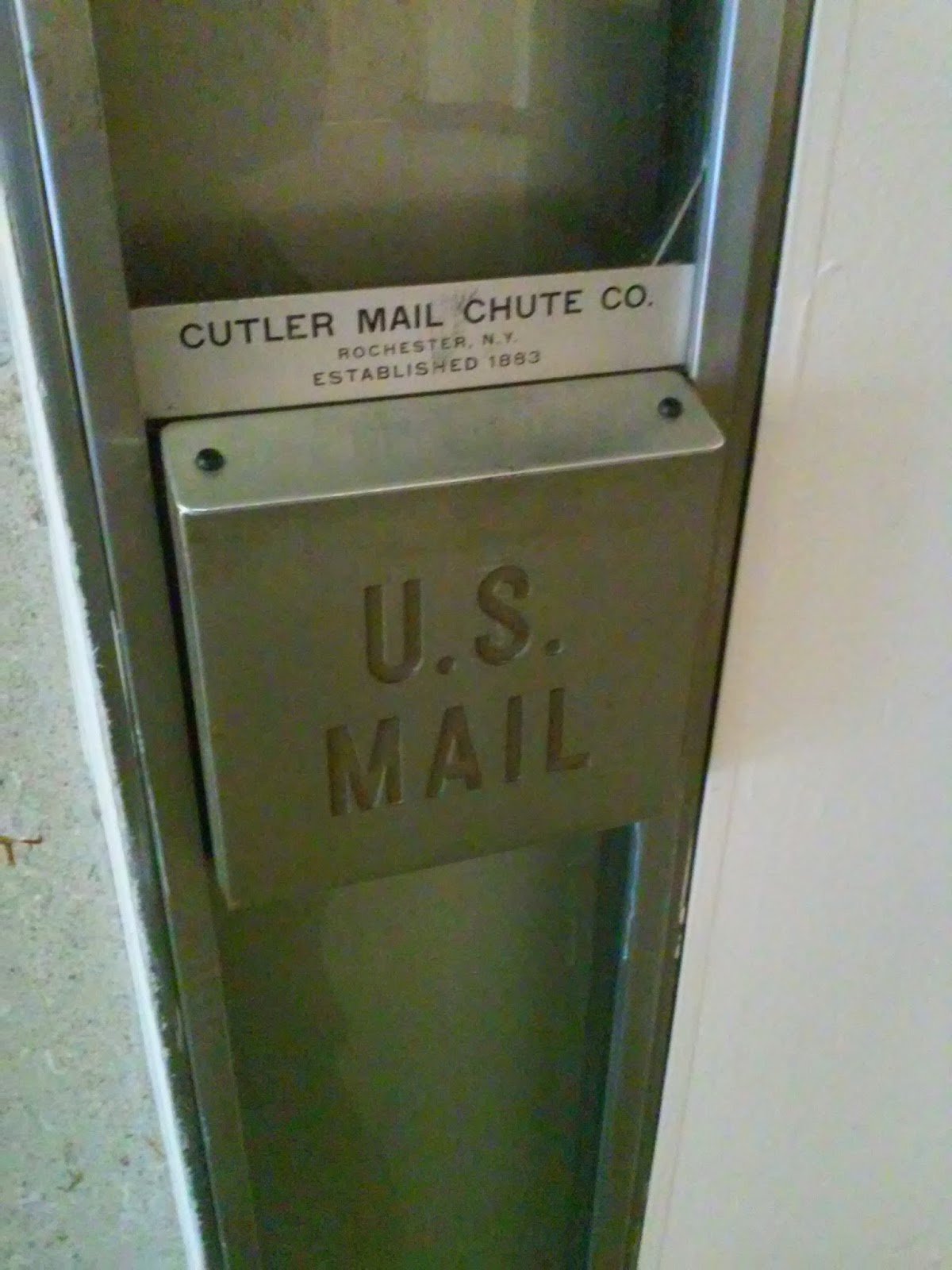
• The courthouse has a mail dropand phone booths. Alas, they were all sealed and non-functioning. Once we used to build grand things. Oh, the humanity.
-
Why police need big guns
My man Eugene O’Donnell wrote this in the Daily News. It’s worth reading, given general opposition (including some from me) to the militarization of police:
At present only a handful of police departments have the capacity to intimidate would-be terrorists and, if need be, wage sustained combat against them in the streets of America. This is a weakness to correct, not a condition to celebrate.
-
Just cause it’s legal don’t make it right
Sometimes it’s fun to play a bit fast and loose with the numbers to make a greater point:
By 2014, [civil asset forfeiture] had ballooned to roughly $4.5 billion for the year…. According to the FBI, the total amount of [reported] goods stolen by criminals in 2014 burglary offenses suffered an estimated $3.9 billion in property losses. This means that the police are now taking more assets than the criminals.
Is this a valid comparison? Kinda sorta not really. But hopefully it did get your attention. Because something is wrong with massive civil forfeiture. And this is one way to look at it.
(Though the fact checker in me would like to verify the burglary stats.)
-
“The most disturbing thing I’ve seen”
Two (black) cops were criminally charged in the fatal shooting of a (white) six-year-old boy in Louisiana, who was in a car, I guess being chased.
I haven’t seen the video, so what do I know? But Colonel Michael Edmonson, the Superintendent of the Louisiana State Police, said footage of the incident was, “the most disturbing thing I’ve seen.” Damn. “The two officers were arrested on Friday after body-camera footage taken from them was assessed.”