Copinthehood.com has moved to qualitypolicing.com

  • I still like the baton

    Maybe this is minor in the bigger picture of what people are saying about Michael Wood Jr, but I have to disagree with Wood’s dislike of the baton. In a radio interview he said he didn’t carry his because he couldn’t imagine hitting somebody with it. In the Balko interview he says cops used them to dent doors.

    I loved my baton. I still have it. Right by the front door, just in case. The straight baton I’m talking about, not the asp. Wood never had a straight baton (BPD phased them out in 2001). The straight baton can do so much more than the asp. It’s defensive. You can wack a leg or arm. You can thrust forward and back. You can hold it in multiple positions (some more benign than others). You can twirl it. (One of my great regrets was trying and failing to master the espantoon.)

    The old-fashioned baton gives you a certain gravitas when you walk the beat.

    Unlike most cops I carried my stick with me to almost every call. I wanted to avoid being in a situation where I might be on the losing end of a fight and have to kill somebody. And partly because of my willingness to carry it (combined with the general view on the street that cops carried a baton only when they planed on using it) I never actually did have to strike anybody.

    But I sure did use it to knock on doors. Did I dent any? I don’t know. Not intentionally. But how else are you going to be heard knocking on a door? The door bell hasn’t worked in decades. I learned pretty quickly that my knuckles aren’t hard enough. There’s loud stuff going on. And I don’t want to waste everybody’s time — they did, after all, call 911 — not knowing whether or not you heard me knock the first time. Also, I wanted to make damn sure you knew that police were at your door. When you’re a cop you knock like a cop. You take a step to the side, rap a few knocks loud as hell (once), and say “PO-lice.” Worked every time.

    I wrote more in defense of the straight baton in 2011.

  • The Futility of the War on Drugs

    Given the recent discussion started by Michael Wood, Jr. this last excerpt from Cop in the Hood couldn’t come at a better time:

    It may seem incongruous for police officers to see the futility of drug enforcement and simultaneously promote increased drug enforcement. But for many, the drug war is a moral issue and retreat would “send the wrong message”:

    “It’s a crusade for me. My brother and a cousin died from heroin overdoses. I know that on some level it’s a choice they made. But there was also a dealer pushing it on them. I want to go out and get these drug dealers.”

    Another officer was more explicit: “You’ve got to see it [drugs] as evil. What do you think? It’s good? When we’re out there, risking our lives, we’re on the side of good. Drugs are evil. It’s either that or seeing half the people in the Eastern [District] as being evil. I like to think that I’m helping good people fight evil. That’s what I’d like to think.”

    The attitudes of police and criminal are largely controlled by a desire to protect their turf while avoiding unnecessary interactions. On each call for service, drug dealers generally do not wish to provoke the police and most police officers are not looking for adventure. At night, curfew violations can be enforced on minors. Open containers can be cited. People can be arrested for some minor charge. But arrests take officers off the street and leave the drug corner largely unpoliced while the prisoner is booked. Nothing police officers do will disrupt the drug trade longer than it takes drug dealers to walk around the block and recongregate. One officer expressed this dilemma well: “We can’t do anything. Drugs were here before I was born and they’re going to be here after I die. All they pay us to do is herd junkies.”

  • Things Police Do

    Things Police Do

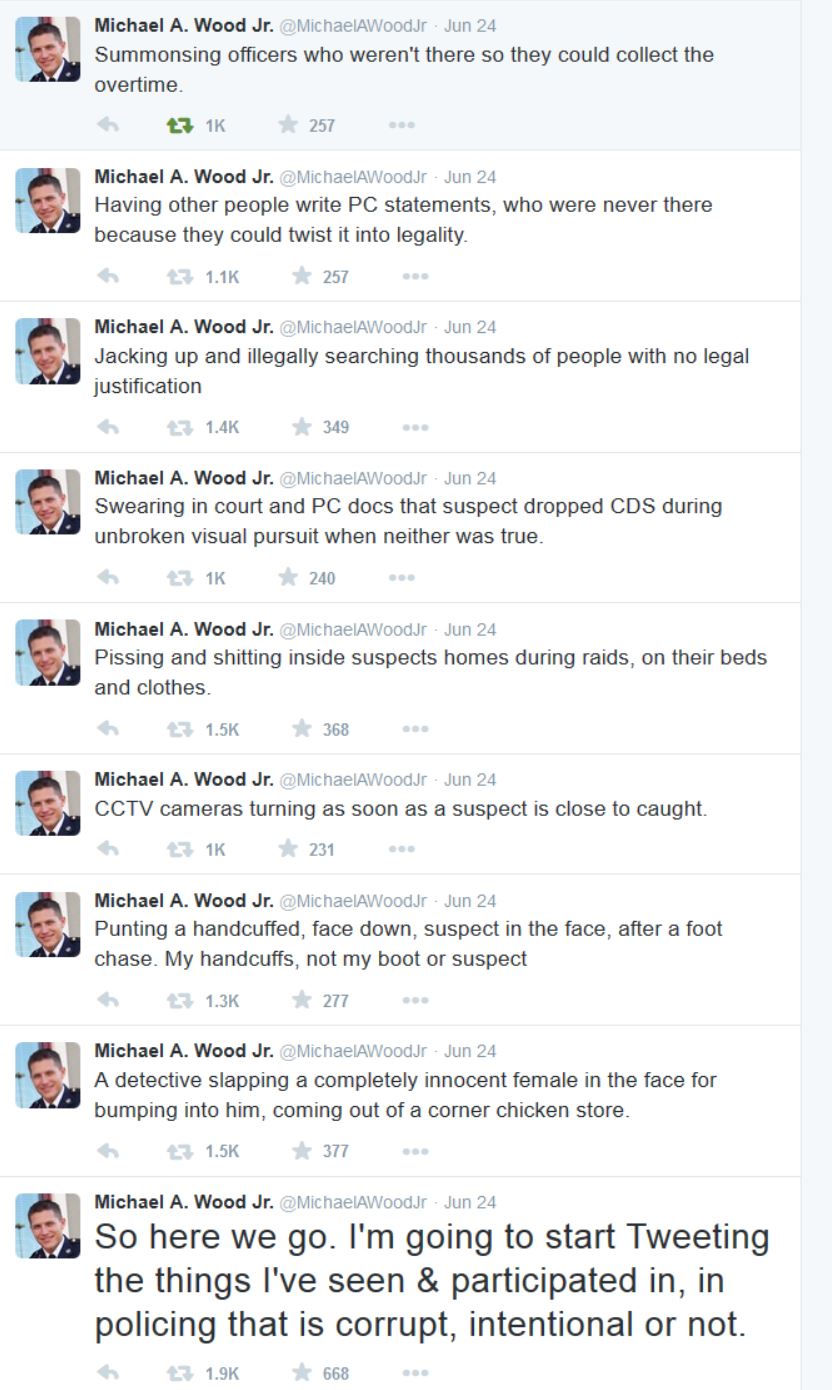
    Michael Wood Jr. has made some waves by tweeting about things he saw as a Baltimore cop.

    [To get up to speed, single best thing to read now is the Balko interview.]

    Honestly, I don’t doubt what Wood says. I am curious if all the bad he saw came from his time in narcotics. And for better or for worse, he wasn’t in narcotics long. I don’t think he made an arrest since 2009. There has been lots of time to bring up these issues. Lots of time to go to IAD. In fact, he still could. But anyway…

    I never worked a specialized unit. I didn’t want to. I didn’t like they way the worked. (I also wasn’t there long enough anyway to get out of patrol.) I saw the drug squads tear up homes during raids. (I was sometimes the lone “uniform” out back.) It was immoral and ugly. Worst of all, it was legal.

    End the drug war and 80 percent of police problems vanish.

    But I’m curious, if Wood was a sergeant, did this stuff happen under his command? Because then it’s also on him. But all in all, I have no reason not to take him at his word:

    I will admit to some self interest in coming forward. I’d like to part of the solution. I woke up to this, and I think I can be a bridge. I speak the language cops speak. If there’s some task force or policing reform committee I can serve on, I’d love to do that.

    Other than that, I think we just need more conversation.

    Unlike Wood, I never had a “come to Jesus” moment working as a cop. The world — and policing — is filled with a lot of gray. I already knew the war on drugs was doomed. (What I learned as a cop on the front line was how that failure worked out on the front line.) I suppose I went in a bit more world weary and cynical than the average cop. I was older (29) than the average rookie. I lived in the city. I did not have a military us versus them attitude. I was college educated. Well traveled. I spent a lot of time with the police in Amsterdam (on and off from 1996 to 1999). So I had a certain perspective as to what I was seeing and doing on the job. I was not completely unfamiliar with the ghetto, black people, or urban life in general. I was not afraid.

    I am afraid that lost in the sensationalism of a cop “telling all” will be the subtlety and nuance of what Wood is saying. It would be unfortunate were this just filed away as ammo in the “cops are bad” camp. I know — as I presume Wood does — too many cops who do care, do have empathy, and do work very hard to help people. I also know a lot of cops who maybe stopped caring, but still do a good job. And, sure I’m all for societal justice, but lofty ideals don’t tell police what to do in neighborhoods with these kinds of problems!

    In a very long radio interview Wood mentions something which deserves highlighting:

    This job is largely impossible.

    The expectation of the modern police officer is that they should be a medic. They need to be MapQuest. They need to be a jujitsu expert. They need to be a handgun superstar who can shoot somebody in the knee…. They need to be a psychiatrist. They need to understand mental illness. They need to be able drive effectively. They need to do all of this while making $45,000, having minimal training, and no education.

    Wood makes the point that there’s too much injustice in our society. He’s right. And he’s right that they’re linked to race and class. He’s right that the rules are different if you grow up in the ghetto. He’s right that the war on drugs is a failure. And he’s right that too many cops come from completely different backgrounds without any empathy or understanding of the area or the people in the area they police. He’s right that what we’re doing isn’t working. He’s right that police can do better.

    Here’s an interview of Wood by Radley Balko in the Washington Post:

    What we’re doing to people to fight the drug war is insane. And the cops who do narcotics work — who really want to and enjoy the drug stuff — they’re just the worst. It’s completely dehumanizing. It strips you of your empathy.

    I found his take on veterans as cops (he is one) interesting:

    But when it comes to former military joining law enforcement, I’m in the camp that says they’re going to be better when it comes to shootings and using force. Bad police shootings are almost always the result of a cop being afraid…. The military strips you of fear. Here’s the thing: There’s nothing brave or heroic about shooting Tamir Rice the second you pull up to the scene. You know what is heroic? Approaching the young kid with the gun. Putting yourself at risk by waiting a few seconds to be sure that the kid really is a threat, that the gun is a real gun. The hero is the cop who hesitates to pull the trigger.

    That’s where I think a military background can help. Very few of these bad shootings were by cops with a military background. There may have been a few, but I can’t think of one.

    I’ve often said it would be nice if we could talk about some of the important issues before somebody dies. Maybe Wood is giving us that opportunity.

    [Though he’s wrong about the baton.]
  • Hey, it’s just the jobs and potential freedom of six police officers.

    Nobody seemed to believe Baltimore’s FOP last week when Robert Cherry said:

    “We have a state’s attorney who used an opportunity of crisis to quell the riots.”

    “The unrest had nothing to do with my decision to charge,” says Mosby. “I just followed where the facts led.”

    Score this one for the FOP. The Sun reports:

    By charging six police officers in the arrest and death of Freddie Gray, State’s Attorney Marilyn J. Mosby restored order to Baltimore “before the entire city became an armed camp or was burned to the ground,” her office argues in a new court filing.

    Thanks, Mosby. Glad you solved that riot problem. And so nice to see you in all the magazines. I don’t think I need to point out how wrong of a justification that is to take into account while deciding whether or not to criminally charge people with crimes.

  • Customers line up for heroin in Chicago

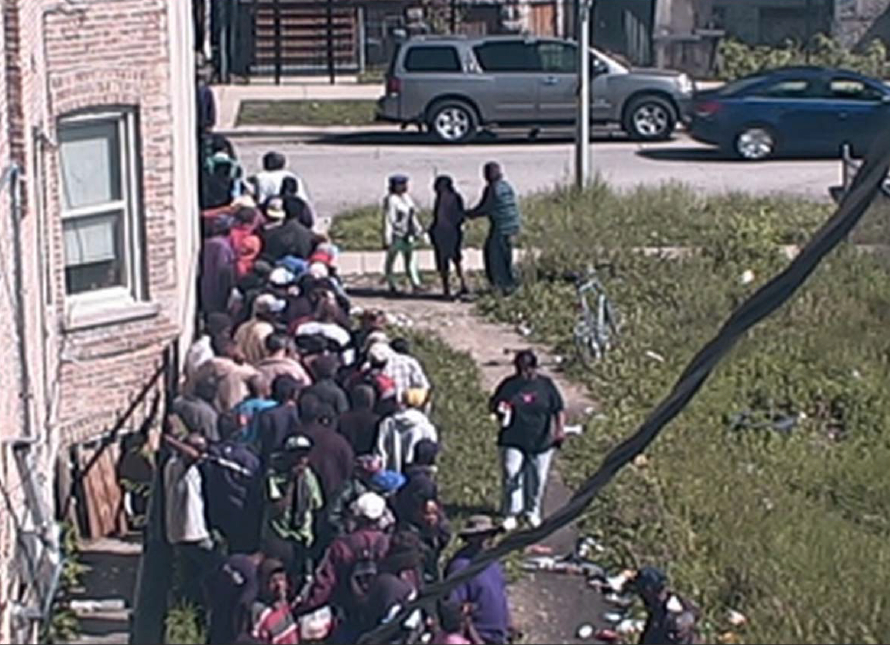
    Customers line up for heroin in Chicago

    So what do you want cops to do about this?

    From the Chicago Sun-Times. The 3700 block of W. Grenshaw. 3711 W. Grenshaw, to be exact, according to my google streetview snooping skills. It’s not even a horrible looking block, to be honest. I mean, it’s not the best looking block. But there are a bunch of well-kept homes. It’s a short walk to the L. Two of Chicago’s largest parks are within walking distance. You can get a great building with a few units for under $120,000. But, of course, that’s not the point. Because of course none of that matter with scenes like pictured above.

    I’m certain the neighbors called police. So what should cops do? Short of legalize and regulate distribution, this is what I have never heard a good answer to.

    Decriminalizing small-scale heroin possession isn’t the answer. Because then police have no legal authority over everybody lined up to buy drugs. And police do need to “do something.”

    In this case, there was an investigation, the Feds were involved, a big raid, and dozens of people were arrested. That’s all well and good. And it cost hundreds of thousands of dollars in law enforcement and court costs. It will cost millions of dollars in prison time.

    And for what? So now somebody else is selling. At a different house. Now what? Wash, rinse, and repeat isn’t good enough.

    [Two miles from this house is this block]

  • On arresting drug offenders

    From Cop in the Hood:

    Because of these problems and the “victimless” nature of drug crimes, most drug arrests are at the initiative of police officers. On one occasion, while driving slowly through a busy drug market early one morning, I saw dozens of African American addicts milling about while a smaller group of young men and boys were waiting to sell. Another officer in our squad had just arrested a drug addict for loitering. I asked my partner, “What’s the point of arresting people for walking down the street?” He replied: “Because everybody walking down the street is a criminal. In Canton or Greektown [middle- class neighborhoods] people are actually going somewhere. How many people here aren’t dirty? [‘None.’] It’s drugs. . . . If all we can do is lock ’em up for loitering, so be it.”

    I don’t think that’s the answer. But… I’m not certain what is the answer. Certainly junkies are a quality-of-life issue. The best we could do is regulate the drug trade. The worst we could do is decriminalize low-level drug offenses. The latter solves neither quality-of-life issues nor the violence around public drug dealing.

  • Police/Community relations in Baltimore

    They weren’t good then. They’re not good now. From Cop in the Hood:

    While the police see good communication between the public and the police as essential to fighting crime, relations are quite poor. This shouldn’t be surprising. Drug users are criminal. If they want to stay out of jail, they and those who care for them have every reason to be wary of police. One officer complained:

    “Nobody here will talk to police. Half the public hates us. The other half is scared to talk to us. I would be, too. But we can’t do anything without the public. They know who’s dirty and who’s not. They know who’s shooting who. We don’t know. They live here. We just drive around in big billboards. How are we supposed to see anything? The public doesn’t understand that nothing will ever go to court if nobody talks. We can only do so much. As long as nobody ever sees anything, things aren’t going to change.”

    New or not, the impact of silence is hugely detrimental to police and prosecutors. Even without personal risks, there is little incentive to testify. Nobody gains through interaction with the criminal justice system. You don’t get paid for it; there is no guarantee that testimony will result in conviction and jail time; and after the second or third postponement, a sense of civic duty usually fades. The hassles of court–passing through metal detectors, wasted days, close contact with crowds of criminals–combined with practical matters such as work and childcare make it far easier, even smarter, to see nothing, hear nothing, and mind your own business.

    That’s the real wall of silence we need to break down. And I have no idea how to do it. Especially given the rules of the game, both judicial and criminal. Make no mistake about it: snitches do get stitches. Witnesses get killed. Not that often, mind you. But just enough to shut people up. (This also seems relevant if you’ve read Ghettoside, which I wrote about in a comment to this post.)

  • Baltmore’s so-called gang problem

    From Cop in the Hood:

    In cities like Chicago and Los Angeles, gangs control the drug dealing. Because of that, some assume that drug violence is intrinsically linked to gangs. But East Coast cities have a different history. Large-scale gangs, such as the Bloods and Crips, are growing but still comparatively small. Gangs in Baltimore tend to be smaller and less organized, sometimes just a group sitting on a corner. Any group selling drugs can be called a gang, but the distinction between a gang and a group of friends is often based more on race, class, and police labeling than anything else. The disorganization of Baltimore’s crime networks may contribute to Baltimore’s violence. Conceivably, organized large gangs could reduce violence by deterring competition and would-be stickup kids.

    While drug-dealing organizations exist, they tend to restrict themselves to wholesale operations without conspicuous gang names, clothes, or colors. In Baltimore, wholesalers–often SUV-driving Dominicans and Jamaicans with New York or Pennsylvania tags–will sell their product to various midlevel dealers once or twice a week. The midlevel dealers will re-up the corner dealers’ stash as needed. Street-level dealers in Baltimore control smaller areas, perhaps three or four corners in close proximity. As a uniformed patrol officer, my focus was exclusively on the low-level street dealer. Going up the drug ladder requires lengthy investigations, undercover police, snitches, and confidential informants. A patrol officer’s job is to answer 911 calls for service.

    Has any of this changed?

  • Violence and the Drug Corner in Baltimore

    Too many people are getting killed! From Cop in the Hood:

    Still the risk of death is astoundingly high. For some of those “in the game,” the risk of death may be as high as 7 percent annually. Each year in Baltimore’s Eastern District approximately one in every 160 men aged fifteen to thirty- four is murdered. At this rate, more than 10 percent of men in Baltimore’s Eastern District are murdered before the age of thirty- five. As shocking as this is, the percentage would be drastically higher if it excluded those who aren’t “in the game” and at risk because of their association with the drug trade. Yet if everybody you know has been shot, killed, or locked up, perhaps such is life.

    Linked to the recent increase in homicides:

    Police don’t find many guns when frisking suspects. The threat of arrest may outweigh the risk of being robbed or attacked. For others, a reputation for violence may be enough of a deterrent. Yet there is no doubt that guns are accessible to many. After all, gunfire is a daily reality and pacifist corner drug dealers don’t last long.

  • Corruption in the Baltimore Police Department

    When I hear people, Commissioner Batts including, talk about the horrible institutional problem of Baltimore police corruption, I know they have never spent any time working on the streets of Baltimore. Batts certainly hasn’t. He’s the chief. He’s separated by five thick layers of chain of command from the rank-and-file. And he didn’t work his way up through that chain of command.

    Here’s what I saw. If you have no first-hand experience, please don’t try and convince me otherwise. It’s the old line about “Who are you going to believe? Me or your lying eyes?”

    This comes from Cop in the Hood:

    Temptation is everywhere. Given the prevalence of drug dealing and the fact that drug dealers hold hundreds and sometimes thousands of dollars in cash, police officers routinely face the opportunity for quick and illegal personal gain. Police could get away with stealing drugs or money, at least for a while. But robbed drug dealers can and will call Internal Affairs. And officers with criminal dealings will usually be ratted out by another criminal. Putting a dirty cop behind bars is as good a get-out-of-jail card as exists.

    I policed what is arguably the worst shift in the worst district in Baltimore and saw no police corruption. I know there are corrupt police officers. After three years on the street, one Eastern District officer stopped a man who drove his motorized scooter through a red light. The man had $6,300 in his pocket. The officer counted the money and allegedly returned $4,900 of it. The man called police to report the missing money and the officer was arrested and indicted on felony theft charges. One year later, these charges were dropped on condition that the officer resign from the police department and agree not to work in law enforcement again. When a cop is dirty, there is inevitably a drugs connection. Over a few beers after work, the subject of the drug squad came up. An older cop warned me to “stay away from drugs [in your dealings as a cop]. They’ll just get you in trouble in the long run.”

    Incidents do happen, but the police culture is not corrupt. Though overall police integrity is very high, some will never be convinced. But out of personal virtue, internal investigation stings, or monetary calculations, the majority— the vast majority—of police officers are clean. A greater problem is that high- arrest officers push the boundaries of consent searches and turn pockets inside- out. Illegal (and legal) searches are almost always motivated by a desire to find drugs. In the academy, an officer warned the class, “Corruption starts six months to a year after you’re out of the academy. When you’re on the streets and you start shaking down drug dealers because they’re worthless shits.” Similarly a sergeant explained:

    You’ll get out there, thinking you can make a difference. Then you get frustrated: a dealer caught with less than twenty- five pieces will be considered personal use. . . . Or you go to court and they take his word over yours. You’re a cop and you’re saying you saw something! . . . After it happens to you, you don’t care. It’s your job to bring him there [to court]. What happens after that is their problem. You can’t take this job personal! Drugs were here before you were. And they’ll be here long after you’re gone. Don’t think you can change that. I don’t want you leaving here thinking everybody living in this neighborhood is bad, does drugs. Many [cops] start beating people, thinking they deserve it.

    Police officers are often in a position to hold various amounts of drugs and money. Legally seized drugs and money are kept in one’s pockets (carefully separated from personal belongings) before being taken to the station house and submitted in the proper fashion. Officers have to be careful not to make honest mistakes. They could put something in the wrong pocket. Something could fall out of a pocket. The night gets busy and they might forget to submit. Before each shift, police officers search the squad car for anything left behind.

    Many residents, after repeated calls to police about drug dealers, assume that officers are either incorrigibly corrupt or completely apathetic:

    I understand what you [police] deal with. But you got to understand. People see police drive right by the dealers, don’t even get out of the car. Or they [police] got them [dealers] with their legs spread [being searched]. Who’s to say you ain’t taking a little something on the side? You can’t have drugs on this scale without somebody letting it happen.

    Police discount such accusations:

    People get bad ideas from the media or from criminals that we’re corrupt or brutal. But we’re not. Or they refuse to think that their son could be involved with drugs. They want the corner cleared, but if we pick up their son it must be the racist cops picking on him because he’s black. And with the amount of drugs you’ve got in this area, of course they aren’t going to like police because we’re trying to lock them up. Too many people here are pro-criminal.

    Even financially, it pays to be straight. A New York City police officer explained:

    My pension is worth between one and two million dollars. I’d have to be a fool to risk that for $100, even $1,000. I’ll tell you when I’ll be corrupt: the day I walk into a room piled with drugs, five million dollars in cash, and everybody dead. For five million, I’d do it. I’d leave the drugs and take the cash.

    Some officers enter the police department corrupt. Others fall of their own free will. Still others may have an isolated instance of corruption in an otherwise honest career. But there is no natural force pulling officers from a free cup of coffee toward shaking down drug dealers. Police can omit superfluous facts from a police report without later perjuring themselves in court. Working unapproved security overtime does not lead to a life in the Mob. Officers can take a catnap at 4 am and never abuse medical leave. There is no slope. If anything, corruption is more like a Slip ’N Slide. You can usually keep your footing, but it’s the drugs that make everything so damn slippery.