Interview with Donta Allen, the second man in the van. He’s Baltimore, that’s for sure. Straight out of the Western. Some might find him unique and charming. I’d just like to point out that his is a voice you don’t hear much.
Copinthehood.com has moved to qualitypolicing.com
-
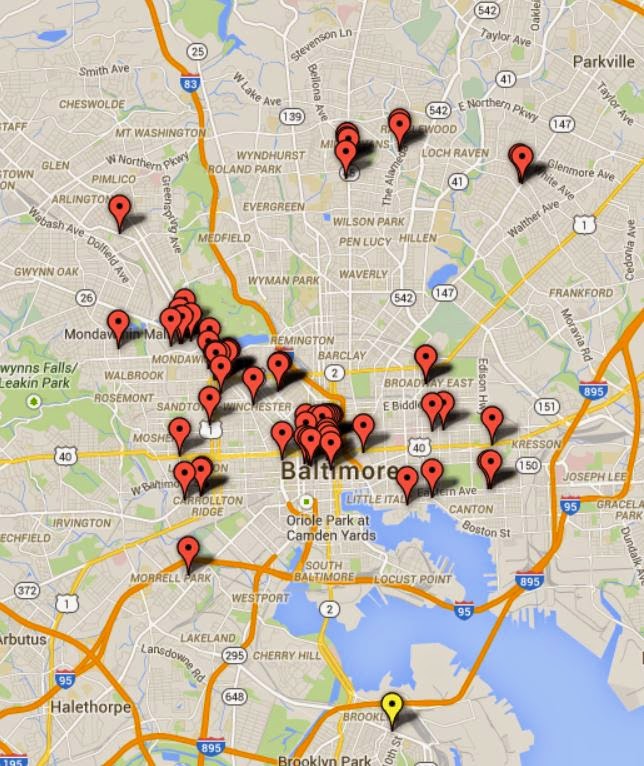
The scale of the riots
In certain circles (like my circles) it’s popular to post things about how when whites riot (and they do) we call it frat boys having a good time. Now whites frat boys riot over stupid shit, like their sport’s team winning, or their sport’s team losing. And don’t get me wrong, I’m not down with frat boy culture.
I think these situations are very different. But I don’t buy the violence against oppression argument either. First let me just say I find white frat boys so completely idiotic because of their drunk stupidity without a cause. It’s a party. And a lame party of that.
In Baltimore’s case, there are real reasons for being pissed off. But that has nothing to do with burning down a senior center or cutting a fire house. You’re allowed to be pissed off. You’re not allowed to be violent. And if you can’t be the former without doing the latter, then you’re a child. This has nothing do to with protests. Looting is also a party. A destructive party. But it’s actually a decent party.
The difference between college riots and Baltimore’s riot is the scale and magnitude of violence. And this may reflect the culture of the rioters. Frat boys: a little violent, very drunk, college educated, very stupid, disrespectful, often come from good families, don’t generally kill each other. Ghetto boys: more violent, less drunk, high-school drop outs, less stupid, disrespectful, often come from horribly dysfunctional families, and they too often do kill each other.
To say we’re only making a big deal out of this because of race is absurd. People need perspective. They also need to understand the scale of destruction here. Any one of these incidents would have been news in a college paper (and probably not much else). A bonfire and a tipped car and broken store are not good. But it is what it is. It destroys neither the college nor the downtown.
This was different. And it bothers me how quickly people are willing to take fact and rumor and whatever else they want from Baltimore when they have no idea what really happened in Baltimore.
The Baltimore Sun has a nice little interactive map on the violence (similar to their great map of city homicide).

-
Don’t believe the hype
Baltimore has 99 problems… gangs aren’t really one. At least not on list of top 5. Batts seems a bit obsessed with them. That’s West Coast bullshit.
An article by Leon Neyfakh in Slate.
-
The “ghetto”
I use the word “ghetto” because it is the vernacular of police officers and many (though by no means all) of the residents. Here’s what I said about “ghetto” in Cop in the Hood:
In any account of police work, inevitably the noncriminal public, the routine, and the working folks all get short shrift. Police don’t deal with a random cross-section of society, even within the areas they work. And this book reflects that.
The ghetto transcends stereotypes. Families try to make it against the odds. Old women sweep the streets. People rise before dawn to go to work. On Sundays, ladies go to church wearing beautiful hats and preachers preach to the choir. But if you’re looking for stereotypes, they’re there. Between the vacant and abandoned buildings you’ll find liquor stores, fast food, Korean corner stores, and a Jewish pawnshop. Living conditions are worse than those of third-world shantytowns: children in filthy apartments without plumbing or electricity, entire homes put out on eviction day, forty-five-year-old great-grandparents, junkies not raising their kids, drug dealers, and everywhere signs of violence and despair.
…If you’re not from the ghetto, and though it may not be politically correct to say so, the ghetto is exotic. One field-training officer accused me of being “fascinated by the ghetto.” I am. There are very few aspects of urban life that don’t fascinate me. But it is not my intent to sensationalize the ghetto. This is a book about police.
If you want to read about the ghetto, good books are out there. Ghettos are diverse and encompass many cultures and classes. Some object to the very term “ghetto.” I use the word because it is the vernacular of police officers and many (though by no means all) of the residents. If you really want to learn about the ghetto, go there. There’s probably one near you. Visit a church; walk down the street; buy something from the corner store; have a beer; eat. But most important, talk to people. That’s how you learn. When the subject turns to drugs and crime, you’ll hear a common refrain: “It just don’t make sense.”
-
Civil Unrest Mom
“Isn’t that child abuse?” “Absolutely”
Holly Walker is my friend. So no saying nothing bad about her. But how could you? She does a great job here.
Get More: Comedy Central,Funny Videos,Funny TV Shows
-
Life and Death in Baltimore’s Eastern (and Western) District
See Update for more current data
More than ten percent of black men in Baltimore’s Eastern District are murdered! Why is this not known? Why is this not discussed with urgency? Why has this been going on for decades?
This is from my book, Cop in the Hood. I can’t find it anywhere online. It should be. I’m still honestly hoping there is some major error in my math. But if there is, nobody has brought it to my attention. This stats comes from 2000-2006. Though it may have changed slightly, I have no reason to think it’s changed significantly. And to be clear, the “men” I’m talking about are black men:
The risk of death is astoundingly high. For some of those “in the [drug] game,” the risk of death may be as high as 7 percent annually.* Each year in Baltimore’s Eastern District approximately one in every 160 men aged fifteen to thirty-four is murdered. At this rate, more than 10 percent of men in Baltimore’s Eastern District are murdered before the age of thirty-five.** As shocking as this is, the percentage would be drastically higher if it excluded those who aren’t “in the game” and at risk because of their association with the drug trade. (p. 73)
And here is the fine print, the dirty details, the footnotes from pages 219-220:
* Levitt and Venkatesh (Levitt, Steven D., and Sudhir Alladi Venkatesh. 2000. “An Economic Analysis of a Drug- Selling Gang’s Finances.” Quarterly Journal of Economics 115 (3):755–89) show an annual 7 percent death rate for those actively involved in street-level drug dealing. A Baltimore City police officer entering the force in 1982 and retiring in 2007 would have had, roughly, a 0.7 percent chance being killed on duty during those twenty-five years.
** More than 11.6 percent of men in the Eastern District are murdered. This is based on homicide and census data. The 2000 Eastern District population for age 15 to 34 is 5,641 (derived from 2000 block-level U.S. Census data). The official U.S. Census citywide undercount for Baltimore was 1.8 percent. I arbitrarily doubled this figure for the Eastern District. Adding 3.6 percent raises the sample population to 5,844. The Eastern District lost 3 percent of its population annually between 1990 and 2000. Following this trend (it may have even accelerated give the massive expansion of Johns Hopkins Hospital), the 2006 population would be 4,867. I keep the 2000 population figure to be more conservative with my estimation of the homicide rate. Daily migration is not taken into account. I do not think this accounts for a large bias in either direction. All homicide victims in the Eastern District are assumed to reside in the district. Likewise no victims outside the Eastern District are assumed to come from the district. Homicide deaths in the Eastern District between 2000 and 2006 (excluding 2003, when I could not acquire data) are, respectively: 59, 38, 61, 55, 35, and 43. The mean is 48.5 murders per year. The demographic characteristics of homicide victims in the Eastern District are estimated from citywide, African American sex and age data. Of the city’s 179 black homicide victims in 2000 age 15 to 34, 168, or 93.9 percent, were men. 78.9 percent of all black male Baltimore homicide victims are 15 to 34 (FBI UCR 2000 Homicide Supplement). Based on these data, the average annual homicide rate for men 15 to 35 is 615 per 100,000. To put it another way, for these men, the odds of being murdered in a single year are 1 in 163. Based on the survival rate function 1 − (1 − r)^x, (r = death rate and x = number of years), 11.6 percent of men are murdered during a twenty-year period.
Source: Peter Moskos. 2009. Cop in the Hood. Princeton University Press.
-
As Reagan said…
I’m going to attribute this to Ronald Reagan so cops will agree with it. Reagan invented compassionate conservatives, right? (Even if he didn’t coin the phrase.) Unlike Obama, Reagan was willing to speak the truth. Liberals just blame everybody else. But Reagan would blame bad parents for messing up their kids. Reagan would call out absent fathers. Reagan knew too many people were dealing drugs. It takes somebody who supports police to say you shouldn’t blame police officers when we send them in to do society’s dirty work of containing these people. And only a great leader would say we need to pay attention to these problems not just when fools burn a drug store or police kill somebody. That’s how I remember him. It went something like this:
If you have impoverished communities that have been stripped away of opportunity, where children are born into abject poverty; they’ve got parents — often because of substance-abuse problems or incarceration or lack of education themselves — can’t do right by their kids; if it’s more likely that those kids end up in jail or dead, than they go to college. In communities where there are no fathers who can provide guidance to young men; communities where there’s no investment, and manufacturing has been stripped away; and drugs have flooded the community, and the drug industry ends up being the primary employer for a whole lot of folks — in those environments, if we think that we’re just going to send the police to do the dirty work of containing the problems that arise there without as a nation and as a society saying what can we do to change those communities, to help lift up those communities and give those kids opportunity, then we’re not going to solve this problem. And we’ll go through the same cycles of periodic conflicts between the police and communities and the occasional riots in the streets, and everybody will feign concern until it goes away, and then we go about our business as usual.
…
But if we really want to solve the problem, if our society really wanted to solve the problem, we could. It’s just it would require everybody saying this is important, this is significant — and that we don’t just pay attention to these communities when a CVS burns, and we don’t just pay attention when a young man gets shot or has his spine snapped. We’re paying attention all the time because we consider those kids our kids, and we think they’re important. And they shouldn’t be living in poverty and violence.
It takes that Morning-in-America-Again vision. If only liberals like Obama could understand stuff like this, things cops have always known.
-
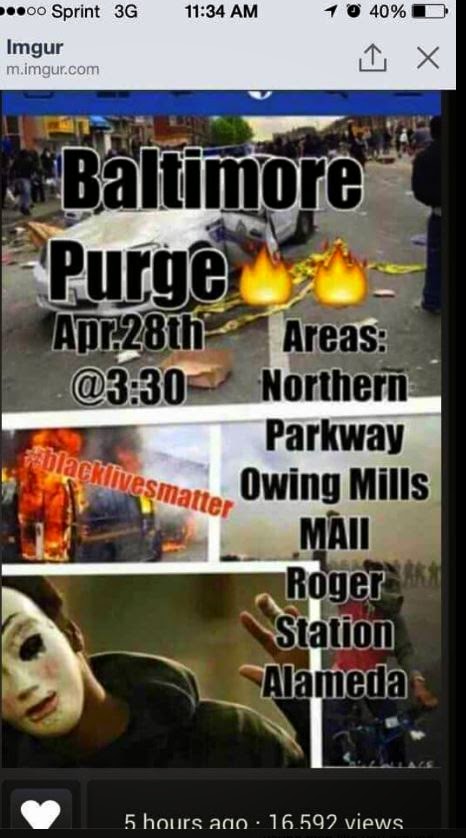
The Purge!
The Purge is coming! No. Actually, really it’s not (even though it sort of did). But this bullshit did a fair bit of work to fuck things up Monday afternoon.
By noon this had already gotten more 16,000 views. The Purge was “scheduled” for 3:30pm. The first cop was injured at 3:45pm.
-
Messages to rioters
These messages also need to be heard by all the apologists for rioters as well. Especially those that live nowhere near Baltimore.
I don’t know these guys (well, I’ve heard of Ray Lewis), but I find these unrehearsed personal messages quite powerful. Especially compared to pontificating buffoons who don’t live in Baltimore and use the city’s destruction to fit their ideological world-view. These are the perspective you won’t hear on NPR or from your over-educated liberal friends.
First from Emeka Mbadiwe. Here is his facebook message to Baltimore Police.
And second, maybe my favorite, from Leroy Wolfgang Harrison. Because sometimes you just need to say, “Fuck you, you ignorant ass motherfucker.” (Also, he uses “bank” a verb, a true Baltimorean.)
And finally Ray Lewis, an NFL player who knows a little something about violence.
-
Baltimore mom beats son for rioting
This had become a popular video in Baltimore.
And the interview with moms.
You know, technically, in our-spanking-is-wrong society, mom committed the crime of physical child abuse. The law says lock her up and put her child in protective services to protect him from her. The law is not made by single mothers in Baltimore.