Both lengthy and honest, from 2011, when Batts was “between jobs.” Post-Oakland. Pre-Baltimore.
[thanks to a commenter]
Both lengthy and honest, from 2011, when Batts was “between jobs.” Post-Oakland. Pre-Baltimore.
[thanks to a commenter]
For those interested, I have a schedule long-form interview on C-Span tomorrow (Sunday) at 9:15am eastern, talking about police issues, I suppose.
The good news from Baltimore, best I understand it — and this is based on my non-knowledge from 220-miles away (ie: twitter and social media, a friend watching a live feed at TV studio, and a few police friends) — is that things seems to be calmer downtown.
I do not mean things are over. Certainly not for police officers working all night. It’s going to be a long night. I mean calmer in the sense I’m going to go to bed (unlike the BPD) and feel confident that police are in control, that the city won’t burn down overnight. It’s a good sign when social media posts go from describing violence and chaos to complaining about “Wildly disproportionate police presence for a couple dozen protesters.” That’s a very good sign.
When things get ugly, when it’s not about protest but violence, then you gotta go in there and make sure things do not explode. As a friend’s dad told him, don’t get in fight with police because they’re not in the habit of losing. The important thing is that everybody gets to go home alive.
Let’s hope the worst is over. Police used both force and restraint tonight. It’s a tough night to be BPD. To those I worked with and those I do not know: stay safe.
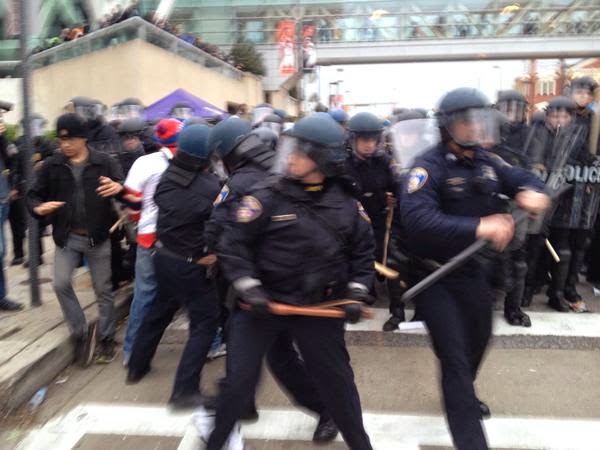
Battles are going in Baltimore. Link to tweets from the Sun. In the long run, police are going to win this. It’s just a question of how many people get hurt in the process.
This breaks my heart. Not just for the people I know at risk, but also for Baltimore. I love Baltimore.


This New York Times story is interesting. And these facts (which were new to me) are unknown or ignored by conservative police officers, who have somehow decided that the DOJ hates cops.
[hat tip to a reader]
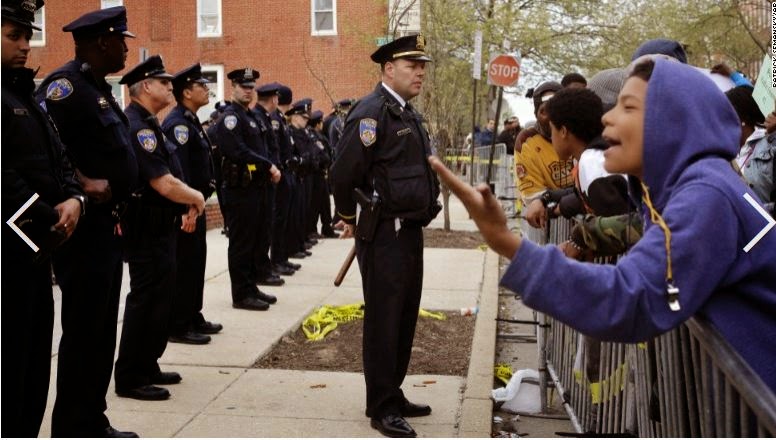
Things went well in Baltimore last night. So far, knock on wood, nobody else has gotten seriously hurt.
Compare this with police tactics in Ferguson. But Baltimore is better than Ferguson. And the BPD is better than the FPD. What we have not seen are flash-bang grenades. No tear gas. No gun shots (except for the “normal” Baltimore homicides). No riots. No fires. No looting.
Nothing is easy. But a bit of police restraint has gone a long way to keeping the peace. So kudos to all the brave Baltimore City police officers for a job well done.
Seeing all those cops lined up last night at the Western District WITHOUT riot gear — looking like human beings, not being provocative, taking shit (and a few bottles), looking bored, and being professional about it — it made me proud to have been a Baltimore cop.
 [photo from CNN]
The whole no riot gear thing is interesting. I heard former commissioner Hammsay on CNN that he he didn’t like that, tactically. “Somebody may get hurt.” He was right. But in this case it worked. Yes, it was just luck. I’m saying this in hindsight. But luck matters.
So what if police had been decked out in riot gear?Sure shields and helmets give you needed protection against rocks and bottles. They also dehumanize police officers and provide a target for people throwing things. What if some SWAT-like team was there, looking bad-ass? (Is it still “QRT” or have they have they been rebranded?) Throw in an armored personnel carrier with a turreted machine parked right out front. Well, think of the message that would send! Now we’ve got a party!
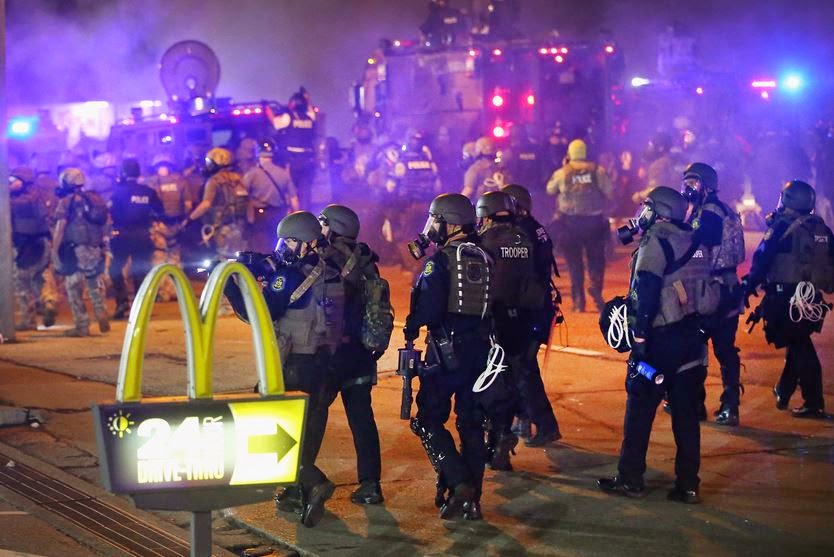 [not Baltimore]
And then somebody throws a bottle. Or maybe lights a fire. And police respond with tear gas, rubber bullets, and flash grenades (the latter makes no sense at all, but anyway)? And then there’s a baton charge. What if in that melee police get hurt? Seriously hurt. Well then those injuries would justify the military-like action.
But that’s not what happened. Give credit where credit is due. And the Baltimore police last night deserve credit. Everybody went home. This didn’t “just happen.” These are choices made.
Look, it’s not easy to say, “Men, women, go out there and stand there like targets. If anybody throws anything at you, duck and dodge. Pray for the best.” But sometimes that is the job of police. Sometimes that is what you have to do to make sure nobody else, officers include, get seriously hurt. Also, ranking officers were there. That matters. (I did not see the mayor. Where was she? Was she at a more pressing meeting?)
Police exercised restraint. Police respected the right of people to protest. The police were professional and brave. Nobody knew how this was going to turn out. Imagine kissing your family goodbye that night before going to work, to stand in a line, in front of a police station, facing angry protesters throwing things at you. Shit is going down. “See you later, honey”! [smooch] It’s not just another day at the office.
I didn’t post this last night because I didn’t want to sound foolish if the Western burnt down and people were killed. One guy with a gun even a rock and good aim could have changed (and still could change) everything. But so far so good.
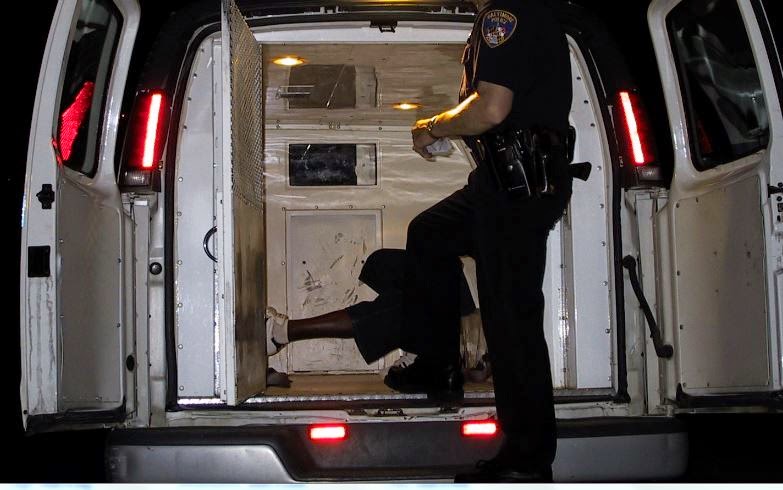
BPD says they can’t make a wagon availableto reporters? (Not the wagon but any wagon?) I hope this baby has been retired, but you never know. What you can’t see are the middle-facing bench seats fitted with seat belts.

Officers arrest somebody and call for a wagon (90 or 91). Sector cars in Baltimore City are not “cage cars” so you can’t transport prisoners in them. The wagon (perhaps driven by a paunchy officer with a few decades on the job) shows up. You give your prisoner to the wagonman (or woman). If you used metal cuffs (as you would unless you planned on making an arrest and brought plastic flex cuffs), you get your cuffs back. The prisoner gets re-cuffed and re-searched by the wagonman taking custody. Every time custody of a prisoner changes hands, the prisoner is searched.
The prisoner is then put in the wagon, selt-belted in, and taken to the district for questioning or to (state-run) central booking. Other prisoners may be picked up en-route by the wagon, as needed. On all transports, mileage of the vehicle is called into KGA at the start and end of trip (with a time stamp given by dispatch).
If the suspect is injured, you would call for an ambo to take the prisoner to the hospital. Central booking won’t take people in need of medical care. If I thought a prisoner wasn’t really hurt but said they wanted to go to the hospital (happens a lot), I would informs them of how we’d both be stuck at Hopkins Hospital for hours and how this would only delay their processing and eventual release from CBIF (all of which is true).
There is no “fast track” at the hospital for police and their prisoners. Often they’d say, “fuck it; take me to jail.” Sometimes I would give a little primer about what not to say to the intake person at CBIF (“my head hurts” “my chest hurts”) because CBIF could decide not accept a person without a doctor’s note. You certain might negotiate their need for hospital attention (read: sitting in the ER waiting room for hours for a 5-minute cursory exam). But if a prisoners insisted on going to a hospital, you don’t refuse medical treatment. You take him there. In the end it was their call.
[Apparently there’s now a metal barrier in the middle of the van.]
I always welcome intelligent comments from police officers. Here is an email (lightly edited) from a retired sergeant about police-involved shootings in general. I always appreciate thoughtful comments from police officers. I don’t necessarily agree with everything he writes (but I don’t need to). It’s a well stated opinion based on experience.
When it comes to police issues, we don’t hear from police officers enough. If you want to understand police, you need to listen to police. I reprint this with his permission:
What irritates me in this brouhaha about police shootings of unarmed people, specifically black males, is that no one as far as I can determine has said anything about the fact that the recent shooting incidents were not egregious examples of trigger happy cops simply deciding to gratuitously confront someone for the hell of it. In reality they are examples of an officer doing his duty and either conducting an investigation, responding to a call for service, or responding to an on-view situation.
For whatever reason, doing the job went south fast, but the shootings were not examples of some psychopathic cop who decided he was going to whack somebody that day to break up a boring day, or have I missed something? Plus, lo and behold, the deceased were not “innocents,” for a few had rap sheets to make a mother cry. Did they deserve to be killed? I can only answer that question the way I answered it when I was peppered by friends about my police experiences, especially when I would relate those of the “hairy” kind where justification for using my service weapon was a no-brainier, even if I didn’t see a weapon. Some of my friends would say they would have shot the person. My seemingly high-minded response was simply to say that I wasn’t raised to be an assassin, but I meant it.
…I joined the force in 1973 at age 29. Prior to this defining life experience, I did 4 years in the Marine Corps, got a BA in American History under the Vietnam era G.I. Bill program, did one year of graduate work in American History and jumped at the Police Agent Program that the [department] initiated to attract clowns like me: college graduates. My wife thought I was nuts, but she relented and continued her graduate work. Why I didn’t bag the whole thing after 6 months on the street is a question I am still trying to answer after 40 years of pondering.
As you realize, no matter what position you take on policing in this country, all types come out of the woodwork — me include — as well as [others]. In my view the average American harbors an ambivalent attitude about American law enforcement, either loving us or hating us depending who is getting the shitty stick shoved up the ass. I can attest to the fact that even good cops can be real knuckle heads when they can’t control their tempers and act professionally, sometimes with tragic results. And cops, or wannabe cops, take any kind of perceived criticisms as an unjustifiable assault on their person. So it goes.
As to more recent events in Baltimore:
Again my point being reinforced by what happened: a seemingly legitimate police action that went South for whatever reason, with two supervisors at the scene to boot, a Sgt. and a Lt. This is a head shaker.
…
Guys always take off…. They did for me when I worked [there]. The deceased … had a respectable rap sheet, so he was no cherry. However, capital punishment doesn’t apply to drug crimes, unless you live in garden spots like Iran or Saudi Arabia.
This doesn’t look good for the Agency, especially with supervision at the scene. What a fucking mess.
[No comments on this one because because it’s somebody else’s opinion.]
The Supreme Court ruled in Rodriguez v. United States (2015) that K9s cannot be used in traffic stops (without cause) if it delays the driver. Period. Previously, the law of the land was that the driver couldn’t be delayed too much. But it wasn’t clear how much was too much. Waiting for a K9 unit was too much. But if the dog was already there, then it was considered OK. No longer.
Both as a constitutional issue and a strike against the war on the drugs, I think this decision is eminently reasonable. I’m never liked fishing for drugs. And telling otherwise innocent people to wait while dogs sniff around is like a police state. (And besides, we should be skeptical of probably cause based on a dog. Have you ever seen a dog put on the stand?)
K9s can be really useful to police. To search large buildings, for instance. (Another break-in at the Monument Street Market?) And the threat of calling in the dogs is useful in getting some idiot to come out of his hole he crawled into.
Post Rodriguez, to search with a dog without cause means you’d have to have another officer doing the traffic stop part while the K9 does his business at the same time. This won’t change policing too much, since there aren’t too many K9 units anyway. But it does make me wonder what those K9 units are going to do when they’re not needed for real police work. I guess they can still give traffic tickets. But it makes the dog kind of superfluous.
I also think it’s important to point out that this will (slightly) increase officer safety. The police academy is filled with videos of cops getting attacked and killed when they start asking to search a vehicle for drugs. Now one could argue that finding and arresting criminals is part of the job, but if your primary concern is officer safety, the safest thing to do in a traffic stop is give a ticket and let the car drive away.
Things are tense for police after the death of Freddie Gray in Baltimore Police custody.
I got no clue what happened. And I’m not going to say much till I do.
Keep in mind that Baltimore cops don’t know what happened. But boy is this turning into quote a jackpot. A man died in police custody. Of a broken spine. Shit is hitting the fan. Six cops have been suspended (with pay).
It’s slowly becoming national news (which is rare, when it comes to Baltimore police issues).
What we do know is that last Sunday morning police in the Western approached a group of people. A guy takes off running. Cops chase. Bike cops catch and arrest the guy, Freddie Gray for carrying a small knife. He gets put in a wagon. When Gray comes out of the wagon, he’s seriously injured. He dies a week later.
From the New York Times:
“We have no evidence — physical, video or statements — of any use of force,” the deputy police commissioner, Jerry Rodriguez, said at the news conference. “He did suffer a very tragic injury to his spinal cord, which resulted in his death. What we don’t know, and what we need to get to, is how that injury occurred.”
Mr. Gray died Sunday, a week after his arrest. Witnesses captured parts of his encounter with the police on a cellphone video, in which screams can be heard as officers drag him into a transport van. An autopsy showed no wounds, except for the severed spinal cord, and the videos do not show the police acting forcefully.
…
On the way to the station, the van made at least two stops — including one in which Mr. Gray was taken out and placed in leg shackles after the driver complained he was “acting irate in the back,” Mr. Rodriguez said. After Mr. Gray arrived at Baltimore’s Western District station, police officers called medics, who took him to a hospital.
From the Sun:
“When he was placed inside that van, he was able to talk, he was upset,” Deputy Police Commissioner Jerry Rodriguez said. “And when Mr. Gray was taken out of the van, he could not talk, he could not breathe.”
Police said they used no undue force when arresting Gray and can find no evidence from cellphone and city surveillance videos that officers brutalized Gray. They said an autopsy shows no indication that force was used.
But you need force from somewhere to be injured the way Gray was fatally injured. It is the responsibility of the wagonman (or woman) to make sure prisoners are safe and strapped down during transport.
It seems we have what started as a case of “felony running.” Running from police is not a a crime. But fleeing from police does give police reasonable suspicion to stop (Illinois v. Wardlow, 2000). We used to make fun of cops who caught a “felony runner.” That would happen when somebody takes off. You chase them! It’s natural. You’re a cop. You catch them… and then you realize they haven’t actually committed a crime. You search (I mean frisk) them hoping to find something. Anything. But if you don’t, you have to let them go. You can’t even get them for loitering. They weren’t loitering if they ran. Now I wouldn’t chase people just for running. But I could have, if I liked running more.
The court vague said you need something other than running, but that something can be almost anything including “high crime area” or “drug corner.” So I’m willing to say the approach, the chase, the stop, the frisk, the search, and the arrest were all legal.
I’m not saying this is the case here, but just FYI, it is not uncommon in Baltimore for corner boys to assign one person to be a “runner,” just to get police off on a wild goose chase. That could be some young kid. It could be a junkie.
Police pull up. Somebody runs. You can chase him. Or you can let him run. Personally, I’d prefer to grab the second guy who tried to get away, figuring he would be more likely to have the stash or a gun.
Now in this case Gray did have a small knife, for which he was arrested. (If you make cops chase you, they can be damn sure they will, as they should, lock you up for any legal reason.)
Meanwhile angry people think the police and politicians are covering things up. And yet most police officers also don’t trust the department and politicians. I wrote about race and police attitudes towards the discipline process back in 2008 in “Two Shades of Blue.” The idea is that the powers-that-be — and Baltimore has a black mayor and black police commissioner — will punish police officers, guilty or not, to placate the public. I assume that among the six suspended officers are those who made the arrest (I don’t know if that’s true). And yet the department has already said that things were OK when they handed off the prisoner. I hope they enjoy their paid days off.
Personally, it’s worth noting my surprise that these Western officers were doing any work at all on a Sunday morning. That is not generally how we rolled in the Eastern. Maybe it’s just because it’s spring. And you it’s spring in Baltimore because the bikes are in bloom.