“According to the Death Penalty Information Center, Mr. Hinton is the 152nd person exonerated from an American death row since 1973.”
You’d think people would care more.
“According to the Death Penalty Information Center, Mr. Hinton is the 152nd person exonerated from an American death row since 1973.”
You’d think people would care more.
This isn’t exactly news, but now it’s official… because it’s in the papers: “Study Finds Mexican Troops Did Not Stem Drug-War Killings“
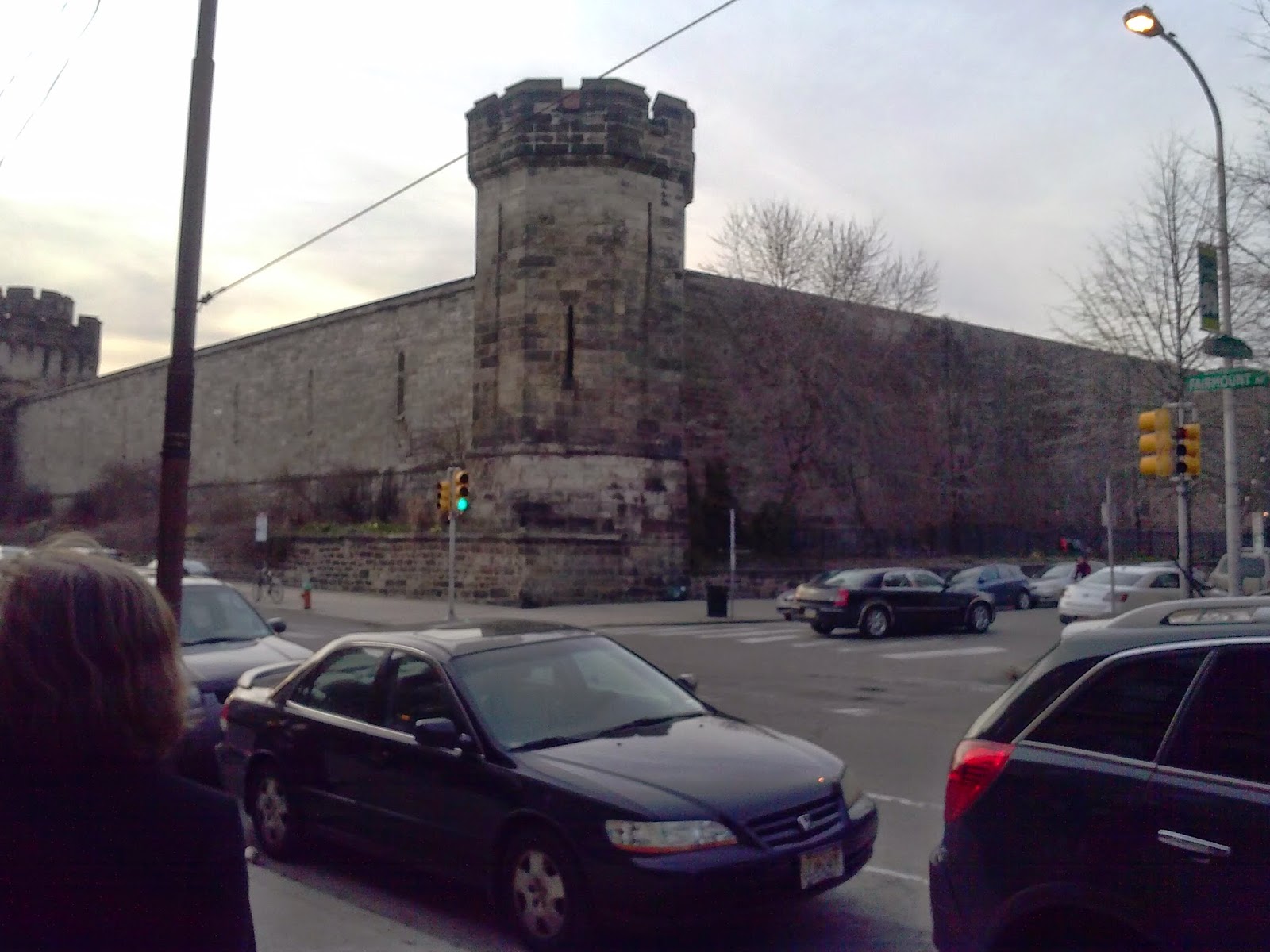
I wrote about Philadelphia’s Walnut Street Jail and Prison and the Eastern State Penn in In Defense of Flogging, but I had never seen the inside of Eastern State Penn…. until now!
Thanks to having written a book about prisons (to be honest, it didn’t hurt that my wife writes guidebooks, but whatev), we got a little private tour . Unfortunate I didn’t even have my real camera with me.


Amazingly, by sheer chance, I stumbled across the site of its sister prison, the lesser known Western State Penn, just last week.

The prison is gone. But the eagle is real!
I don’t know what the right percentage is, regarding cops living where they work. Though I am partial to 100 percent of cops living or having had lived in the city they police. But whatever the right number is, the percentage is larger than friggin’ seven percent, which is what you find in Oakland. Now is this why Oakland cops have such troubled community relations? Well… actually, yeah, in part. Maybe not the majority part. But certainly a partial part.
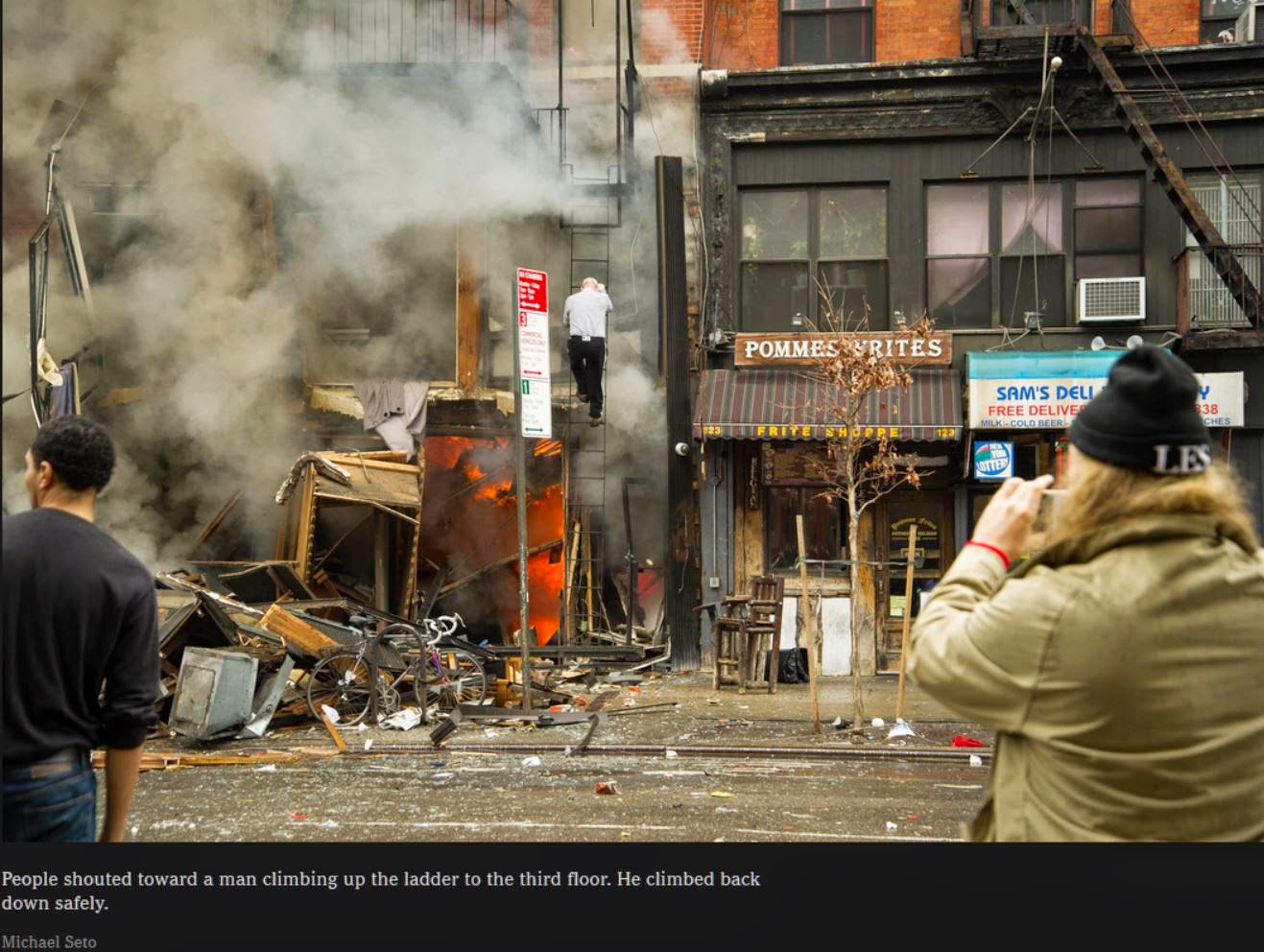

Civil servants too often get disparaged. But that man on the ladder is a New York City civil servant and he is climbing up, not down. I’m no longer a civil servant, but this makes me proud just to be fellow worker for the City of New York.
Here’s a video of climbing down here.
Previously unidentified, he is Bronx Firefighter Mike Shepherd. He was off-duty and just happened to be nearby. Talk about being a first responder! While other people took pictures of an exploding building, he climbed into the flames to look for and save people!
This is what I mean about the job being different if you walk into danger. His base salary is about $77,000. How much would they have to pay you to think and react this way?
According to the Times:
Mr. Shepherd went up the fire escape and climbed floor by floor. At the building’s second floor, the floor was buckling. People on the ground began yelling for him to get down. He continued his ascent to the fourth floor, yelling, “Anyone here, anyone here?”
And my eyes get a teary when I read thisabout one of the presumed dead:
A day after the explosion, Hyeonil Kim, 59, the owner of Sushi Park, said the police and rescue workers were still not able to locate Moises Ismael Locón Yac, 27, a member of his restaurant staff. Of the 15 employees at work on the day of the blast, three were injured, according to Mr. Kim. Of those people, two remain hospitalized; one, a Nepalese man, was injured badly, he said. Mr. Kim described Mr. Locón as “earnest” and good at his job.
“Everything I lost is just lost, nothing I can do about it,” he said. “But this friend —” Mr. Kim stopped speaking, overcome by sobs.
Locón was from Guatemala and lived in Queens, not far from me.
Now I’m not saying you should climb into a burning building (and don’t do it if you’re wearing polyester). Just be happy others will do it for you!
[Also, I don’t mean to pick on that guy taking a picture. He actually did help somebody!]
This isn’t really news. But some seem to think that blacks only care about black lives murder when it’s at the hands of police. (And certainly police-involved killings seems to be the only ones that get a lot of press). But when blacks do protest and act against violence in the black community, very few seem to notice.
This happenedin Baltimore. The mayor said, “Some people have said the work we’re doing here is blaming black men. I refuse to ignore the crisis.” The sobering facts:
This year, all but three of the city’s 44 homicide victims were black. Last year, 189 of the city’s 211 murder victims were black. And most were young. The largest group of victims — 54 — were age 25 to 29,
I don’t know. And that’s what I told Meaghan Corzine of CBS St. Louis. Luckily, I wasn’t her only source. It’s a good story.
Compared to last year, shootings and homicides in NYC are up 20 percent. Twenty percent is a real increase.
Here’s the compstat page and also a link to last week’s summary (no matter when you click the link).
I don’t know why crime is up. But… I can’t help but think it’s part of (or some combination of) everything that has happened in NYC in the past year. I mean, I know what most cops think is the cause: stop and frisk has stopped; marijuana arrests have plummeted; there’s more oversight of cops; De Blasio is mayor; Obama is president; Eric Holder is Attorney General; cops find it preferable to do too little rather than do to much (“if you don’t work you can’t get in trouble”).
Some of that is just ideological sour grapes. But some of it, part of it, is true.
What I find amazing is I don’t hear any critic of the NYPD sounding any alarm. Oh well, I guess 60 extra murder victims per year — 54 of whom, based on passed statistics, will be black or hispanic men — is a small price to pay to keep innocent people from getting harassed by the police. I for one don’t buy that equation.
Those who opposed past police practices (and to be clear it’s not like I loved everything the NYPD was doing) seem to be very silent right now. Shouldn’t the increase in murders lead to a discussion about what police should be doing?
I guess the same people who think the police had little if anything to do with the crime drop now just think it’s preordained that crime goes up. But it is not “written.” Why don’t I hear debate? Instead I hear a lot of silence.
My latest piece at CNN.com is up. They titled it: “Why would you want to be a cop?”
I speak to a lot of police officers, retired, on the job, and soon-to-be. Anybody who knows cops knows it’s in their nature to complain (there’s an old barb about there being just two things cops don’t like: change and the status quo). But the idealism of my students can be lost with on-the-job realities: incompetent bosses, nasty working conditions, and any quota system (be it for revenue or arrests) that demeans their professionalism.
Police officers try to maintain their pride and idealism on the job, but it can be a tough battle when faced with a hostile political structure and a misunderstanding public too quick to blame police for society’s ills. Blaming one officer for the misdeed of another is neither fair nor productive. To have the hashtag #blacklivesmatter held against you is both frustrating and absurd. The general public doesn’t seem to care about black lives unless a cop is involved. Police see and help victims every day while most murders don’t even make the evening news.
Police do become thin-skinned to criticism — too quick to take offense to even well intentioned criticism — because the job isn’t just what you do for a living, it ends up defining who you are. The job damages you physically and, more worrisome, drains you emotionally.
Policing demands a level of hyper-alertness synonymous with post-traumatic stress disorder.
…
So as best they can, police officers make do with the job they have. Certainly police can and should play a role in rebuilding the public’s trust. But the public should have more empathy for those who have no choice but to deal with society’s problems — poverty, massive incarceration, racism, crime — that we, collectively and to our shame, cannot or will not fix.
[Special thanks to Sgt B and to A.D. for his comment on a previous post. I probably could have done it without you, but it certainly wouldn’t have been as good!]
Sometimes it’s important to remember how you got to Point B from Point A to where you are today.
You don’t just stumble into a system like Ferguson’s where the city tries to get 30 percent of it’s total budget from fines, citations, and court fees. Ferguson isn’t unique.
I just stumbled across this article from 2010, writen by a police officer, that lays out the potential of using police for revenue:
Based on the research for this article, there is a clear presumption of need for law enforcement to generate new income streams. A first necessary step in that process is to examine possible revenue-generating ideas.
…
Their most prominent recommendations were:
• fees for sex offenders registering in a given jurisdiction,
• city tow companies,
• fine increases by 50 percent,
• pay-per-call policing,
• vacation house check fees,
• public hours at police firing range for a fee,
• police department-run online traffic school for minor traffic infractions,
• department-based security service including home checks and monitoring of security cameras by police department,
• a designated business to clean biological crime scenes,
• state and court fees for all convicted felons returning to the community,
• allowing agency name to be used for advertisement and branding,
• triple driving-under-the-influence fines by the court,
• resident fee similar to a utility tax,
• tax or fee on all alcohol sold in the city,
• tax or fee on all ammunition sold in, the city,
• public safety fees on all new development in the city,
• 9-1-1 fee per use,
• police department website with business advertisement for support,
• selling ride-a-longs to the public, and
• police department–run firearm safety classes.
…
Modeled after other California agencies, the party ordinance allows an administrative citation to be issued at loud parties where the music is plainly audible 50 feet from the property line. The first citation is $100, a second $200, and a third or subsequent citation within 12 consecutive months is $500. The goal of the ordinance is to reduce repeat party calls, improve the quality of life for surrounding residents, and generate a revenue stream to offset the cost of response and enforcement.
It’s just so blatant and wrong to see police (or the courts, or prisons) as a source of generating revenue. If you need money, that is what taxes are for.
Anyway, for what it’s worth, West Covina, CA, does not seem best to be a particularly bad offender in terms of milking its residents, best I could understand their municipal budget. And some of those ideas above are actually pretty good ideas.