Copinthehood.com has moved to qualitypolicing.com

  • Police killing whites and blacks

    A lot of people really believe that cops are out there gunning for blacks. People who know more about police officers find this absurd. Of course black lives do indeed matter. But other things being equal (like committing a violent crime), are cops more likely to shoot and kill blacks because they are black? That’s an empirical question worth trying to answer. And recent event and protests not withstanding, based on the data we have, the answer seems to be no.

    This is not to say there isn’t a problem with some police use of lethal (and less-lethal) force. But if you want to improve policing, you’re barking up the wrong tree if your only solution is to make cops less racist. I’ve said it before:

    Sure, race matters, but if you want to improve policing, you need to move past the idea that police only do bad things to black people. This isn’t a black and white issue. It’s a police issue.

    Here is what we know: taking population into account, if one looks at black and white men of all ages killed by police (based on very shoddy data, mind you) blacks are four times more likely than whites to be killed by police.That doesn’t sound good. But since we know police-involved homicides correlate with homicide and violence among individuals policed, what rate of racial disparity would one expect to find in police-involved homicides? Certainly not 1 to 1.

    Somebody on facebook (and no, I won’t be your “friend”) just asked me a rather basic question: “What is the racial breakdown of those who kill police?” Fair question. And you would think I would have known the answer. But I didn’t. I would assume there would be a pretty tight correlation between the race of those feloniously killing cops and the race of those shot and killed by police. Violence begets violence.

    At least one would expect that correlation if one thinks, as I do, that cops are not out there gunning for blacks. So I found that we actually do have some decent data about those who kill cops (but not so much the other way around). Based on FBI data of cop killers 289 cop killers have been white and 243 black. (If one really is looked for a group to scapegoat, 98 percent of cop killers are men.)

    [This is UCR data from 2004 to 2013. And data is those who kill cops is pretty complete. During these past 10 years, according to Officer Down, a very reliable source, there have been 520 cops shot and killed, 14 stabbed to death, and 82 killed by a vehicle (not all of the latter feloniously).]

    Adjusting for population, black men, overall, are 5 times more likely than white men to kill police officers. But to put a less ominous-sounding way, the odds that any given black man will kill a cop this year is 0.000012 percent. For white men it is 0.0000024 percent. And for women it is basically zero.

    If one takes rates of violence into account, police are not more likely to shoot and kill blacks than they are whites. Given the racial disparity found in violent crime rates (for homicide it’s 6:1, black to white) and the racial disparity among those who kill police officers (5:1, black to white), the disproportionate rate of blacks killed by police (4:1, black to white) (Ed Note: 3:1, based on 2016 Washington Post data, is a more accurate figure) seems, well, less than I would actually expect.

    If you find this difficult to believe, consider some possible reasons:

    1) Big-city police departments (cities are disproportionately minority) might be better trained and less trigger-happy.

    2) Cops in more violent neighborhoods (disproportionately minority, like where I policed in Baltimore) are less likely to over-react to real and perceived threats than are cops in less violent neighborhoods. (Even though these shootings tent to get all the press.)

    3) Police might indeed improve and become less likely to be involved in shootings, both good and bad, in response to a public outcry — and the public simply does not cry out when whites are killed by police.

    The idea that police don’t use lethal force in a racist way might be a tough pill for many to swallow. But keep in mind that the fact remains that blacks are indeed four times more likely than whites to be killed by police! Even if the cause isn’t racist cops, something is seriously wrong. So what is the solution? As I’ve said before:

    If one wishes — as one should — to reduce the racial disparity of police-involved shootings, one needs to focus on racial disparities in crime and violence in general. If one wishes — as one should — to reduce the incidences of unjustified police shootings and improper police use-of-force, one needs to improve police training and reduce police militarization.

    It’s also worth mentioning, unrelated to race, the average age of your average killer of cops is 30, which is higher than I would expect. And in case you were wondering why cops want to keep everybody in jail? Well among cop killers, 82 percent (n=565) have been previously arrested (and 63 percent convicted) of a previous crime. Twenty of those who killed police officers (3.5 percent of the total) had a previous conviction for murder. And then they got out and kept killing.

    [see follow up]
  • Just a few racist comments

    Very recently I received two absurdly racist comments to a post. (A popular post from a google search, ie: not a regular copinthehood reader). My question is this: Why are RACIST COMMENTS TO THIS BLOG ALWAYS WRITTEN WITH THE CAPLOCKS KEY ON!?!?!?

    I’ve been writing this blog for seven years now. And, as Blogger tells me, I have written 2,048 posts and published 6,508 comments. Out of all that, I think these were the first comments I wouldn’t publish because they were racist (THOUGH MAYBE I’M FORGETTING ONE OR TWO I’M NOT SURE).

    So kudos to all of you who do comment! My sincere thanks for engaging with me and other while keeping things interesting and civilized. Honestly, it’s so rare to see that with police issues.

  • How many people do police kill?

    We don’t know how many people are killed by police. That’s an outrage. But seriously, think about it: police kill more people than America executes. We spend a lot of time and money when it comes to executions. And we don’t even count those killed by police. And this isn’t even a pro- or anti-police issue. Either way we just need to know.

    Here’s somebody who is taking it on himself to keep track. It might even work. Similar methods have been used to give us idea of how many people have been killed as a result of fighting the drug war in Mexico. Another website keeps very good track of Taser-related deaths since nobody else does (about one per week, in case you were wondering. And here’s a parallel site).

  • Fighting Liberal Lies

    I try and fight them lies on both sides. And finally one ace reporter, William Freivogel of St. Louis Public Radio, sets the record straight regarding ProPublica’s lie that that black teens are “21 times” more likely than white teens to be killed by police. This is the first light of day my lengthy bitching on the matter has received. Makes me almost think some of the time I waste trying to spread some truthiness is worth something.

    But this isn’t before that damn 21-times figure was repeated as fact by both a New York Times editorial and the Economist. [sigh] And what also bothers me is that I spoke at length with one of the ProPublica authors. He seemed to understand a) the sever statistical limitations of UCR homicide data, b) the statistical need for a larger “n,” and c) the concept of a statistical outlier… but then he still refuses to publicly update or correct anything because the numbers — statistically somewhere between meaningless and misleading — are, well, computationally correct. I think he and his team are statistically savvy enough to know this is ideological bullshit.

    One of the ProPublica authors recently doubled down: “We weren’t cherry picking years. We looked
    at all of the years. But we were looking at what is happening in the
    most recent years. The disparity is growing.” But… but… they looked at the last three years. And if you look at just the last year or two (worth repeating: this is based on basically meaningless data), the number is actually shrinking. 

    It’s one thing if they just happened to pick a year that was a statistical outlier. I could have pointed that out and they could say “Oops. my bad” (besides, it’s not like the more correct numbers couldn’t also help them make the same point). But to say they considered all the years and then chose the outlier that statistically means the least? Come on, now.

    After reading this, take a break by watching David “1 of 3 Hanks” Klinger on the Daily Show. Klinger is the guy heavily quoted in that St. Louis Public Radio piece. Good stuff.

  • Right-Wing Lies (X): Obama has never honored cops

    Right-Wing Lies (X): Obama has never honored cops

    This is the tenth (or so) in my occasional series of “Right-Wing Lies.” Now I know there are some left-wing lies, too. (It’s not true that 1 in 5 college women are raped, for instance. Nor is it true that black teens are 21 times more likely to be shot and killed by police than white teens.) But among my friends, I find there are many more simply false statements coming from my dear conservative brethren.

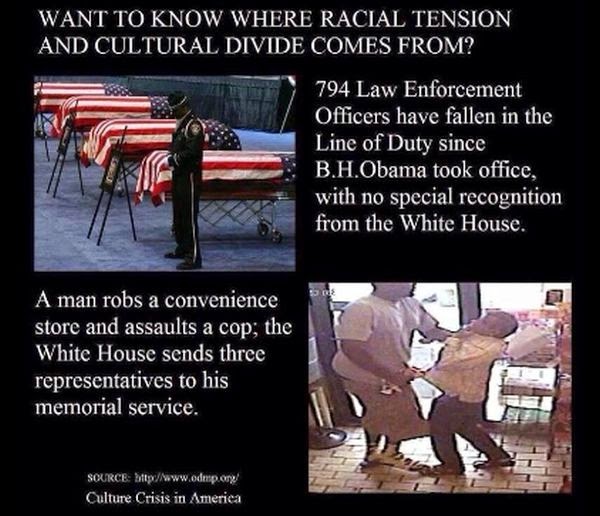
    One of the recently forwarded picture/meme involving Obama’s supposed disrespect for police officers.

     “794 law enforcement officers have fallen in the line of duty since
    B.H. Obama took office, with no special recognition from the White
    House. A man robs a convenience store and assaults a cop; the White House sends three representatives to his memorial service.”

    (Never seen this before? Then you, my liberal friend, really need to have a more diverse group of friends.)

    Of course the above is not true. At least not the part of Obama never offering recognition to fallen police officers. From politifact you can get six quick links to special proclamations. Obama has said things like this:

    Every American who wears the badge knows the burdens that come with it
    — the long hours and the stress; the knowledge that just about any
    moment could be a matter of life or death.  You carry these burdens so
    the rest of us don’t have to….

    The rest of us can never fully understand what you go through. But
    please know that we hold you in our hearts — not just today, but
    always. We are forever in your debt. And it is on behalf of all of us,
    the entire American people, that I offer my thoughts, my prayers, and my
    thanks. May God shine a light upon the fallen and comfort the mourning. May he protect the peacemakers who protect us every day.

    It’s kind of touching, to be honest. Politifact goes on to conclude, in part: “Archived information about these events was easily available to the
    public on the White House website, meaning that the meme’s creator was
    reckless in not taking them into account. We rate the claim Pants on
    Fire.”

    But… if you believed the lies when you first read them, my bet you will continue to believe them, facts be damned. Because well, if you hate Obama, then something like this just should be true. Even if it’s not.

    (Also, the number 794 isn’t right either, but whatever.)

  • The Courts

    Did I mention I met Sgt. Plantinga last time I was in San Francisco? Good guy. He bought me lunch.

    Here’s the last (for now) from Plantinga’s 400 Things Cops Know: Street-Smart Lessons from a Veteran Patrolman:

    You won’t feel sorry for many defendants. You figure they probably committed a dozen crimes before they finally got caught for this one. But it can give you a moment of pause when you’re subpoenaed for court and you look around to see how few people have shown up to support the defendant in his criminal trial. Sometimes it’s just one. An elderly woman, the defendant’s grandmother perhaps, who appears interested in the proceedings but a little disoriented. Then when that woman gets up and leaves, you realize that she wasn’t the grandmother, just some old lady who realized she was in the wrong court room. Back down to zero. The defendant may have gone through life largely alone and is now being sent to prison alone. If I ever got arrested, my friends, extended family, junior high art teacher and every member of the Polecats–my elementary school T-ball team–would show up with supportive banners and character references and exculpatory evidence. It is yet another difference between the haves and the have-nots.

  • Court Attire

    Yet another from Plantinga’s 400 Things Cops Know: Street-Smart Lessons from a Veteran Patrolman. My friend Dan gave me aline about people showing up for court “in their best sweatpants.” That always stuck with me.

    Many defendants dress casually, even for felony trials. The collared shirt is a rarity. Most wear what they might don to watch Saturday morning cartoons, like a shirt that says Lucky Charms or flip-flops and shorts. Or an oversized football jersey and their good jeans, the ones with the embroidered dragon on the rear pockets. Defendants will show up for trial on a marijuana sales case wearing a shirt with a marijuana leaf design, not on a dare, or as some kind of political statement, but because they’re so oblivious that they put the shirt on and don’t think anything of it. My partner Steve recently told me of watching a defendant stand before the judge during sentencing wearing the latest urban T-shirt that said No Remorse in bold script, a choice of apparel that probably made the man’s defense attorney, at the very least, loosen his tie.

  • On Youth

    More from Plantinga’s 400 Things Cops Know: Street-Smart Lessons from a Veteran Patrolman.

    Cynicism in law enforcement is wide-spread and to some degree, self-perpetuating. But sometimes you strive for optimism. You try to picture many of the juvenile criminals you deal with years later, as adults, having turned it around. One day you’d run into them and they’d be healthy and gainfully employed. They’d remember you and you’d remember them and you both would look back at that day in question and shake your heads knowingly at the folly of youth.

    You snap back to reality as you book the 13-year-old auto thief. There is food stuck in his hair and he smells bad. He lives with his grandma because he doesn’t know his father and his mother is in prison for the next decade. When you’re filling out your arrest paperwork and ask him how to spell his middle name, he takes a stab at it before admitting he’s not sure. You stare at him, trying to penetrate his thoughts, to mentally peel open his brain to see what’s going on in there. To see if he’s going to make it. And you don’t know. What you do know is that, for better or worse, he’s the future.

    And the future has to start somewhere.

  • Use of Force

    I’m out of the country for a week. So here’s another bit of insight (the 11th) from Adam Plantinga’s most excellent 400 Things Cops Know: Street-Smart Lessons from a Veteran Patrolman.

    The general public doesn’t always understand use of force dynamics in police work. Maybe it’s unreasonable to expect them to. Police departments do what they can to explain them, either through media channels or during periodic citizen police academies. But deep misunderstandings continue to drive a wedge between the cops and the public.

    Now, the public and media provide police oversight. That’s fine, because cops carry guns, drive large cars very fast down busy streets, and take away people’s liberty; you should have oversight. You also understand how people can criticize cops and their tactics without fully comprehending them much in the way you might heap verbal abuse on your favorite NFL team’s offense without ever having played a down of organized football. But it would be nice if the public and media sometimes gave you the benefit of the doubt. While media coverage of police brutality is commonplace, you rarely watch a news story about how officers took a violent suspect into custody using the minimum amount of force necessary even though it happens every day because, after all, what’s interesting about that?

    That being said, you will see cops who have a knack for escalating even the most benign encounter into a fist fight. Maybe they got cut from the high school football team twenty years ago and they’re still looking for payback. Or maybe they’re young and unproven and think that if they are quick to shove some people around, they won’t be perceived as weak. Whatever the case, they seem to want not just to arrest suspects but to teach them a lesson, failing to realize that there isn’t much honor in kicking a guy when he’s already under control. But these officers are in the minority, which is good, because roughing up suspects unnecessarily isn’t just wrong, it’s bad business. You can lose your job, be charged criminally, and become embroiled in a federal civil rights lawsuit. As police, you have to be better than that. And most of the time you are, respecting the law even if the criminals don’t. In the words of one Milwaukee police deputy inspector, “You have to guarantee someone his constitutional rights no matter how much of a puke he is.”

  • Garner’s Death

    I don’t have much to say because I wasn’t sitting on the grand jury. I have no new information. Apparently the good citizens of Staten Island have spoken. From the Daily News:

    After four months of reviewing the evidence, a majority on the panel
    concluded there was not enough there to charge Pantaleo with
    manslaughter, reckless endangerment or criminally negligent homicide. The 23-member grand jury, sources said, was comprised of 14 whites, with the rest being black or Hispanic.

    I wrote about Garner in the Daily News a few months ago and stand by it. And here’s everything I’ve blogged about the incident. And see this in the Times.

    I will add:

    A) I’m a bit surprised that the officer wasn’t indicted. My money would have been on an indictment.

    B) The cop is lucky as hell he killed a guy in Staten Island (as opposed to Brooklyn or the Bronx).

    C) I strongly suspect the officer is a dick. Now this isn’t based on fact but just my own small-minded prejudice. But from my limited experience policing, when you have a group of cops, the cop who first gets physical? The cop who jumps on an unarmed suspect? The cop who, with a half dozen other cops right there still deems it necessary to single-handedly take a guy down? Half a dozen other cops, smart cops, also there at the scene didn’t see a need to get physical right there and then. And one cop decides to get physical? And getting physical is a way you can’t get yourself cleanly out of? From my experience: 9 times out of 10 that cop, the most aggressive cop, is a dick. And 10 times out of 10 the cop who is most aggressive sets the tone for the entire incident.

    But being a dick isn’t a crime. Nor is a chokehold.

    D) But a chokehold is against departmental rules. That officer is now going to be f*cked by the department. It is written.

    E) And yet… I still keep thinking that a fat guy in horrible shape maybe shouldn’t make such a stupid choice as to actively resist arrest. The force stops when the resistance stops. He died. There seemed to be no intent to kill anybody. You might have bad policy, bad tactics, and a tragedy, but even all of that together doesn’t equal a crime.

    F) I would love for just one “progressive” liberal to come out against New York City’s crazy cigarettes taxes and prohibition against selling loosies (individual cigarettes). By one estimate (in the Bronx) 76%(!) of cigarettes are now bootlegged! Prohibition has consequences, particularly — historically and today — for minorities.

    I’m off to Mexico for a week. Comment nicely and stay safe.