If you’re a right-winger who wants to call the European social-welfare state “socialism,” so be it. Use whatever word you want for a system that provides housing and health care and education, helps poor people, and keeps the streets safe. I’ll take it.
Take the Netherlands, as Russell Shorto does in an excellent article in the New York Times Sunday Magazine.
In Holland there are still businesses and rich people. The Dutch are capitalists. Arguably, they invented the system. But they also believe that the collective power of the state has the ability, even the duty, to help those least able to help themselves. In the end, virtually everybody benefits. The Dutch system isn’t perfect, but it’s very good.
It’s not all good. In the Netherlands, like most of Europe, there’s a problem with immigration. The issues of immigrants in Holland (and generally all of Europe) make me proud to be an American.
And then there’s the Dutch weather. It’s horrible. The brilliant Dutch light that inspired so much beautiful painting is real. And it comes as a result of clouds and being so far north. It can be cold and rainy at any time of year. And it never gets hot. One summer I was there, summer never came. I couldn’t take the prospect of another dreary winter without a summer.
That’s the down side. But I imagine when Republicans complain about Obama being socialist, they’re not talking about the weather.
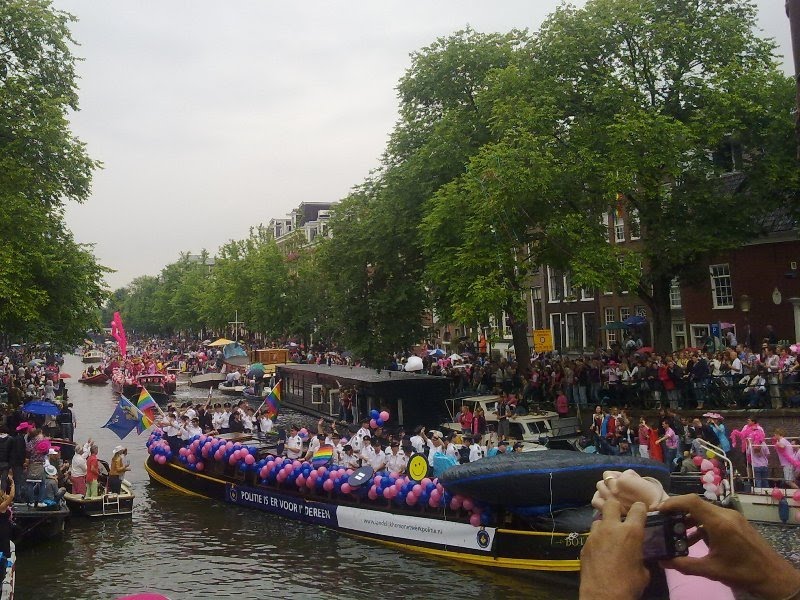
Along with doing police research in Amsterdam and working for time at my brother’s theater, I also started a non-profit boat club. It’s still there and whenever I can get back, I take out a lot of tourists on the beautiful canals.
Americans are constantly amazed that a city could be so livable and so beautiful (and pedestrian and bicycle friendly). I am always quick to tell them we could do that too, if we wanted to… and were willing to pay half our income in taxes.
Their collective approach could be the result of much of the country being below sea level. It could also be some strain of Calvinist Protestantism. The Dutch, contrary to public opinion, aren’t liberal. They’re tolerant. If anything, they’re amoral. And since morality generally does not make good public policy, things in the Netherlands generally work. And if they don’t, they spend money and fix them till they do.
I’ve lived in Amsterdam. My brother still does. He was first attracted by their permissive attitude toward legal marijuana. While partaking in that, he and a friend had the brilliant idea to open a business, a comedy theater.
He did. Amsterdam is now home for him now. Seventeen years later Boom Chicago is the fruits of his labor. Now that my brother is a business man, he frequently complains about Dutch labor policy. Like the fact you really can’t fire workers. Ever. Even bad ones. And then there’s a tendency for these workers–in what has to be one of the least stressful countries on earth–to go out on employer subsidized sick leave because of, you guessed it: “stress.”
And workers, and even the unemployed, get an extra month salary, “vacation money,” for their annual month of paid vacation. This is so hard for Americans to conceive of that I’ll say it again: Dutch workers get a month paid vacation and during that month, they get an extra month of salary. Otherwise, the thinking goes, how could you afford to go on vacation?
But because taxes in our country are considered socialist (or worse), we don’t. I lose close to 40 percent of my paycheck every other week. I would be happy to give up another 10 percent of my income for all the benefits the Dutch get from their taxes.
Anyway, read Shorto’s article. Especially if you’ve never been to Europe but instinctively nod in agreement whenever people criticize their economic policies.
Here’s a sample:
Then there are the features of European life that grate on an American sensibility, like the three-inch leeway that drivers deign to grant you on the highway, or the cling film you get from the supermarket, which clings only to itself. But such annoyances pale in comparison to one other. For the first few months I was haunted by a number: 52. It reverberated in my head; I felt myself a prisoner trying to escape its bars. For it represents the rate at which the income I earn, as a writer and as the director of an institute, is to be taxed. To be plain: more than half of my modest haul, I learned on arrival, was to be swallowed by the Dutch welfare state. Nothing in my time here has made me feel so much like an American as my reaction to this number. I am politically left of center in most ways, but from the time 52 entered my brain, I felt a chorus of voices rise up within my soul, none of which I knew I had internalized, each a ghostly simulacrum of a right-wing, supply-side icon: Ronald Reagan, Jack Kemp, Rush Limbaugh. The grim words this chorus chanted in defense of my hard-earned income I recognized as copied from Charlton Heston’s N.R.A. rallying cry about prying his gun from his cold, dead hands.