I just want to put this out here so *I* don’t forget. I somehow hadn’t heard of Tony Timba until like two weeks ago. This is an egregious Floyd like case of a man killed by cops. But only Floyd, here there was also a cover up and there was no accountability. Cops did nothing wrong, they say. I disagree.
Tag: bad shooting
-
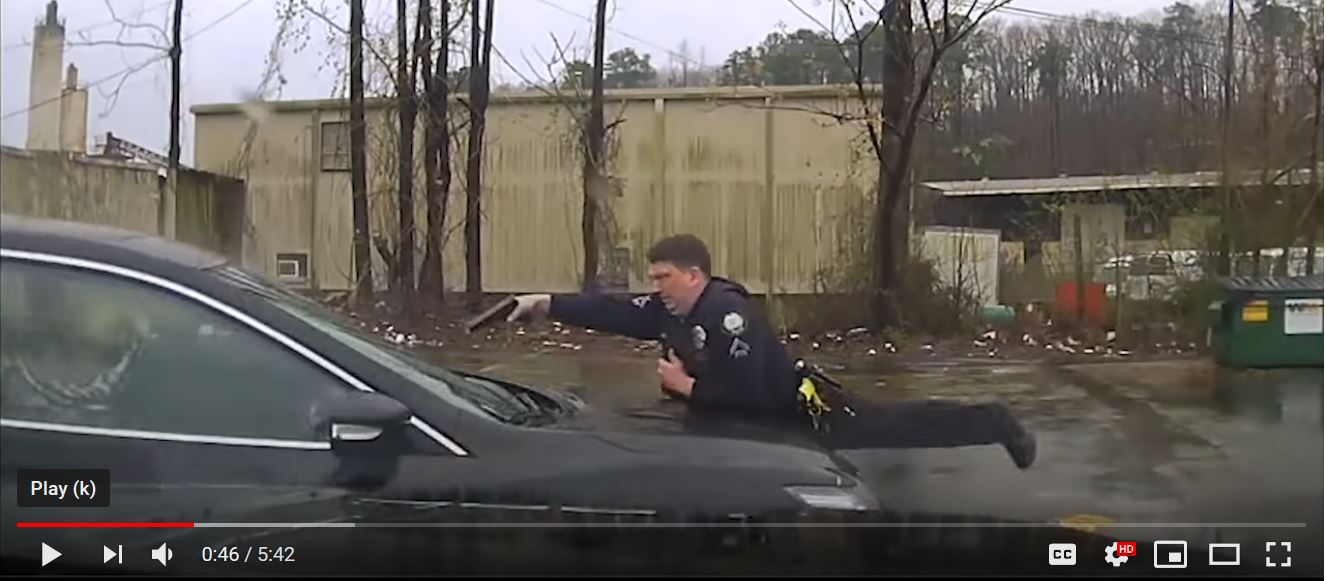
“Stop the car or I’ll step in front of it”
This was not a good shooting. And cringe-worthy from an officer’s perspective. From the suspect’s perspective, well, he’s dead.
I’m quoted in this article.
The background is the car popped up on a stolen car list (I think from an automated license plate reader). The officer is told to investigate. The car is in a parking lot. There is no car stop. There was no fleeing that preceded this.
The first problem is Officer Starks stops his car in front of the stolen car. That in itself isn’t bad, if you don’t care about your police car. But he does so in such a way that he has to get out of the police car in front of the suspect’s car. You don’t do that by choice.
The second problem is the officer doesn’t wait for backup and the third problem is he exits the car with his gun drawn (or immediately does so after exiting the car). If you feel the need to approach the car with your gun drawn (which is fine but not required for a car that comes back stolen), shouldn’t you also feel the need to wait for backup? Either there’s a potential threat or there isn’t. And if there isn’t, he shouldn’t have had his gun out. And if there is, he should have waited for backup.
There was no good reason to think the driver of the car, later identified as Bradley Blackshire, was armed. Though indeed he might have been. But he wasn’t. (Though in an odd but irrelevant twist the passenger later tells cops on the scene that Blackshire “has a gun,” even though he doesn’t; no gun is found. Turns out she got of jail that day. She asks to get her jacket back, because, you know, it’s cold. She’s bizarrely calm and compliant after all this.)
But the fourth problem is the biggie. The driver, Blackshire, starts to slowly drive away after not getting out of the car, and the officer shoots and kills. When the car starts moving, Officer Starks is on the driver’s side of the car. The car is brushing against him, but it is not going to hit him. There is no threat. Just a dude slowly driving away at gunpoint. Yes, the driver could have complied. Should have, even. But non-compliance is not the issue. Non-compliance is pretty common. More to this point, non-compliance is not a lethal threat. The officer shot four times and killed Blackshire over being in a car reported stolen (it’s not clear it ever was) and “failure to obey a lawful order.” That’s unacceptable. Also likely a convictable criminal offense.
And then, to make matters worse — who knows, perhaps Blackshire would still be alive if Starks had left well enough alone, but no — Officer Starks chooses to nominate himself for a Darwin Award. He steps in front of a moving vehicle.
Sure, sometimes police officers end up in a chaotic situation where they find themselves in front of a moving vehicle. Shit does happen. But you don’t choose to put yourself in front of a moving vehicle. Especially not if you just shot and incapacitated the driver.
As I say in the newspaper article: “It’s just shocking to see. Not getting in front of a car is the rare case where general orders, common sense and officer safety coincide.”
It looks like the driver does indeed hit the brakes when Starks steps in front of the car. But then, if I had to guess — which I don’t, but I will — Blackshire can’t keep his foot on the brake, perhaps because, you know, he’s been shot and is dying. So the car, as cars do, idles forward. At this point Starks goes up on the hood of the car and fires another 11 rounds.
The car hits and stops against dumpster or something, and then there’s the predictable period of curse-filled verbal commands being shouted at a dead or dying man. Blackshire seems to have enough life left in him to raise his hands, until he doesn’t.
What makes this situation unusual is that the officer was actually in control of setting the stage for this interaction. Officer Starks chose how to approach, and he chose wrong. And then Officer Starks shot when there was no imminent threat, and then he placed himself in danger and shot again. There never even was a split-second decision that had to be made.
I’d bet this isn’t the first time Officer Starks made unwise aggressive decisions in his career. And if I have to bet — and I don’t, but I will — this time will be his last.
[Update: In January 2020, A judge ruled that firing the officer was unjust.]
-
Dogs, Data, and Dastardly Deeds
Nick Selby and I talk about all this and more on our latest Quality Policing Podcast.
Here’s the bad shooting we discuss.
It’s not much in the news because there’s no racial angle to it. The officer was criminally charged today. I would say this might be third worst shooting of all time (Walter Scott and Andrew Thomas come to mine. Jonathan Ayers, too.) Speaking of Walter Scott. Former Officer Slager, who shot Scott, was sentenced today to 20 years in prison.
[Update: Dustin Pigeon was killed by Sgt Keith Sweeney on November 15, 2017. Sweeney was convicted of murderin November 2019.]
-

Terence Crutcher shooting
I’ll cut right to the chase, I think this is a bad shooting; but not as bad as many people seem to think. (In my very first sentence, I probably just pissed everybody off.)
Terence Crutcher wasn’t armed. And I don’t think he was an imminent threat when he was shot. Therefore it wasn’t reasonable. And that’s the legal standard for a justifiable shooting.
One very troubling thing here is why nobody renders aid. It probably wouldn’t have helped (with a bullet going through a body from one side to the other). But you can’t just shoot somebody and not render aid. You can’t. And they did. What they hell were they doing backing up in formation? What weird part of training was that?
Nor do I like the helicopter guy saying, “he looks like a bad dude.” Would the guy have said that about a white guy? I don’t know. I first thought it was a contributing factor, but from what I’ve read their broadcast was not being transmitted to the officers.
But what was Crutcher doing? False narratives are unfair. And dangerous, as we just saw in Charlotte. (Keith Lamont Scott seems to have approached officers with a gun, not a book.)
Despite what I keep reading, Crutcher was not complying. Crutcher was going to his SUV against the orders of cops. This is odd, worrisome even. But it doesn’t elevate somebody to a lethal threat. And Crutcher’s hands were not in the air when he was shot.

But I still don’t understand why the cop shot at that moment. I like to think, had I been there, I would have taken Crutcher out with my straight baton and a blow to a leg. Tasing would be justified. I don’t want him getting in that car when my partner is telling him not to. Perhaps, if you have the muscle, you just tackle the guy.
It seems to me Crutcher wanted to get back in his car. And cops are not going to let that happen, because we don’t to be killed like Officer Dinkheller died. What I’m saying is this isn’t Walter Scottbad. It wasn’t Charles Kinseybad. It wasn’t Levan Jonesbad. It wasn’t James Boydbad. It wasn’t Bobby Canipebad. It wasn’t Jonathan Ayersbad.
Bad is bad, and there’s no reason that every police-involved shooting has to be as bad as the worst shootings to warrant criticism. But I mention those names in part because many of these names are not African American. If people don’t know that cops shoot white people, too, they should. And sometimes these shootings aren’t justified. Too many police are too quick to pull the trigger. And this problem is not evenly spread throughout policing (more on that in my next post).
Back to Crutcher: As a cop you’re also aware that gunfire deaths of cops are up 50 percentthis year. But you can’t just shoot people because they’re non-compliant and drop their hands. You can’t be a police officer and be that afraid. Damn that Dinkheller video from 18 years ago. Before you shot, you need to wait till you see an imminent threat, like a gun or movement towards what you know is a gun. Look, people should be compliant, but as a cop you know people aren’t going to be compliant. It’s why we have police. People do not act rationally and police officers have to deal with them.
That said, this wasn’t just a motorist with a stalled car. From the 911 call:
Caller: There was a guy running from it. He, like ‘somebody was going to blow up.’ I think he’s smoking something.
Dispatch: Ohh (laughing).
Caller: I was rude to him too because I got out and was like, ‘do you need help’? And he was like, ‘come here, come here.’ I said ‘well, what’s going on’ and he’s like, ‘come here come here. I think it’s going to blow up.’ I’m like, ‘nah I’m out.’
Dispatch: OK.
Caller: He started freaking out and he took off running.
Crutcher was not acting reasonably. He’s talking about something blowing up. He’s roaming the street in what was probably a drug-induced high (we don’t know for sure, but PCP was found in the car). None of this justifies the shooting. But it does all matter.
Let’s imagine that Crutcher was going to blow up his SUV or had guns in there. It’s possible (though it wasn’t the case). Then would the shooting be justified? Still, no. (But it sure would be a better narrative.) Even then the shooting would not have been reasonable because at the moment the shot was fired, I don’t think a reasonable police officer would see an imminent threat. At least I don’t. As a cop, you don’t have to wait till a gun is pointed at you before you shoot. You shouldn’t wait till a gun is pointed at you before you shoot. But there’s got to be a gun! I mean, people should be compliant, but as a cop you know people aren’t going to be compliant. It’s why we have cops.
So now we’ll see how justice plays out. I suspect the officer will be criminally charged, as does happen in many bad shootings.
So here we have another “incident.” One of many, certainly. And don’t ignore the historical context. But there will be another bad policing shooting. I guarantee it. We can’t base reform on anecdote. Cops kill roughly three people a day. They’re not all good shootings, but most of them are.
What is the goal? The goal could be fewer bad shootings. The goal could be more accountability for tax-payer funded agents of state. Fine. But we’re never going to have zero bad shootings. Not only is that impossible, it’s not even a good goal. When cops save a life by killing a criminal, it is not an example of “global and national hatred.” Policing is not a pacifist occupation. We give cops guns because sometimes, at certain moments, we want them to shoot somebody. That is the reality. The way forward cannot be continued outrage, incident by incident.
That said, we can reduce bad and unnecessary police-involve shootings. I’ll get to that in my next post.
-
Hands up don’t shoot
“As long as I got my hands up, they’re not going to shoot me. This is what I’m thinking. Wow. Was I wrong.”
What the f*ck? Charles Kinsey is almost obscenely complaint. And unarmed. Does anybody have a link to a video that shows the moment he’s shot? I’d like to see it. But unless a gun magically flew into his hands, this might top Walter Scott, Oscar Grant, and Andrew Thomas as as the worst police-involved shooting ever.
And how long does an autistic guy have to rock with a toy truck before cops realize it’s a toy truck after being told it’s a toy truck. Do none of the cops have binoculars? I had binoculars.
The only silver lining is that Mr. Kinsey won’t have to work as a therapist much longer. (And also that the cop was a bad shot.) Of course he may need to spend some money on therapy himself.
-
Philando Castile
This police-involved shooting is bad. And unlike the killing of Alton Sterlingin Louisiana, I’m willing to call this one before the polls have closed.
This more recent shooting in Falcon Heights, Minnesota reminded me of Joseph Schultz. Schultz, you probably don’t remember because you’ve never heard of him, got shot in the face in 2003 by FBI agents who were conducting a traffic stop on the wrong car. (Schultz is white, and apparently white people don’t get bothered by being shot by police for no good reason.) I wonder how many traffic stops FBI agents have made before or since. The FBI agents got off. It was called an “unfortunate accident.” No. It was worse than that.
Over in the twitter world — which is like the real world but somewhat more poor, nasty, brutish, and short — David Simon seems aggrieved (a burden he carries well) about my wait-for-the-facts position on Sterling in Louisiana but my willingness to rush to judgement in Castile’s death.
I wrote:
(Actually, I’d bet Louisiana shooting not good either, but I’m not ready to call it yet. And I’m not a betting man.)
In a ever-so-slightly trolling manner, Simon prodded:
You don’t need to see the beginning of the video? Or learn all the possibilities of reasonable suspicion and probable cause for car stop? Why not?
No, I don’t. These shootings are very different. Because one involved a fighting man with an illegal gun.
@AoDespair I'll try and speak more slowly: one involved a fighting man with an illegal gun.
— Peter Moskos (@PeterMoskos) July 7, 2016
In Sterling’s death, I can imagine a scenario — one that may or may not be true but is very much possible when three people with three guns are rolling around on the ground — where the shooting was justified. What if Sterling was trying reach for a gun to kill somebody? My guess is this isn’t what happened, but I don’t know. (And neither do you.)
But it’s not just that. Castile was a police-initiated engagement. That matters. The victim, judging from post shooting reactions, was compliant. There was no fight. It’s a car stop, which limits the possibilities of motion. That’s relevant less for the possible danger aspect than for me being willing to make some assumptions about what happened before the video. I have no idea what happened before Alton got shot and tased. I know very well how car stops work.
And I’ll just keep mentioning this: Castile wasn’t carrying an illegal gun.
Ah, respondedSimon (foolishly trying to find flaw in my logic):
But video I saw was after shooting occurred. How do you ascertain all of the above other than witness credibility
And:
Do you have video of the run-up to and shooting of victim in Minnesota? Maybe I saw something abbreviated.
There’s no reason to think Castile was a threat or pointed his gun at the cops. The cop, later audio indicates, told Castile to reach for something, and he did. That’s called being compliant. I am willing to give police the benefit of the doubt. But having done that, and also willing to admit I can’t honestly conceive of a way the shooting of Castile was justified (unless there’s really something big we don’t know). And it’s not the first time or even second timea compliant individual was shot by police.
But it’s sometimes hard to explain nuance in 140 characters. So I left it at this:
@AoDespair But, this being twitter, my assumptions are reasonable and yours are not!
— Peter Moskos (@PeterMoskos) July 7, 2016
And though I generally think race is overplayed as a factor in police-involved shootings (and geographic region and act of being a lethal threat underplayed). Honestly, in this shooting, with this cop, in this locale, I don’t think there’s a chance in hell Castile would have been shot had he been white.
-
Courage, not fear
I still can’t believe this guy got shot down by a cop playing whack-a-mole with his service weapon. The D.A. said:
The evidence in this case shows the shooting to be accidental, and possibly negligent, but not criminally so. “This shooting is not justified, but also not criminal.”
I don’t know if I buy the stutter-step no-double-tap explanation. But at least the legal concept is sound. Something can be wrong and not criminal.
In fact, the only charges are against the paralyzed victim with the dead wife. [Update: Charges were dropped. He died.] This seems kind of mean. And there are no national politicians weighing in. Just a small local protest. Al Sharpton must be previously engaged. (As is often the case, this unnecessary shooting happened in California.)
Officer Feaster claims he didn’t know he shot Thomas:
No, no. … I don’t think I shot him. I wasn’t even pointing at him but the gun did go off.
“Did go off“? What are you saying? It just blew?
Let’s leave aside whether Feaster is the world’s best shot or the world’s worst cop. Perhaps it doesn’t matter. The question I have, the question any reasonable police officer might have, is why the hell did he draw his gun in the place. What made this cop so afraid that he felt the need to approach a crashed presumed drunk driver with his gun drawn and shot the man trying to get out of the wreck? The guy was going to run? What use is your gun in that case? A car just flipped. What exactly was the threat?
In the same vein, a reasonable police officer wonders, as did Levar Jones complying with orders, why he got shot. Why did cops feel that innocent Jonathan Ayers was a lethal threat while driving away? Why is a man not carrying a gun a lethal threat when he drops his hand?
Why did all these police officers see non-existent threats? Why were they so damn afraid? (I’m tempted to add “…these days,” but maybe it’s always been this way. I don’t know.)
In the face of danger you need to act but not overreact. You need courage, not fear. There’s a line I always liked in Birds Without Wings:
His courage was not the foolish kind of a young and silly man. It was the courage of a man who looks danger in the face, and forces himself not to flinch.
Hell, a little fear can be a good thing; you don’t want to be blasé in the face of danger. It starts in the police academy. “Stay alert, stay alive!” It’s a good lesson. Even “make a hole” isn’t so bad when it’s put in the context of situational awareness. But too much fear becomes paranoia. And that’s not conducive to good policing (or a happy life).
Here are some of the videos cops watch in the police academy. Some I saw myself. Others are more recent. They’re all on YouTube (which didn’t even exist when I was a cop). I guarantee you that every last one one of these has been watched in some police academy somewhere. Every cop I know knows 1) Dinkheller.
And 2) here’s that woman cop getting her ass kicked trying to arrest some big guy. His daughter is there. The cop kind of came back, but never recovered.
Go on. Watch them. Watch them all. It won’t take but 10 or 15 minutes. I’ve cued them all up to the key moment. It’s a parade of snuff films (though many of the cops do live, somehow). Can you watch all of these and not perceive threats and car stops a bit differently?
3) Here’s a man who wouldn’t stay in his car.
4) Here’s a routine traffic stop.
5) Here’s another routine traffic stop.
6) And other routine car stop.
7) This was a routine car stop but the guy drove away.
8) Here’s a guy in cuffs and a girl. What could possible go wrong?
9) Three cops. One suspect. Everything under control?
10) This guy isn’t wearing a shirt and doesn’t seem hostile.
11) This guy is naked and unarmed. There are three cops, two of them with tasers. The guy is still a threat.
12) And sometimes this happens. Things can go from 0 to 100 really quickly.
13) This guy does a little jig. He must be just be an odd character.
14) And everything seems OK here. Except for that shot cop.
15) This is what happens when you don’t put suspects on the ground.
16) We all know that when it comes to an armed man, it’s easier to act than react.
17) And people who have done time can be especially dangerous.
18) Out-of-shape fathers with their 16-year-old sons? Could always be cop killers.
And to cops these aren’t just abstract videos. There are people I know, friends, some taught in the academy, who were shot and lucky to live. Others, the pictures on the walls, weren’t so lucky.
Certainly cops need some of this. Some people are willing, even eager, to kill police. You can’t go on the job as a pacifist. But at some point fear isn’t healthy. It isn’t good for the job. It can even make the job less safe.
And I worked in a dangerous post. It made me less afraid. You face danger a few times, and you learn to respect it. Cops in the Eastern don’t squeal every time somebody steps on a leaf. But you don’t shoot at everything that moves.
But what if your work in some place without much danger? How do you stay awake, much less alert? (In my squad we could be alert and asleep!) And then, during some “routine” traffic stop or domestic — blam — something goes off script. Maybe you, the young cop who took the warrior mindset to heart, get a flashback to one of those videos in the academy where the cop got ambushed. And you think: “This is exactly how that cop got killed.”
[Cue trippy flashback music and echo]
“This officer hesitated [tated] and it cost him his life [life, ife, f…]”
“Better to be judged by 12 [elve] than carried by six [six, ix, x…].”
So you misidentify a threat, overact, and pull the trigger. You’ve screwed up because you’ve gone through life in a constant state of “Condition Yellow” because you didn’t want to slip into unaware “Condition White” in which:
You may very well die — unless you are lucky. I prefer to not depend on luck.
…
Some insist you cannot go through life using this system without becoming a hair-trigger paranoid person who is dangerous to ones self and others. I believe well-adjusted police officers can run through the color code dozens of times every day and be no worse for wear. Most experienced police officers who learn the color code realize they have been taking these steps on their own all along.
Maybe. For some. For me even. (This is why cops don’t sit with their back toward the door.) But even if constant hypervigilance doesn’t make you paranoid, it is very tiring. Exhausting, even. I don’t miss it. And stress affects some people more than others. NYPD officers are much more likely to commit suicide with their service weapon than be killed by a criminal. Why?
I don’t know the answer. I don’t like the “warrior” or “guardian” dichotomy. I would certainly put the emphasis on the latter, but you need a bit of both. You can’t let the warrior mindset take your soul.
Seth Stoughton writes in the Harvard Law Review:
Officers learn to be afraid. That isn’t the word used in law enforcement circles, of course. Vigilant, attentive, cautious, alert, or observant are the terms that appear most often in police publications. But make no mistake, officers don’t learn to be vigilant, attentive, cautious, alert, and observant just because it’s fun. They do so because they are afraid. Fear is ubiquitous in law enforcement.
And to those who say police need to abandon this warrior mindset for guardian mindset. Well, they’ve got an answer for that, too. And it’s not crazy. What do you do when it’s time to fight?
At some basic level policing does involve confronting and fighting criminals intent on hurting you or others. I always notice that when people talk about police reform or improving community relations, the word “criminal” will never come up. It’s as if the entire job of policing is nothing more than dancing with kids and smiling at church-going ladies in fancy hats.
See, just as the public needs to have a more realistic perspective about the “epidemic” of police killing innocent people (happens, but not too much), police need to get a realistic grip about being shot on the job (happens, including to friends of mine, but still less than cops think). Nationwide police get shot and killed about 3 times every month. That’s an annual homicide rate (cops getting killed per 100,000 officers) of under 5, which just happens to be almost identical to the national homicide rate. Of course keep in mind cops are on-duty only a fraction of the time, so cops on the job have a homicide rate 5 times higher than the national average. But hell, it’s still safer to be a cop than to live in Baltimore.
Stay alert. Stay alive. But for God’s sake stop being so damn afraid all the time.
[In memory of the police officers killed in the above videos: Kyle Wayne Dinkheller, Jonathan Richard Schmidt, Edward Scott Richardson, Billy Colón-Crespo, Ramón Manuel Ramirez-Castro, Darrell Edward Lunsford, Sr., Thomas William Evans, and Robert Brandon Paudert. They gave their all.]
-
Perhaps the worst police-involved shooting ever
I don’t say that lightly. There have been some bad ones.
Click on this link or you can jump to about 0:50 sec on this:
Andrew Thomas, the victim, a drunk driver, is paralyzed. He is white. So is Paradise, California.
1:35: “I got a male in the car refusing to get out.”
Maybe, you think, just maybe, it’s because you just shot the mother f*cker for no reason?!
And yet I hadn’t even heard of this shooting until a Baltimore cop just brought it to my attention tonight. We were talking about Baltimore cops actually do their job pretty well, all things considered. A Baltimore cop would never do this; we can’t imagine this happening in Baltimore. Apparently the officer in this shooting won’t face charges.
And yet in Baltimore six cops are being tried for failure to seat belt and bring prompt medical care? Has the world gone mad?
It’s not just that white people don’t care about black lives. Honestly, most white people don’t care about white lives, either.
[Update: he died]
[Further update: The officer was found guilty of involuntary manslaughter and sentenced to 6 months in jail.]
-
Bad shooting in Gardena, California
Usually when I get called from the media about a police-involved shooting I expect I’m going to have to explain how a reasonable police officer might perceive a potentially lethal threat.
Not here.
This is a bad shooting:
The killing happened two years ago. The video was just released. The officers faced no legal consequences. The city paid $4.7 million. The victim, Diaz Zeferino? Never heard of him before yesterday:
Three media outlets pushed for its release…. A judge granted their request, saying it was in the public’s interest to know why that city money was being spent.
Why are these cops so afraid? Why it is so obvious to me, formerly a reasonable police officer, that the guy is holding a hat and thus isn’t holding a gun?
Might this help demonstrate why citizens of California are 50 percent more likely than the national average and almost 4 times more likely than New Yorkers to be killed by police.
-
“You’re doin’ fine, Oklahoma!” Not.
A 73-year old man, Robert C. Bates, liked to play cops and robbers. He thought he was going to get to Tase a bad guy. But instead of holding his Taser, Bob was holding his personal gun. Bang. You’re dead. Oops.
Bates wasn’t a real cop. He was a “reserve deputy sheriff,” which isn’t necessarily a bad concept, within reason. But this isn’t reasonable. Bates paid to play. He gave money to the Tulsa County sheriff’s election campaign. Maybe he could have been a deputy sheriff without donating money. But he gave cars to the undercover unit to which he had access. And now, irony of ironies, Bates might be convicted based on the evidence provided by the very eye-glass cameras he perhaps gave to the department!
Bates didn’t even have good reason to even Tase Eric Harris. Cops were on scene. Harris wasn’t getting the upper hand. He wasn’t going anywhere. Despite what Bates later said, I do not think Bates thought Harris was armed. I say this because Harris was flying. Booking. Like a man who does not have a gun in his waistband. His arms were pumping, not going to his dip. Not in what I saw. And this is very much contrary to what supposedly “independent consultant” Sgt. Jim Clark claimed while defending Bates after being paid to investigate the shooting.
[And Kudos to the cop who tackled Bates. Good job. He was a fast runner and knew exactly where to tell the driver to stop the car, though the driver was a bit slow in doing so.]
“This horrible situation is going to be about what a corrupt sheriff’s office does after a bad shooting,” said Daniel Smolen, said a lawyer for the SOB who was shot.
I think Smolen may be right…. wait. Did I just speak bad of the dead? Yeah. And I say this without at all saying the shooting was justified. And I’m certainly not defending an elected sheriff who allowed the guy to be on the scene with a gun. But what a bastard Harris was: Violence. Drugs. Guns. Robbery. Assault on cops. Escape from prison(?!). The whole nine yards. A real life of crime.
I mention this in relation to my Washington Post article in which I describe how cops were so bothered about the shooting of Walter Scott. That one was different. This was a tragedy. A fuck up. And blame can and should be placed. But if you want cops to shed a tear over the death of Eric Harris, you’re going to be waiting a long time. Harris was a harbinger of violence and doom.
[Having watched the whole unedited video in the CNN office today, it’s unfair to just air the part where cops say bad things to Harris. One line — “fuck your breath” — out of context is just a gotcha moment. The media should also show Harris yelling at the cops. Now granted, Harris has just been shot. Maybe you wouldn’t like the line even in context, but the context matters. Harris, on the ground after a dangerous chase, is yelling about how he “didn’t do shit.” This is a man who had just ran from police after selling an illegal gun to an undercover cop. My actual thought when I heard his protests of innocence was, “fuck you!” Though I did manage to just think this and not blurt it out in the middle of a newsroom. I also didn’t just have to chase, catch, and restrain this jerk. This situation, to paraphrase Jay-Z, has 99 problems, but the cops’ words ain’t one.]
Maybe it’s because as a police officer you’re around of lot of death and even a lot of people murdered. So perhaps it’s inevitable to rank order the value of life. It’s one way you cope with dealing with a lot of death. An innocent kid is worth more than a guilty adult. A robbery victim’s life is worth more than the robber’s life. Somebody who could have prevented his own death by complying with lawful orders deserves less sympathy than somebody who didn’t run. The death of a guy killed after some minor vehicle violation is more tragic than a long-time felon who dies after running and selling undercover cops a gun. Somebody killed with intent is different than somebody killed in an accident. And both of those deaths would be different than somebody who happens to die as a result of less-lethal force.
So Bates had a Taser. And I think Bates wanted to use his toy. Oh, boy! I suspect moments like this were exactly why Bates had given so much to the Tulsa County Sheriff. He wanted to play cop. Bates and the Tulsa County Sheriff’s Department have made a mockery out of professional policing. Clearly Bates should not have have had a gun and a Taser.
Let us not start to consider “slip and capture” (a term I had forgotten before today) justification for using a gun instead of a Taser. Yeah, apparently it is possible to hold and fire a gun that you think is a Taser. “Slip and capture” reminds me of the invented concept “excited delirium,” which to some people means it’s OK when people die after getting tased. Just because you give something a name doesn’t make it real, or defensible. At best, “slip an capture” is a description. Bates, from everything he said before and after firing one round, obviously did not intend to shoot and kill Harris. But that doesn’t make it OK. And with proper training you don’t do it.
And it’s interesting to note that both in this case and the shooting of Walter Scott in South Carolina (and the shooting of Oscar Grant on the Fruitvale BART platform), that these victims would be alive if the cops (or, “cop” in the Oklahoma case) had not been armed with a Taser. I’ve never been a big Taser fan. I wonder if this is something to consider. There’s particularly irony in people being killed because officers have less-lethal weaponry. (Not running from cops is also a wise preservation strategy, though that didn’t help Grant.)
Finally, let me observe that I don’t know much about Oklahoma except a song (and the history and meaning of “Sooner”). But maybe Oklahoma is not “doin’ fine.”
Oklahoma (together with fair New Mexico) has the highest rate of police-involved killing in the nation! The rate at which people are being killed by police in Oklahoma is twice the national average and five times the rate in New York or Michigan. Five times higher? That’s a big difference. It’s also the subject of my next post.