Tag: Baltimore

  • “So what’s the big deal?”

    What’s weird, at least to me, is that many (mostly from the political left) seem to dismiss the never-before-seen increase in homicides in Baltimore as just some random uptick. “You know,” I’ve been told (and more than once), “violent crime is up in New York City, too.”

    Are you fucking crazy?!

    Homicide in Baltimore is up 250 percent over-fucking-night! And that night, April 27, 2015, just happened to be the night of the worst riots “Mobtown” has seen since 1968. This was a time when the mayor said police need to give room to people who want to destroy. (To be clear, I firmly believe this is not at all the message the mayor was trying to say… but still, a good mayor doesn’t let things slip from her lips that can be — and were — reasonably misinterpreted as letting people know that violence and destruction would be tolerated.)

    April 27th was also (and this is more Commissioner Batt’s fault) when police were confronted with some kookie young kids at Mondawmin Mall. The police, in riot gear, were told to stand down. I don’t think police should go too quickly to riot gear… but when you do use force, you go in strong! Instead, cops charged… and then retreated. This was on order, say police friends who were there, of the high-command.

    So the police charge became a half-assed charge. And 5 angry kids became 15 when police retreated. And then one more pseudo charge. And then 15 rock-throwing kids became 50. It was horribly policing, tactically. Horrible. (But not the only problem, mind you. I still want to know who the hell closed down the MTA and thus prevented school kids from leaving the mall?)

    So on April 27th, 2015, there were riots. And fires. And looting. And then starting the next day, twice as many get shot. People, this isn’t a fucking coincidence! This isn’t something that was meant to happen. It’s not like the Almighty wrote it. People on the streets, with guns, go up to other pull people, pull the trigger, and shoot them. So now, in a city of 620,000 people, this is happening one more time every goddamn day!

    So yeah, to those who point out homicides in NYC are up 13 percent compared to the same time last year: whatever.

    13 percent may be a statistical fluke. Or maybe it’s not. Maybe we can live with 40 more people murdered annually in NYC if it is at all related to half-a-million other people not stopped by police. I don’t know. But those are the discussions we should be having.

    Here’s the thing — and this is what bother me — I’m willing to discuss why crime is up, the role of police in crime prevention, what we can do to reduce violence, and the relationship between more aggressive/repressive police and less violent crime. I mean, that is kind of what I do for a living.

    But I’m not willing to debate that more people are getting killed in Baltimore and that something changed because of the fallout from the death of Freddie Gray.

    So the starting point for me is that something has changed in Baltimore vis-a-vis violence and homicide.

    The reason some people can’t accept this, I suppose, goes back to the fallacy that police don’t really matter, except as agents of racist repression. This argument says that crime is caused by society and root causes (and not criminals, per se). If racism, unemployment, and even aggressive policing cause crime, than some are happy to blame cops, society, racism, Broken Windows, Bill Bratton, and everybody but those who actually pull the trigger and kill somebody.

    Get real.

    So here we have the most sudden sustained increase in violence — overnight, mind you — in American history (best I know… please, if you know anything comparable to this, let me know). Of course it has to do with the riots. Not directly the riots, mind you. They’re over, at least for now. And nobody was actually killed during the riots, which is kind of amazing. This surge in shooting? It’s because of politics and police.

    Given that six officers were criminal charged for the death of Freddie Gray — a death that certainly not all six of them were responsible for — why would you go out and do more than have to?

    What you have — I can’t help but keep harping on the failed “gang truce” so loved by the mayor and police commissioner — is a police department that:

    A) isn’t doing much proactive police work (which means not doing more than answering calls for service);

    B) isn’t going hands-on with criminals hanging out on the corner so much (ie: not frisking people on violent drug corners means criminals are emboldened and guns are more accessible);

    C) an understaffed force that has been reduced to about 2,200 (down from more than 3,000 cops when I was there — doing more with fewer cops is yet another west-coast concept that hasn’t worked so well in Baltimore);

    and D) large crowds getting in the way of every routine call for service. (This means more cops need to respond to every call. And keep in mind that some of those getting in the way are responsible for the horrible increase in shootings. So it’s not like cops are paranoid about the situation.)

    Maybe I’ll break those down more later, but let’s just keep going with the 250 percent increase in killings.

    I’d bet (though I don’t know) that complaints against police are down equally dramatically. Probably the same 50 percent that arrests are down. Some say police arrest too many people. So fewer arrests should be good (it happened in NYC without a big increase in crime)…. so if you believe that, please try and explain this increase in murders in a way that doesn’t involve police. Or tell me what you want police to actually do. It’s not a simple question. And I’m all ears.
  • Murder in Baltimore

    With murdered doubled post-riot, you’d think more people would care. I don’t mean people in high-crime neighborhoods in Baltimore, they do care. It’s all those other people who so righteously saw police as the biggest problem in the hood. Where are they, now that the murder rate has doubled?

    Oh, and how did that “gang truce” work out? Well that hasn’t worked out so well. Legitimizing and empowering gangs is not the answer. It’s the Cloud Cuckoo Land idea, embraced by too many, that crime prevention can be purely collaborative and never confrontational. It’s also a strangely insulting concept, especially when it comes from outside white liberals, that criminals somehow represent the community more than the police.

    Yes, police can and should be more polite in their job. There’s no reason to be an asshole on the job (which is not to say that some people sometimes don’t need to get told off sometimes). But being a dick is not only wrong, it’s bad policing. It makes the job tougher for all police. Still, more polite and empathetic and understanding police — which can make non-criminals less anti-police (a more important than many cops want to admit) — will not stop criminals from killing each other.

    I think a lot of this comes down to the old sociology fallacies that A) police don’t deserve credit for preventing crime, B) culture doesn’t matter, and C) the only real causes of crime and what is perceived as bad culture are inequality, racism, and lack of opportunity. But the “root causes” did not magically change on April 27, when Baltimore burned.

    After the riots and horrible leadership from Baltimore’s mayor and police commissioner, proactive police patrol all but stopped. Why? Because all police work has the risk of going south. There’s long been the maxim in policing, “if you don’t work you can’t get in trouble.” I’m not a big fan of the thin-blue-line trope, and yet here you have a pretty clear cut case where police have done less and criminals have done more.

    Racism in America and violence in America are two separate problems. To walk up to an enemy and pull a trigger is something some people choose to do and others do not. Somehow, lots of poor people — even in Baltimore — manage to live decent and even joyous lives without killing somebody. Calling out racism and racists — a noble calling — isn’t going to save one black life in Baltimore. To see police as some kind of nexus between racism and violence is a tragic mistake. Baltimoreans aren’t being killed by racists. They’re being killed by each other (Freddie Gray being a notable exception).

    In parts of Baltimore we pay police to deal with those people who think murder is an acceptable problem-solving methods. Police deal with these criminals daily because these criminals are hanging out on the corner all day dealing drugs. Some neighbors have the gumption to not like this. So they call the police. And in come the police to clear the corner. And that’s what real police do.

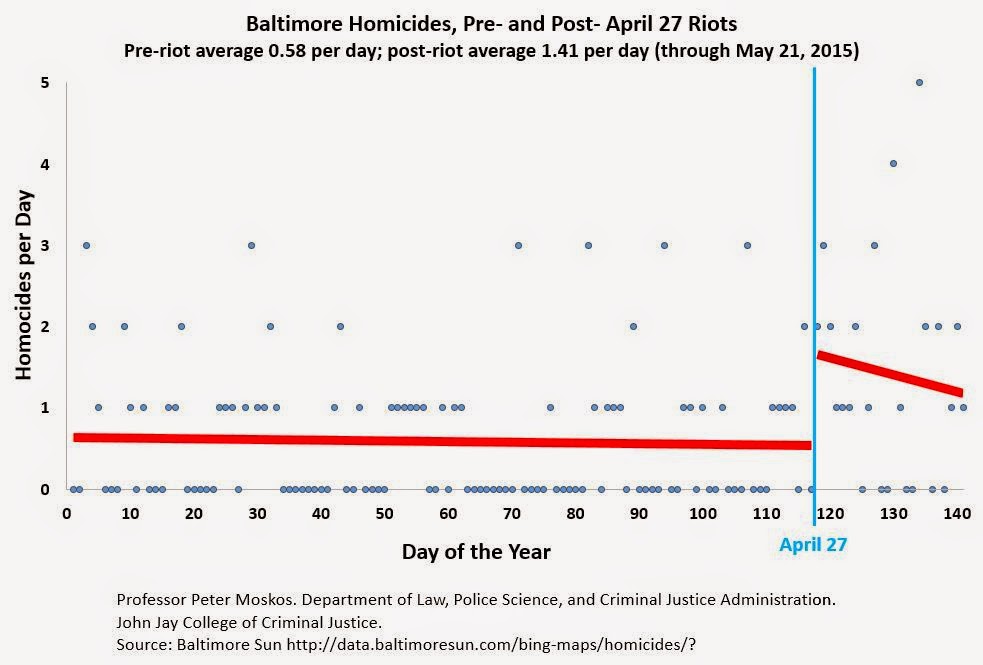
  • Baltimore Homicides, pre- and post- riot

    Baltimore Homicides, pre- and post- riot

    After the riots, the daily number of homicides in Baltimore more than doubled from 0.58 to 1.41. That’s a lot more dead people. 0.8 per day. (For those of you not too good with math, that’s almost one a day. And yes, Gotti, I’m looking at you.)

    Click to embiggen.

    The trendlines, pre- and post-riots, are in red.

    [Updated May 21]

  • Taking a break

    This will be my last post for close to three weeks. I’m heading out of the country (hiking in Greece).

    The late-breaking news is that six BPD officers have been criminally charged. That’s a lot. This will be a very tough case for the prosecutor to win. The most serious charges need intent (said a law professor I was just on the radio with). Intent beyond negligence or indifference.

    The other detail well worth mentioning is that, according to the state’s attorney, Gray had not committed a crime. The knife was legal, she said. Hence there was no probable cause for arrest. (Strangely, though, the Supreme Court has ruled that officers are OK as long as they think something is illegal. But I don’t know if that applies to something like this. Best I remember that case was something about a traffic (non) violation and a subsequent search.)

    So legally, best I understand, the initial chase and stop were legal (reasonable suspicion based on flight from police). But there was no probable cause for arrest because Gray wasn’t doing or carrying anything illegal. Fleeing from police gives reasonable suspicion to stop (and a frisk leads to plain-touch with regards to the knife; that plain-touch then gives probable cause to search for said object; and the knife would be legally found). But if the knife isn’t a crime… well, you don’t have probable cause for arrest. That’s minor compared to the more serious charges, especially if you think the knife is illegal, but it certainly does not help the police.

  • The 2nd man in a van

    Interview with Donta Allen, the second man in the van. He’s Baltimore, that’s for sure. Straight out of the Western. Some might find him unique and charming. I’d just like to point out that his is a voice you don’t hear much.

  • The scale of the riots

    The scale of the riots

    In certain circles (like my circles) it’s popular to post things about how when whites riot (and they do) we call it frat boys having a good time. Now whites frat boys riot over stupid shit, like their sport’s team winning, or their sport’s team losing. And don’t get me wrong, I’m not down with frat boy culture.

    I think these situations are very different. But I don’t buy the violence against oppression argument either. First let me just say I find white frat boys so completely idiotic because of their drunk stupidity without a cause. It’s a party. And a lame party of that.

    In Baltimore’s case, there are real reasons for being pissed off. But that has nothing to do with burning down a senior center or cutting a fire house. You’re allowed to be pissed off. You’re not allowed to be violent. And if you can’t be the former without doing the latter, then you’re a child. This has nothing do to with protests. Looting is also a party. A destructive party. But it’s actually a decent party.

    The difference between college riots and Baltimore’s riot is the scale and magnitude of violence. And this may reflect the culture of the rioters. Frat boys: a little violent, very drunk, college educated, very stupid, disrespectful, often come from good families, don’t generally kill each other. Ghetto boys: more violent, less drunk, high-school drop outs, less stupid, disrespectful, often come from horribly dysfunctional families, and they too often do kill each other.

    To say we’re only making a big deal out of this because of race is absurd. People need perspective. They also need to understand the scale of destruction here. Any one of these incidents would have been news in a college paper (and probably not much else). A bonfire and a tipped car and broken store are not good. But it is what it is. It destroys neither the college nor the downtown.

    This was different. And it bothers me how quickly people are willing to take fact and rumor and whatever else they want from Baltimore when they have no idea what really happened in Baltimore.

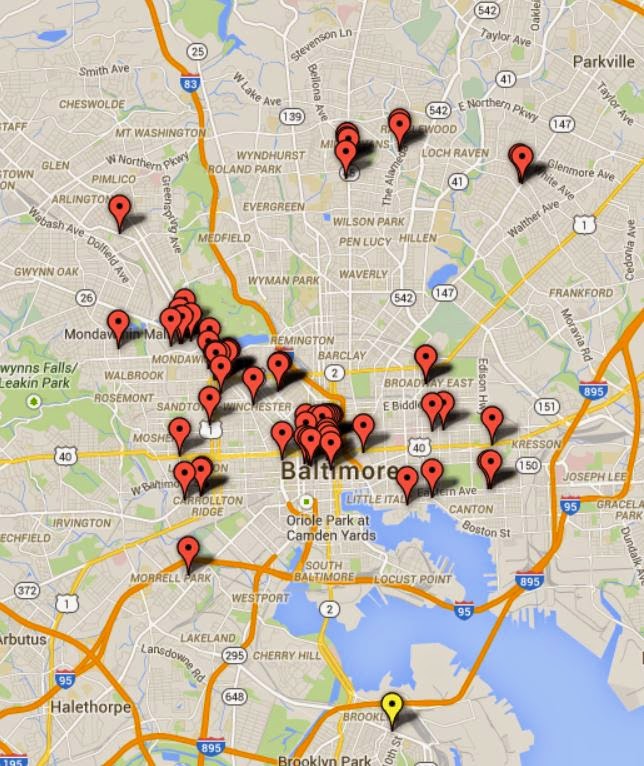
    The Baltimore Sun has a nice little interactive map on the violence (similar to their great map of city homicide).

  • Don’t believe the hype

    Baltimore has 99 problems… gangs aren’t really one. At least not on list of top 5. Batts seems a bit obsessed with them. That’s West Coast bullshit.

    An article by Leon Neyfakh in Slate.

  • The “ghetto”

    I use the word “ghetto” because it is the vernacular of police officers and many (though by no means all) of the residents. Here’s what I said about “ghetto” in Cop in the Hood:

    In any account of police work, inevitably the noncriminal public, the routine, and the working folks all get short shrift. Police don’t deal with a random cross-section of society, even within the areas they work. And this book reflects that.

    The ghetto transcends stereotypes. Families try to make it against the odds. Old women sweep the streets. People rise before dawn to go to work. On Sundays, ladies go to church wearing beautiful hats and preachers preach to the choir. But if you’re looking for stereotypes, they’re there. Between the vacant and abandoned buildings you’ll find liquor stores, fast food, Korean corner stores, and a Jewish pawnshop. Living conditions are worse than those of third-world shantytowns: children in filthy apartments without plumbing or electricity, entire homes put out on eviction day, forty-five-year-old great-grandparents, junkies not raising their kids, drug dealers, and everywhere signs of violence and despair.

    …If you’re not from the ghetto, and though it may not be politically correct to say so, the ghetto is exotic. One field-training officer accused me of being “fascinated by the ghetto.” I am. There are very few aspects of urban life that don’t fascinate me. But it is not my intent to sensationalize the ghetto. This is a book about police.

    If you want to read about the ghetto, good books are out there. Ghettos are diverse and encompass many cultures and classes. Some object to the very term “ghetto.” I use the word because it is the vernacular of police officers and many (though by no means all) of the residents. If you really want to learn about the ghetto, go there. There’s probably one near you. Visit a church; walk down the street; buy something from the corner store; have a beer; eat. But most important, talk to people. That’s how you learn. When the subject turns to drugs and crime, you’ll hear a common refrain: “It just don’t make sense.”

  • Civil Unrest Mom

    “Isn’t that child abuse?” “Absolutely”

    Holly Walker is my friend. So no saying nothing bad about her. But how could you? She does a great job here.

    Get More: Comedy Central,Funny Videos,Funny TV Shows

  • Life and Death in Baltimore’s Eastern (and Western) District

    See Update for more current data

    More than ten percent of black men in Baltimore’s Eastern District are murdered! Why is this not known? Why is this not discussed with urgency? Why has this been going on for decades?

    This is from my book, Cop in the Hood. I can’t find it anywhere online. It should be. I’m still honestly hoping there is some major error in my math. But if there is, nobody has brought it to my attention. This stats comes from 2000-2006. Though it may have changed slightly, I have no reason to think it’s changed significantly. And to be clear, the “men” I’m talking about are black men:

    The risk of death is astoundingly high. For some of those “in the [drug] game,” the risk of death may be as high as 7 percent annually.* Each year in Baltimore’s Eastern District approximately one in every 160 men aged fifteen to thirty-four is murdered. At this rate, more than 10 percent of men in Baltimore’s Eastern District are murdered before the age of thirty-five.** As shocking as this is, the percentage would be drastically higher if it excluded those who aren’t “in the game” and at risk because of their association with the drug trade. (p. 73)

    And here is the fine print, the dirty details, the footnotes from pages 219-220:

    * Levitt and Venkatesh (Levitt, Steven D., and Sudhir Alladi Venkatesh. 2000. “An Economic Analysis of a Drug- Selling Gang’s Finances.” Quarterly Journal of Economics 115 (3):755–89) show an annual 7 percent death rate for those actively involved in street-level drug dealing. A Baltimore City police officer entering the force in 1982 and retiring in 2007 would have had, roughly, a 0.7 percent chance being killed on duty during those twenty-five years.

    ** More than 11.6 percent of men in the Eastern District are murdered. This is based on homicide and census data. The 2000 Eastern District population for age 15 to 34 is 5,641 (derived from 2000 block-level U.S. Census data). The official U.S. Census citywide undercount for Baltimore was 1.8 percent. I arbitrarily doubled this figure for the Eastern District. Adding 3.6 percent raises the sample population to 5,844. The Eastern District lost 3 percent of its population annually between 1990 and 2000. Following this trend (it may have even accelerated give the massive expansion of Johns Hopkins Hospital), the 2006 population would be 4,867. I keep the 2000 population figure to be more conservative with my estimation of the homicide rate. Daily migration is not taken into account. I do not think this accounts for a large bias in either direction. All homicide victims in the Eastern District are assumed to reside in the district. Likewise no victims outside the Eastern District are assumed to come from the district. Homicide deaths in the Eastern District between 2000 and 2006 (excluding 2003, when I could not acquire data) are, respectively: 59, 38, 61, 55, 35, and 43. The mean is 48.5 murders per year. The demographic characteristics of homicide victims in the Eastern District are estimated from citywide, African American sex and age data. Of the city’s 179 black homicide victims in 2000 age 15 to 34, 168, or 93.9 percent, were men. 78.9 percent of all black male Baltimore homicide victims are 15 to 34 (FBI UCR 2000 Homicide Supplement). Based on these data, the average annual homicide rate for men 15 to 35 is 615 per 100,000. To put it another way, for these men, the odds of being murdered in a single year are 1 in 163. Based on the survival rate function 1 − (1 − r)^x, (r = death rate and x = number of years), 11.6 percent of men are murdered during a twenty-year period.

    Source: Peter Moskos. 2009. Cop in the Hood. Princeton University Press.