Tag: Baltimore

  • “Anybody want to try the spread?…”

    “Anybody want to try the spread?…”

    “…The spaghetti with brains is mind blowing.”

    Sure, it’s not the funniest quip ever, but I said something like that while guarding the crime scene of a 12-person shooting back in 2001. What else are you going to do? Have a moment of silence?

    I miss the laughs from the job. Non-cops may not understand cop humor, which is often a desperate attempt to make people laugh at precisely the most inopportune time. Granted it may not look good to be laughing over a dead body (especially if the victim’s relatives are nearby…) but hey, you gotta have fun.

    Well, now it’s official. Or at least peer-reviewed (“Is humor the best medicine? The buffering effect of coping humor on traumatic stressors in firefighters.” Sliter, Michael; Kale, Aron; Yuan, Zhenyu. Journal of Organizational Behavior vol. 35 issue 2 February 2014. p. 257-272).

    Cops don’t crack such jokes because they’re evil people. Quite the contrary! Cops (or at least firefighters) laugh at the misfortune of others because it keeps them sane. Humor, shocker of shockers, is good for you.

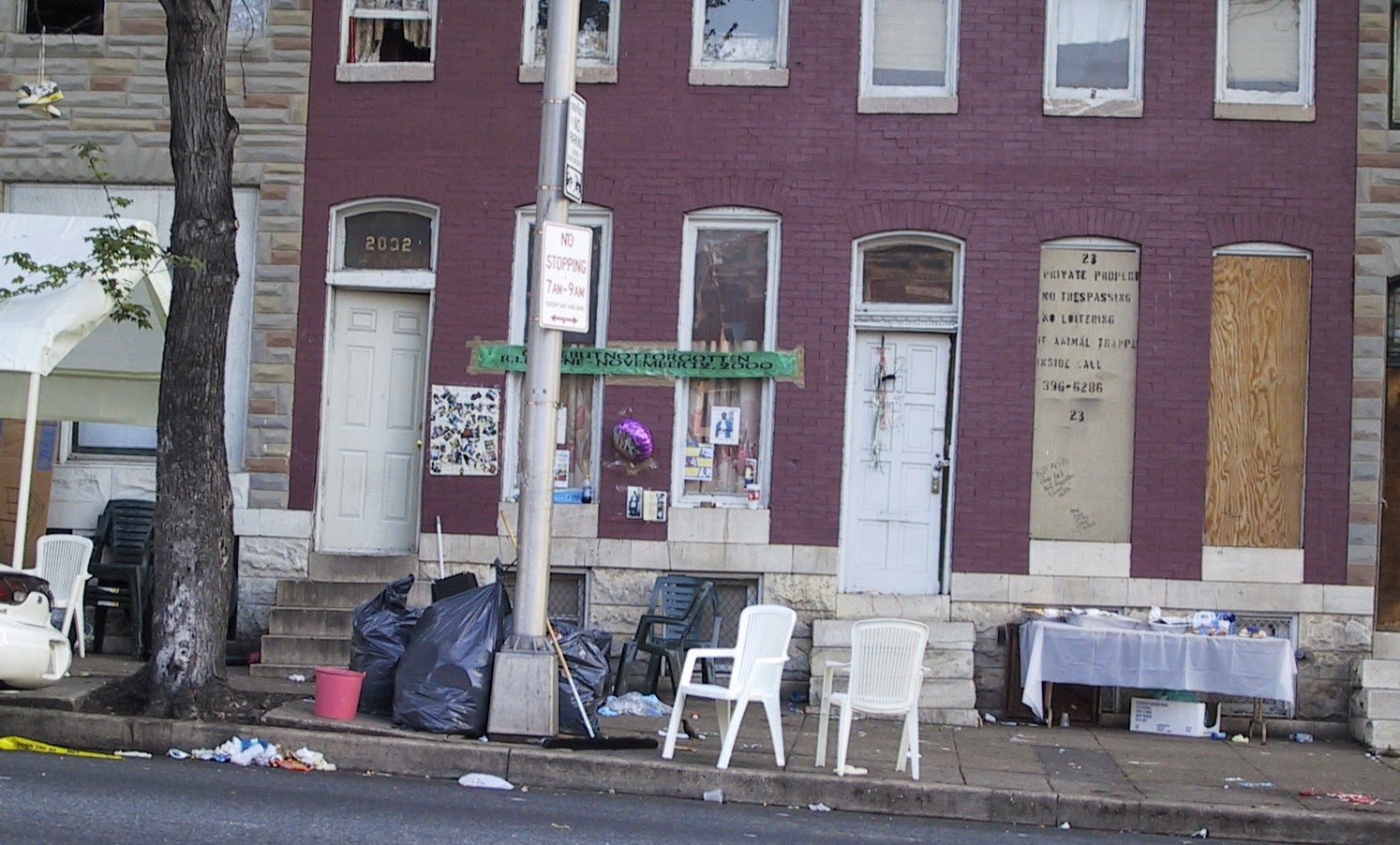
    That shooting on E. North Avenue was at an “RIP party” for a guy who went by the name of “Bone.” (“RIP party?” I remember one of my partners saying with disgust, “We already have a word for that. It’s called a wake.”)

    Just now I discovered that one of the “Hot Boys” shooters, stuck with the unfortunate nom de guerre “stink,” did 10 years. “Stink” was undoubtedly minding his own business just a few months ago, last December, when he was shot and killed. Oh well. I wonder what they’re serving at the wake?

    Also, I like how the Baltimore Sun says, “The block party shooting was one of the highest profile crimes at the time.” And yet at the time, the Sun didn’t even put the mass shooting on the front page.

  • Baltimore Police Department History

    A little over two years ago, William Hackley, retired Baltimore police officer and amateur historian, passed away.

    Were it not for Officer Hackley, so much of the history of the BPD would have been be lost to time.

    I was afraid that project would end with Hackley’s passing. Luckily, retired detective Kenny Driscoll has kept the history alive.

    The website is now here: https://baltimorecitypolicehistory.com/index.php. Give it a look. There’s a lot there. Driscoll wrote in a comment, “I hope everyone will continue to enjoy the site, and send pics, and info.”

  • Destructive Culture

    Najee Thomas, the 14-year-old son of Ronnie Thomas, was shot and killedin Cherry Hill (south Baltimore). You may better know Ronnie Thomas as Skinny Suge, he who 10-years ago created the semi-famous/infamous “Stop Snitching” DVD and is now in federal prison.

    Now I know it’s not popular in liberal circles to allow people to talk about “culture” — at least in any form except as related to mainstream dominant hetero-normative white male oppression. But social scientists can’t let conservatives co-opt and define the cultural perspective when talking about the ghetto.

    You don’t have to be a racist to note something is toxic about the culture of the Thomas family (see, for instance Stop Snitching parts one, two, three, and four). Not only are Skinny Suge’s life choices morally repugnant, they fail to succeed even by their own street-code values (unless these goals are to actually remain poor, in prison, or be killed).

    To blame America for America’s failings may be morally cathartic and even factually correct, but it does a great disservice to those who make better choices to ignore the culture of a community (and by “better,” yes, I’m using judgmental bourgeois standards of, like, holding a regular job and being a good parent.)

    Let me turn to one of my favorite takes on the matter, written back in 2006 by Harvard Sociologist Orlando Patterson (who was my PhD dissertation adviser). It’s well worth reading in its entirety, but here’s a bit in edited form:

    Why have academics been so allergic to cultural explanations?

    First is the pervasive idea that cultural explanations inherently blame the victim; that they focus on internal behavioral factors and, as such, hold people responsible for their poverty, rather than putting the onus on their deprived environment. (It hasn’t helped that many conservatives do actually put forth this view.)

    But this argument is utterly bogus. To hold someone responsible for his behavior is not to exclude any recognition of the environmental factors that may have induced the problematic behavior in the first place.

    Second, it is often assumed that cultural explanations are wholly deterministic, leaving no room for human agency. This, too, is nonsense…. Cultural patterns are often easier to change than the economic factors favored by policy analysts.

    Poor schools, per se, do not explain why after 10 years of education a young man remains illiterate.

    Nor have studies explained why, if someone cannot get a job, he turns to crime and drug abuse. One does not imply the other.

    And why, finally, do [so many young unemployed black men] murder each other at nine times the rate of white youths?

    Socioeconomic factors are of limited explanatory power.

    [When] the economy grew at a rapid pace, providing millions of new jobs at all levels[,] the jobless black youths simply did not turn up to take them. Instead, the opportunity was seized in large part by immigrants — including many blacks — mainly from Latin America and the Caribbean.

    One oft-repeated excuse for the failure of black Americans to take these jobs — that they did not offer a living wage — turned out to be irrelevant…. Such jobs offered an opportunity to the chronically unemployed to join the market and to acquire basic work skills that they later transferred to better jobs, but that the takers were predominantly immigrants.

    To understand self-destructive culture, one would be better served by disaggregated culture from its greater environmental causes rather than adopt, what is at its core, an old-fashioned functionalist and determinalist perspective.

    To say something is fucked up in ghetto culture is not to say that everybody in the ghetto is fucked up or even that everything ghetto culture is necessarily bad. Certainly people don’t have a choice as to where and to whom they are born. Certainly the criminal justice system contributes to the problem and can make it next-to impossible to succeed. And certainly people logically have survival skills to best suit their geographic and class-based-cultural environment. But the effed-up part of ghetto culture isn’t about survival, it’s about bad parenting, non-inevitable decisions, and poor life-style choices that are often distinctly counter-productive to actually surviving.

    Yes, oftentimes street behavior does make rational sense in street culture, but other times impulsive short-sighted street-behavior is just impulsive, short-sighted, and wrong.

    [Also, odds are nobody will ever do time for Najee Thomas’s murder. I can’t help but wonder how Skinny Suge feels about snitching when it comes to the guy who killed his baby boy.]

  • Speak like a Baltimoron

    One of my life’s great regrets is that I can’t for the life of me imitate the Baltimore accent. And I love the Baltimore accent. Well, I’m not the only one who has trouble with those sounds that go from DC to Philly. This is actually about the Philly accent, but a lot of it applies to Baltimore, too.

    Plus, the author, Arika Okrent, I went to high school with her. And she’s as cool as any Klingon speakeryou’ve ever met!

  • Officer Down

    Yesterday an Eastern District sergeant, Keith McNeill, was shot and very seriously wounded. My thoughts go out to him, his family, and all those who know and work with him.

  • Lexington Market

    Last week I mentioned“the army of junkies outside Lexington Market.” My tender New York eyes were a bit shocked by 20 people shouting and 20 other people nodding in what I call the “junkie lean.” You can’t expect decent people or caring parents with children to walk a gauntlet of junkies to go shopping. They won’t do it. Nor should they have to. Scott Calvert writes about the efforts to deal with this in the Sun:

    A man staggering around zombie-like, eyes slowly closing and opening. He came to rest against Konstant’s outdoor peanut counter, next to the market entrance.

    Gerald Butler, one of about two dozen unarmed market police officers, approached. “You need to keep it moving, sir,” he said.

    “I’m not trying to do anything, to be smart,” murmured the man.

    Canty walked up and asked if he needed recovery treatment.

    “I’m already on the program,” the man replied. He told Canty that he’s on methadone and had also taken other medication that day. Canty warned that he could be banned from the market for his behavior. “They see you nodding, they’re going to bar you.”

    “I will keep it under control,” the man promised. “I will leave. Thank you very much.”

    Canty handed him a referral card just as the man’s eyes fluttered shut. A moment later he was headed north on Eutaw, swaying as if buffeted by a strong wind.

    “We don’t see much violent crime around Lexington Market,” he said, “but the environment that’s conducive to the sale of prescription drugs is not conducive to drawing tourists to the market on a daily basis.

    I’ll say!

    Two weeks ago, after getting a crabcake with a friend, I too was leaning on Konstant’s outdoor peanut counter looking at the wares. A few feet away were dozens of junkies doing their slow junkie dance. Meanwhile right next to me and my friend was an overly made-up white woman in a full-length fur coat. On a weekday afternoon, she and I were perhaps the only two white customers in the market. She was sampling a peanut, seemingly oblivious to the chaos swaying around her. I asked her if the peanuts were good. In a slow southern drawl she said, “These are excellent, darling. And I know because I used to grow peanuts.” Only in Baltimore, hon! I bought two bags. They are excellent.

    We can disaggregate the problems outside Lexington market (inside things tend to be OK) into four issues:

    1) quality of life for customers

    2) economic survival of the Lexington Market (and Baltimore)

    3) crime

    4) public health of the addicts

    So while a holistic approach would be best, I have no objection to simply pushing the junkies somewhere else. I’m a police guy, so I’ll leave public health to others (alas, there is no silver-bullet solution to heroin addiction), but the market entrance is too important. It is not right (or economically viable) that a few dozen people damage the market and the city.

    Law enforcement efforts (and the threat of arrest) combined with social services can work. Port Authority was cleaned up in 1990s. It’s worth looking at how they did so. But one big difference is that the main problem of Port Authority was people living inside the bus station while the biggest problems of Lexington Market are addicts outside the market.

    The Sun article also quotes an architect who…

    thinks focusing too much on the scene around the market is “misguided.” He said it makes him feel uncomfortable, and no safer, to see police handcuffing someone sprawled on the sidewalk.

    If the market can attract a broader range of customers, he said, “that will thin out the impression one currently has that mostly they’re very poor people.”

    Philipsen says there’s also a racial dimension that “nobody wants to talk about.” Most market patrons are black, including those living in parts of West Baltimore without a supermarket nearby. Ideally, he said, the market would appeal across socioeconomic, racial and geographic lines.

    “If you’re white and want to see more white people, we can get them there by making this more attractive,” Philipsen said. “It’s not about subtracting people or making poor African-American folks not go there, but bringing some additional people so everybody feels comfortable.”

    Well I mentioned the racial dimension, and I also don’t think we need to focus on the tender comfort of white folk who “want to see more white people.” The solution to the problems of Lexington Market is not a few more white people. White people are not the solution. Besides, (to paraphrase Yogi) if white people don’t want to come to the market how are you going to stop them?

    [Best pickup line I heard outside the market, to a woman passing by: “Yo, baby, I got a job!” That was it. Alas, it didn’t seem to work.]

    I’m bothered by the architect’s comments because they seems to equate race and poverty with drug addiction and the shitty public behavior that makes decent people of all colors and income afraid. This isn’t about race or poverty (or even, to some extent, drug addiction) but about bad (and illegal) behavior.

    Most of the shoppers at the market may be poor and they may be black, but they’re inherent “decent” — to invoke Elijah Anderson’s concept. The problem is not the demographics of the customers, but the two or three dozen (decidedly non-“decent”) junkies shouting, nodding-off, and buying, selling, and using illegal drugs. That’s it! It’s their behavior that needs to change (or move elsewhere), not their race or socioeconomic status. If people could get in the market without being hassled and made to be fearful, you’d see more “decent” people — of all races (and yes, that would include white people, I suppose).

    And then there’s this: “The market’s image took a hit in 2009 when the owner of the Utz Potato Chip stall was sentenced to 15 months in federal prison after pleading guilty to selling illegal guns from his stand.” Oh yeah. That.And for the record that malaka was neither poor not black.
  • Baltimore, oh baby!

    I was in Baltimore for a sociology conference. Sure, I ate 5 crab cakes at four locations in three days. (Let’s just settle this debate once and for all — ha! — Faidley’s is still the best, if you don’t let the army of junkies outside Lexington Market get you down. Plus what other place sells crabcakes, oysters, and frozen friggin’ Muskrat?! — but only in season from Jan 1 to March 15…)

    Thursday night I hiked down Eastern Ave from Dundalk Ave to 500 W Pratt (about 65 blocks). I passed my old apartment (now above a barber shop on the 4900 block of Eastern Ave). Saw good ol’ Xenophone and ate his delicious food at Ikarus. Saw a lot of Spanish on the street. Had two cocktails at Bad Decisions(what could possible go wrong?) The city was looking good. This time was probably the longest I’ve been away from Baltimore since I worked there, and it was the first time I left thinking the city was better than the last time I’d seen it.

    But that was Thursday. Now it was Friday night, and I had nothing to do and was feeling lonely.

    Nothing to do on a Friday night in Baltimore? Text a cop, get picked up at 11:30pm at your hotel, and then have a fabulous night out in the Eastern District. Hey, at least I’m a cheap date.

    I was thrilled to still see a few good people I worked with. It’s hard to believe it’s been 13 years since I policed those streets.

    It was a quiet Friday night. Just a few calls. One big party broken up. But there was not a single gunshot to be heard. I spent the night shooting the shit with a friend. Good times. Almost makes me wish I was still on the job…

    But speaking of shooting, I was there just a few hours after one of my academy-mates shot some dumb-ass who pulled a [BB] gun out on him. It was a good shooting. [update]

    He (the cop I know) is doing OK. As to the dumb-ass, I would like to ask him, as he recovers in his tax-payer funded Hopkins hospital room with police guard, “so what exactly were you hoping for as you pulled out a gun from your waistband? Please describe the ideal situation, as you hoped to see it at the time, where drawing down on a cop with a BB gun was going to end favorably for you.”

    The day before, a city Sargent and a couple of other-county cops were arrested for soliciting prostitutes in Baltimore County. Here’s a good Baltimore-area rule: if she has all her teeth, she ain’t a ho. (Also, if the doesn’t jump in your car, she’s probably a cop).

    My friend whom I rode with, I had forgotten, was involved in a police-involved shooting the previous year (and has been shot at a few times, too). My friend also mentioned how two women in his academy class have killed themselves. And talking to another guy in my academy class, we figured that after 14 years there are probably about half of the original 50 of our class left (history will probably not look back on our class as, well, on of Baltimore finest).

    By our very rough and incomplete account: one was killed on duty(car crash). Another was shot and forced to quit. Two were fired. At least one quit before getting fired. One can’t testify in court. Two or three transferred to other departments (at least one of whom was subsequently fired). Perhaps eight out of the 50 total are out on permanent medical (most of which were very legit). And a few (including me) just quit. And these were the ones we knew about.

    On the plus side we do have a couple sergeants, a lieutenant, and a homicide detective. Still, all in all, I don’t think history will look back at our class of 99-5 as, well, one of Baltimore Police’s finest.

    It was great to go down memory lane with old friends. The memories from 14 years ago are surprisingly vivid. I remember the good times (funny who the bad times fade over time) from just 20 months on the job more than in the 14 years in academia since then…

    At 6am I was getting tried. Take me home, I said. And then back in my overpriced hotel I drifted off to sleep as dawn lit up the (rehabbed) Bromo Seltzer tower.

    Lookin’ good Baltimore, looking good.

  • You can’t make this stuff up

    Life imitates art, after art imitated life. In the Baltimore Sun: “arksdale, ‘Wire’ inspiration, pleads guilty in drug case”

  • A tale of two cities

    Murder in Baltimore is at a four-year high.

    Murder in New York City is at a record low.

    Meanwhile, from Justin Fenton’s Baltimore Sun article, in other cities:

    Homicides across the country

    Oakland, Calif. — down 25 percent (as of Dec. 12)

    Philadelphia — down 24 percent (as of Dec. 16)

    Flint, Mich. — down 22 percent (as of Dec. 18)

    New Orleans — down 22 percent (as of Nov. 14)

    Chicago — down 19 percent (as of Dec. 8)

    Detroit — down 14.6 percent (as of Dec. 18)

    Baltimore — up 8 percent (as of Dec. 24)

    Newark, N.J. — up 19 percent (as of Dec. 1)

    Washington — up 26 percent (as of Dec. 18)

  • How much do blue crabs cost this week?

    The questioneverybody is asking, for sure. I don’t even know, when is the cheapest time to buy crabs? Clearly not this week. (if you click on the link, you can see the crabs are still alive, which is pretty amazing for a cooked crab!)