Tag: Baltimore

  • Drug corner in action

    Here’s a nice action video of a drug corner shot by a police officer friend of mine back in October 2001.

    Basically this corner is a three-man (or boy) shop. The guy in the green shirt is the money man and the biggest man of this not-so-impressive. The kid in the white t-shirt (let’s call him “Little Man”) is kind of a go-between man and utility boy. An apprentice. A thug in the making. By the way, I’m guessing he’s about 13. I’m also guessing that if you had to live in what probably passes as his “home,” you might be on the corner, too.

    The third guy (white do-rag ) may be around the corner hitting people off or may be out and about, drumming up business. He’s not around in the beginning and appears to not be in cuffs at the end.

    The drug stash is in the rubble by the steps.

    I describe an efficient drug shop in a lot more detail in my book, Cop in the Hood. Here, I’m not impressed. Things are sloppy. They’re all doing a little of everything. Too often the drugs and money are too often in the same hands. It takes way too long to complete the drug deal with white girl. And I think Mr. Green Shirt is drinking on the job. Plus they get arrested.

    It is good police work. Usually patrol doesn’t have the time to this kind of surveillance. Maybe the rain kept the radio quiet.

    3 min., 15 sec. No audio.

    Here’s a timeline:
    6:35:00 Kids standing in the rain.
    6:35:18 White addict comes up. Just strolling through the hood in the rain, minding her own business. How did I know she’s addict? Sometimes being a cop is very easy.
    6:35:45 Reach in stash.
    6:36:47 Go around corner to hit off.
    6:37:31 Reach in stash again, pass to young kid.
    6:37:50 Positively skips with delight because he’s about to make four sales!
    6:37:55 Cluster fuck of junkies on corner. Crowd control skills come into play.
    6:38:12 What the hell is that guy carrying?
    6:38:45 Junkies heading back after hit off.
    6:39:30 Counting money.
    6:41:45 Running away. Po-po must be near. (Is that a bottle or the stash in his hand? I think a bottle).
    6:42:47 Back at stash. He thinks he’s safe.
    6:44:29 Two of the three in cuffs.
    6:45:45 Police officer recovers stash.

    If you have police video I can have, let me know. Especially if you’re police. I promise to keep you anonymous and edit out anything that needs to be edited out.
  • KGA Radio is on the Air

    This video isn’t exactly action packed. In fact, nothing happens. Really. It’s just a one minute drive through the streets of East Baltimore. But that’s one minute more than you’ve probably seen. And notice the sleepy-voiced dispatcher over the police radio. If he didn’t sound sleepy, It would get your attention. He was skilled. The last thing you want as a cop is a dispatcher who can’t handle the pressure. When things are going crazy, you want confidence that the dispatcher at least has things under control. This guy was always on the ball. Plus I loved his smooth DJ voice.

    A bad dispatcher is dangerous. And even if nobody gets hurt, a bad dispatcher just makes work unpleasant. Dispatching is not an easy skill. And they don’t get paid much. So quality is too often low. This dispatcher was the best. From police headquarters downtown, if need be he could direct you in or of Iron Alley. He knew the streets of East Baltimore. That’s a safety thing. Too bad he didn’t work midnights.

  • State raids mayor’s home

    Is Baltimore’s Mayor Sheila Dixon a crook? I guess we’ll find out.

    Please note that in this case, Officer Pete’s Fourth Rule (below) does not apply.

  • Don’t eat the paint

    Why is there so much violence in Baltimore? Maybe it’s the lead. Or you could say, “It’s the lead, stupid!” There’s a lot of lead paint in Baltimore, especially in poor neighborhoods.

    Greg Toppo reports in USA Today.

    In the academy, a friend and I used to joke that one of our dim classmates had licked the windowsill one too many times. Maybe he had.

  • No Parking = No Drugs?

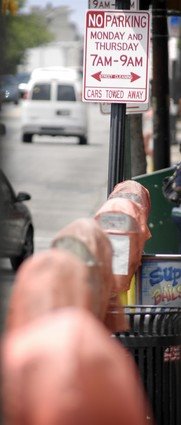
    No Parking = No Drugs?


    In a comment, Timothy turned me on to an article by Liz Kay in the Sun, “No parking, Less Drugs.” Leaving aside the grammatical question (it should be “fewer drugs,” right?), what about the concept? They banned parking on part of the business strip of Pennsylvania Avenue to get rid of drug dealers. Apparently, it has gotten a little better. It’s also hurt business.

    [Sun photo by Andrew F. Chung]

    My firstthought is that it’s a dumb idea. As Mr. Sussman, pawnshop owner and president of the Merchants’ Association, is quoted as saying, “Sometimes there’s a worry that you can cure the disease and kill the patient.”

    And I also don’t like a vision that prefers empty streets to streets crowded with non-criminals. That’s very anti Jane Jacobs.

    That being said, there are many things in favor of this idea.

    1) It isan idea. Maybe it’ll work. Maybe not. But I’m all for trying it.

    2) The problem of public drug markets is big. Desperate times often do require desperate actions.

    3) Apparently the business owners support it. As long as the businesses support it, I will, too. In a business strip, the business owners should have a big say. Besides, probably the main people inconvenienced by this are the business owners themselves who park in front of their store and feed the meter all day. I wonder how many of these spaces were open to the public, anyway.

    4) The greater impact seems to result from increased police presence rather than the removal of parking space.

    Is it a long-term solution? Of course not. But I guess it’s worth a try. There are lots of places you can deal drugs in Baltimore. It would be nice if Pennsylvania Avenue weren’t one of them.

    From the article:

    Deidre Danois said she and a friend had to park across the street recently when they stopped on Pennsylvania Avenue to grab some breakfast.

    “I bet you police don’t go up to Roland Park and tell them they can’t park on their street,” Danois said as she shopped at Sweet Sixteen.

    That’s right, hon. Because they’re not dealing drugs in front of stores in Roland Park. She reminds me of one time when I was in the 7-11 at 2300 Orleans St (which is actually the Southeast but we would go there because it was next to 24 post and hell, we didn’t have a 7-11 in the Eastern). I liked this 7-11 because of Lorraine, one of the employees. Sometimes we would swap our respective soul foods. She’d bring me homemade collards and I’d give her just baked spanakopita. Lorraine quit when she won the lottery and got engaged to a nice Indian man. That’s two separate events. I didn’t want her to quit. But hell, could you blame her? Who works midnights in that 7-11 by choice?

    Anyway, this 7-11 could get pretty wild. One night they were out of chili and cheese and posted a sign by the hot dogs saying so. There were a bunch of yo-boys acting up, ordered hot dogs, and hadn’t seen the sign. They were upset that they couldn’t top off their “dugs.” Between curses, one guy shouts, “I bet the white man’s 7-11 has chili!”

    Sure thing, dog, and an open bar, too.

  • Overdose deaths

    In 2007, 235 Baltimore residents overdosed. The story in the Sunis here.

    Interestingly (and surprisingly), 74 of those were from methadone. I don’t quite understand the point of methadone. If it’s addictive and you can die from it, why not just give junkies heroin?

  • Getting away with murder in B’more

    The Baltimore City Paper tells the story. Well, one guy did get 5 years.

    Here’s their first story.

    Here’s the concept:
    The Murder Ink column in the print edition of City Paper tracks homicides in Baltimore, giving details on each murder in the city. But what becomes of those homicide cases after we’ve reported the murder? Recently, we started looking at old cases to see whether those arrested for murders were ever convicted of the crimes they were accused of committing. For most murder cases, that information is not reported in the press. So, starting with this post, we’ll follow up on old homicide cases, beginning with murders in 2006, to see what happened.

  • Man bites dog?

    One of the stranger headlines appears in today’s Sun: City infant was not hit by bullet, police say.

  • Community Policing query

    Dear Prof. Moskos

    First off, let me say that I enjoyed your book. As someone who has recently moved to Baltimore and now finds themselves living on the edge of the Eastern I found it a fascinating read. Your discussion of 911 helped to explain the very big difference in reaction between the community meetings.

    Commanders (not a direct quote) “We won’t know something is happening unless you call 911 and tell us. We can’t do anything about it if you don’t tell us.”—911 operators “You’ve got transvestite hookers working in the park across the street? We can’t do anything about it unless you call when one of them is getting into a car.”

    Even without my new context, “Cop in the Hood” would have been an interesting book. I appreciate how you are able to speak with two voices; both the police and the sociologist.

    That out of the way, I have a question I would appreciate your opinion on: are citizen’s patrols actually effective? I’ve made some minor forays into the literature and searched for opinions. Although community policing generally seems to have a positive effect in some studies, I can’t find anything pointing to which aspect(s) is effective.

    At a gut level I have a cynical reaction to the overall effect of having a random group of neighbors walking around the area in green vests and waving the occasional flashlight at a dark corner. Keep in mind that I live in Greenmount West straddling the border between the Eastern and Central, so we have to communicate with 2 separate districts. This seems to reduce the level of direct contact with anyone who we have direct contact with.

    I’m very interested in your viewpoint…

    I answer:

    Living between two police districts really does make things worse. And having to deal with a different set of officers on two different blocks is a pain. There is a natural tendency for police officers to push problems (such as prostitution) “away.” I certainly pushed some people away from the Eastern and back into the Southeast. Counterproductive, when you consider I lived in the Southeast.

    Community policing, by and large, doesn’t exist and never has. It was supposed to mark a move away from reactive policing. But despite lip service to the contrary (I mean, nobody will ever come out againstcommunity policing), I don’t think any police department has every implemented a real long-term community policing program. Quite simply, you can’t have community policing if patrol officers are sitting in cars waiting for radio calls.

    About citizen patrols… I don’t know. My thought is that they can be effective (both directly and indirectly). It really is community policing. That’s good, right? But for all the effort put in, the gain is probably very very small.

    I’m a big fan of the Guardian Angels, for instance. But that’s more from the perspective of being a young guy very happy to see them on the Chicago L than from any actually academic proof that they prevent crime. Buy my guess is that they dohelp prevent crime from a Broken Windows perspective. And even if the Guardian Angels (or other citizen groups) don’t prevent crime, at least they made me feel safer. That’s worth something.

    District Commanders in Baltimore tended not to be the most enlightened bunch. (At least from my experience back in 2000. I’m sure they’re all much better now.) Getting police to move away from rapid response and toward foot patrol in not in their genetic DNA. They’re right that they won’t know until you call 911. So the question they and you should be asking them is why don’t they know and what can theydo to know better.

    And that 911 operator is an idiot. Just call for disorderly then, to get police to respond. But even better would be to talk to your post officer (on any of the three shifts, but the midnight is probably the best because we had more time) and talk to him or her about ways to solve the problem. As a police officer, I would much prefer to help a real person than just respond to another anonymous 911 call for prostitution. What the cops can do is arrest. And some arresting is probably part of the solution here. But probably just one piece of the solution.

    Interestingly, there weren’t many street-walking prostitutes in the Eastern when I was there. My guess is it was too dangerous for prostitutes and Johns alike.

  • You can ask my man right here with the broken neck

    911 is a joke. We should all know that by now. If patrol officers didn’t have to always be ready to answer the next bullshit call, they could do a lot more to prevent crime. I’ve written about this.

    I’ve always argued that while rapid response doesn’t make sense for police, it does for ambos and fire trucks. David Kohn writes in the Baltimore Sun that there are problems with repeat 911 for ambulances as well. One person called for an ambo every third day:

    Baltimore’s busy public ambulance service went out on more than 150,000 calls last year, responding to everything from car accidents to heart attacks. About 2,000 of those calls were from the same 91 people.

    “We want to get these people better healthcare so they don’t call 911 so much,” said Dr. Joshua M. Sharfstein, Baltimore’s commissioner of health.

    I’d like to give people better police serviceso they don’t call 911 so much.

    One woman in my sector called police at least 600 times a year. She’d call a couple times a day starting around 5am when she got up to sweep the street. She called for drug dealing. She was right. There was drug dealing. It’s just too bad we couldn’t really do anything about it. Not with her calling 911 so much.