Tag: Baltimore

  • Beware of the Risen People

    Beware of the Risen People

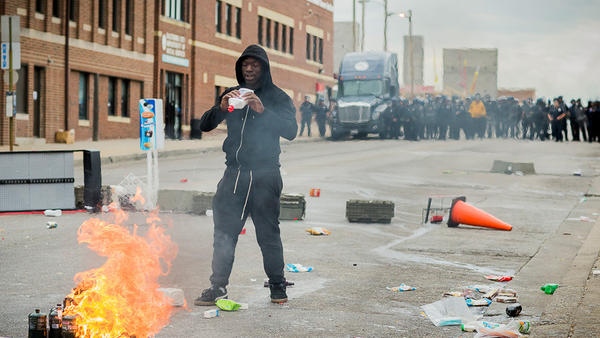
    The ATF released a version of this photo taken during the April 27 riots. The guy (“repeatedly captured in photographs and other images on the day of the rioting”) was later identified as Donta Betts:

    He confessed to creating the explosion to ward off the cops “so people could finish … stealing whatever they was going to steal.”

    “I figured I did all this because that was my period of time to go wild on the police…. I figured I did all this because that was my period of time to go wild on the police.”

    The image above became a symbol.

    It’s pretty easy to find people defending looting, riots, militancy, and destroying police cars. “All that rage is justified.” At the time (and still today) some insist they were no “riots.” Just an “uprising.” Beware of the risen people, oppressed, angry at (among other things) arrest-based policing that under Mayor O’Malley (who left office when Betts was 11, presumably before even his first arrest). People living in the hood in Baltimore have reason to be angry. That doesn’t mean they’re burning down drug stores and old-folk homes.

    So it’s with a bit of schadenfreude that I read Kevin Rector’s story in the Sun today in which Betts pleaded guilty to a bunch of stuff:

    Donta Betts participated in the looting of the CVS pharmacy at the intersection of Pennsylvania and North avenues on April 27 — which became a symbol of the unrest when it burned to the ground — and lighted a roll of toilet paper, placed in on top of propane cylinders and then squirted lighter fluid onto both in an attempt to prevent police from responding to looting at the pharmacy.

    But wait, there’s more:

    Then on July 2, Betts shot a woman after she only paid him $20 for $40 worth of heroin, according to Rosenstein’s office and the plea deal. He was later captured on a recorded call by the Maryland Department of Public Safety and Correctional Services admitting to the shooting but asking an associate to get the woman to sign an affidavit saying he did not shoot her, according to Rosenstein’s office.

    In summary:

    “Donta Betts engaged in arson, looting, assault and other mayhem during the Baltimore riots. He threw rocks at the police near Mondawmin Mall; tried to destroy police cars; stole from a pharmacy, a liquor store and a shoe store; and set off a homemade bomb. Ten weeks later, he tried to murder a woman over a $20 drug dispute, then he conspired to get her to sign a false affidavit. We caught him only because police and prosecutors spent many hours reviewing video and audio recordings. It may sound like a story arc from a TV series, but it is real life in Baltimore.”

    You know what pains me about the picture? The line of cops “holding the line.” It was the tactics of April 2015, and not the oppression of centuries, that allowed parts of Baltimore to explode. Bad leadership has consequences. The mayor and police commissioner were not up for the job. Of course there’s always been oppression. Luckily riots happen less often.

  • The “Gray Effect”

    Stephen Morgan, my grad-school colleague, released his Baltimore report (co-authored with Joel Pally) that looks at crime and arrests pre- and post-riot.

    [The Harvard sociology cohort of 1995 always turned to Morgan as the quant guy when we needed help with stats class, which was often. So rather than blame my own limitations and laziness, I prefer to entirely and falsely blame Steve for the fact that I still can’t really tell you what a poisson regression is and why you would want to use one.]

    I had some input in the drafts. One of my points was that the take-away would be an idiotic headlines like this one: “Study: There Has Been No ‘Ferguson Effect’ in Baltimore.”

    Citilab never talked to Morgan, which seems odd.

    Of course that headline isn’t the point of the study. I think the narrative focus of the study should have been centered around April 26, 2015 (the riot) and not early events half a country away (Ferguson). All policing is local. Buried halfway down that Citilab story is a mention of the “Gray Effect.” It is a better term. Perhaps because of the double meaning of gray, it can be applied elsewhere in a generic sense.

    I’m baffled by many people’s attempt to disaggregate a so-called “Ferguson Effect” from local police issues, since I’ve been arguing this is the same thing. But shorthand terms are only helpful if they have an accepted meaning. And clearly the Ferguson Effect does not. I’m not willing to waste time in a semantic debate or defend a term — the Ferguson Effect — that I never liked. So let’s call it the Gray Effect. My point is that police matter and that society influences policing, sometimes for the good and — as last year’s spike in homicides portends — sometimes for the bad. Call it what you will, the effect is real.

    Better reporting is done by Baynard Woods and NBC. From the latter:

    “I do think we provide some pretty compelling evidence that it is possible for the police to use discretion, to use alternatives to arrest, in a place like Baltimore without influencing the pattern of crime,” Morgan said.

    That is why Morgan says the eight months before Gray’s death could represent a “sweet spot.”

    The next part of Morgan’s analysis, the Gray period, was much less surprising.

    “Everything fell apart,” Morgan said.

    Crimes of all types, violent and non-violent, spiked, for an overall increase of more than 11 percent. [Ed note: In reported crime…. Homicides doubled, and there is good reason to believe more crime was non-reported. And decreasing arrests will also serve to reduce crime stats without a corresponding reduction in actual crime.] The drop in arrests became much more pronounced, from 19 percent to 30 percent, “consistent with the widely discussed conjecture that the Baltimore police pulled back from some routine policing in response to a perceived lack of support from the city’s leadership,” the researchers wrote.

    [Maybe it’s minor, but I’ll take credit for the subtle addition of “lack of support from the city’s leadership,” thank you very much. Correction: Steve, ruining my fun as only a quant guy can, says that phrase was in the earliest drafts and had nothing to do with me. –eye roll– ]

    From Woods in the Guardian:

    “One reasonable interpretation of these entangled effects is that the crime spike in the Gray period could be a Ferguson effect that would have remained dormant had it not been ignited by a localized Gray effect,” the report states. “However, the size and duration of the crime spike is almost certainly attributable to particular features of the unrest.

    The study found a decrease in crime in the period after the new police commissioner, Kevin Davis took office, which they dub the “Davis effect.” Davis replaced then-commissioner Anthony Batts, who was fired just after a Fraternal Order of Police report criticizing his handling of the riot came.

    The whole point of the Gray Effect (née Ferguson Effect) is that it is not necessarily centered around the events of Ferguson. Let’s the just accept that and move on. It is about media focus and changing political pressures of the past few years.

    The substantive issue is that anti-police movements and protests can affect policing and policing impacts criminals and crime. The events around the riots in Baltimore — specifically the failure of political leadership and the politically motivated prosecutions of police officer — were Baltimore’s Ferguson Gray Effect.

    Public events, media reporting, and political leadership all matter to police officers. And when this process is happening in many different cities, a shorthand label can be useful. When the factors combine to change policing in a negative way — when police are less proactive and more young black men are killed as a result — we need to recognize the facts and react accordingly.

  • Stop paperwork (2)

    Stop paperwork (2)

    An email from a Chicago Police Officer (emphasis added by me):

    I wanted to go through our new “investigatory stop report (ISR)” training before I replied. By now you realize we have an extremely long form to fill out every time we do a street stop. The form is ridiculous and redundant but fortunately the department has created a shorter form that will we start using on March 1st. I think they missed the point with the gripes about low street stops. The form sucks, is burdensome, and redundant, but it’s just paperwork.

    The issue is that there is still heavy oversight by the ACLU and many private attorneys and their quick access to all information on ISRs. So now, instead of just your sergeant deciding if you have articulated enough reasonable suspicion, each ISR has to be approved by a sergeant, the integrity unit, and then combed over by an endless amount of lawyers looking for the slightest hiccup in the report. Private attorneys have started contacted people stopped about two weeks after each incident, by phone and/or mail and asking them how the police treated them while they were stopped. This is really unsettling.

    All of this seems like a direct result from the McDonald shooting, even if it’s not. Although no one is talking about it (the media has moved on to other police issues from where we park to the “thin blue line” code of silence). Immediately after the dashboard camera video came out, most cops were defending the shooting even after seeing the video. I get it. I would not have shot, but I understand why Van Dyke did. A crazed maniac on PCP with a knife is certainly dangerous and it doesn’t morally bother me that he was shot. I do think it was a bad shooting, but not by much. Although, I come from a newer generation of policing with a different mindset I suppose.

    After the protests and eventually when the ISR system came out, everyone started to vilify Van Dyke as the cause of all this oversight whether or not they believed it was a good shoot or not. Those that believed it was a good shot, no longer say anything about it, if that makes any sense. Basically, no one is supporting Van Dyke anymore, at least not openly. Meanwhile, street stops are down an astronomical percent and homicides are at at 12-year high through February. On the 11th, the superintendent sent out an email to the department reminding them that it’s still okay to do street stops. No one took it seriously but the bosses have to do something to get numbers.

    The idea that every report is being read by people looking to sue police officers is not a way to encourage productive proactive discretionary police activity.

    The first two months of 2015 saw 51 homicides. 2016 has seen 101. That’s double, for those slow in math. If you don’t want to call this a “Ferguson Effect,” fine. I’ve never liked the term. But perhaps we can agree that if police feel they can’t do their job for fear of lawsuits and/or criminal prosecution and thus do their job differently and then crime goes up, something is going on?

    So if you don’t like “Ferguson Effect,” how about we call it the “when police feel they might get in trouble for doing their job, so police — mostly to satisfy critics on the left who seem not to care how many people die as long as police are not involved — get out of their car less, stop fewer people, interact with fewer criminals, and then murders skyrocket” effect?

    See part of the police job is to harass criminals. Maybe you can think of a better word than “harass,” but I use that work intentionally. Because policing isn’t all please-the-old-ladies-going-church. People don’t like to talk about it, but there is an actual repressive part of the job — legally and constitutionally repressive, but repressive all the same. When that doesn’t happen, criminals commit more crime.

    [What I also find interesting in that a change in police culture with regards to what constitutes a good shooting is happening in front of our very eyes in Chicago.]

    And here’s the email from the Acting Chief:

    Good Evening Everyone,

    I want to clarify concerns regarding the Investigatory Stop Report (ISR) and the Department’s Agreement with the American Civil Liberties Union of Illinois (ACLU). I have heard your concerns and I am working toward a solution.

    First, since January 1, 2016, Illinois Law requires all law enforcement agencies in Illinois to document investigatory stops and protective pat downs. We are not alone in this endeavor; the entire state is tasked with documenting investigatory stops and protective pat downs. Neither the law nor the Department’s Policy has changed as to when stops and pat-downs are appropriate; merely the documentation has changed.

    Second, Officers will not be disciplined for honest mistakes. I know that the Department ISR Policy has been in effect since January 1, 2016. The Department is working tirelessly to train everyone on the ISR policy and procedures. I know there is a learning curve and I appreciate your understanding as we make this transition.

    Third, I would like to clarify the agreement between the Chicago Police Department and the ACLU. The Department has not relinquished any control of our policies and procedures to the ACLU. The agreement does not provide the ACLU with any role whatsoever with respect to individual officers’ compliance with the Department’s policies. The Department alone is responsible for supervising compliance with policies and procedures. Rather, the Department’s agreement with the ACLU provides that a former federal judge, the Honorable Arlander Keys, will review CPD’s policies, practices, and data regarding investigatory stops and recommend any changes that are reasonable and necessary to comply with the law, and that the ACLU will have an opportunity to review and comment upon CPD’s policies, practices, and data.

    Fourth, our Department is working to reduce the burden on officers. Remember, completing an ISR is in the best interests of Officers based on the Illinois State Law. A properly completed ISR helps protect the officer by documenting the basis for the stop and any resulting pat-down. Additionally, the transparency of the agreement with the ACLU and the ISR create a trust and mutual respect between our agency and the communities we serve.

    Lastly, officer safety is one of my greatest concerns, and continues to be a valid basis for a protective pat down. Officers simply need to describe in the ISR why they believe their safety was at risk. To perform a stop, an officer must have reasonable articulable suspicion, based on the facts and circumstances, that a crime has been, is being or is about to be committed. And, before an officer conducts a protective pat-down, he or she must have reasonable articulable suspicion that a person stopped is armed and dangerous and therefore poses a threat to the officer’s safety or the safety of others. Neither of these requirements are new policies.

    I appreciate all of the hard work that each of you do on a daily basis. Additionally, thank you for your service and dedication to the people of Chicago. Take care and stay safe.

    Sincerely,

    John J. Escalante

    Interim Superintendent of Police

    Chicago Police Department

    Here’s the long form in question and my previous post on “stop paperwork.”

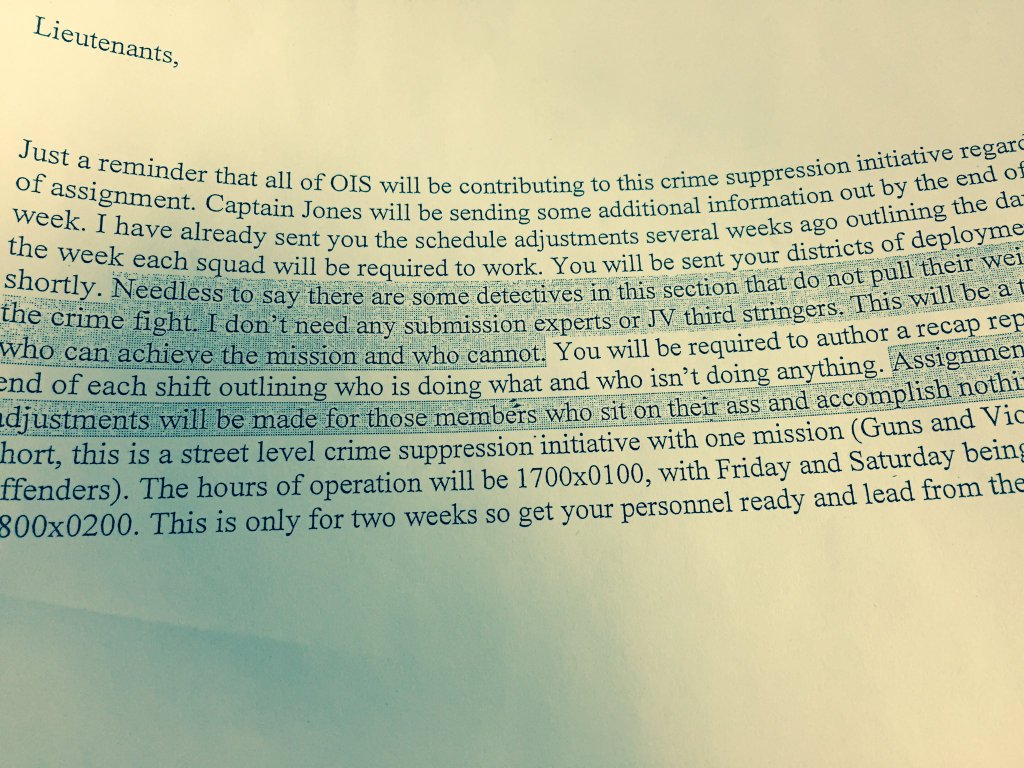
    Maybe Chicago could learn from the Baltimore way of motivating cops: pull your weight; and no “submission experts” or “JV third stringers” need apply!

  • The Baltimore 6 Effect

    To paraphrase Tip O’Neill, “All policing is local.” But that doesn’t mean that something in one town can’t have an effect on policing nationwide. And a trend can be large and worrisome — and national — without being universal. That’s why they call it a trend.

    I don’t know what’s going on everywhere (or even most-where), but I can tell you a bit about Baltimore. And I suspect it holds true in many cities.

    I looked calls for service, arrest numbers, and crimes. Most dramatic is the drop of arrests in Western District. I looked at arrests with a post number assigned to it. The majority of arrests by patrol officers are discretionary. These are the ones I presume were not being made. Arrests listed without a post (a geographic beat) would be a specialized unit that didn’t know or care about the post, a court arrest, or a probation violation. Arrests with no post listed also declined, but not nearly as much.

    Arrests in the Western District, from May to December, were down a whopping 47 percent comparing 2014 and 2015 (39 percent overall in the city).

    Look, the link between police and crime prevention will always be shrouded in some mystery. Causation in the real world can never be “proved” with certainty. But at some point, if you get enough correlation and no alternative causation, correlation might actually be indicative of causation! [queue stats-class thunder bolts.]

    Now there are good and not so good reasons for this drop in arrests. But leaving that why: it happened. Police were less involved, by choice and necessity, and violence skyrocketed. Just because correlation does prove causing, correlation certainly doesn’t mean causation is impossible or even unlikely. I mean, what else changed in the Western except police and crime?

    Arrests and crime vary a lot during the year. Winter is slow. Late spring and late summer hot. But the drop in Baltimore arrests began before the riots of April 2015. They started going down in July and August of 2014, after the deaths of Eric Garner (Staten Island) and Michael Brown (Ferguson). That’s when attention turned to police. That’s when officers started feeling they were being targeted, not for malicious actions but for trying to do good. And there’s a huge drop is arrests in December of 2014 (when protests really got going). Just 2,126 citywide (probably the lowest monthly figure in 50 years). December 2014 was 28 percent off 2013.

    And then May 2015, when normally you’d see more arrests as the weather warms and kids get out of school, arrests were down 50 percent from the previous year. (I looked at arrests that have a post number listed in Open Baltimore data. I can’t be 100 percent certain, but I think these are more likely to be on-view arrests from patrol officers and in response to calls for service. Arrests without post number are more likely to be specialized units and administrative arrests.)

    Cops stopped making discretionary arrests and being proactive in clearing corners and frisking subjects. Look, it’s no surprise where shootings happens and who gets shot. There is a criminal class in Baltimore. You can police aggressively or wait for somebody to call police. Even then, when responding, you can get out of your car or not risk “harassing” the “innocent” youth.

    Arrests, especially non-domestic misdemeanor arrests, are a good proxy for discretionary officer interaction with the public. Arrests can also tip the crime stats up because many crimes aren’t recorded unless an arrest is made (which is why, as an indicator of crime overall, I trust shootings and homicides more than anything else). In 2015, arrests in the Western District went down from 215 April to 114 in June (and an outlyingly low 79 in May, when cops were busy with post-riot curfew). The previous year, 2014, saw 259, 292, and 265 arrests in April, May, and June, respectively. To put this in perceptive, my squad (one of three working midnight and one of nine total in the Eastern District) used to make 60 arrests a month on average.

    Meanwhile, after the riots, with police demoralized and understaffed and politicians wasting resources prosecuting innocent cops, criminals in the Western were shooting or killing another black man every other day. These deaths are real. They are evidence. And they matter.

  • Ferguson and Death in Baltimore’s Western District

    Ferguson and Death in Baltimore’s Western District

    Usually I focus on the Eastern District, because that is where I policed. But I was looking at stats for the Western District, where Freddie Gray died. Homicides in the Western went from a long-time record low (but still shamefully high) 21 in 2014 to a record high 66 in 2015. Holy mackerel, that’s a huge increase! (The Eastern went up from 34 to 55. Baltimore as a whole from 211 to 355 homicides.)

    People, crime is up.

    If memory serves me correct, the entire Western District is like 2.7 square miles and has a population of 40-some thousand. (Without going to block-level census data, population for Baltimore’s police districts is not easy to determine. And even with the census, could any area be as hard to count accurately?)

    66 homicides is about 25 murders per square mile. In one year. Extrapolated over a lifetime, you’re more likely to be murdered in Baltimore’s Eastern or Western District than die in the D-Day Assault on Normandy.

    I just spent a day in Malta, perched over the Grand Harbour, looking at Open Baltimore data. This is my view:

    (Which goes along great with this book.)

    Here’s what bothers me about all these killings: the concerted effort to shift focus elsewhere, specifically to police. And one result of this police-are-the-problem narrative is more dead people. I’m all for fixing society and even fixing police. In the meantime, can we let police do their job? In the Nation, Mychal Denzel Smith writes:

    The fight to end police violence is not separate from that to end intra-racial violence, because they are direct results of the same system, and must be addressed through the same measures.

    Actually, no. They’re not the result of the same system. Police violence does, some of the time, represent America’s history of racial oppression. But other times it represents nothing more than a good cop having a bad day or a bad cop simply being bad.

    Intra-racial violence may be a legacy of slavery (though I find it interesting that the Left doesn’t like subscribing to this belief) or it may be because of more recent discrimination. It also may be because people choose a culture and lifestyle that thinks it’s OK to pick up a gun and shoot somebody. It may — get this — be all of the above.

    But at some point, from a police perspective, I don’t care what caused it; I care what causes it. A homicide happens when somebody has a beef, gets a gun, loads it, finds the sucka, goes up to him, pulls out the gun, pulls the trigger, and aims well enough to hit the person. And then the person has to die.There are a lot of steps. So much can go wrong! If any one of those steps breaks down, the person lives! A homicide postponed is often a homicide prevented. This is where police can be effective.

    Except for the death of Freddie Gray, things had been looking up in Baltimore. People were moving into the city for the first time in decades. Homicides were near a multi-decade low. Police were arresting a small fraction of what they had been just a few years earlier. And then Freddie Gray done dies and some knuckleheads decide police are the biggest problem facing Baltimore City. Next there were protests, and then riots, and then six cops were criminally charged, at least most of them, for being in the wrong place at the wrong time.

    Nothing else changed in Baltimore. Not in the macro sense. The “system” didn’t change when some Baltimoreans decided to riot.

    Smith links to some post, Stop Pretending the “Ferguson Effect” is Real:

    In fact, 2015 has been one of the safest years in the past two decades. … As such, fears of a national “crime spike” are not based in reality.

    Really?!

    2015 saw a huge increase in murder, perhaps the largest increase in the homicide rate in US history. Just because we don’t yet know the accurate numbers doesn’t mean those bodies aren’t dead. Those dead bodies are a reality some people prefer not to see.

    The “system” didn’t get more racist and unjust on or after April 27th. There is “evidence” — no matter how much it is denied — that A) violence is up, B) policing matters, and C) Ferguson, broadly defined, changed things.

    But Smith says:

    This position rests on a few different fallacies: first, that police are being less aggressive out of fear of being the next cop to have their tactics publicly scrutinized, and secondly, that aggressive policing leads to a reduction in violent crime. There is no evidence to support this.

    Except it is true. I’ve been noticing this “there is no evidence to support this” a lot recently. And it’s always from those who deny the efficacy of police. It’s a smug assertion from people ideologically biased or simply too lazy to open their eyes to reality. Usually it’s from those who simply wish they could wish the existing evidence away, be it the effective Broken Windows policing in 1990s or the dramatic rise in violence last year.

    Smith turns to incidents of cops being violent to prove his point. But dammit, a schoolgirl brought to the ground in a classroom really does not prove anything about policing a drug corning in Baltimore. If you want to say the whole damn system is guilty, great; y ou might even be right. You still haven’t told a single police officer how to confront a violent criminal. And God only knows you’ve never done it yourself.

    So after Freddie Gray’s death and the riots of April 27, calls for service in the Western went down some 20 percent, compared to the previous year (this is a bit of an educated guess as Open Baltimore data goes back only to Jan 2015). Maybe people bought the narrative that police were no good. Maybe people thought police were too busy with real problem to bother with their petty bullshit. For whatever reason, calls for service went down and crime went up. (Even at a reduced load, there were still 280 calls dispatched a day, just in the Western District. As one friend put it, “If they hate us so much, why do they keep calling for us to be with them?”)

    Those racist cops, most of them black and other minorities, were worried about their safety and worried about being arrested for making on honest mistake or no mistake at all. Moreso, police were disgusted at a political system that made them the scapegoat and a liberal narrative that made police out to be the bad guys while simultaneously making a hero out of some two-bit junkie criminal who never held a real job and cycled in and out of the criminal justice system. Of everybody who’s died in Baltimore. Hell even if you think Freddie Gray was killed, of everybody who’s been killed in Baltimor — hell, of everybody who’s been killed by police in Baltimore, you go make make a hero out of this guy?! It just don’t make sense. Of course that affected how police do their job.
  • You gotta break some eggs… to make a mess

    You gotta break some eggs… to make a mess

    According toMaryland Governor Hogan, C.O.R.E. stands for Creating Opportunities for Renewal and Enterprise.

    “We should be able to make tremendous progress over the next for year,” said the mayor.

    What’s the cause for celebration? Demolition.

    Forgive me if I hold my applause till something is built. Now don’t get me wrong, tearing these buildings down is necessary.

    These buildings are beyond saving not just because they’re abandoned but because everything of value has been stripped. There is no metal left in them. No pipes. No wires. Nothing left but rotted wood and brick walls. And even Baltimore’s bricks are kind of crappy. Or they get squatted by drug addicts, and then they end up looking like this.

    Earlier this year, the mayor said his goal to eliminate vacant dwellings in Sandtown-Winchester will help complete a nationally recognized renaissance in the neighborhood.

    “We’ve got a tremendous commitment to Sandtown…. We need to show that we can make a difference.”

    Besides new housing, the area has got a prenatal outreach program and drug treatment services.

    These and other community projects are supported by neighborhood residents, who, for the first time in their lives, are becoming involved in their community, the mayor said.

    City Council President Mary Pat Clarke said the push to eliminate vacant houses in Sandtown-Winchester may start a larger push to diminish the tally of 6,000 vacant dwellings scattered throughout Baltimore.

    Yeah, if only 6,000 vacants doesn’t give it away, that was from 1993.

    How’d that work out? Not so good. A few years later in 1996, when there were 9,000 vacant buildings in the city:

    Baltimore is preparing to tear down more than 800 vacant rowhouses as part of a vast, multimillion-dollar undertaking to revitalize impoverished sections of the inner city.

    The first will be torn down in the West Baltimore community of Sandtown-Winchester….

    Most of the land would be transformed into parks, yards and vegetable and flower gardens. Only a quarter of the properties would be redeveloped for housing, and a few others would become neighborhood shopping centers.

    How’d that work out? Not so good.

    This 1996 plan was to be “the largest rowhouse clearing in Baltimore since the early 1970s, when homes were razed along Franklin Street for an expressway that was never completed.”

    Oh, that.

    Yes, it is America’s goofiest 15-block highway. Does this happen in other cities?!

    Maybe one day — not for decades, I hope — we can name it the John Waters Memorial Highway.

    And before that in the 1950s:

    the city cleared several slums and replaced them with huge public housing projects. The four high-rise complexes that were built after World War II have since deteriorated, beset by crime, drugs and poor conditions, and are being torn down.

    Today, a few decades later, there are 17,000 vacant houses that used to be homes. Plus seventeen-more-thousandvacant lots.

    There’s a long strain in Progressive thinking that blames bricks and mortar for the problems of the people who live there. It’s most exemplified by the building and then razing of high-rise public housing. But high-rise housing not inherently worse (or better) than the “slum” tenements they replaced. I hate to say it, but a slum is less defined by a bunch of buildings than the people who live live there. Not all the people, mind you. Not at all. But some of the people — the murders, the junkies, the people who never wanted a regular job, the kids who grow up without loving parents — they exist. And they don’t make good neighbors.

    The problem is, demolition is a necessary first step to improvement. Vacant buildings are bad for crimeand good for nobody. But building is the hard part. And getting people to want to live there. That’s hard, too. And even if it is necessary, it’s still kind of sad to see these handsome Formstone buildings come down.

    Maybe this time it will somehow work. It can’t get better if we don’t try. But forgive me for not being optimistic.

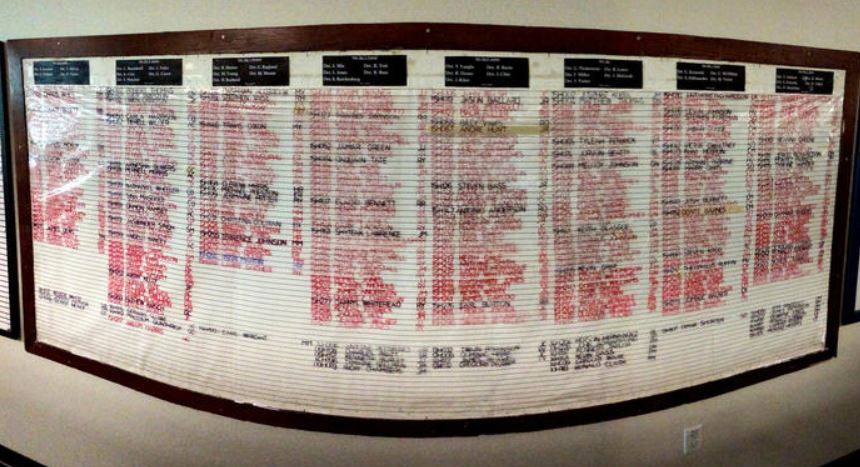
  • Black lives matter to homicide detectives

    Black lives matter to homicide detectives

    The homicide board downtown. I have to admit, when I first walked by it, I had to do a double take, thinking, “it really does exist!”

    That’s a lot of red.

    From Justin Fenton’s five part series on a homicide investigation.

  • Happy New Year

  • The “Freddie Gray Era”

    Justin Fenton on solving homicides in the Sun:

    A couple of decades ago — the last time the city saw so much killing — Baltimore’s homicide unit closed more than 70 percent of its cases. Veterans talk of returning to the office from a crime scene to find a fistful of tips waiting for them. [Former Commissioner Thomas Frazier broke up that homicide squad to increase diversity in its ranks. He accomplished his goal; the homicide clearance rate plummeted.]

    But the widening gulf between police and the community since then has made witness cooperation a rarity.

    Forensic science has advanced, and surveillance cameras have grown common in the city. But detectives say witnesses remain the most important element in successfully bringing charges against a suspect.

    The challenges are not exclusive to Baltimore, but are being felt here more acutely. Among similar-sized cities in 2014, the average for cases closed — through arrest or other means, such as the death of the suspect — was 56 percent.

    In Baltimore, it was 45 percent. This year, it has fallen to 31 percent.

    Detectives say they have suspects in as many as three-quarters of cases, but in many instances they lack the evidence to move forward or can’t convince prosecutors, who in recent years have wielded more authority over detectives’ ability to charge.

    You want cause and effect between politicians’ rhetoric, a narrative that says police can’t be trusted, and less trust in police? There you go. And prosecutors are spending their precious resources putting six cops on trial. It’s all just the perfect shit storm. And as a result people are literally getting away with murder. There is no justice and indeed, no peace.