Tag: broken windows

  • Broken Windows in question

    This article in the Times is worth reading. Of note: the most discretionary arrest in NYC, Dis Con, down 91 percent. Meanwhile the courts are close to empty.

    “This proves to us is what we all knew as defenders: You can end broken-windows policing without ending public safety,” said Justine M. Luongo, the deputy attorney-in-charge of criminal practice for the Legal Aid Society.

    I love how it took the police union and police (in)action for police officers to prove what Legal Aid lawyers have been saying along. But are they correct?

    Stupid arrests are not part of Broken Windows. And they have been part of NYC policing. And by “stupid” I mean giving tickets or summonses to non-criminals using a park at night, riding the subway, riding a bike on a bike path/sidewalk, and walking through a park at night to get home (p 207 of Cop in the Hood). Now I don’t think those BS things were the majority of arrests and summonses, but they did happen. And they happened because pressure from compstat and community meetings got passed down through the chain of command. And there didn’t seem to be any way to stop these abuses from happening. Until now!

    Any time discretionary arrests go down 90 percent without crime going up, it’s noteworthy. First it was stop and frisk going down and now it is arrests. Maybe this is good. There have always been too many arrests in American policing because policing in American has for too long been defined by making arrests. And that’s a shame (see p 144 of Cop in the Hood). You don’t need to arrest people to use Broken Windows. Indeed, you shouldn’t need to. That’s been the disconnect here in NYC. This takes a major shift in police mentality. One that is hopefully happening right now. The optimist in me likes to think of this as a clean slate, where a police department and can get its priorities in order and police officers can be left to use discretion and do their job. The realist in me knows better.

  • Blue Flu (II): Arrest “only when you need to”

    Conor Friedersdorf has a excellent piece in The Atlantic, “The NYPD’s Insubordination—and Why the Right Should Oppose It.” [And just for the record I did scoop the New York Post, albeit only be a few hours.] There’s lot here that doesn’t fit in our normal political divide. And I love that cognitive dissonance!

    You’ve got union blue-collar workers, and the left that hate them. You’ve got union blue-collar workers, and the right says that says they can do no wrong. You’ve got an elected mayor cops (many non-residents) are saying doesn’t represent the people of New York City (De-legitimize the mayor — even though De Blasio got more votes than Bloomberg ever did). And you’ve a police union that other unions (mine included) do not like and insist is not a real union (de-legitimize the workers’ voice). You’ve got some cops who would love to see crime go up, just to prove their anti-liberal political point. And these same cops aren’t working too hard in the name of safety. Even though the worst thing for cop safety would be an increase in crime.

    I love it when my head hurts!

    And then you’ve got the Zero Tolerance vs. Broken Windows angle. This is important and will probably get lost in the shuffle. But right now the police are doing exactly what opponents of police (though they would prefer to be known as supporters of police reform…) have been advocating for years: having police do less. Because if you see police as overly aggressive tools (or, more extremely, state-sponsored tools of oppression) who do more harm than good, you welcome a police slowdown. If you think police have little or nothing to do with crime — and many academics, generally those who hate Broken Windows, still believe this (it all goes back to root causes and society) — there’s no downside to fewer arrests and tickets. (Though I don’t want to be too dismissive about fewer arrests and tickets. I’m all for police discretion and more informal enforcement of public order.)

    A lot of what the NYPD has been doing the past decade or so is Zero Tolerance: write tickets, stop people, arrest people, no discretion. A lot of what police need to do is Broken Windows: problem solve, identify quality of life issues, reduce public fear, maintain public order, cite and arrest as a last resort.

    If you, like me, think police matter, then you want the good without the bad. It’s not easy, but it’s certainly possible. You want police maintaining public order without stopping people without good causes. You want police discretion without police quotas (also known as “productivity goals”). You actually don’t care so much about response time and are more interested in anything that gets police out of cars and dealing with the public — good people and criminals alike.

    So if cops stop making arrests that aren’t absolutely necessary. That’s fine with me. Arrests should never be a measure of police productivity! But if police stop policing…. well, that would be bad.

    From Friedersdorf’s piece, here’s Scott Shackford from Reason.com:

    Well, we can only hope the NYPD unions and de Blasio settle their differences soon so that the police can go back to arresting people for reasons other than “when they have to.” The NYPD’s failure to arrest and cite people will also end up costing the city huge amounts of money that it won’t be able to seize from its citizens, which is likely the real point. That’s the “punishment” for the de Blasio administration for not supporting them. One has to wonder if they even understand, or care, that their “work stoppage” is giving police state critics exactly what they want– less harsh enforcement of the city’s laws.

    And here is Friedersdorf’s take on that:

    That’s how some policing reformers see it. Others, like me, don’t object to strictly enforcing laws against, say, public urination, traffic violations, or illegal parking, but would love it if the NYPD stopped frisking innocents without probable cause or even reasonable suspicion, needlessly escalating encounters with civilians, and (especially) killing unarmed people, goals that are perfectly compatible with data-driven policing that targets actual disorder. Keep squeegee men at bay–and leave innocent black and Hispanic men alone.

    That last sentence there is good. And Friedersdorf concludes (read the whole thing):

    The right should greet [pro-police rallies] with the skepticism they’d typically summon for a rally on behalf of government workers as they seek higher pay, new work rules, and more generous benefits. What’s unfolding in New York City is, at its core, a public-employee union using overheated rhetoric and emotional appeals to rile public employees into insubordination. The implied threat to the city’s elected leadership and electorate is clear: cede leverage to the police in the course of negotiating labor agreements or risk an armed, organized army rebelling against civilian control. Such tactics would infuriate the right if deployed by any bureaucracy save law enforcement opposing a left-of-center mayor.

    It ought to infuriate them now. Instead, too many are permitting themselves to be baited into viewing discord in New York City through the distorting lens of the culture war, so much so that Al Sharpton’s name keeps coming up as if he’s at the center of all this. Poppycock. Credit savvy police union misdirection. They’re turning conservatives into their useful idiots. If the NYPD succeeds in bullying De Blasio into submission, the most likely consequence will be a labor contract that cedes too much to union negotiators, whether unsustainable pensions of the sort that plague local finances all over the U.S., work rules that prevent police commanders from running the department efficiently, or arbitration rules that prevent the worst cops from being fired. Meanwhile, Al Sharpton will be fine no matter what happens. Will the law-and-order right remain blinded by tribalism or grasp the real stakes before it’s too late? Look to National Review and City Journal before laying odds.

  • “The Police-Community Divide”

    Best 22 minutes you’re going to hear about the current state of policing. My colleague David Kennedy on WNYC’s Brian Lehrer show. I can’t thing of anything he said that I don’t agree with.

  • “A fairer, safer city”

    I stumbled across this column by Harry Siegel yesterday in the Daily News while getting my shoes shined. It’s bar far the best thing I’ve read in a while about the current state of crime and New York City. Read the whole thing. But here are some highlights:

    Pay no mind to the shrill voices on the left warning of a creeping police state. Or to those on the right shrieking about urban anarchy around the corner.

    Almost everyone lies about crime and cops, because no one knows exactly how the two relate and almost no one cares to admit an obvious truth: that safety and justice are often competing interests.

    Still, former Commissioner Ray Kelly sounded ridiculous insisting hundreds of thousands of stops and frisks of New Yorkers, the vast majority young men of color who had done nothing wrong, were crucial to keeping guns and blood off the streets. And his critics sounded equally ridiculous insisting those stops had no impact on crime, never deterred anyone from taking their guns to town.

    But it’s the police unions — who complained bitterly about Kelly’s quotas and numbers-driven approach and now are muttering about a work slowdown in response to Bratton’s calls for cops to exercise “discretion” on pot arrests and more generally — who sound most ridiculous of all.

    How many bad stops are worth a saved life? There’s a reason cops and critics have both ducked that question for a decade now.

    But, as de Blasio has rightly stressed, broken windows is based on officer discretion, and only stopping people suspected of a crime. Stop-and-frisk-based policing, on the other hand, was based on stopping huge numbers of people, mostly black and brown young men, who had done nothing wrong.

    The bottom line: Crime is down. Stops are down. The new mayor — politically accountable in ways his billionaire predecessor was not — and his commissioner are living up to a wonderful, difficult promise to deliver a “fairer, safer” city.

  • On jaywalking and giving tickets and 84-year-old men: “If the ends of justice are not met…”

    In a comment Kyle W was kind enough to get me going about the situation in which a Manhattan resident Kang Chun Wong suffered injuries after an officer attempted to give him a jaywalking ticket and Mr. Wong seems to have tried to walk away. Mr. Wong is 84.

    I wasn’t there, so it’s hard for me to talk about this specific incident. But I have plenty to say in general about jaywalking and ticketing old men…

    First of all, it is never the fault of an 84-year-old man for getting hurt at the hands of police for something non-criminal and non-violent. Why? Because he’s 84.

    Yes… I’m saying different rules apply to people who are 84. (Or in a wheelchair. Or mentally ill. Or pregnant to name just a few). This is common sense. This is why officers have discretion. And this is why their bosses should chew them a new one when they abuse such discretionary potential with such absolute stupidity.

    So you’ve got an 84-year-old man jaywalking in NYC. How about not giving him a ticket at all? This might not be understand by non-New Yorkers, but jaywalking is OK in NYC. You do it in front of cops. Cops do it. Everybody does it. With rare exceptions, you will not get a ticket for jaywalking in NYC. Nor should you. Such is the culture of our city. And it’s good.

    Last year there were 531 jaywalking tickets issued. For the whole city. For the whole year. That’s 531 citations out of exactly 8.4 gazillion incidents of jaywalking (By comparison there were roughly 23,000 misdemeanor marijuana arrests.) This year jaywalking tickets were up to 10 a day. So *if* you want to to be one of those 10 lacking-in-common-sense not-living-in-NYC officers who choose to write a jaywalking ticket, don’t friggin’ pick an 84-year-old man to write up! I guarantee you there were at least dozen other jaywalkers during that light cycle alone.

    [Jaywalking may even be good, collectively, for pedestrian safety here. It keeps cars from going too fast because pedestrians walk like the own city, because they do. Individually it can be good for safety to jaywalk when there are no cars coming. If you wait for the walk sign, then cars also get the green light who can and do turn into you. If the choice is between crossing with no cars and waiting for the light and putting myself at great risk, you should always cross when it’s safest. But that’s for another day…]

    If your bosses tell you to write jaywalking tickets, you could as an adult and professional, and as police did when Giuliani “cracked down” on jaywalking in 1998, simply refuse to do so (unless somebody jaywalks while flipping the bird or something). Or, as one real po-lice put it back then: “The only incentive they have to make me is fear, and that ain’t gonna work because writing these is up to our discretion…. This is just taking hard-earned money from people who can’t afford it, and I’m not going to prostitute myself for the Mayor or anybody else.”

    But let’s say you do choose, for whatever reason, to write a ticket to an old man. Then you, as a young officer, need to remember you’re dealing with an old man. He can be restrained, if absolutely necessary. He should not be pushed to the ground. Why? Because he’s 84!

    Clearly this was bad policing. I just can’t be certain if it happened early in the situation (deciding to ticket an old man), in the middle of the situation, at the end, when things got physical, or all of the above.

    At some point, if push came to shove, because he’s 84, let him go. Why? Because he’s 84 and we’re talking about the non-offense of jaywalking. Unlike letting some young thug walk away, this old man is not and will not be a permanent threat to your authority. Don’t get into a pissing battle with an old man. Why? Because you can’t win.

    Once, year ago, I almost got into a fight with an old man in Amsterdam. He was dumping wheelbarrows of trash into a canal after Queens Day. I asked him to stop dumping trash into the canal. He told me to fuck off. I informed him he didn’t need to dump trash as the was going to clean it all up anyway. He continued to tell me to fuck off. I tried to prevent him from dumping trash in the canal. Words were exchanged. I was in the right. He was ready to fight….

    So I walked away. Why? Because I couldn’t win. I was like 26. He was like 84. What if, by some happenstance, mano-a-mano, he beat me down. Then I lose. I got beat up by an 84-year-old. What if, on the other hand, I ducked his first punch and then put him down with a strong right. Then I still lose. I beat up an 84-year-old.

    Remember this truism when it comes to fighting an 84-year-old men: you cannot win. If he wins; you lose. If you win, you *still* lose. And a smart cop would never put himself into a situation he couldn’t win.

  • Lexington Market

    Last week I mentioned“the army of junkies outside Lexington Market.” My tender New York eyes were a bit shocked by 20 people shouting and 20 other people nodding in what I call the “junkie lean.” You can’t expect decent people or caring parents with children to walk a gauntlet of junkies to go shopping. They won’t do it. Nor should they have to. Scott Calvert writes about the efforts to deal with this in the Sun:

    A man staggering around zombie-like, eyes slowly closing and opening. He came to rest against Konstant’s outdoor peanut counter, next to the market entrance.

    Gerald Butler, one of about two dozen unarmed market police officers, approached. “You need to keep it moving, sir,” he said.

    “I’m not trying to do anything, to be smart,” murmured the man.

    Canty walked up and asked if he needed recovery treatment.

    “I’m already on the program,” the man replied. He told Canty that he’s on methadone and had also taken other medication that day. Canty warned that he could be banned from the market for his behavior. “They see you nodding, they’re going to bar you.”

    “I will keep it under control,” the man promised. “I will leave. Thank you very much.”

    Canty handed him a referral card just as the man’s eyes fluttered shut. A moment later he was headed north on Eutaw, swaying as if buffeted by a strong wind.

    “We don’t see much violent crime around Lexington Market,” he said, “but the environment that’s conducive to the sale of prescription drugs is not conducive to drawing tourists to the market on a daily basis.

    I’ll say!

    Two weeks ago, after getting a crabcake with a friend, I too was leaning on Konstant’s outdoor peanut counter looking at the wares. A few feet away were dozens of junkies doing their slow junkie dance. Meanwhile right next to me and my friend was an overly made-up white woman in a full-length fur coat. On a weekday afternoon, she and I were perhaps the only two white customers in the market. She was sampling a peanut, seemingly oblivious to the chaos swaying around her. I asked her if the peanuts were good. In a slow southern drawl she said, “These are excellent, darling. And I know because I used to grow peanuts.” Only in Baltimore, hon! I bought two bags. They are excellent.

    We can disaggregate the problems outside Lexington market (inside things tend to be OK) into four issues:

    1) quality of life for customers

    2) economic survival of the Lexington Market (and Baltimore)

    3) crime

    4) public health of the addicts

    So while a holistic approach would be best, I have no objection to simply pushing the junkies somewhere else. I’m a police guy, so I’ll leave public health to others (alas, there is no silver-bullet solution to heroin addiction), but the market entrance is too important. It is not right (or economically viable) that a few dozen people damage the market and the city.

    Law enforcement efforts (and the threat of arrest) combined with social services can work. Port Authority was cleaned up in 1990s. It’s worth looking at how they did so. But one big difference is that the main problem of Port Authority was people living inside the bus station while the biggest problems of Lexington Market are addicts outside the market.

    The Sun article also quotes an architect who…

    thinks focusing too much on the scene around the market is “misguided.” He said it makes him feel uncomfortable, and no safer, to see police handcuffing someone sprawled on the sidewalk.

    If the market can attract a broader range of customers, he said, “that will thin out the impression one currently has that mostly they’re very poor people.”

    Philipsen says there’s also a racial dimension that “nobody wants to talk about.” Most market patrons are black, including those living in parts of West Baltimore without a supermarket nearby. Ideally, he said, the market would appeal across socioeconomic, racial and geographic lines.

    “If you’re white and want to see more white people, we can get them there by making this more attractive,” Philipsen said. “It’s not about subtracting people or making poor African-American folks not go there, but bringing some additional people so everybody feels comfortable.”

    Well I mentioned the racial dimension, and I also don’t think we need to focus on the tender comfort of white folk who “want to see more white people.” The solution to the problems of Lexington Market is not a few more white people. White people are not the solution. Besides, (to paraphrase Yogi) if white people don’t want to come to the market how are you going to stop them?

    [Best pickup line I heard outside the market, to a woman passing by: “Yo, baby, I got a job!” That was it. Alas, it didn’t seem to work.]

    I’m bothered by the architect’s comments because they seems to equate race and poverty with drug addiction and the shitty public behavior that makes decent people of all colors and income afraid. This isn’t about race or poverty (or even, to some extent, drug addiction) but about bad (and illegal) behavior.

    Most of the shoppers at the market may be poor and they may be black, but they’re inherent “decent” — to invoke Elijah Anderson’s concept. The problem is not the demographics of the customers, but the two or three dozen (decidedly non-“decent”) junkies shouting, nodding-off, and buying, selling, and using illegal drugs. That’s it! It’s their behavior that needs to change (or move elsewhere), not their race or socioeconomic status. If people could get in the market without being hassled and made to be fearful, you’d see more “decent” people — of all races (and yes, that would include white people, I suppose).

    And then there’s this: “The market’s image took a hit in 2009 when the owner of the Utz Potato Chip stall was sentenced to 15 months in federal prison after pleading guilty to selling illegal guns from his stand.” Oh yeah. That.And for the record that malaka was neither poor not black.
  • Broken Windows does not equal Zero Tolerance

    This article in Slate by Justin Peters is perhaps not the stupidest thing I’ve ever read on policing. But it is the stupidest thing I’ve read about Broken Windows since Bratton was announced as the next NYPD commissioner about 20 hours ago.

    Peters writes, “Broken-windows strategies and zero-tolerance policing strategies go hand in hand.” Well, no. They don’t. Bill Bratton is not a defender of Zero Tolerance policing. He never has been. In fact, Broken Windows is the philosophical opposite of Zero Tolerance. Bill Bratton can tell you why this is so. George Kelling can tell you why this is so. Kelling is the guy who coined the phrase and write the “Broken Windows” article (coauthored with James Q. Wilson) in the March, 1982, issue of the Atlantic. (I took a class from Kelling back in the 1990s when I was a graduate student at Harvard.) And I can tell you how. This and why so many seemingly rational people oppose Broken Windows — often on an ideological level — is important. And I will tell you this, but not tonight. It’s late and I’m going to bed. But I leave you with this:

    The equation … between police order-maintenance activities (“broken windows”) and “zero tolerance” for disorderly behavior raises issues that go beyond semantics. … It is an equation that I have never made, find worrisome, and have argued against, considering the phrase “zero tolerance” not credible and smacking of zealotry.

    –George Kelling “‘Broken Windows’ and Police Discretion.” NIJ (1999).

  • James Q. Wilson

    James Q. Wilson passed away yesterday. From The Chronicle of Higher Education:

    James Q. Wilson’s Practical Humanity
    James Q. Wilson made me a cop, even though I never met the man. I think I heard him give a conference talk once. Many say that Wilson, who died Friday after a battle with leukemia, was a kind and nurturing soul. Indeed, I hope he was. But to me his compassionate nature was exemplified by his commitment to broader society. More so than any other academic, and over the course of many decades, Wilson influenced intelligent American public discourse inside and outside academia.

    I cannot be the only one who finds it difficult to comprehend the intellectual world as I know it without Wilson’s ideas. I knew him primarily through his contributions to policing, but his legacy spans political science, criminology, sociology, philosophy, and economics. Most impressively, that intellectual breadth did not limit his contributions to each field. Quite the contrary. Wilson was able to use the methods and nomenclature of various fields without succumbing to the intellectual blinders that so compartmentalize academic research. Compared to you and me, Wilson, who taught at Harvard, the University of California at Los Angeles, and Pepperdine University, simply had more tools in his toolbox. And boy did he know how to use them.

    While many, myself included, may disagree with some of Wilson’s more politically conservative leanings, one cannot question the intellectually honesty from which they came. Undoubtedly a few will be quick, too quick, to dismiss or embrace Wilson as some conservative warrior in the Great American Culture Wars. The label doesn’t stick.

    Click through for the rest.

    Here’s the NYT obit. And a better obit in the LA Times, in which George Kelling says, “[Jim and I] gave police a rationale to pay attention to the problems bothering citizens.”

  • “Zero tolerance for what?”

    Here’s a great interview from Investigative Voice with Baltimore homicide detectives Irving Bradley and David Hollingsworth.

    You had to be an actor. I had to convince you, what I was telling you to do was the right thing to do. Even though before I got you, you had torn out every window in the neighborhood, you had torn up somebody’s car, and threw a hatchet at somebody — all of this prior to my arrival. I had to convince you that fighting me was wrong, and that it would be better for you to come with me and let me lock you up so I could solve your problem.

    You see, we were on our own; the community is who you depended on. Those neighbors, they knew who the assholes were in the neighborhood. When they saw you confronting them, they would get on the phone and call the police and say, “Officer so-and-so is out there and I’m sure some shit is going to happen.” And you would look around the corner and an officer would be coming for back-up, but that was initiated by the community. Because you protected them.

    The worse thing they could have ever done is put everybody in a car and create this 911 system without proper instructions. Because what is an emergency to you is not necessarily an emergency to me. You call 911 and say, My cat is stuck up on the fire escape.” And another guy calls 911 and says, “I have stabbing in progress and if someone doesn’t get here soon he’s going to die.” Both are 911 calls.

    But the officer in the car has got to go; he does not have the discretion to say, “Okay, that cat got up there, he can stay there.

    You should know the players, you should know who is on your post. If you have a 64- year-old man on your post, I would know him. Like I said, it’s the basics that are lost.

    “You really can’t arrest your way out of the problem,” Bradley says.

    When I was a cop, I met the mayor in 2001. One meeting. One-on-one. Nice guy, I thought. I remember telling him, “You know, Mr. Mayor, you can’t arrest your way of the problem.” He looked at me quizzically and said, “Why not?”

    On Zero Tolerance, Hollingsworth says:

    Where’s the crime? They have no idea what a tolerable crime is, and what an intolerable crime is. It depends on the neighborhood. Your dog, you’re walking through Charles Village, and you have Foo Foo with you and Foo Foo craps on the ground, you put it in the bag and you keep walking. Well, on Mount Street, a guy is walking home with his bulldog and the dog craps in your yard… what are going to do, call a police officer and say, “He ain’t pulled that poop up?’ It all depends.

    Get out of the car. Walk in the neighborhood. They would see a world of difference if they could get out of that car. Get out of the car and you’ll learn real fast.

    These are real police. And they were Broken Windows when Broken Windows wasn’t cool.

    Part I is here. Great stuff on community policing back in the old days. (But they’re actually wrong–not morally, but legally–about the requirements for frisks. I couldlegally frisk almost everybody on my post. Reasonable suspicion and the Terry Frisk go a long way to get me touching your pockets).

    (And I’m glad Lt Peel is still raising hell. I liked that goof when he was just a crazy sergeant with a dirty shirt. Oh and the things he read! I couldn’t hang with him intellectually… and I was the Harvard Student! I got to send him my book. If you’re reading this, LT, will you get in touch with me? I’d love to hear what you’re reading this month.)

    Part II is here.

    [thanks to a Canadian reader]

  • Alan F. Kiepper dies at 81

    Alan F. Kiepper dies at 81

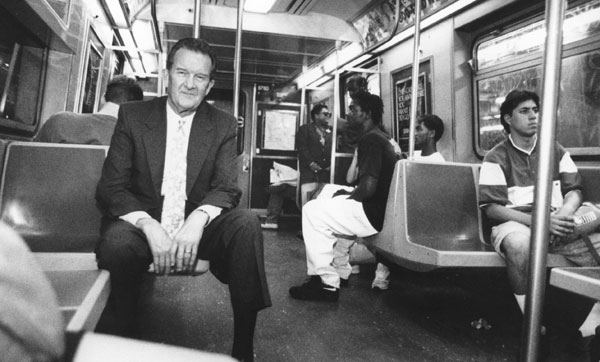
    OK. I’ll be honest. I had never heard of the guy either. But it turns out he might be responsible for America’s great crime drop (not that he ever claimed such a feat). But he did hire Bill Bratton to run the New York Transit Police, and that was perhaps the start of it all.

    “Effective management is doing small things well, and sometimes small things include picking up paper,” Mr. Kiepper told The New York Times in 1990. He had just picked up litter and a penny from a subway platform, drawing stares from straphangers. “The penny I’ll keep for good luck,” he said, “which anyone would need to run a system of this magnitude.”

    Sounds like Broken Windows to me.

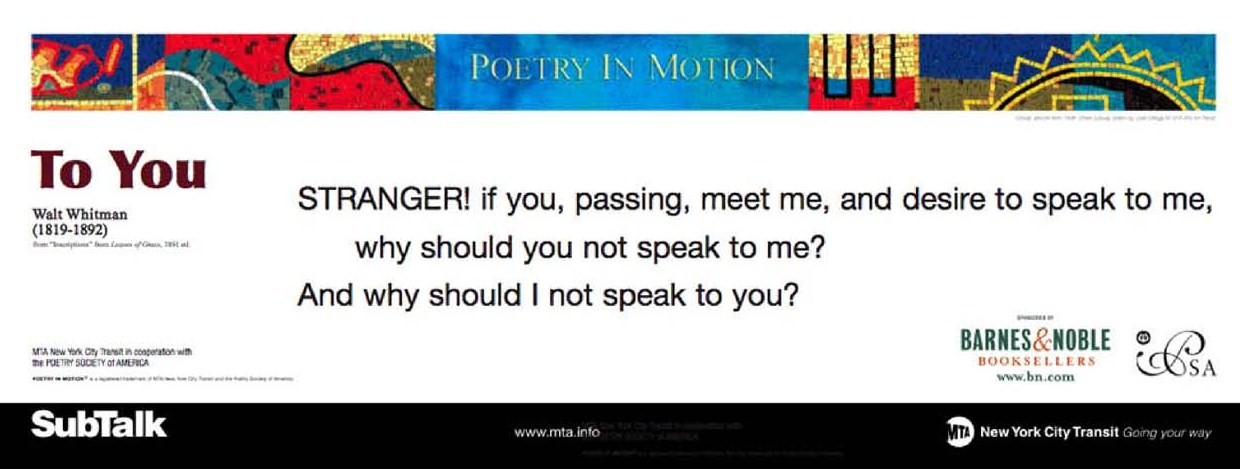
    It seems like he took just as much pride as starting Poetry in Motion (something I, a subway rider, always appreciate):