Tag: chicago

  • Murders in concentrated locations

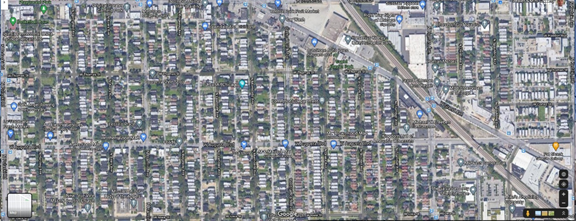
    There’s an article by Frank Main in the Chicago Sun-Times about the deadliest police district in Chicago. It’s a small area on the West Side of Chicago. My eyes went to the blue area, below. About 3 by 15 square blocks. Maybe 34 of those blocks are residential. Perhaps about 650 houses in all. Nice housing stock. Maybe 5,000 residents? I don’t know. Just a guess. (3,000 or 10,000 people is a big difference, but it doesn’t really matter.) There were 18 people murdered this year. Many more shot. And many more shot, this year.
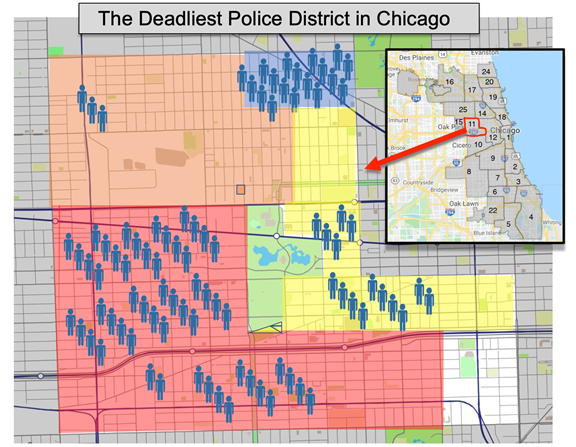
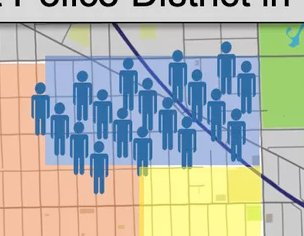
    Note that even within this one part Chicago, violence is strictly demarcated. Dramatically so. That, as they say, is a clue. The murders happen north of Chicago Ave, in a more hispanic area. South of Chicago Ave (orange and yellow, above) is almost 100% black. There are no murders there.

    Now even a dozen or active shooters among 5,000 residents is a lot. But we’re probably talking about just 20 or so men, 15-35, that are literally killing the neighborhood. They’ve all probably been arrested for violence before. So why not focus on those 20 men?

    The increase in shootings this year has happened only where there are shooters. That might sound obvious, but it matters. Programs that target cities, demographics, neighborhoods, and even parts of neighborhoods are too broad. Most people don’t kill. To reduce killings, focus on killers.

    Chicago Police, meanwhile, have been diverted from violent neighborhoods to protect the mayor’s house and also to act as scarecrows standing in The Loop and N. Michigan Ave. Should police be deployed like that? I don’t know. That’s a political decision. But people are dying.

    Of course it’s easier to say “focus” on the shooters than it is to actually focus. Your typical shooter is in his late 20s. After-school programs won’t much help prevent violence (which is not a reason not to do it, if it’s good on its own.)

    Arresting a killer after he’s killed is good. Clearance rates matter. But that involves incarceration. And racial disparities. And conviction isn’t easy. Nor does it bring back the dead.

    So you’re left with preventing violence. This nebulous but needed concept of pro-active policing. How do you “target” a killer? Well, you identify him. Because of past crimes. And then go after him for whatever you can.

    Going after illegal gun possession is good. But it needs to be prosecuted and punished. That seems harder to do, politically. Going after offenders for other crimes, drug dealing and minor offenses, can work, too. But now do you see the problem? These are “non violent” offenses.

    If you go after major players for minor offenses, well, when it comes to gun violence, it leads to racial disparity. Mind you, even when the disparity is consistent with the shooting population, it won’t be with the city’s general population.  And now the ACLU sues to stop it. Of course policing also affects the innocent. You want to minimize that, but innocent people will be stopped. As will targeted offenders on a drug corner who aren’t arrested. (I mention this because the ACLU counts them too as “innocent.”)

    It kind of comes down to this: if you’ve got somebody who is a known violent repeat offender, is that guy deserving special police attention? Or is that racist police harassment? Policing has trade offs. Is it worth it? Generally, I’d say yes. But I’d also say it’s not for me to decide. Why? Because—this is important—I don’t live there. So listen to those who do live there. And not just those “harassed” by police, but those afraid to leave their home.

    If residents want more policing, and I guarantee you most do, don’t listen to out-of-touch people who don’t live there clamoring for less policing in minority neighborhoods against the wishes of the residents.

    Of course it can’t be just policing. But policing plays an essential role. A service, even. But policing will never be perfect. It can be better, though. We need to minimize bad policing and promote good policing. But more policing is needed. And it will save lives.

    Imagine if this neighborhood had 18 covid deaths this year? If the area (because of demographics) has a COVID fatality rate 50% more than Cook County in general, which it might. And if there are 5,000 people (a big if), there would have been 13 COVID deaths this year. Now if we were talking about COVID, we would be talking about racial disparity, but we’d also be talking about doctors. Of course doctors don’t prevent COVID, but they’re an important part of saving lives.

    Permit me to compare COVID to shootings; masks and social distancing to social programs; doctors to police. Right now it’s popular to talk about how to reduce violence without police. That’s a great discussion. Sort of. And there are ways. But not in lieu of police. Public safety without police is like health care without doctors. Yes, preventive care is important. But doctors play a role in that, too. Can I _imagine_ a health care system of diet and exercise and no doctors? Sure. But why would I want to? And what if I have a tumor?

    There’s an element of police abolitionists that is a bit like anti-vaxxers. They’re so convinced they’re on to something. And yet so wrong. And so harmful to others. Though anti-vaxxers also put themselves at risk, whereas anti-policers usually theorize from very safe homes.

    For most people, a safe neighborhood without much policing is the life they live and see every day. It doesn’t mean everybody has that privilege. It would be like being healthy and telling a sick person, “You don’t need a doctor. Maybe you should try yoga and eating organic?”

    Yes, some neighborhoods need more policing that others. Some people need to be policed. And some more than others. Many more people need good policing around them. That is the world we have. And people who live with daily gunshots rightfully expect public agencies to respond.

    But that’s where we are with violence and police. There’s more violence and there’s less policing. You could say our health care has failed, as demonstrated by COVID. It doesn’t mean we should #defund hospitals. That’s where the academic discussion is right now with violence and policing. Anything but police. Sure I can “reimagine” public safety without police. But it will be less safe world. This doesn’t mean we can’t _also_ fund programs that don’t involve police. We absolutely should. But most won’t work well without safe streets.
  • Van Dyke Guilty in Chicago

    Former Chicago Police Officer Jason Van Dyke was convicted of second-degree murder in the shooting of Laquan McDonald. This isn’t surprising. I think Van Dyke was found guilty because, get this, he was.

    I wrote this in 2015:

    The video is out. Finally. After long attempts to sweep it under the rugfailed.

    It’s a bad shooting…. The officer who killed McDonald fits the pattern of bad cops: high activity, drug work, too many complaints. Sure, all the complaints weren’t justified, but some of them were. And undoubtedly he did a lot of bad shit that people didn’t file formal complaints about.

    Now of course I know that in a court of law anything Van Dyke did in the past is irrelevant to his guilt or innocence is this criminal case. Whether he was a “bad” cop or not is irrelevant and inadmissible in a court of law. But I’m mentioning it because I’m not a court of law.

    And second-degree murder seems correct. It meets these conditions:

    Intended to kill or do great bodily harm to that individual (or knew that the act would do so); or

    Knows that the acts create a strong probability of causing death or great bodily harm to the individual.

    Combined with this mitigating factor:

    At the time of the killing, he/she believed that the killing would have been lawfully justified but the belief was unreasonable.

    Van Dyke had options not limited to A) doing nothing, B) not shooting, and C) not continuing to pump rounds into McDonald after McDonald was down. As judged by this former police officer, I say Van Dyke was not reasonable.

  • Why they carry illegal guns in Chicago

    There an interesting studyby the Urban Institute on young men carrying guns in Chicago. This has already been misrepresented in the Chicago Sun-Timesas “1 in 3 young people surveyed in four Chicago neighborhoods say they carry a gun.” Factually true… but meaningless because they’re trying to survey people who carry a gun. 100% is the goal. It’s not trying to be a representative sample (even of a high violence neighborhood) or figure out how many people carry illegal guns. Rather, they tried to figure out why people carry guns (and what will make them less likely to do so).

    Not surprisingly, most people who carry a gun illegally do not do so all the time. Of gun carriers (n = 97), 7% say they always carry; 16% say they often do; 32% say sometimes; 45% rarely. Most who carry say they do so “for protection,” which also isn’t surprising. (What is surprising is the 6 people who said they carry a gun to commit crime.) Fear is real. So is the chance of being shot. So either we work to arm everybody who is afraid, or — better — we deescalate the streets and work to reduce fear by reducing violence and number of people carrying illegal guns.

    Of those who carry a gun, 37% say they have been the victim of a shooting or attempted shooting in past year. 85% know somebody who has. That figure is important and perhaps not well known enough. Instead of complaining when certain politicians call Chicago a disaster or a war torn — “oh, it’s not all neighborhoods,” say some — perhaps we should focus on making sure some neighborhoods aren’t so lethal!

    Most respondents say it’s easy to get a gun, and they could get one in a few hours from a street dealer, a friend or family member, or steal a gun. 84% of gun carriers say they’re not likely to get caught carrying. That percentage is lower (by a little) for those who don’t carry. Still, this indicates some potential for a deterrent effect.

    The sample of those who have illegally carried a gun is, not surprisingly, not pro-police. 75% of those who have carried say police have stopped them “for no good reason.” This in kind of ironic, since illegal gun carriers are exactly whom we want police to stop.

    And there’s an odd bit of data presentation. Either they’re not being great at the stats game or are trying to mislead. I think it’s the former. Two groups are compared over and over again: “those who have carried” and “entire sample.” But why include the first group in the 2nd group and then compare differences? Separate them. Also, “entire” implies it’s representative of something, but it’s not. It’s a non-random targeted sample.

    The groups are easy to separate. Or at least I did so based on their figure 9. And when I did so, for instance, 71% of the sample says police “often stop people for no good reason.” But of those who don’t carry guns, that figure goes down to 60%. Even for this sample, it’s surprising to me that of those who don’t carry, as many as 40% cannot agree with the statement “police stop people for no good reason.”

    I would like to see a sample in the same neighborhood of those who have nothing to do with carrying illegal guns or those who do. What are their opinions of police? That’s the group I would care about, in terms of police legitimacy.

    Do tell us what illegal-gun carriers think of police. But criminals aren’t supposed to like the police. And as this is an intentionally non-random sample, the part of the sample that doesn’t carry (or says they don’t) is an odd group from which one should not generalize.

    Their attitudes on police will be used to question police “legitimacy,” but that seems like abit of a distraction. The carriers of guns say they are carrying because of fear of victimization. More violence decreases legitimacy. Fewer stops by the Chicago Police Department haven’t increased legitimacy. And after having a “well paid job,” the top 5 leading preventative factors, according to those who carry illegal guns, are “none of their friends did,” “knew they would be arrested,” “more police on the street,” “guns cost more,” and “knew they would end up doing time.”

    To me those are all clues. I do want to know why gun carriers carry guns. And I also want to know what those don’t carry avoid doing so. The study concludes by stressing non-police “holistic” solutions “outside the criminal justice system” (which are no doubt needed). But based on gun-carrying respondents, four of the top six solutions involve police.

    Fear of getting caught can give people an out, a good excuse to not carrying a gun. Even though people don’t want to admit it, arrest, prosecution, legal stops, and legal frisks are *part* of the solution. And while others get holistic, police can focus on the police side. Police can reduce violence by reducing fear by getting people to leave their guns at home. De-policing to reduce encounters in Chicago (and elsewhere) hasn’t worked. “Holistic” needs to include police.

  • The best of times, the worst of times

    The best of times, the worst of times

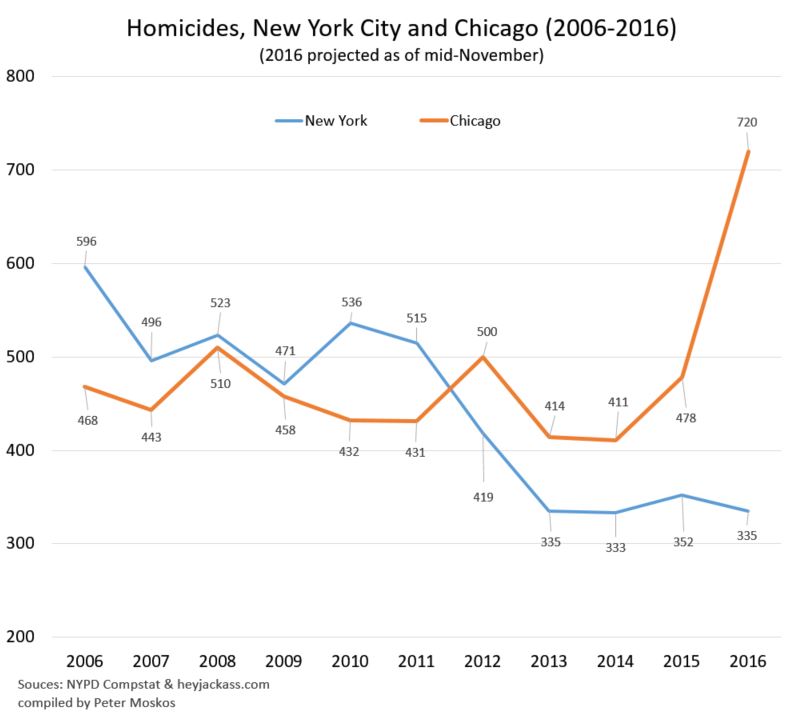
    Ah, the ol’ Tale of Two Cities trope. But the diverging homicidal paths of Chicago and New York City are striking. The New York Post has a surprisingly good (especially for the NY Post) article on homicide in Chicago and NYC.

    These are raw numbers and not a rate. Chicago is roughly one-third the size of New York City. [Notwithstanding rumors to the contrary, the national increase in murder would still be large, even without Chicago.]

    First observe NYC’s unheralded murder drop from 2011 to 2013. Police weren’t even willing to take credit! Why? Because it corresponded with the demise of stop and frisk. And then liberal Mayor de Blasio came on the scene in 2013. If you listened to cops, the city was going to immediately descend to some pre-Giuliani Orwellian hell. That did not happen.

    It turns out that quota-inspired stops and misdemeanor marijuana arrests are not good policing. Now we knew that (though even I’ll admit I was surprised that literally hundreds of thousands of stops didn’t have some measurable deterrent effect on gun violence.)

    In Chicago, stops also stopped, but unlike New York, it was not because cops stopped stopping people they didn’t want to stop. Cops in Chicago got the message to stop being proactive lest controversy ensues. Bowing to political and legal pressure, police in Chicago (and also Baltimore) became less proactive in response to the bad shooting of Laquan McDonald, excessive stop-related paperwork, the threat of personal lawsuits based on these same forms, and a mayor in crisis mode.

    Less proactive policing and less racially disparate policing is a stated goal of the ACLUand DOJ. See, if police legally stop and then frisk six guys loitering on a drug corner and (lucky day!) find a gun on one and drugs on another, the remaining four guys, at least according to some, are “innocent.” I beg to differ. (Though I should point out that in the real world, the “hit rate” never comes close to 20 percent.)

    And then there’s my beloved foot patrol. Policing is the interaction of police with the public. But there are no stats I know of to determine how many cops, at any given moment, are out and about and not sitting inside a car waiting for a call. From the Post:

    A high-ranking NYPD official credited the city’s increasing safety to the widespread, targeted deployment of cops on foot patrol.

    “Most cities only place foot posts in business districts. We put our foot posts in the most violent areas of the city, as well as our business district,” the source said.

    “It’s not a fun assignment, but it’s critical to keeping people safe.”

    Meanwhile in Chicago:

    Former Chicago Police Superintendent Garry McCarthy — who was fired last year amid controversy over the police shooting of an unarmed teen — said criticism of policing methods by local officials there had left cops “hamstrung.”

    “They’re not getting out of their cars and stopping people. That’s because of all the politics here,” said McCarthy, a former NYPD cop.

    “In Chicago, performance is less important than politics. It’s called ‘The Chicago Way,’ and the results are horrific.”

    My buddy Gene O’Donnell says:

    “The harsh reality in Chicago is that you have the collapse of the criminal justice system,” O’Donnell said.

    “The police aren’t even on the playing field anymore, and the police department is in a state of collapse.”

    O’Donnell, who was an NYPD cop during the 1980s, said that although “New York had a similar dynamic” during the height of the crack epidemic, “we had a transformation, because people realized you don’t have to tolerate that.”

    Guns are part of the mix:

    Veteran Democratic political consultant Hank Sheinkopf noted that Chicago “is much more porous to guns” than New York, with a “direct pipeline” leading there in “a straight line from Mississippi.”

    But that is more of an excuse than an explanation. Newark, New Jersey, just a PATH-train subway ride away from Manhattan, has more of a gun problem than New York City. Hard to imagine a subway and a few bridges plugs the gun pipeline.

    There are other differences between Chicago and New York in terms of poverty and segregation (greater in Chicago), commitment to public housing that actually works (greater in New York), and maybe even lower-crime foreign immigrants (greater in New York… but I say “maybe” because it’s still substantial in Chicago, with 22% foreign born).

    And then there’s this:

    Psychology professor Arthur Lurigio of Chicago’s Loyola University cited an “intergenerational” component to the mayhem, with sons following their fathers — and even grandfathers — into the city’s extensive and ingrained gang culture.

    “Chicago’s problem wasn’t a day in the making — it’s 60 years in the making,” he said.

    “Working at the jail as a staff psychologist, I’ve seen two, maybe three generations pass through.”

    I don’t mean to criticize an academic willing to highlight culture and the inter-generational transmission of violence, but I quibble with the line that Chicago’s problems are 60 years in the making. I mean, yes, it’s true…. But the explosion of homicide in the past two years is, well, a problem exactly two years in the making.

    Chicago may always have a higher homicide rate than New York because of history and structural issues. But the short-term solution is getting more cops out of their cars, back on beats, and supported when they legally confront violent people we pay police to confront.

    Violence-prevention depends, in part, on such confrontation. And since violence is racially disparate, this will mean racially disparate policing. Innocent people — disproportionately innocent black people — will get stopped. There’s no way to square this circle (though we can help sand down the rougher corners).

    The alternative to proactive policing is what is happening in Chicago. Police have responded to public and political (and legal) pressure: stops are down, arrests are down, and so are police-involved shootings and complaints against police. Police are staying out of trouble and letting society sort out the violence problem. How’s that working out?

  • “Chicago cop murders unarmed man after fender bender”

    That’s the headline that wasn’t.

    Instead we have this headline: “Officer Didn’t Shoot Attacker Because She Feared Backlash.”

    A 43-year-old female 17-year-veteran suffered this:

    The man had punched her and “repeatedly smashed her face into the pavement” until she was knocked out, police said. She suffered head trauma and multiple cuts to her face and head.

    When you’re a cop losing a fight and a man is bashing your head on the ground trying to kill you, it’s OK to shoot the guy. Can we agree on that?

    Fran Spielman in the Sun-Times:

    A “simple traffic accident” that turned ugly.

    “A subject who was under the influence of PCP attacked a female officer. Viciously pounded her head into the street as her partner was trying to get him off of her. This attack went on for several minutes,” [Chicago Police Supt.] Johnson told the assembled dignitaries.

    “As I was at the hospital last night visiting with her, she looked at me and said she thought she was gonna die. And she knew that she should shoot this guy. But, she chose not to because she didn’t want her family or the department to have to go through the scrutiny the next day on national news.”

    The superintendent said he plans to turn that around by “encouraging” his officers and assuring them he has their backs.

    “But, at the same time, we know we have to change this national narrative that the cops are the bad guys. The cops are actually the good guys trying to do a difficult job,” Johnson said.

    It took many cops to arrest this guy. And three of those cops were hurt. The female officer is still hospitalized.

    Tribune Columnist (and fellow Greek American) John Kass:

    She’s alive, but what if she had pulled her gun and used it?

    We’d be going through the old rituals we know by heart, angry activists, the dead re-created as the victim of state-sponsored racism, politicians cowering and turning their backs on her, the entire urban political liturgy we’ve seen so many times.

    Cops are getting in trouble for shooting armed suspects. You think she’s get a pass for killing an unarmed black man? (I’m not 100 percent certain the man is black, but the neighborhood is.)

    “She murdered an innocent unarmed man!” “They should have helped him after his accident.” “How could one man be a threat to multiple officers?” “They didn’t have to kill him!” And indeed, they didn’t. He was taken alive.

    Of course the guy who beat the cop is a violent felon. But who would hold that against him after being victimized by police? I’m sure there’s a nice picture of him and relatives willing to say how “he was turning his life around” and would “never hit a woman.” Who would believe Chicago cops?

    So this officer was willing to let herself be beat to unconsciousness in order to save her family and the department from the now inevitable “scrutiny” had she decided to use lethal force.

    So what should have she done? Honestly, I don’t know. I’m not convinced she made the wrong choice. The reality today is there would be hell to pay if she shot the guy. Her job and family might be ruined. There would be protests. Threats. She could lose her job or face criminal prosecution. She might have to move and take her family into hiding. She made her choice. But that is a choice no cop should ever have to make, especially at the moment when your face is smashed on concrete again and again and the world fades into darkness around you.

  • “Three Years of Nights”

    Very good piece by Peter Nickeas in Chicago magazine. “Three Years of Nights: Violence convulses the city after dark. Reporting on it leaves its own scars.” It sure does. Same for policing (though for some more than others). And just another 17 years of the same and he’s have the career of a copper:

    It was the beginning of a three-year stint working overnights at the Chicago Tribune, covering any violent event that happened in the city after dark. I’d wanted a job at the paper, and this was the one they had. I was 25 years old.

    Earlier in the night, two guys had fired an AK-47 and a revolver into a park where people were hanging out and playing ball. They wounded 13, including a 3-year-old…. A park had been sprayed with bullets. Not in a war zone. In this city. Stretcher after stretcher was wheeled away. A rare bit of emotion in a dispatcher’s voice on hearing that a 3-year-old had been shot in the face: “Jesus Christ. Ten-four.”

    Sometime that summer — I have trouble recalling exactly when — the bursts of exhilaration that had been keeping me going started to peter out. I had trouble staying awake and was stealing sleep in the car between shootings. I spent slow nights in a sort of tape delay, neither awake nor asleep, stirring only when I heard something on the scanner. My senses were dulled. The adrenaline valve wasn’t opening like it used to. I responded to intense scenes — bystanders screaming at police, a paramedic wrestling an air mask onto a victim’s face — with a weird calm. Jason felt it, too, and described it as the feeling you get just after you dive into a pool, your body weightless, your muscles relaxed, sounds muted, your mind focused. At ease.

    And yet the shootings that followed that Fourth of July weekend were some of the most harrowing I’d ever covered. A kid killed at a slumber party. A 3-year-old shot on the block with his mom. Jason and I spent hours one August night in Englewood listening to relatives of a dead 16-year-old girl wail with grief. Hours of shrieking. A detective had confirmed the mother’s fear that it was her daughter lying dead down the street by walking up and starting the conversation with “So, uh, she has a tattoo on her left hand?”

    I looked like shit. Few people told me, but I knew. I’d gained weight, and I’d taken on this gaze I couldn’t shake. My right eye twitched. I hadn’t been sleeping, and I looked mean when I was relaxing.

    When my shift was done that morning, I went to the Billy Goat and drank Jameson with friends. We drank more at Rossi’s. I went home, ordered Mexican food, and passed out before I could eat it. It was a celebration for me.

    I never really left overnights. I still work them here and there. More over the summer, when it’s busy.

    For three years, I’d inhabited a world separate from the one my friends lived in. On the train into work on summer Fridays, the other passengers dressed up for a night out in Wicker Park or Lake View, I’d sit there preparing for my shift, checking Twitter to see where people were getting shot or where people were calling in gunfire. I’d vacillate between wishing I were out with my wife and just wanting to start working.

    There’s not a relationship in my life that is stronger now than it was when I started covering violence. I don’t remember when I stopped giving honest answers when people at dinners or parties asked, “How’s work?” The truth is a conversation ender. I’d start a story, see things getting awkward, then power through it, apologizing at the end. It’s an isolating job. Part of leaving nights has been learning to move past that, or deciding whether to even try. Maybe it’s not healthy, but writing about violence feels like what I should be doing. It feels normal. It’s what I want to do. I want to help the city understand a little. That’s important to me.

  • 40 shooting victims and 672 arrests? “That’s ridiculous!”

    CBS reports:

    At least 52 people were shot across [Chicago] over the weekend, including nine homicides.

    (“At least”? Has it got so bad that we can’t even keep track?)

    Chicago Police Supt. Eddie Johnson, talking about the 40 victims known to police, is “sick of it”:

    672 arrests? That’s ridiculous!

    There’s a certain segment of the community that is driving this violence. The police department is doing its job. We’re arresting these individuals. Where we’re missing the boat is we’re not holding them accountable.”

    2,639 people have been shot in Chicago this year. That’s an increase of more than 50 percent from last year. That really is ridiculous.

    And it’s even worse in Baltimore. Stephen Morgan, my Harvard squash mate — I love saying that because, put together, those might be the four snootiest words in the English language! (That said, in grad school Steve and I did play squash once or twice, and I’m pretty sure I won.) — anyway, Steve sent me these numbers for Baltimore:

    28 days beginning Monday 6/27/16

    Homicide 33

    Shooting 63

    Carjacking 32

    Street robbery 283

    28 days beginning Monday 6/29/15

    Homicide 38

    Shooting 84

    Carjacking 31

    Street robbery 327

    Prior five-year average of equivalent four weeks (from 2010 through 2014)

    Homicide 18.4

    Shooting 38.2

    Carjacking 13.6

    Street robbery 210.6

    If there was any doubt, murdres and shooting doubled after last year’s April riot. There’s a link to his updated report (and a few other things) here.

    But when I bring up increased crime, I feel like half the world is gas-lighting me. First there’s this inevitable rebuke: “Fear mongering! Crime isn’t up. It’s at all time low!”. There’s usually talk about the the “latest available data” as if time stopped in 2014. Yeah, back then crime was at a many-decades low. But now it’s not. Who you gonna believe?

    If history is any guide, liberals really should not concede crime fears to the Right. Yes, the public always thinks crime is getting worse. But now those fears just happen to reflect reality. So rather than say, “you were wrong for years” it behooves us to say, “OK, now you are right, and what are we going to do about it?”

    Politically, I don’t want to the only people responsive to rising crime to be Trump and the “law-and-order.” They scare me. But every time anybody, myself included, dares think about what has happened in the past two years that might impact crime, you get the inevitable “correlation isn’t causation” mantra. Makes me bang my head against the wall! Even Steve agrees. (And Steve, unlike me, is a quantitative stats guy.)

    Correlation actually can be indicative of causation. At the very least, it’s a clue. I mean, what else has changed so dramatically except police and crime? And some point, if you get enough correlation and have taken other variables into account (and reach an all too arbitrary “there’s less than a 1 in 20 chance it’s random”), well, that’s what qualitative social scientists call “proof.” And then if you don’t like the conclusion, you harp on measurement error or non-random missing data.

    Morgan writes (he always has sounded more academic than me. How does he do that?):

    I think it is undeniable that this is a downstream effect of the “unrest” last year, but there are still a lot of unanswered (and some probably unanswerable) questions on the particular mechanism that generated the effect.

    I’m more rash than Steve, quicker to point at the mechanism of decreased discretionary proactive policing as indicated by, you know, by cops telling me their do less discretionary proactive policing. (If you prefer your data more dry and processed, you could look at reduced arrest numbers.)

    Let’s play the counterfactual game. Pretend crime went gone down in Baltimore after April of last year but everything else stayed the same. Well, what then would be some possible reasons? People would be pointing to less proactive policing as part of the solution. They might say crime went down because of the indictment of cops. Perhaps this increased police “legitimacy.” Or maybe the presence of DOJ investigaters improved policing and lowered crime. Maybe City Council President Jack Young and State Sen. Catherine Pugh’s celebrated gang truce” saved lives. But none of that is true. Becuause violence doubled. We’ll never have definitive proof. There will always be “a lot of unanswered (and some probably unanswerable) questions on the particular mechanism that generated the effect.” But until somebody can show me something else that makes sense, I’m quite happy to Occam’s Razor this baby and focus on a massive decline in proactive and aggressive policing. It really is ridiculous.

  • Paul O’Neal shot and killed by Chicago police

    Last week Paul O’Neal was fleeing from police in a stolen car. He crashed past one police car, and cops shot at him. He then veered head-on into another cop car, bailed, jumped over a fence (being more agile than any of the chasing cops), and was then shot at again. One (or more?) of these shots hit O’Neal in the back and killed him. O’Neal did not have a gun.

    I spent a few too many hours editing these videos down to an annotated good parts version. Here’s the timeline:

    0:00 1st police car passenger’s bodycam

    0:21 1st police car passenger’s bodycam, with comments

    1:47 1st police car driver’s bodycam

    2:01 1st police car driver’s bodycam, with comments

    2:50 rammed police car’s dashcam

    3:08 rammed police car’s dashcam, with comments

    It all does happen so fast. But it’s a bad shooting. And that’s before O’Neal is killed. The bottom line is that the first cop who shot — the passenger in the first police car struck — shot too quickly and unreasonably. His actions directly led to O’Neal’s death by creating what is known, in technical police circles, as “a complete clusterfuck.”

    This cop fucked up in so many different ways, it’s hard to count the ways. But I came up with eight, for starters:

    1) His gun is unholstered in the car (WTF?) before he even gets out.

    2) He shoots without an imminent threat to him or his partner.

    3) He shoots one-handed, while moving, without trigger control.

    4) He shoots at a moving vehicle (which goes against department policy).

    5) He came damn close to shooting his partner!

    6) Twice!!!

    7) He shoots at a fleeing felon (which goes against Tennessee v. Garner).

    8) He shoots downrange toward a light-flashing police car coming in his direction.

    And for what? A stolen car?

    And after the shootings, his most-vocalized worry was:

    Fuck, I’m going to be on the desk for 30 goddamn days now. Fucking desk duty for 30 days now. Motherfucker.

    Don’t worry. You won’t be sitting at a desk for long. You’ll be criminally charged with something, as you should be. Probably convicted, too. And I hope you’re fired for shooting at other cops. No cop will work next to this trigger-happy shooting-at-his-partners cowboy. The other officers on scene could only be so lucky if it turns out that the fatal bullet did come from his gun. See, despite having fired at at least 10 times, Officer 30-Goddamn-Days can’t be convicted of homicide because he probably never hit O’Neal! It would be fitting if they made him pay for the bullet hole in the car.

    The officer who fired the fatal shot probably shot O’Neal in the backyard, and there’s no video of this. He or she will have a reasonable defense. They had good (albeit incorrect) reasons to believe O’Neal was armed, dangerous, and shooting at cops. O’Neal was a felon who rammed a cop car head-on. The irony is that Cowboy Cop, by shooting, makes the subsequent officers’ actions more reasonable.

    This could turn out like the police-involved shooting of Amadou Diallo: a tragedy, a bad shooting, and a collective fuck-up, but still not a convictable criminal offense for cops thinking they’re under fire. “Reasonable” is the legal standard. (But it doesn’t do justice to Diallo to compare these shootings. Diallo’s death was worse because Diallo was innocent, compliant, not in a stolen car, and not fleeing from police.) This won’t be as open-and-shut obvious acquittal as, say, homicide by failure to seatbelt. But cops don’t have to be right; they have to be reasonable. And criminal cases need to be proved beyond a reasonable doubt.

    And yes, it should be said: kids, don’t steal cars!

    [I first saw the videos on Tanveer Ali’s article in DNAinfo. Unedited videos can be found at Vimeo under Log# 1081642.]

    [The one “good” shot, in my opinion, comes from the driver of the first police car. He gets out of the way of the car coming at him and takes fire (turns out from his stupid partner, but he didn’t know that). What he does know (even though it turns out to be wrong) is that a felon is shooting at cops and driving toward more police officers. You can shoot at a vehicle if you believe that vehicle to be an imminent threat is a form other than the vehicle itself. (The police passenger knew the car thief wasn’t shooting, so his shots were not good.) The police driver assumes a good shooting stance, aims, and fires once (or maybe twice), hoping to hit the driver in his back. Given what he knew right there and then, it’s a good shooting (even with the cop car downrange, but off-target). This is not the same as saying his shooting was right in hindsight. It wasn’t. But shootings can be legally justifiable even when hindsight proves them wrong.]

    Update (January 12, 2018) from the Chicago Tribune:

    Two Chicago police officers should be fired for shooting at a moving vehicle without justification during a chase and fatal police shooting in 2016, disciplinary officials ruled in a report obtained Friday by the Tribune.

    Officers Michael Coughlin Jr. and Jose Torres endangered the public and the lives of their fellow officers when they shot at 18-year-old Paul O’Neal as he tried to flee police in a stolen Jaguar convertible on a residential street in the South Shore neighborhood, according to the report by the now-defunct Independent Police Review Authority.

    The same report concluded that a third officer, Jose Diaz, who ultimately shot and killed O’Neal during an ensuing foot chase, was justified because he reasonably believed that O’Neal had a gun and had already fired shots at the police, even though O’Neal turned out to be unarmed.

    It was recommended, however, that Diaz be suspended for six months for kicking O’Neal and yelling “Bitch ass mother——, f—— shooting at us!” while the teen lay mortally wounded in a backyard.

    That same profanity-laced statement, which was captured on a police body camera, convinced investigators that Diaz “genuinely believed” at the time that O’Neal had fired at him, according to the report, obtained by the Tribune through an open records request.

    Further update, October 2018. Looks like both officers are going to be fired.

    Further more update, March 2020. They are being fired. I can’t believe it’s 4 years later.

  • 10 shootings a day: This is the homicide problem

    10 shootings a day: This is the homicide problem

    The Chicago Tribune has an excellent articlethat starts on the West Side [2 miles from this house]:

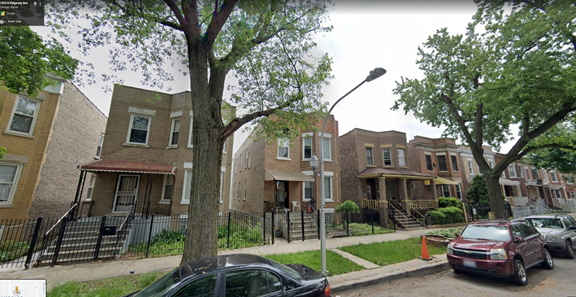
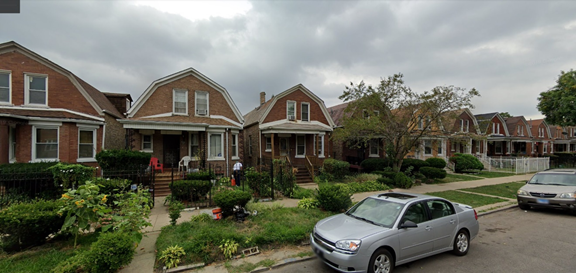
    To understand Chicago’s violence, start at Kostner Avenue and Monroe Street and walk west up a one-way stretch of graystones and brick two-flats. There on a boarded-up front door you’ll see the red stain of gang graffiti. On the cracked sidewalk below lies an empty heroin baggie. Hardened young men sit on a porch.

    This single block on the West Side — part of the Harrison police district — has been the scene of at least six shootings so far this year

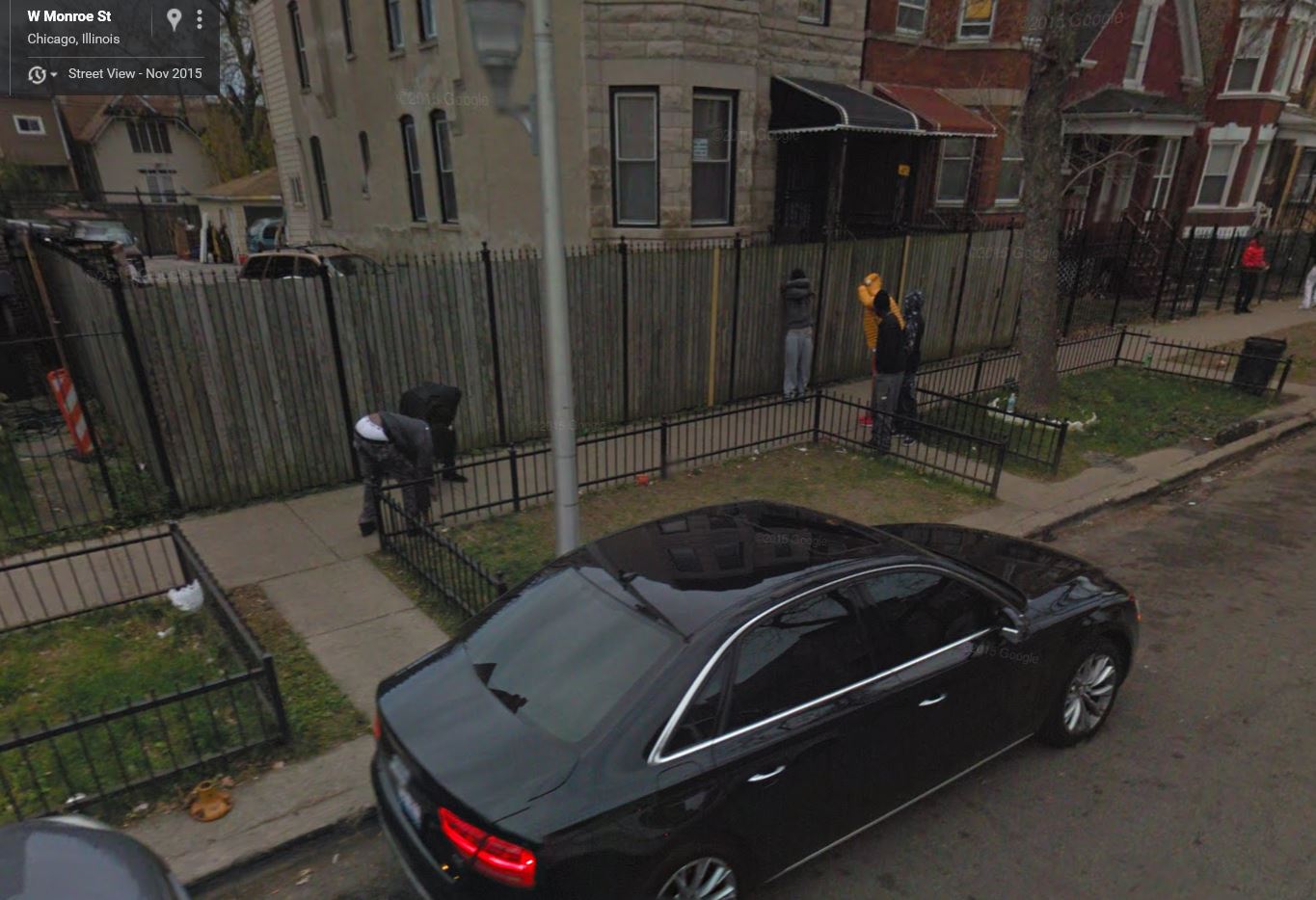
    My father grew up in this neighborhood, a mile away on North Avers Ave. The Greeks are long gone, of course. My father’s family moved to Albuquerque in 1947. I checked Google street view for that block of six shootings:

    These guys are totally not cool with the google car taking their picture.

    Think they’re up to no good?

    Kind of cracks me up.

    Here’s the thing. Those guys you see. Them. There. In that picture right there above. Those guys in front of that fence? They are the problem! Sometimes it really is that simple. Seriously. It’s not rocket science. There they are.

    And police officers know that. But now what?

    Chicago cops aren’t stopping these guys anymore because, well, why should they? The ACLU sues cops and the Chicago Police Departments for stopping six black guys who are just minding their own business:

    All this has led many officers to feel unsure about stopping anyone. Just this week, the president of the police union said many officers feel that “no one has their backs.” Other veteran officers agree that Chicago cops are dispirited and have slowed down on the kind of proactive policing that can remove a gun or criminal from the street.

    The makeup of Chicago’s gangs has changed dramatically over the years. They once were massive organizations with powerful leaders and hundreds of members who controlled large chunks of territory. Now small cliques battle for control over a few blocks.

    Experts also agree that personal disputes increasingly are playing a role in the violence. One veteran cop recalled with disbelief recently how a slaying he investigated boiled down to an insult over shoes.

    Police also said so-called net-banging on social media fuels conflicts. Gang members have been known to post menacing videos on YouTube, showing them furtively entering rival territory, waving guns and issuing threats.

    Ranking officers say reports from the field indicate more gang members are being caught carrying guns than in the past, a troubling trend that could explain in part the surge in shootings.

    Morale plummeted as officers expressed concern about their every move being captured on smartphone video, a Tribune story reported earlier this year. Some have suggested that officers became hesitant to make street stops and arrests for fear of backlash.

    Dean Angelo Sr., president of the Fraternal Order of Police, said street stops had plunged by 150,000 so far this year, but he blamed the more extensive paperwork that officers must fill out this year for every street stop.

    Another veteran cop said the forms are so complicated that they take as long as an hour to fill out, keeping officers from street duty and leading many to reconsider whether a stop is worth the effort. It’s affected the department’s ability to gather intelligence on gangs, he believes.

    The ACLU has disputed the notion that fewer street stops contribute to spikes in violence.

    Of course they have. But the ACLU is wrong. Dead wrong. Look, if you want to argue that these young men shouldn’t be stopped at all, fine. You agree with the ACLU (and don’t live on that block or hear the gunshots). And the ACLU is right in criticizing police who stop people for the sake of making a stop.

    As a cop you don’t (or shouldn’t) harass everybody walking down the block. You harass these guys on this block. And by “harass” I mean, within the law and constitution, make it little less fun for them to hang out in public and sell drugs. Yes, you as a cop give these guys a hard time. Is that fair? Yes. Because there have been six shootings on this block this year. Is it racist? No. Because these guys are the problem.

    If you’re a cop, you need to ask a bunch of questions 1) do you know these guy are slinging and shooting? 2) Should you stop these guys? 3) Are they committing a crime? 4) Are they a Broken Window? 5) What legal basis do you have to stop and frisk those guys?

    [The answers are 1) get out of your damn car and talk to them, or at least watch them disperse in your presence, 2) yes, 3) no, and 4) yes. 5) very little at first, but you can build it, ask for a consent search, or conduct a Terry Frisk.]

    You pull up to them. See what they do. You can crack down on this group by enforcing Broken Windows quality-of-life crimes. You get to know who they are. You can use your discretion and ticket them for something — drinking, smoking joints, jaywalking, littering, truancy, spitting — whatever it takes. You can arrest them when they can’t provide ID (they can’t, trust me). You can harass these criminals legally and within the bounds of the constitution. This is what police are supposed to do. It’s how homicides are prevented. It’s how some kids stay out of gangs. But if cops do their job, then we, society, need to support police officers against inevitable accusations of harassment, racism, and even discourteous behavior in their confrontations with these criminals.

    As a cop you will not win the war drugs, but as long as drugs are illegal you need to fight the fight against pubic drug dealing. But we’re telling cops not to do this. In Chicago cops are listening. And so are the criminals.

  • Is this what the Ferguson Effect looks like?

    Take this fightat North Avenue Beach in Chicago. Seems like mostly a bunch of stupid frat bro’s, one wearing an SAE tank top. (“These people” also have problems.)

    Why does does this have to do with the Ferguson (or “Viral Video”) Effect? Well, if you’re looking for an example of how fear or negative publicity can impact policing and create disorder and crime, this is a good example.

    I mean, unless you’re in Chicago, you probably haven’t seen this video because there are no police to be seen. I hate to think this is future of policing. But in terms of limited bad policing, lack of police really does completely solve the problem.

    But there should have been police here. I used to bike by here quite frequently as a kid. There was always a phalanx of cops hanging around the beach areas, flirting and keeping order. Had there been, maybe the fight never would have happened. Maybe it never would have gotten out of hand. Or maybe a half-dozen cops would have entered the fray and physically restored order — fists, pepper spray, maybe a billy club — and a few idiots would be led off in cuffs. But then we would have criticism of police excessive force — maybe a lawsuit by the ACLU, definite discourtesy, somebody would say police were the instigator, “stop” paperwork would not have been filled out — and the focus wouldn’t be on the idiots fighting but on the nature of the police response. But what if there is no police response and nobody calls 911? Problem solved, at least from a viral police video perspective. Like it never happened:

    CPD says they did have officers in the area, but did not get any reports of fights on the beach. No arrests were made.

    Crime even goes down (at least by the official stats). That’s what happens when you don’t have proactive policing. See, officially, this never happened. No arrests were made. (Though later reports do say a few arrests were made along with a few going to the hospital.) Luckily, nobody had a gun and started shooting.

    And, best of all, nobody can fault the police.

    If you want police, just call 911. An officer will be with you shortly. Crime is up. Boy, is it up in Chicago. But of course, say some, we really have no idea why. No clue. Meanwhile… Chicago police are understaffed. Recruitment is down. Chicago police fear lawsuits from the ACLU. Paperwork requirements tell cops never to “stop” people unless absolutely necessary. Chicago police officers don’t want to be in the next viral video. Police are not being proactive. Chaos ensues.

    But really, who can say for sure?